Real Estate Investor Resume Examples: what gets the call
A Real Estate Investor Resume That Reads as a Track Record
By Mustafa Tarabya, founder of CVBooster · Published · Updated
Real estate investor resume example and guide covering acquisitions, rehab budgets, rent rolls, financing sources and portfolio performance.
Sample resumes for a real estate investor
The same real estate investor content laid out in three CVBooster templates, so you can see what the finished document looks like before you write a word.
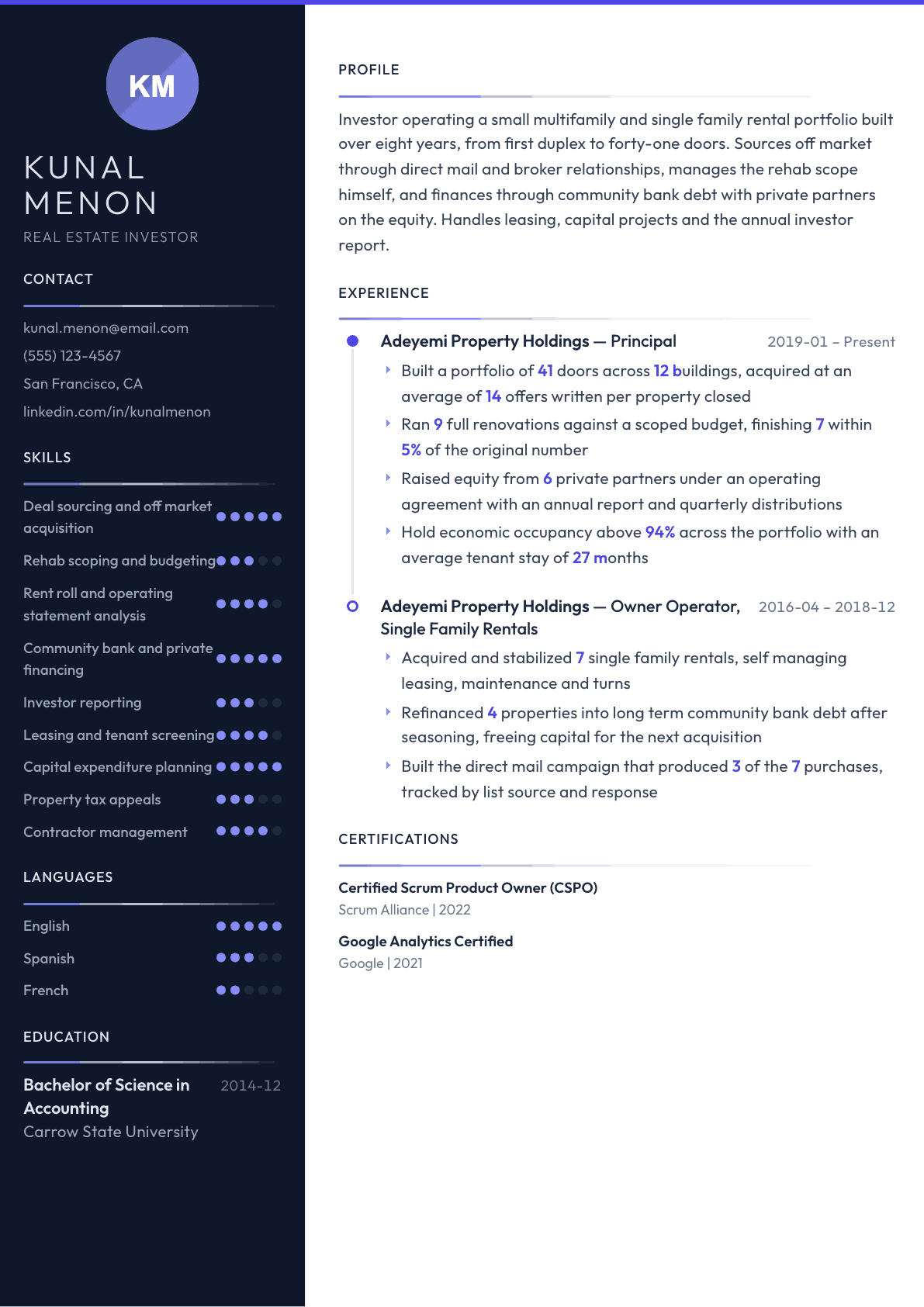
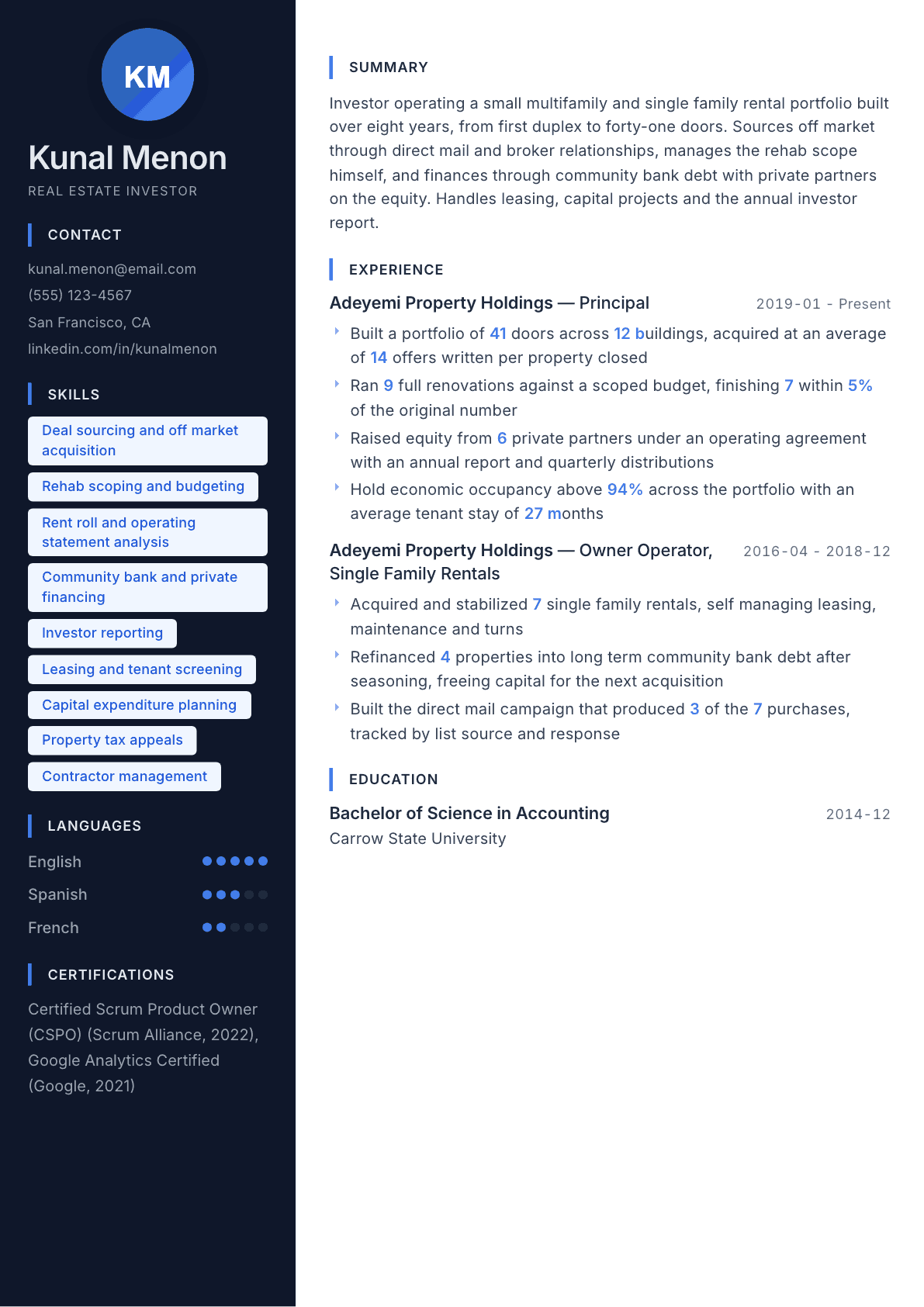
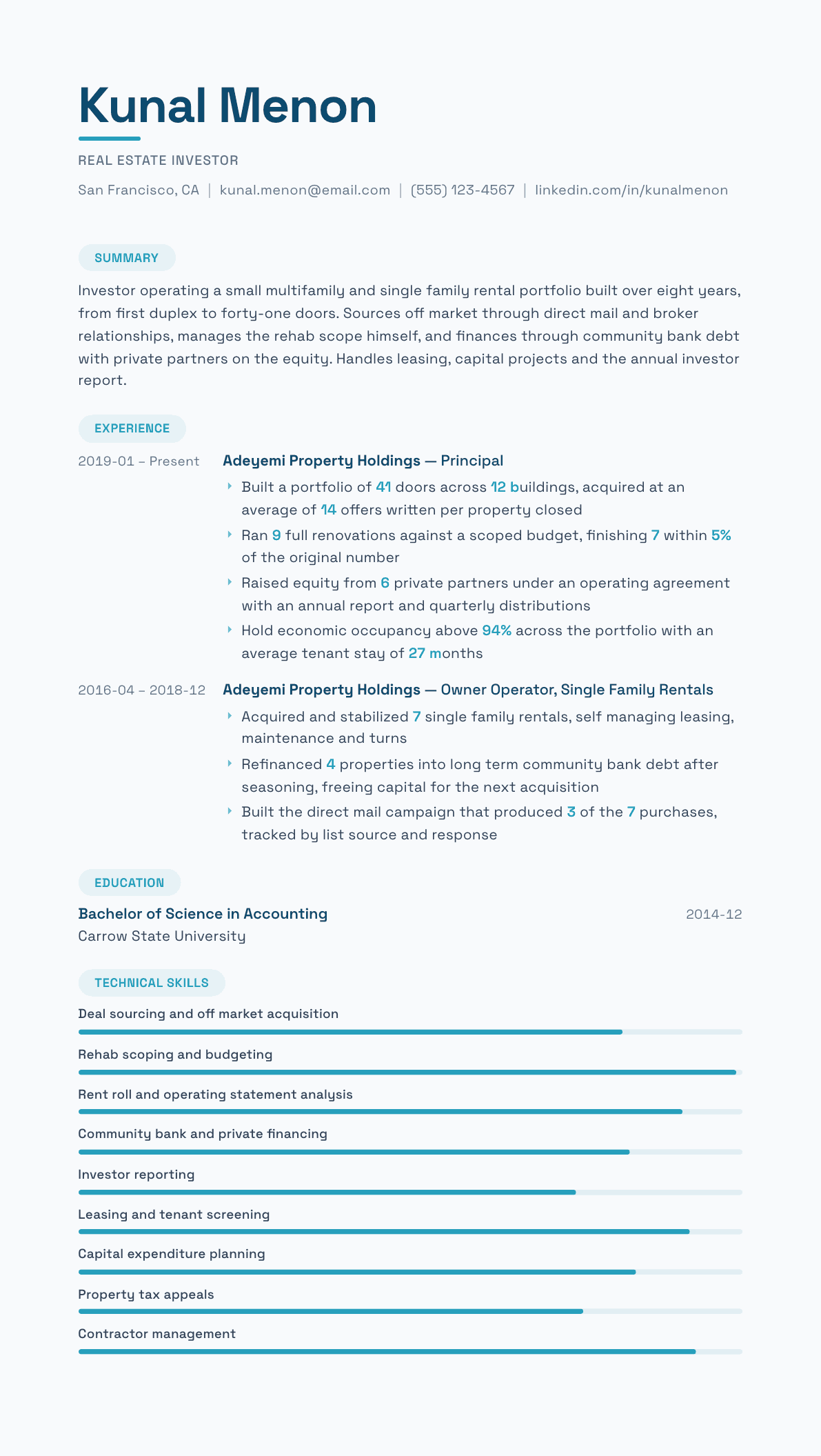
Example Real Estate Investor summary
Real estate investor operating forty-one doors across twelve buildings built from a first duplex over eight years. Sources off market through direct mail and broker relationships, writes many offers for each closing, and scopes renovations personally against a fixed budget. Finances through community bank debt with private equity partners, reports to them quarterly, and holds economic occupancy above ninety-four percent with an average tenant stay over two years.
Skills to list on a Real Estate Investor resume
- Off market deal sourcing
- Direct mail and seller outreach
- Underwriting rental cash flow
- Renovation scoping and budgeting
- Contractor bidding and management
- Community bank financing
- Private equity partnerships
- Operating agreements and distributions
- Tenant screening and leasing
- Property management oversight
- Capital expenditure planning
- Property tax appeals
- Insurance and risk review
- Investor reporting
- Refinance and disposition timing
What actually gets this resume read
- Give the portfolio in doors and buildings, not in dollars, because unit counts travel between markets and prices do not.
- Show the offer to close ratio, since a hiring firm wants to know how much sourcing work sits behind each acquisition.
- Say how you financed deals: bank debt, private equity partners, seller financing, or a mix, and who you reported to.
- Give occupancy and average tenant stay together, because one without the other hides a churn problem.
- State whether you self manage or use a third party manager, since the two describe very different daily work.
- Describe a renovation by scope and budget variance rather than by calling it a successful value add project.
How to write a real estate investor resume
A real estate investor writes a resume for a reader who was not expecting one. It might be a bank underwriter reviewing a borrower, a private partner deciding whether to fund the next acquisition, a sponsor hiring an acquisitions lead, or a family office looking for someone who has personally lost money on a roof and learned from it. Each of them wants a track record, not a biography.
Track record means units, buildings, holding periods, financing sources and what actually happened after you bought. The genre is full of pages that describe a passion for creating wealth through real estate and never name a single door. Those read as aspiration, and the reader knows the difference immediately.
This guide covers how to present a portfolio without leaning on dollar figures, how to describe renovation work by budget variance, what a partner reader wants from your reporting habits, and how to handle the deals that went badly. Three summaries, before and after bullets, and the questions investors ask when they first put their operation on paper.
Format: portfolio block in units, then acquisitions, operations and capital
One page unless you are presenting to a capital partner, where two pages with a deal schedule is normal. Open with a portfolio block in units and buildings rather than in dollars. Unit counts are comparable between markets, and a value figure mostly reports the price band of the city you happened to buy in.
Then organize by function rather than by company, because most investors have worked under one entity the whole time. Acquisitions, operations and capital are three sections a reader can navigate, and they map to the three questions a bank or a partner will ask you anyway.
- Portfolio block for an investor: doors, buildings, property types, markets, and years held.
- Acquisitions section: sourcing channels, offers written per closing, and the diligence you perform yourself.
- Operations section: occupancy, average tenant stay, turn costs and whether you self manage.
- Capital section: debt sources, equity partners, reporting cadence and refinance or disposition history.
Summary: doors, years, sourcing, and how it is financed
Three lines that answer scale, tenure, origin of deals and origin of money. An investor with forty doors built over eight years from off market sourcing and community bank debt has told a reader almost everything they need in one sentence. An investor who describes building a diversified portfolio of high performing assets has told them nothing.
Say which market you operate in and whether you are in it. Local operators who drive their own properties are underwritten differently from remote owners with a third party manager, and neither is wrong, but a reader who has to guess will assume the version that costs you.
Acquisitions: sourcing channels and the offers behind each closing
Name the channels and give each one a result. Direct mail with the list source and response rate, broker relationships and the pocket deals they produced, driving for dollars, wholesaler feeds, auctions, or on market purchases where you simply underwrote faster than the competition. A reader wants to know whether your pipeline is repeatable or whether the last few deals were luck.
Then give the ratio that everyone in this business understands: offers written per property closed. It is the single most honest measure of how much work sits behind a portfolio, and it separates operators who grind through inventory from people who bought two houses in a rising market and started calling themselves investors.
Operations: occupancy, tenure, turns and the renovation numbers
Give economic occupancy rather than physical occupancy where you can, since physical occupancy hides concessions and unpaid rent. Pair it with average tenant stay, because high occupancy sustained by constant turnover is an expensive way to look full. Add turn cost and turn days if you track them.
Renovations are where investor resumes get vague. Describe them by scope, original budget and variance against that budget, not by calling them successful value add projects. A partner reading that seven of nine renovations finished within a tight band of the scoped number now believes your next budget. Add how you bid trades, how you handle change orders and who supervises the site.
Say plainly whether you self manage or use a third party manager, and if it changed, say why. Both answers are respectable. What is not respectable is a page that leaves the reader unable to tell whether you have ever taken a maintenance call at night.
Capital, reporting and the deals that did not work
Banks and partners read this section hardest. Name your debt sources and structures without attaching figures to a specific lender: community bank term debt, agency loans, portfolio lenders, seller financing, or lines against stabilized assets. Give your refinance history and the seasoning discipline behind it. If you have raised outside equity, describe the operating agreement, the distribution cadence and the reporting you send, because reporting habits are the closest thing to a reference an investor can put on paper.
Include at least one deal that went sideways. A renovation that ran long, a tenant class you misjudged, a property tax reassessment you failed to underwrite. Say what it cost in months and what you changed afterward. Every experienced reader has had one, and a page without a single scar reads either as inexperience or as marketing.
Real Estate Investor resume summary examples
First few doors
Owner operator of 4 doors across two duplexes acquired in 2022 and 2023, self managing leasing, turns and maintenance. Wrote 26 offers to close the two properties, financed both with local bank debt, and holds occupancy at 100% with an average tenant stay so far of 19 months.
Forty doors, eight years
Investor operating 41 doors across 12 buildings built from a first duplex over eight years. Sources off market through direct mail and broker relationships at about 14 offers per closing, scopes renovations personally, and holds economic occupancy above 94% with average tenant stay of 27 months.
Sponsor with outside equity
Sponsor of 6 partnerships holding 180 doors, responsible for acquisition, capital structure and quarterly investor reporting. Completed 9 full renovations with 7 landing within 5% of the scoped budget, refinanced 4 assets into long term debt after stabilization, and has never missed a distribution date.
Work experience bullets: before and after
Before: Grew a successful rental property portfolio over several years.
After: Built a portfolio of 41 doors across 12 buildings over eight years, starting from a single duplex and adding small multifamily and single family rentals in one submarket.
Doors, buildings, product type and a starting point make the growth checkable instead of decorative.
Before: Found great deals below market value.
After: Wrote an average of 14 offers per property closed, sourcing through a direct mail campaign tracked by list source and response alongside broker relationships that produced 3 pocket listings.
The offer ratio and named channels show a repeatable pipeline rather than a claim about finding bargains.
Before: Renovated properties to increase their value.
After: Ran 9 full renovations against a scoped budget, finishing 7 within 5% of the original number by locking trade bids before demolition and holding change orders to written approval.
Budget variance and the method behind it tell a lender whether your next renovation number is trustworthy.
Before: Kept the properties occupied with good tenants.
After: Held economic occupancy above 94% across the portfolio with average tenant stay of 27 months, using consistent written screening criteria and a renewal offer sent 90 days before expiration.
Occupancy paired with tenure and a screening process shows stability rather than a lucky quarter.
Before: Worked with investors to fund acquisitions.
After: Raised equity from 6 private partners under an operating agreement with quarterly distributions and an annual report covering rent roll, capital spend and refinance timing on every asset.
Naming the structure and the reporting cadence is the closest an investor gets to a written reference.
Hard skills
- Off market deal sourcing and direct mail
- Rental cash flow underwriting
- Renovation scoping and budget control
- Contractor bidding and change order management
- Community bank and portfolio lender financing
- Private equity partnerships and operating agreements
- Tenant screening and lease enforcement
- Turn scheduling and make ready cost control
- Capital expenditure and reserve planning
- Property tax appeals
- Insurance and risk review
- Refinance timing and disposition analysis
Soft skills
- Walking away from a deal after doing the work on it
- Holding a contractor to a scope without losing the crew
- Delivering bad news to partners before they hear it elsewhere
- Deciding when a tenant situation stops being solvable
- Staying patient through a long stretch with no acquisitions
Mistakes that cost real estate investor candidates the interview
- Describing the portfolio in dollars rather than doors, which tells a reader about your city instead of your operation.
- Omitting the offers written per closing, the ratio that shows how much sourcing work sits behind each acquisition.
- Calling renovations value add projects without a scoped budget and the variance against it.
- Reporting physical occupancy while quietly skipping economic occupancy, concessions and delinquency.
- Leaving out whether you self manage, which changes what your daily experience actually consists of.
- Presenting an unbroken record of wins, which experienced readers discount because nobody buys ten buildings without one hard lesson.
Real Estate Investor resume questions
Why would a real estate investor need a resume at all?
Bank underwriters, private equity partners, sponsors hiring acquisitions staff and sellers evaluating competing offers all ask for one. A clear track record page shortens due diligence and often decides whether a lender treats you as an operator or as a hobbyist.
Should I put portfolio value or purchase prices on the page?
Lead with doors, buildings and holding periods, and keep price detail for the deal schedule you provide on request. Values move with the market and the city, while unit counts and tenure describe what you have actually operated.
How do I show experience when I only own a few properties?
Go deep instead of wide. Offers written, the diligence you performed, the financing you arranged, the turns you completed and the tenant issues you resolved. A small portfolio described with operator detail reads better than a large one described in slogans.
Should I include a deal that lost money?
Yes, one, told briefly with the cause, the cost in months and the change you made afterward. Readers who have operated for years distrust a page with no setbacks on it, and a well handled loss is evidence that your judgment was bought rather than borrowed.
How do I present partnership deals where I was not the only decision maker?
State your role in the partnership precisely: sourcing, underwriting, capital raising, construction oversight or asset management. Naming your lane is more credible than implying you did everything, and it lets a reader place you against the seat they are filling.
Related resume examples
- Property Management Resume example
- Real Estate Appraiser Resume example
- Real Estate Analyst Resume example
- Real Estate Developer Resume example
- Regional Property Manager Resume example
- Asset Manager Real Estate Resume example