Asset Manager Real Estate Resume Examples: free score
Build a Real Estate Asset Manager Resume Around Hold Period Results
By Mustafa Tarabya, founder of CVBooster · Published · Updated
Real estate asset manager resume example with NOI growth, business plan execution, lender reporting and disposition keywords, plus a writing guide.
Sample resumes for a asset manager real estate
The same asset manager real estate content laid out in three CVBooster templates, so you can see what the finished document looks like before you write a word.
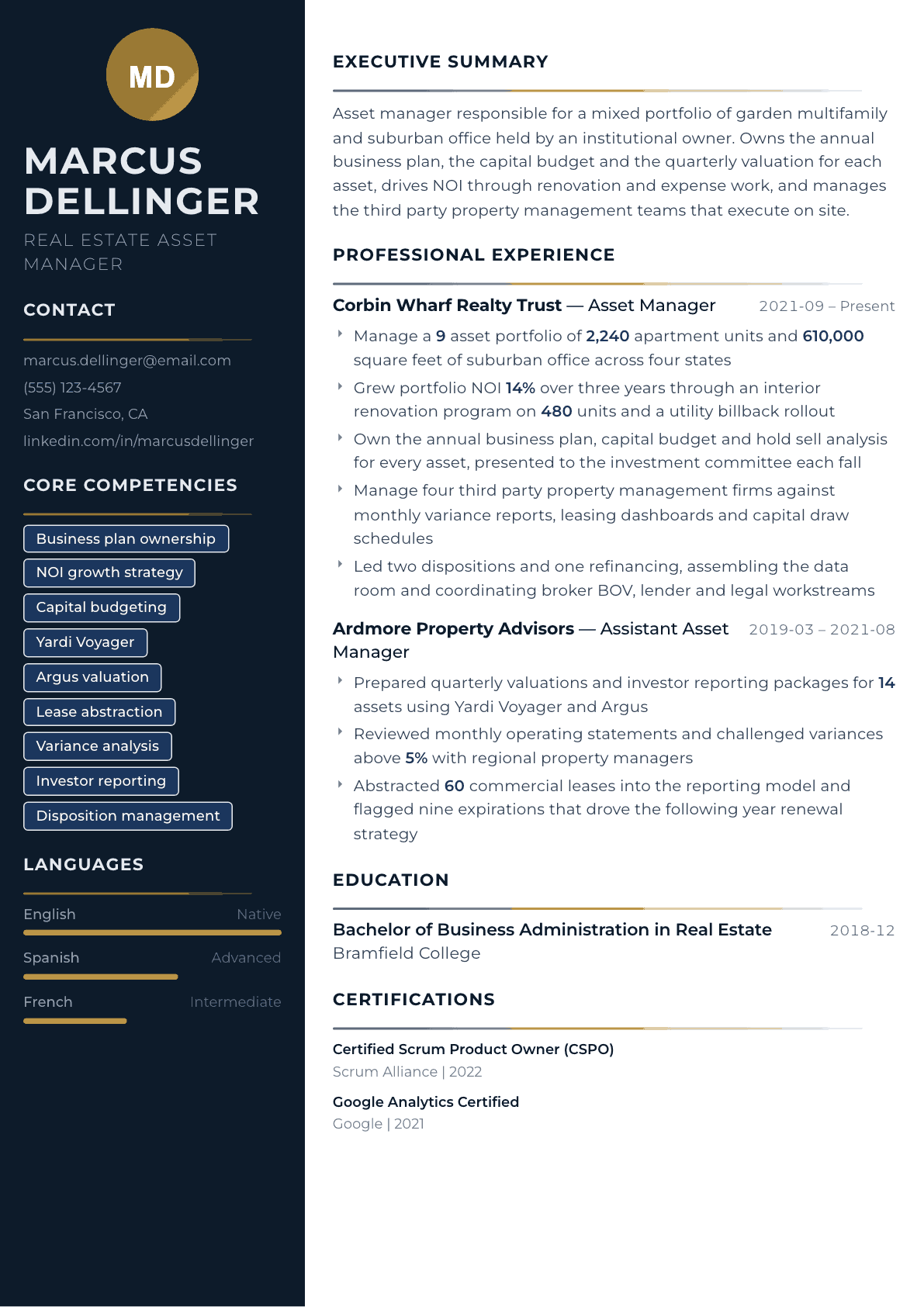
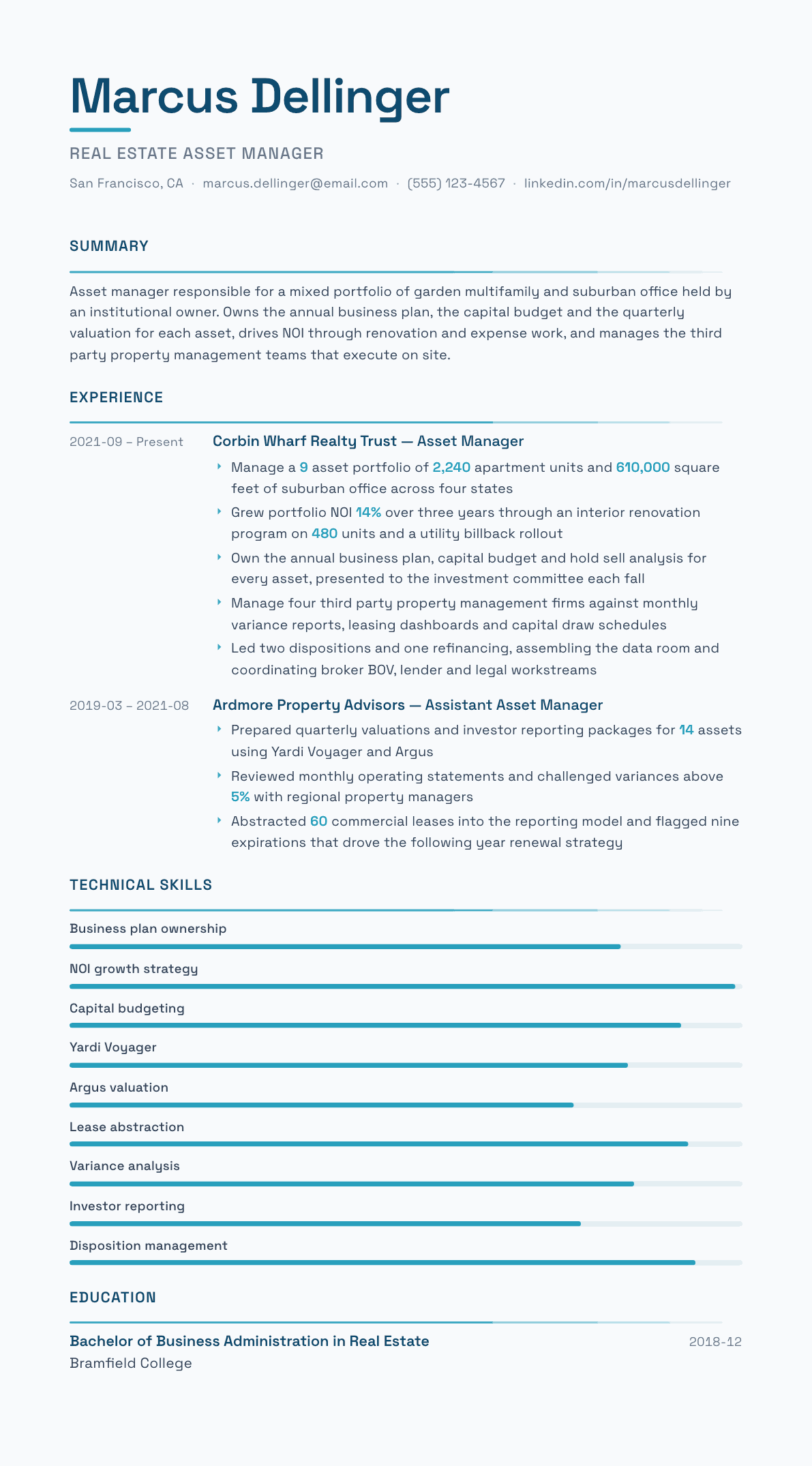
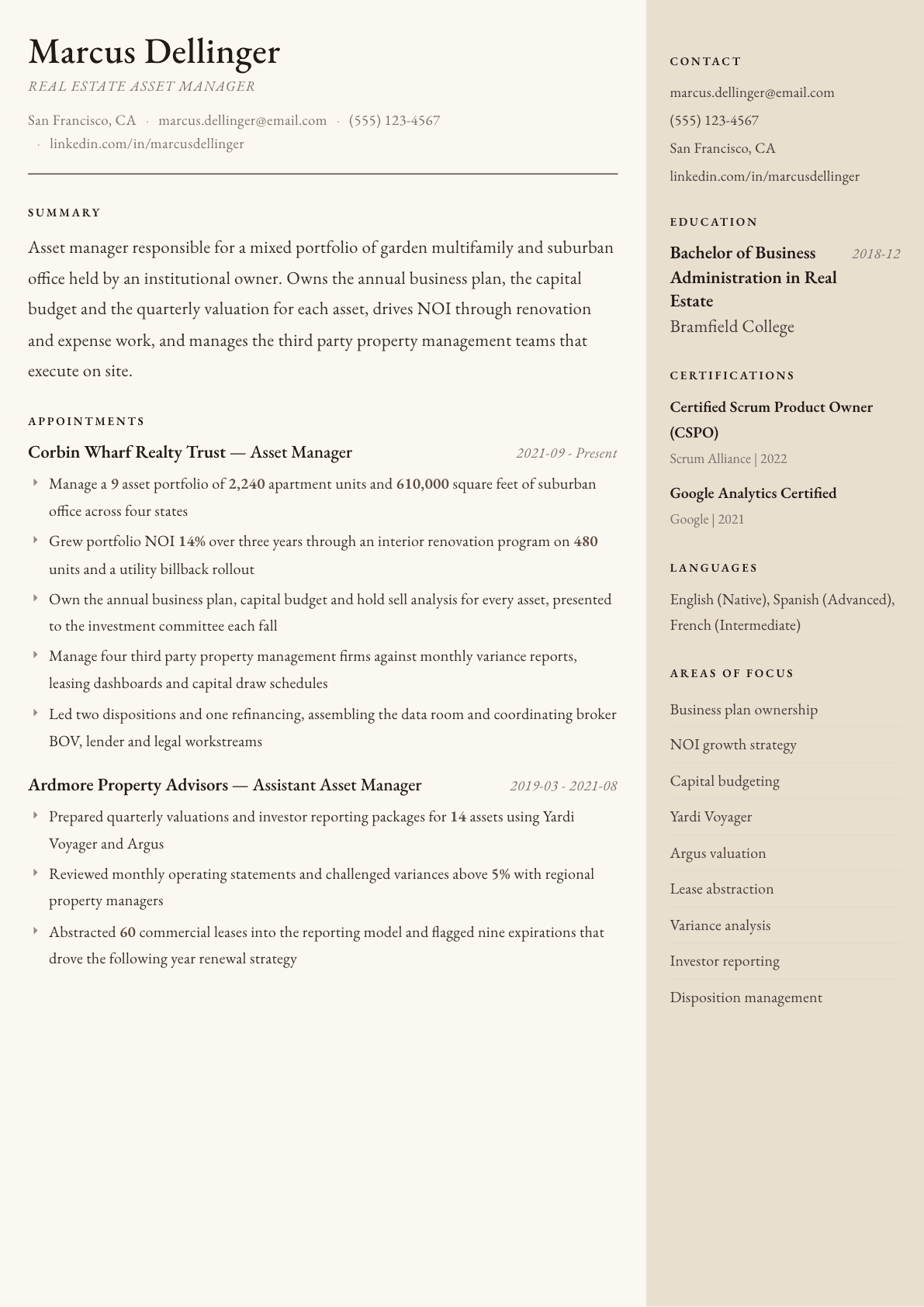
Example Asset Manager Real Estate summary
Real estate asset manager overseeing nine multifamily and suburban office assets for an institutional owner, covering the annual business plan, the capital budget and the quarterly valuation for each one. Grew portfolio NOI through an interior renovation program and a utility billback rollout while holding four third party management firms to monthly variance targets. Led two dispositions and a refinancing from data room to close.
Skills to list on a Asset Manager Real Estate resume
- Annual business plan development
- NOI and expense management
- Capital expenditure budgeting
- Hold sell analysis
- Quarterly valuation
- Argus Enterprise
- Yardi Voyager
- MRI Software
- Lease abstraction and analysis
- Property manager oversight
- Investor and lender reporting
- Refinancing coordination
- Disposition and BOV process
- Renovation program management
- Variance and budget review
What actually gets this resume read
- Lead with portfolio scale in units and square feet plus the number of assets, because that sets your level instantly.
- Show NOI movement across a hold period and say what you did to cause it, not just that it rose.
- Name the property management firms you supervise as a function, and describe how you hold them to a business plan.
- List every capital event you touched: refinancing, recapitalization, disposition, because owners hire for those weeks.
- Give the reporting systems by name, since a Yardi shop and a MRI shop screen for different resumes.
- Separate what you owned from what you supported, and never claim the deal team credit for an acquisition you only reviewed.
How to write a asset manager real estate resume
A real estate asset manager resume is read by an owner who wants to know what you were handed and what you handed back. The acquisitions team bought a business plan. Your job was to execute it through a hold period, and the page has to show the difference between the plan on the day of closing and the property on the day of sale.
That is why a list of duties fails here. Reviewing monthly financials, attending property tours and preparing investor reports describe the calendar of the job, not the outcome. The reader is looking for net operating income movement, occupancy and rent trajectory, capital projects delivered, and the capital events you helped execute.
This guide sets out the section order an owner expects, how to size a portfolio, how to write about third party property managers you supervise but do not employ, three summaries by level, and rewritten bullets that turn calendar work into hold period results.
Format: portfolio scale in the first two lines
One page works through roughly eight years. After that, two pages are normal because a senior asset manager has multiple capital events worth their own lines. Use reverse chronological order and keep a clean single column, since institutional owners often run resumes through a tracking system before anyone reads them.
Put portfolio scale where the eye lands: asset count, unit count, square footage, property types and geography. A reader who cannot size your book in five seconds moves on to the next file.
- Header: name, city, phone, email, and the property types you have managed through a hold period.
- Order the page summary, portfolio snapshot, asset management experience, capital events, education, systems.
- Analysts moving up put the valuation and reporting work first and the transaction support second.
Summary: what you own, across how much, and what moved
Say the ownership type first, because a real estate investment trust, a private sponsor, a debt fund workout desk and a corporate owner run asset management differently. Then the scale, then the two or three levers you actually pulled: renovation programs, expense reduction, lease up, rollover strategy, refinancing.
Close with the capital event experience. Owners hire asset managers with the expectation that a sale or a refinancing will land during your watch, and a summary that never mentions one reads as caretaker work.
Experience: business plan, execution, result
Structure each job as a portfolio line followed by bullets. The portfolio line gives asset count, units and square feet, property types, states and ownership structure. The bullets then follow the shape of the work: the annual business plan and capital budget you author, the operating results you drove, the projects you delivered, and the capital events you supported.
Write net operating income movement with the cause attached. Growth that came from a renovation program at a specific unit count is credible. Growth with no explanation reads as a rising market you happened to stand in.
Third party property management deserves its own bullet. Say how many firms, how many sites, and the mechanism you use to hold them accountable: monthly variance calls, leasing dashboards, capital draw approvals, site visit cadence and a scorecard at renewal.
Capital events: refinancing, recapitalization, disposition
Give each capital event its own line with your specific role. Assembling the data room, coordinating broker opinion of value work, managing lender diligence, running the buyer question list and clearing title exceptions are all separate jobs, and saying which one you owned tells the reader what to expect from you next quarter.
Hold sell analysis belongs here too. An asset manager who can show the annual recommendation, the assumptions behind it and what the investment committee decided is demonstrating the judgment the role is actually paid for.
Systems and reporting: name the stack
Yardi Voyager, MRI Software, RealPage and Argus Enterprise are not interchangeable in a hiring manager's mind, because a migration costs a quarter. Name the platform you reported in, the valuation tool you used, and whether you built the investor reporting package or reviewed one someone else built.
Add the reporting rhythm: monthly operating review, quarterly valuation and investor letter, annual business plan and budget. That rhythm is the spine of the job and proves you have carried a full cycle.
Asset Manager Real Estate resume summary examples
Analyst stepping into asset management
Real estate analyst supporting asset management on 14 assets, preparing quarterly valuations in Argus and investor reporting packages in Yardi Voyager. Abstracted 60 commercial leases into the reporting model and flagged nine expirations that shaped the following year rollover plan. Ready for direct asset ownership.
Four years managing assets
Asset manager for a 9 asset portfolio of 2,240 apartment units and 610K square feet of suburban office across four states. Grew portfolio net operating income 14% over three years through a 480 unit interior renovation program and a utility billback rollout, and supervised four third party management firms.
Senior asset manager
Senior asset manager with eleven years across multifamily, office and industrial for institutional owners. Delivered two dispositions and a portfolio refinancing in the last cycle, authored every annual business plan and capital budget in the book, and presented hold sell recommendations to the investment committee each fall.
Work experience bullets: before and after
Before: Responsible for a portfolio of multifamily and office properties.
After: Managed a 9 asset portfolio of 2,240 apartment units and 610K square feet of suburban office across four states for an institutional owner.
Asset count, units, square feet, property mix and geography let a reader size the book before the next line.
Before: Increased net operating income across the portfolio.
After: Grew portfolio net operating income 14% over three years through an interior renovation program on 480 units and a utility billback rollout across seven properties.
The number is only believable when the levers behind it are named and sized.
Before: Worked with third party property management companies.
After: Held four third party management firms to the annual business plan through monthly variance calls, leasing dashboards and capital draw approvals, replacing one firm after two consecutive missed lease up targets.
The mechanism and the replacement decision show real supervision rather than a standing meeting.
Before: Assisted with the sale of two properties.
After: Led two dispositions from broker opinion of value through closing, assembling the data room, managing 90 buyer diligence items and coordinating legal and lender workstreams to an on time settlement.
Naming the stages and the diligence volume shows the reader exactly which part of a capital event you can run.
Before: Prepared quarterly reports for investors.
After: Produced quarterly valuations and the investor reporting package for 14 assets in Argus and Yardi Voyager, including variance narrative, leasing pipeline and capital spend against budget.
The contents of the package prove you wrote the analysis rather than collating pages from the property manager.
Hard skills
- Annual business plan authoring
- Capital expenditure budgeting
- Net operating income analysis
- Hold sell and disposition analysis
- Quarterly valuation
- Argus Enterprise
- Yardi Voyager
- MRI Software
- Lease abstraction and rollover planning
- Variance and budget review
- Investor and lender reporting
- Refinancing and loan covenant tracking
- Renovation program management
- Property management oversight
Soft skills
- Owner and investor communication
- Vendor accountability
- Judgment on hold versus sell
- Negotiation with property teams
- Prioritizing across many assets
- Site visit observation
Certifications worth listing
- Certified Commercial Investment Member (CCIM) (CCIM Institute)
- Certified Property Manager (CPM) (Institute of Real Estate Management)
- Real Property Administrator (RPA) (BOMI International)
- Chartered Financial Analyst (CFA) (CFA Institute)
Mistakes that cost asset manager real estate candidates the interview
- Describing the reporting calendar instead of the hold period result, which makes an asset manager sound like a bookkeeper.
- Giving a net operating income figure with no lever attached, so the reader assumes the market did the work.
- Omitting portfolio scale, leaving a hiring owner unable to tell a two asset book from a thirty asset book.
- Blurring the line between acquisitions and asset management, which invites a technical question you will not enjoy.
- Skipping the capital events, when a refinancing or disposition is the strongest proof of judgment on the page.
- Naming no reporting platform, which matters because an owner on Yardi will weigh a MRI only candidate against a ramp.
Asset Manager Real Estate resume questions
How do I size a portfolio on an asset manager resume?
Give asset count, unit count for residential, square footage for commercial, the property types and the number of states or markets. Skip dollar values, because fund scale varies so widely that a number without context misleads more than it informs.
Should an asset manager resume include acquisitions work?
Include it as support if you genuinely contributed underwriting or diligence, and label it as support. Owners screen for hold period execution, so a page weighted toward deal screening suggests you would rather be on the acquisitions desk than run a business plan.
How do I write about property managers I did not employ?
Describe the accountability structure rather than the reporting line. Say how many firms and sites, the cadence of variance calls and site visits, what you approve, and any instance where you rebid or replaced a firm. That reads as supervision without overstating authority.
Is a certification worth it for real estate asset management?
The Certified Commercial Investment Member designation carries weight for investment focused roles, and the Certified Property Manager designation helps when the job includes heavy operations oversight. Neither replaces a track record of business plan execution, but both help a resume clear an early screen.
What if my portfolio underperformed because of the market?
Write what you controlled. Expense management, retention, capital delivered on budget, lease up against a schedule and a defensible hold recommendation are all yours regardless of cap rate movement. A resume that shows judgment during a hard cycle often interviews better than one that rode a good one.
Related resume examples
- Commercial Property Manager Resume example
- Real Estate Analyst Resume example
- Acquisitions Analyst Resume example
- Property Management Resume example
- Real Estate Developer Resume example
- HOA Manager Resume example