Treasury Manager Resume Examples: the lines they read
Build a Treasury Manager Resume Around Cash and Liquidity
By Mustafa Tarabya, founder of CVBooster · Published · Updated
Treasury manager resume examples with cash forecasting, banking structure and hedging bullets, plus a guide to the keywords treasury postings screen on.
Sample resumes for a treasury manager
The same treasury manager content laid out in three CVBooster templates, so you can see what the finished document looks like before you write a word.
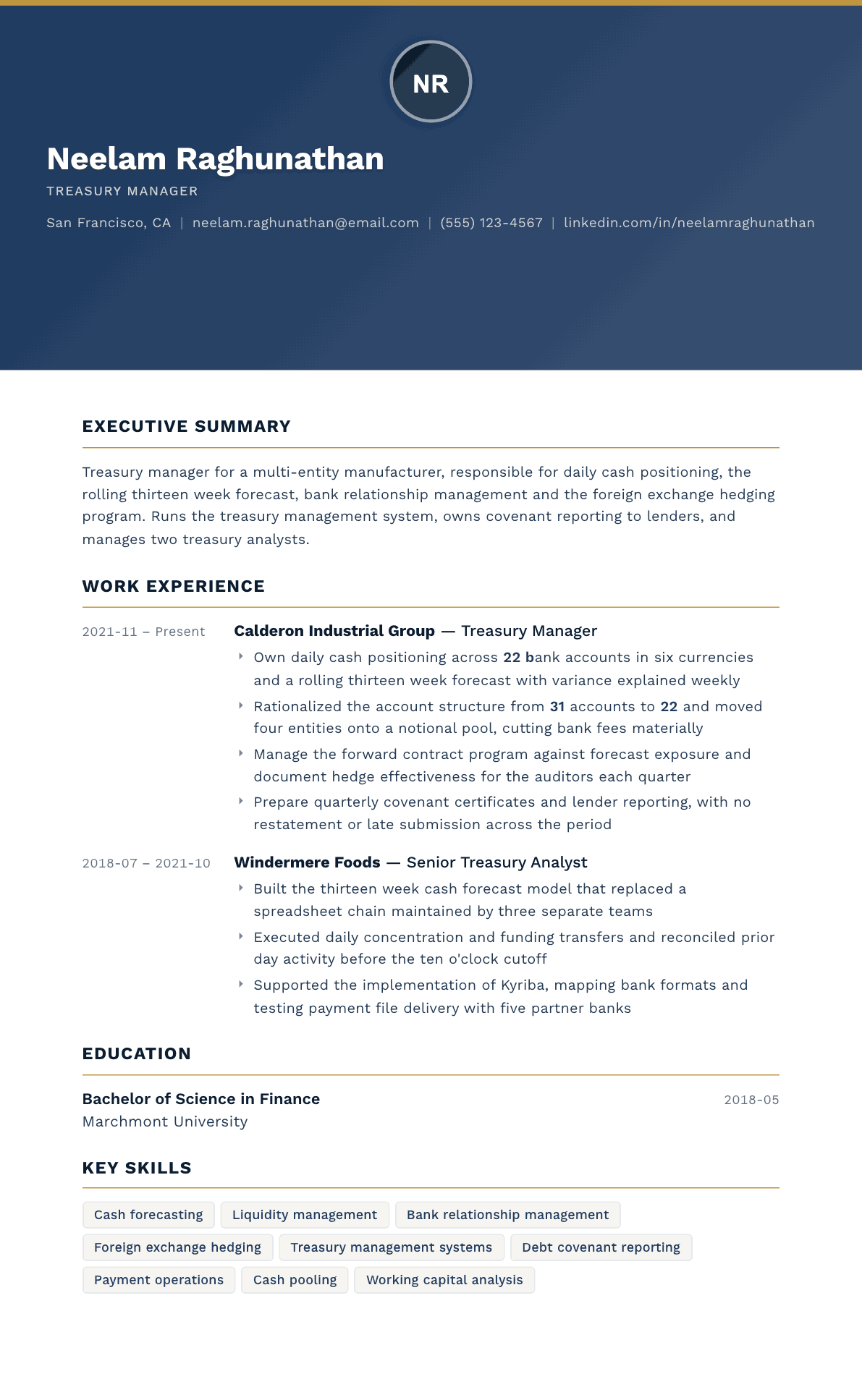
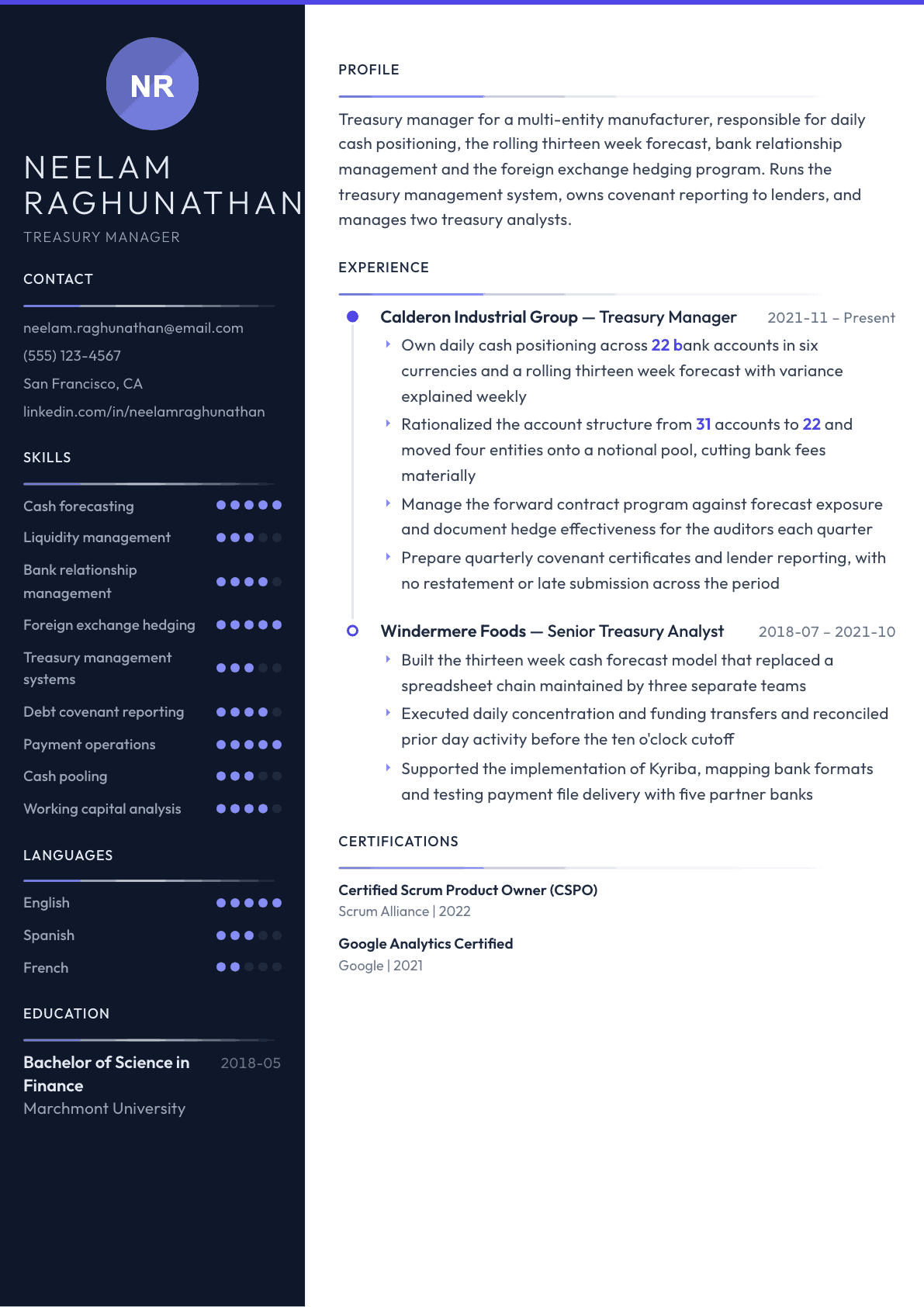
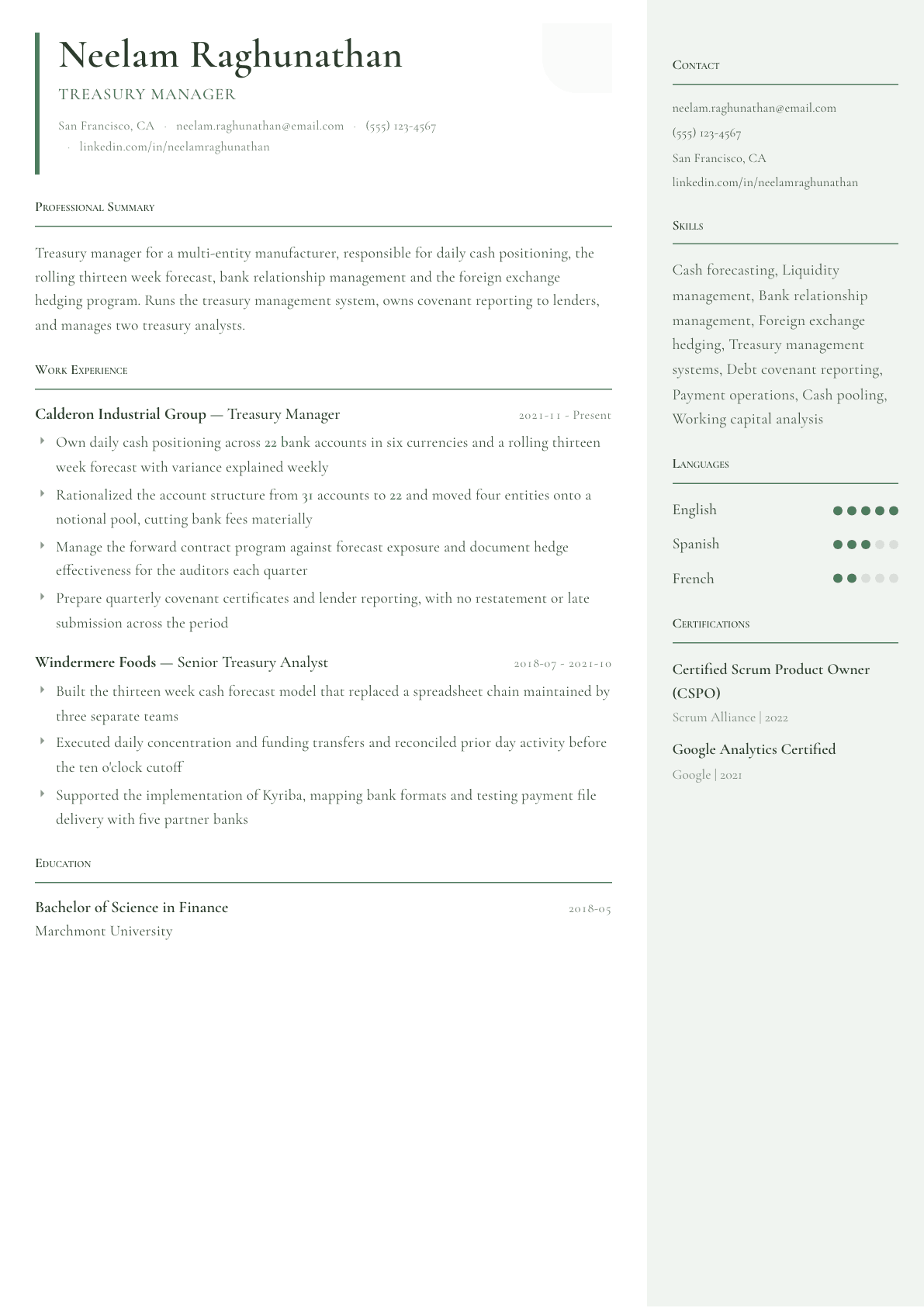
Example Treasury Manager summary
Treasury manager for a multi-entity manufacturer covering 22 bank accounts in six currencies. Owns daily cash positioning, the rolling thirteen week forecast, the forward hedging program and quarterly covenant reporting to lenders. Rationalized the account structure and moved four entities onto a notional pool. Ran a Kyriba implementation end to end and manages two analysts.
Skills to list on a Treasury Manager resume
- Cash positioning
- Thirteen week cash forecasting
- Liquidity management
- Bank relationship management
- Treasury management systems
- Foreign exchange hedging
- Interest rate risk management
- Debt covenant compliance
- Cash pooling structures
- Payment operations and controls
- Working capital optimization
- Investment policy administration
- Bank fee analysis
- Intercompany funding
What actually gets this resume read
- Open with the treasury scope: entities, currencies, bank accounts and whether you carry debt, because that defines the role instantly.
- Name the treasury management system you ran, since postings screen hard on Kyriba, GTreasury, Coupa Treasury or an SAP module.
- Describe the forecast you own by horizon and accuracy discipline rather than by saying you prepared cash flow reports.
- Show bank structure work such as account rationalization, pooling, or a request for proposal, which separates managers from analysts.
- If you have hedging experience, state the instruments and whether you handled hedge accounting documentation under the standards.
- Include lender and covenant reporting, because treasury managers at leveraged companies are hired largely for that reliability.
How to write a treasury manager resume
A treasury manager is hired to make sure the company always has the money it needs where it needs it, and never learns about a shortfall on the morning it happens. The person reading your resume is checking whether your treasury scope matches theirs: how many entities and currencies, how many bank accounts, whether there is debt with covenants, and whether hedging is part of the job or a separate desk.
The second check is systems. A treasury run on spreadsheets and bank portals is a different job from one run on a treasury management system with automated bank statement import and payment file delivery. Both are legitimate, but a company mid-implementation will pay specifically for someone who has survived one, and that experience has to be visible.
What follows covers the layout finance leaders expect from a treasury manager, three summaries from analyst step-up through to group treasurer, before and after bullets on the parts treasury people habitually undersell, and the questions that come up when moving between corporate treasury and banking.
Format: scope line first, then the systems
Reverse chronological, single column, one page under eight years and two after. Open each role with a scope line: entities, currencies, bank accounts, debt facilities and team size. A treasury manager resume without that line forces the reader to guess whether you handled a single domestic account structure or a cross-border group, and the guess is usually unflattering.
Put the treasury management system in the scope line too, or immediately below it. Postings screen on those product names, and a recruiter with twenty files will filter on them before reading anything else.
- Header: name, city and state, phone, email, and whether you have multi-currency or cross-border experience.
- Sections: summary, experience with scope lines, systems and banking platforms, education and certifications.
- Say whether treasury reported into the controller, the chief financial officer, or a group treasurer.
Summary: entities, currencies, forecast, debt, hedging
Three lines that answer the five scope questions. Entities and currencies establish complexity. The forecast horizon you own establishes rigor. Debt and covenant reporting establish reliability, because a lender relationship is unforgiving of a late certificate. Hedging establishes whether you have handled instruments and documentation or only cash operations.
Add what you improved. Treasury is a role where structural work is memorable: account rationalization, a pooling structure, a bank request for proposal, a systems implementation. Naming one of those in the summary immediately distinguishes you from a candidate who kept the existing structure running competently.
Experience: positioning, forecasting, banking, debt, hedging
Cash positioning bullets should show the daily discipline: accounts covered, currencies, the cutoff you work to, and how prior day activity is reconciled before funding decisions are made. That detail proves operational competence in a way that a sentence about managing daily cash never does.
Forecasting bullets need a horizon and a quality practice. Owning a rolling thirteen week forecast is standard, but explaining variance weekly against actuals is the part that earns credibility with a chief financial officer, because it means the forecast is being corrected rather than merely produced.
Bank structure work belongs in its own bullet. Account rationalization, notional or physical pooling, in-house bank arrangements and fee analysis are all projects a treasury manager can point at, and they read as senior work because they require negotiation as well as analysis.
For debt and hedging, keep the language precise. Covenant certificate preparation, borrowing base reporting, forward and swap execution against a documented policy, and hedge effectiveness documentation for the auditors are each verifiable claims. Vague references to managing financial risk are not.
Systems and controls: the part that gets you shortlisted
Name every platform: the treasury management system, the enterprise resource planning system it connects to, the bank portals, and any payment or file transfer tooling. Then state your role in any implementation. Mapping bank formats, testing payment files with partner banks, and running parallel cycles are concrete implementation tasks, and companies about to start a project search for exactly those phrases.
Payment controls deserve a mention because treasury sits closest to the fraud exposure. Dual approval limits, callback verification on bank detail changes, and positive pay administration are all things a treasury manager owns, and they signal that you understand the control environment rather than only the cash flow.
- Treasury management system, enterprise resource planning system and bank connectivity method.
- Implementation or upgrade work, described by the tasks you performed rather than the project name.
- Payment controls administered: approval hierarchies, callback procedures, positive pay, account validation.
Keywords treasury postings match on
The recurring vocabulary is cash positioning, liquidity management, rolling cash forecast, bank relationship management, cash pooling, intercompany funding, foreign exchange exposure, hedge accounting, debt covenant compliance, borrowing base, investment policy and bank fee analysis. Use the phrases that are genuinely yours, once in the summary and once where a bullet proves them. Treasury hiring managers read carefully, so a term that appears without supporting evidence stands out in the wrong way.
Treasury Manager resume summary examples
Analyst stepping up
Senior treasury analyst ready for a manager seat, with three years of daily concentration transfers, prior day reconciliation before the morning cutoff, and ownership of a rolling thirteen week forecast model that replaced a spreadsheet chain across three teams. Supported a treasury system implementation through bank format mapping.
Running corporate treasury
Treasury manager covering 22 bank accounts across six currencies for a multi-entity manufacturer. Owns daily positioning, the rolling thirteen week forecast with weekly variance explained, the forward hedging program and quarterly covenant certificates. Rationalized the account structure and moved four entities onto a notional pool.
Group treasurer
Group treasury leader with fourteen years across manufacturing and consumer goods, managing a five person team, a multi-currency pooling structure and a syndicated facility with quarterly covenant reporting. Ran two treasury system implementations and a bank request for proposal that consolidated cash management onto two partners.
Work experience bullets: before and after
Before: Managed daily cash for the company.
After: Own daily cash positioning across 22 bank accounts in six currencies, reconciling prior day activity before the morning cutoff and funding each entity from a single concentration view.
Account count, currencies and the reconciliation-before-funding sequence show the actual operating discipline of the desk.
Before: Prepared cash flow forecasts.
After: Maintain a rolling thirteen week cash forecast built from receivables aging, payables scheduling and confirmed capital spending, explaining variance against actuals to the finance leadership meeting each week.
Naming the inputs and the weekly variance review proves the forecast is corrected rather than only produced.
Before: Worked with banks to improve the account structure.
After: Rationalized the account structure from 31 accounts to 22 and moved four entities onto a notional pool, renegotiating the analysis fee schedule with both partner banks in the same cycle.
Before and after counts plus the fee negotiation turn a project mention into a measurable structural outcome.
Before: Handled foreign exchange hedging.
After: Execute forward contracts against forecast exposure under a board approved policy, and prepare the quarterly hedge effectiveness documentation reviewed by the external auditors.
Instrument, policy authority and audit documentation make the hedging claim verifiable instead of aspirational.
Before: Helped implement a new treasury system.
After: Supported a treasury management system implementation by mapping bank statement formats, testing payment file delivery with five partner banks and running two parallel cycles before cutover.
Listing the tasks you performed shows exactly what you can repeat, which is why implementation experience gets shortlisted.
Hard skills
- Daily cash positioning
- Rolling cash forecasting
- Liquidity and funding management
- Bank relationship management
- Treasury management systems
- Cash pooling and concentration
- Foreign exchange hedging
- Hedge effectiveness documentation
- Debt covenant reporting
- Payment operations controls
- Bank fee and analysis review
- Intercompany funding and netting
Soft skills
- Negotiation with banking partners
- Composure on funding deadlines
- Clear reporting to executives
- Cross-entity coordination
- Process documentation habit
- Judgment on counterparty exposure
Certifications worth listing
- Certified Treasury Professional (CTP) (Association for Financial Professionals)
- Certified Public Accountant (CPA) (State Boards of Accountancy)
- Chartered Financial Analyst (CFA) (CFA Institute)
- Certified Corporate Financial Planning and Analysis Professional (FPAC) (Association for Financial Professionals)
Mistakes that cost treasury manager candidates the interview
- Omitting entity, currency and account counts, which leaves the reader unable to judge whether your scope matches the opening.
- Failing to name the treasury management system when postings filter on those product names before anything else.
- Describing forecasting without a horizon or a variance practice, which reads as report production rather than ownership.
- Leaving out covenant and lender reporting, the reliability signal leveraged companies weight most heavily.
- Claiming hedging experience without naming instruments, policy authority or the audit documentation you prepared.
- Skipping payment controls, even though treasury owns the exposure that fraud teams spend their days chasing.
Treasury Manager resume questions
Is the Certified Treasury Professional credential necessary?
It is not universally required, but it appears in a large share of corporate treasury postings and some employers use it as a filter. If you are working toward it, list the credential with your registration status and keep your practical scope evidence strong in the meantime.
How do I move from banking into a corporate treasury manager role?
Translate the relationship side into operational terms. Cash management product knowledge, account structuring, payment rails and liquidity products all map directly onto corporate needs. Then close the gap honestly on forecasting and covenant reporting, which are the two areas bankers most often lack.
Should I include treasury figures on my resume?
Use counts and structures rather than balances. Account numbers, currencies, entities, facility counts and forecast horizons communicate scope precisely, and they avoid disclosing information your employer would reasonably consider confidential or commercially sensitive.
What if my treasury runs entirely on spreadsheets?
Say so plainly and describe the control practices you built around them: version control, reconciliation to bank portals, approval evidence and documentation. Many hiring companies are in the same position, and a candidate who has kept a manual process controlled is genuinely attractive to them.
How much accounting knowledge does a treasury manager need?
Enough to close the cash side of the month, support hedge accounting documentation and explain foreign currency translation effects. You are not preparing the statements, but treasury sits next to the controller, and an interviewer will test whether you can hold that conversation.
Related resume examples
- Treasury Analyst Resume example
- Controller Resume example
- Finance Manager Resume example
- Financial Controller Resume example
- Finance Director Resume example
- CFO Resume example