Financial Controller Resume Examples: what gets the call
Write a Financial Controller Resume That Proves Close Control
By Mustafa Tarabya, founder of CVBooster · Published · Updated
A financial controller resume example built on close ownership, audit results and system rollouts, with the keywords finance leaders search and a guide.
Sample resumes for a financial controller
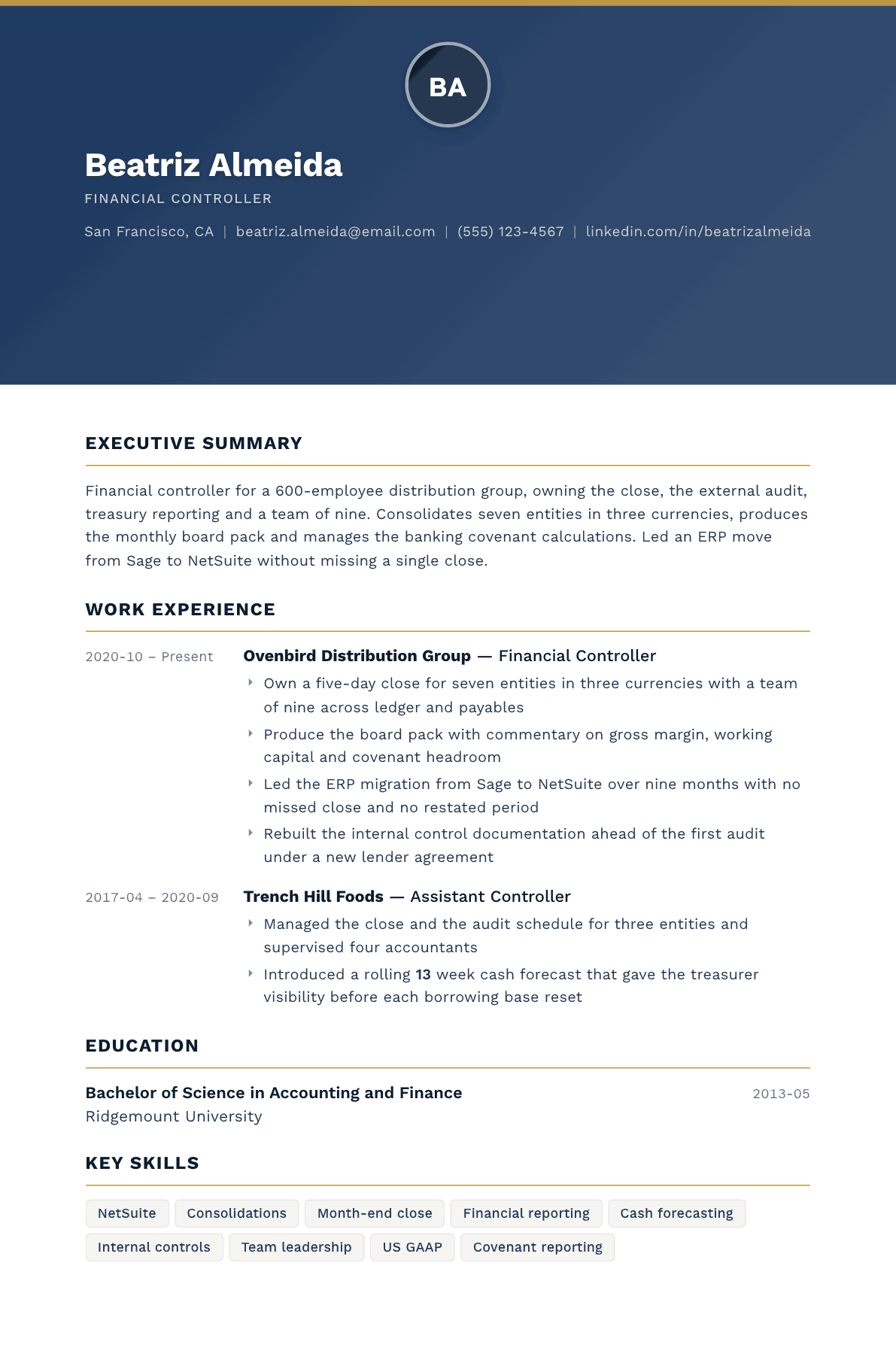
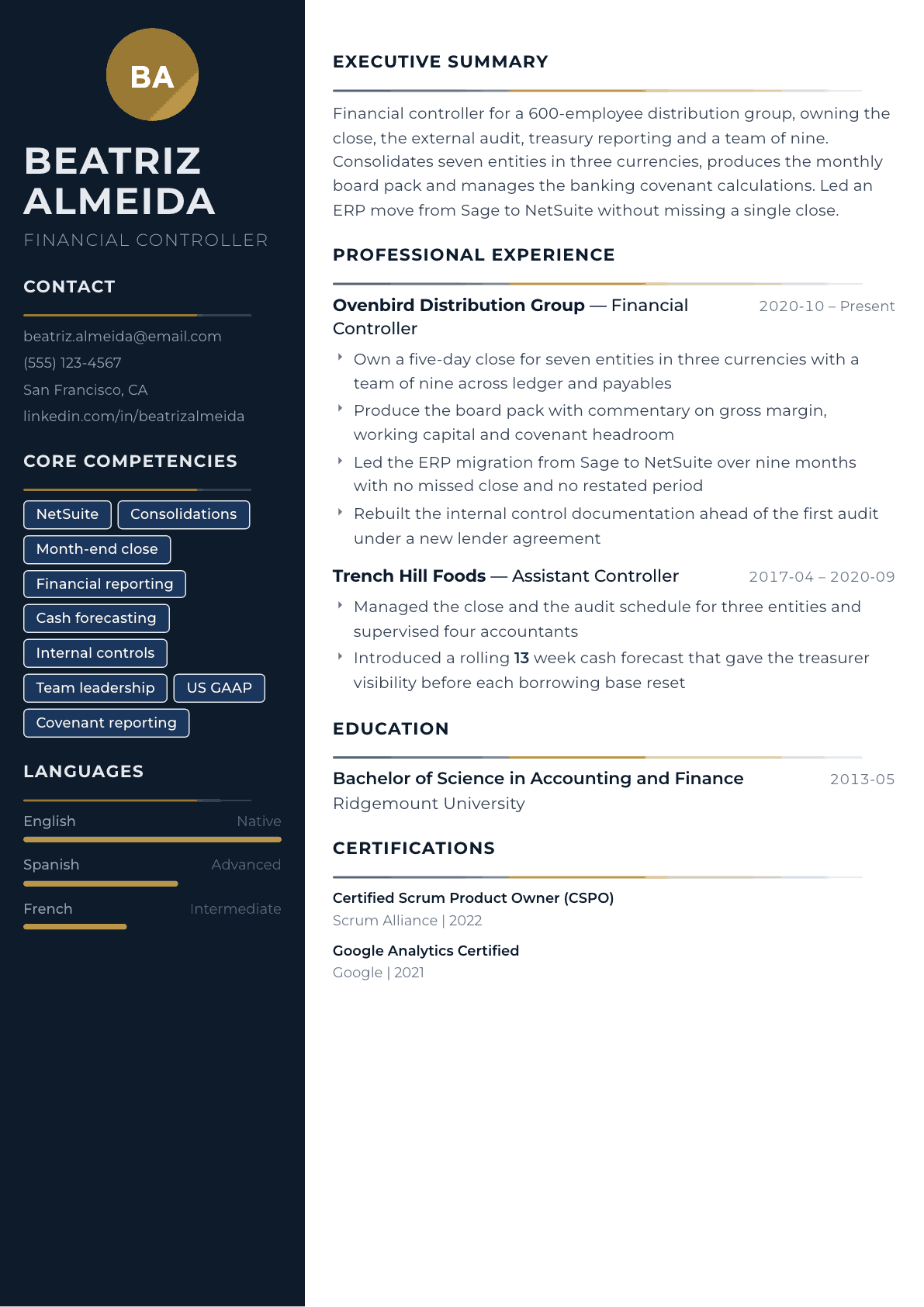
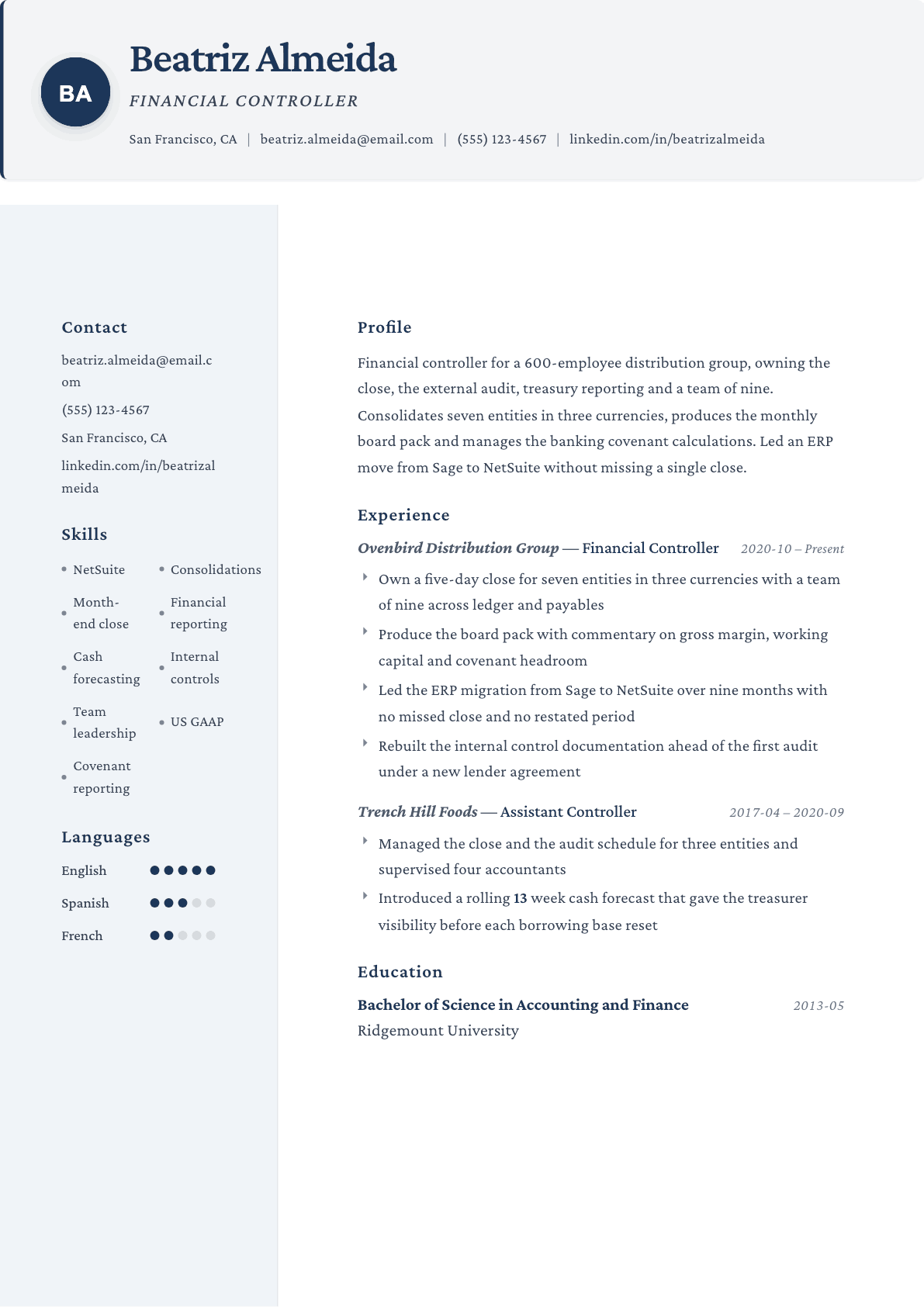
The same financial controller content laid out in three CVBooster templates, so you can see what the finished document looks like before you write a word.
Example Financial Controller summary
Financial controller for a distribution group of 600 employees, owning a five-day close across seven entities in three currencies with a team of nine. Produces the board reporting pack, manages the external audit and the lender covenant calculations, and led an ERP move from Sage to NetSuite without a missed close. Looking for a controller role in a sponsor backed business.
Skills to list on a Financial Controller resume
- Month-end close
- Consolidations
- Multi-currency accounting
- Financial reporting
- Board reporting packs
- External audit management
- Internal controls
- Cash forecasting
- Covenant compliance
- Working capital management
- ERP implementation
- NetSuite
- US GAAP
- Team leadership
- Budgeting and forecasting
What actually gets this resume read
- Open with scope: entities, currencies, revenue size in words, headcount you manage and the close length.
- Show the audit and lender side, because a controller is judged on clean audits and covenant reporting.
- Name any ERP implementation you led and whether the close continued uninterrupted during the cutover.
- Separate technical accounting ownership from operational finance, since employers hire for a different mix.
- Quantify working capital wins in days of inventory, receivable days or the cash the change released.
- Include the reporting pack you produce and its audience, whether board, sponsor or lending group.
How to write a financial controller resume
A financial controller resume is usually read by a chief financial officer, a private equity operating partner or a founder who has outgrown their bookkeeper. All three are buying the same thing: certainty. They want a person who guarantees that the numbers arrive on a fixed day, survive an audit, satisfy a lender, and do not surprise anyone at the board table.
Certainty on paper looks like scope plus a record of things that did not go wrong. Entities, currencies, headcount, close length and reporting cadence establish the scope. Clean audits, covenant compliance, a system migration that did not break a close and control documentation that held up establish the record. Duty lists establish nothing.
This guide covers how to open a controller resume with scope, how to write the audit and lender relationships, how to present an ERP implementation, and how to separate the accounting half of the job from the operational finance half that many postings now bundle in.
Open with the scope of the finance function you run
The first three lines should establish size and structure: the industry, revenue size in words, the number of legal entities and reporting currencies, the headcount reporting to you, the close length and who receives your reporting pack. A reader can then place you against their own environment in seconds.
Do not lead with responsibilities. Every controller owns the general ledger and the close, so listing that consumes the most valuable space on the page. Lead with what is different about your environment, which is where the fit judgment actually happens.
- Scope line: entities, currencies, countries, team size, close days, reporting audience.
- Ownership line: close, audit, treasury, tax coordination, payroll, controls, systems.
- Evidence line: audit outcomes, covenant compliance, a migration or a restructuring you carried.
The close: length, structure and what makes it hold
State the close length and then show the machinery behind it. A checklist with named owners and due dates, reconciliation sign-off before reporting, a flux review that questions movements before anyone external asks, and a hard cutoff on late entries. Controllers are hired on the belief that the close will keep working after they arrive.
If you shortened a close, give the before and after and the change that caused it. Removing manual consolidation steps, automating recurring journals, moving reconciliations into a platform, or fixing the intercompany process are all credible mechanisms. A close that got shorter without a stated reason reads as a claim rather than a result.
Audit, lenders and controls
Write the external audit as a program you manage: the planning meeting, the request list you own, the fieldwork window, the number of proposed adjustments, and whether the timetable held. Two audits closed without adjustments says more about you than any adjective in a summary.
Lender and investor obligations deserve their own bullets when you carry them. Covenant calculations, borrowing base certificates, monthly reporting packages to a lending group and the questions that follow are controller work that many candidates leave silent. Add control documentation when you have built or remediated it, naming the cycles covered.
Systems: an implementation is your strongest single bullet
If you have led an ERP selection, implementation or migration, give it a bullet of its own: the systems moved between, the duration, the entities in scope, whether historical data was converted, and above all whether the close continued uninterrupted. Finance leaders remember every migration that broke a reporting cycle, and one that did not is a strong hiring signal.
Beyond the ERP, name the reporting and consolidation layer, the reconciliation platform, the payables automation and the treasury or banking portals you administer. Controllers are increasingly expected to own the finance system landscape rather than just live inside it.
Separating accounting ownership from operational finance
Many controller postings now include budgeting, forecasting, cash management and business analysis alongside the accounting. Show both halves with a clear boundary, because employers hire for a specific mix and a resume that blends them makes the reader guess.
When the posting emphasizes planning, bring the forecast, the cash model and the working capital work forward. When it emphasizes technical accounting and audit, lead with consolidations, standards applied and the audit record. The underlying facts stay the same, only the order changes.
Financial Controller resume summary examples
First controller seat
Assistant controller stepping up, managing the close and audit schedule for three entities with four accountants reporting in. Owns consolidations, the reconciliation calendar and the rolling cash forecast. Introduced a thirteen week cash view that gave the treasurer visibility before each borrowing base reset.
Controller of a mid-market group
Financial controller for a distribution group with 600 employees, owning a five-day close across seven entities in three currencies with a team of nine. Produces the board pack, manages the external audit and the covenant calculations, and led an ERP move without a missed close.
Group controller
Group controller across three countries and eleven entities, leading two accounting managers and a shared service team. Owns consolidated reporting, technical accounting positions, the audit relationship and the finance systems roadmap. Integrated two acquisitions onto a single chart of accounts inside two close cycles.
Work experience bullets: before and after
Before: Managed the accounting department.
After: Led a team of nine across the general ledger, payables and receivables, delivering a five-day close for seven entities in three currencies.
Team composition, close length and entity structure define the function instead of naming it.
Before: Oversaw the annual audit.
After: Managed the external audit as the client side owner, holding the agreed fieldwork window and closing with no proposed adjustments for two consecutive years.
The window and the adjustment count are the two facts a chief financial officer uses to judge audit control.
Before: Implemented a new ERP system.
After: Led the ERP migration from Sage to NetSuite over nine months across seven entities, with no missed close and no restated period during cutover.
Duration, scope and continuity turn a project mention into the reassurance a hiring finance leader wants.
Before: Prepared reports for management.
After: Produced the monthly board pack with commentary on gross margin, working capital and covenant headroom, and presented it to the lending group each quarter.
Naming the content and the audience shows the reporting reached decision makers rather than a folder.
Before: Improved cash management.
After: Introduced a rolling thirteen week cash forecast and renegotiated supplier terms, releasing cash equivalent to several days of receivables.
A named tool plus a working capital outcome makes the cash improvement concrete without inventing figures.
Hard skills
- Close management and calendar design
- Multi-entity consolidations
- Foreign currency translation
- Statutory and management reporting
- External audit ownership
- Internal control documentation
- Covenant and lender reporting
- Cash forecasting and treasury reporting
- ERP selection and implementation
- NetSuite
- Budgeting and forecasting
- US GAAP
Soft skills
- Giving bad news early
- Building a team that closes without heroics
- Explaining accounting to a board
- Negotiating scope with auditors
- Holding a cutoff when operations pushes back
Certifications worth listing
- Certified Public Accountant (CPA) (State Boards of Accountancy)
- Certified Management Accountant (CMA) (Institute of Management Accountants)
- Certified Treasury Professional (CTP) (Association for Financial Professionals)
- Chartered Global Management Accountant (CGMA) (American Institute of Certified Public Accountants)
Mistakes that cost financial controller candidates the interview
- Opening with responsibilities every controller carries instead of the scope that makes your environment specific.
- Omitting entity and currency counts, the fastest way for a chief financial officer to judge complexity.
- Leaving the audit record silent, which invites the reader to assume it was not clean.
- Mentioning a system implementation in passing rather than giving it the bullet its hiring value deserves.
- Blending accounting ownership and planning work so the reader cannot tell which half you are strongest in.
- Listing the team as a headcount with no structure, so the reader cannot see whether you manage managers.
Financial Controller resume questions
What is the difference between a controller and a financial controller?
The titles are used interchangeably in most markets, with financial controller more common outside the United States. Describe the scope rather than relying on the title, since the same word covers very different jobs by company size.
Do I need a CPA to be a financial controller?
It is preferred in many postings and effectively required where technical accounting or an audited filer is involved. Without one, lead with consolidations, audit ownership and system work, and consider a management accounting credential instead.
How much of the resume should cover planning and forecasting?
As much as the posting asks for. Read the job description for whether budgeting and cash sit with the controller or with a separate planning team, then reorder your bullets so the emphasized half appears first.
Should I name the private equity sponsor or lender?
Name the type rather than the firm unless it is public information and relevant. Saying a sponsor backed business with a lending group and quarterly covenant reporting conveys the environment without breaching confidentiality.
How do I show I built a finance team rather than inherited one?
Give the before and after: headcount, roles added, work brought in house from an outsourced provider, and how long the team stayed. Team building is a differentiator because it outlasts any single close you delivered.
Related resume examples
- Controller Resume example
- CFO Resume example
- Accounting Manager Resume example
- Finance Manager Resume example
- Finance Director Resume example
- Treasury Manager Resume example