Treasury Analyst Resume Examples: the lines they read
Create a Treasury Analyst Resume That Manages Cash Flow
By Mustafa Tarabya, founder of CVBooster · Published · Updated
Build a treasury analyst resume highlighting cash management, liquidity forecasting, and investment strategy with quantified financial outcomes.
Sample resumes for a treasury analyst
The same treasury analyst content laid out in three CVBooster templates, so you can see what the finished document looks like before you write a word.
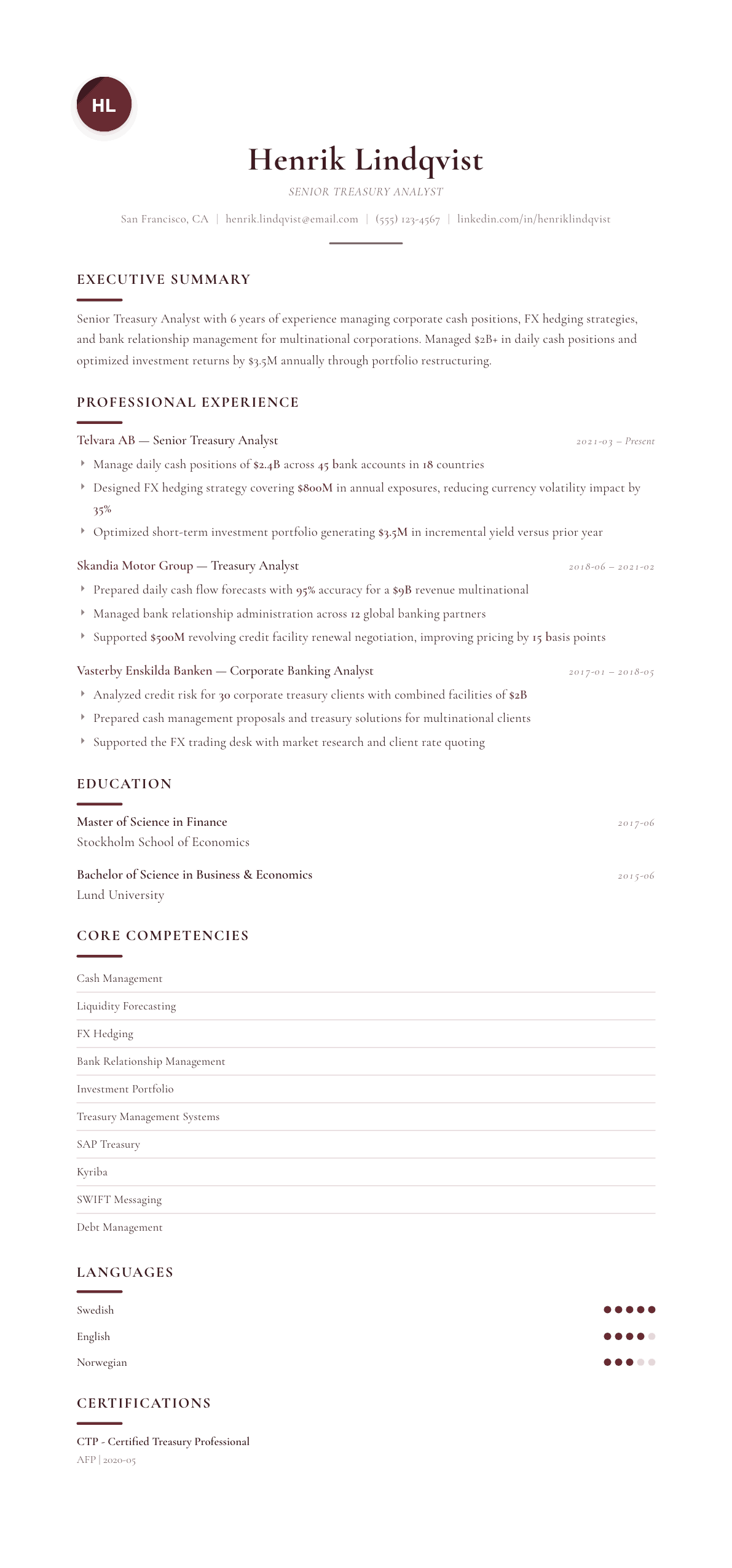
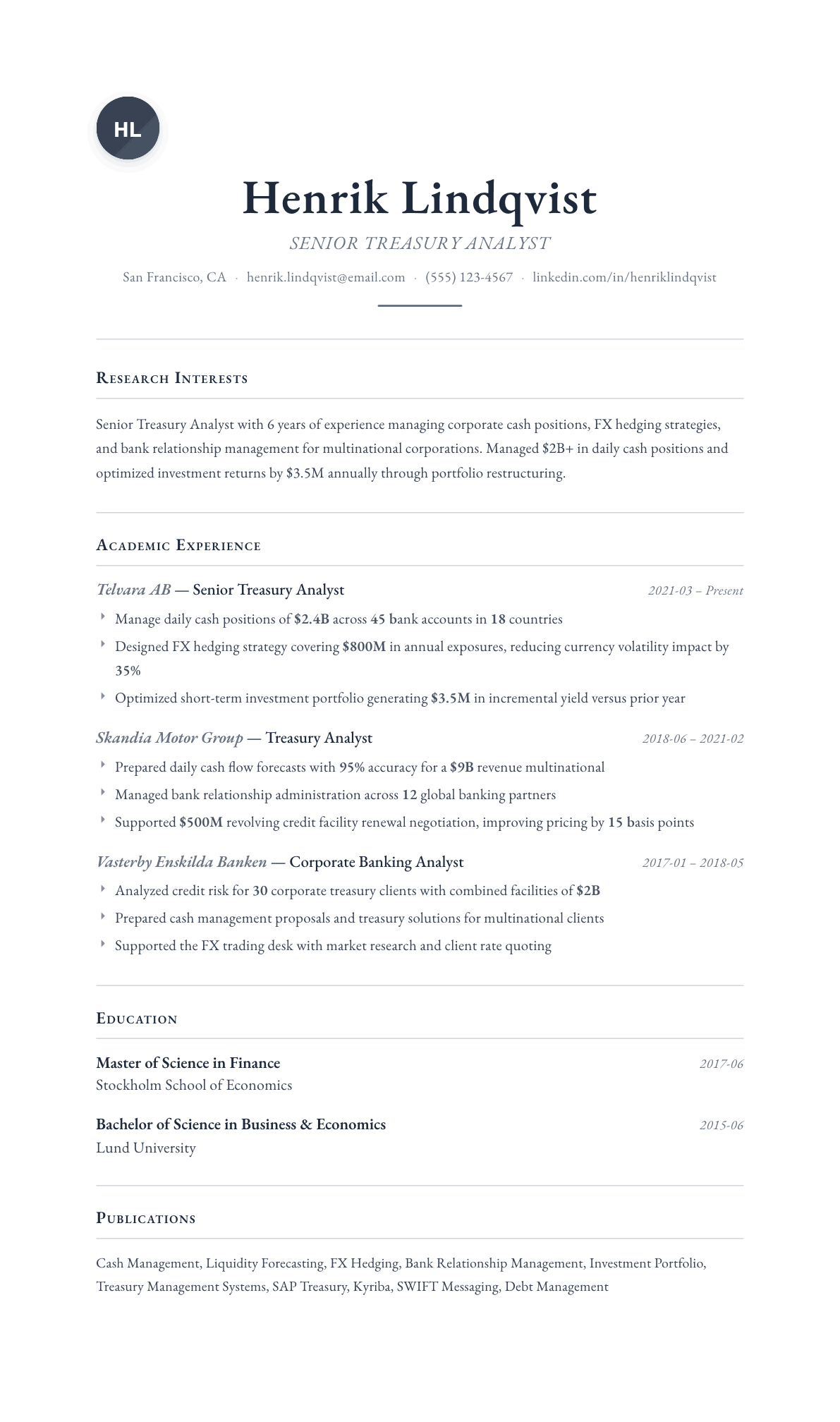
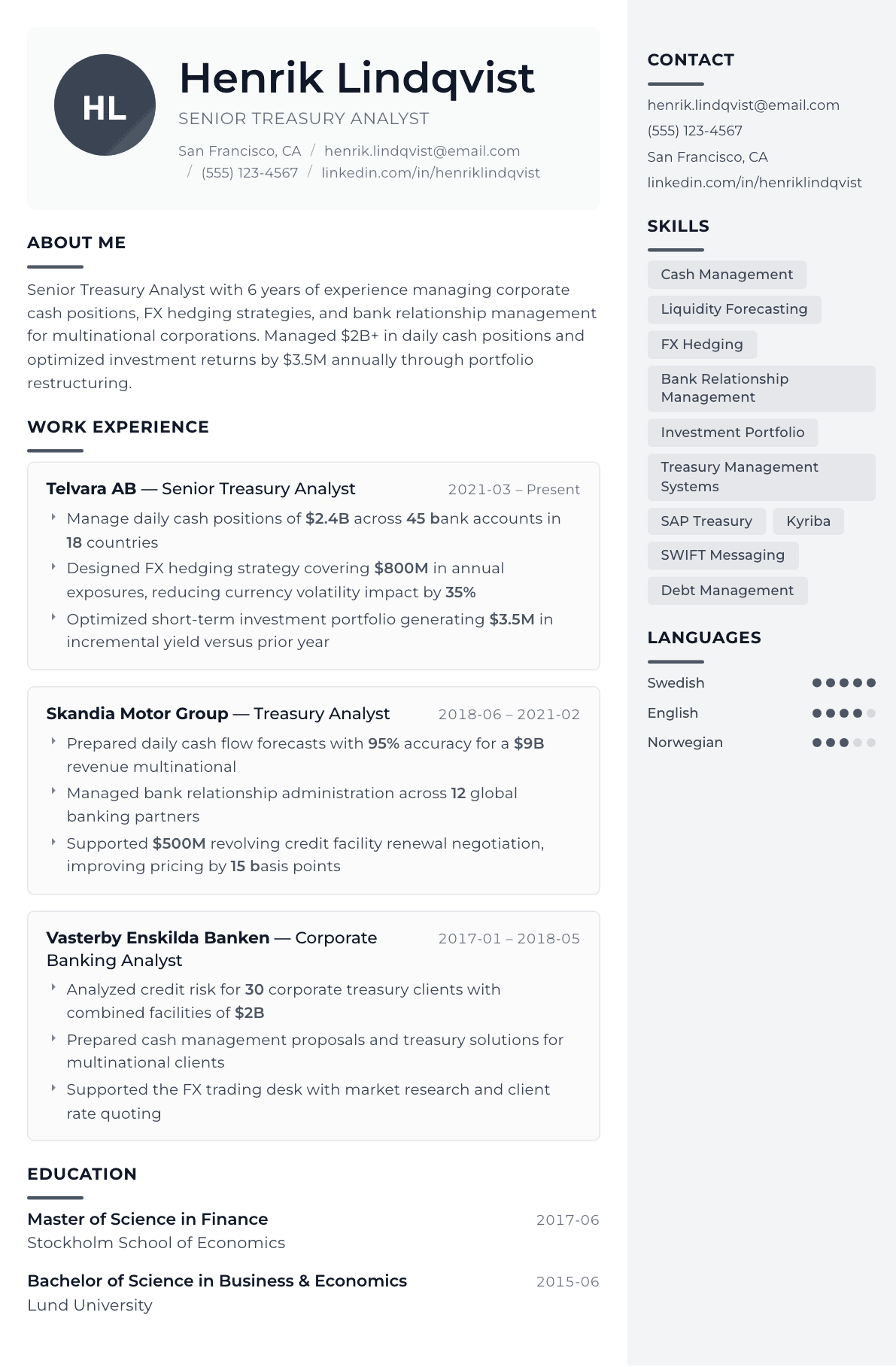
Example Treasury Analyst summary
CTP-certified Senior Treasury Analyst with 6 years of experience managing $2B+ daily cash positions and FX hedging strategies for multinational corporations. Generated $3.5M in incremental investment returns and reduced currency volatility by 35%. Seeking a Treasury Manager role to lead cash management and risk mitigation at a global organization.
Skills to list on a Treasury Analyst resume
- Cash Management
- Liquidity Forecasting
- FX Hedging
- Interest Rate Risk
- Bank Relationship Management
- Investment Management
- Treasury Management Systems
- SAP Treasury
- Kyriba
- SWIFT
- Debt Management
- Working Capital Optimization
What actually gets this resume read
- Quantify cash positions managed, FX exposure hedged, and investment returns generated.
- Highlight treasury management systems (Kyriba, FIS, SAP Treasury, ION) you have used.
- Show experience with cash forecasting accuracy and liquidity management.
- Include bank relationship management and credit facility negotiation experience.
- Demonstrate FX, interest rate, and commodity hedging capabilities.
- CTP certification is the gold standard for treasury; display it prominently.
How to write a treasury analyst resume
Treasury sits between the bank and the business, and a treasury analyst resume has to prove competence on both sides of that seam. The treasurer reading it wants to know whether you can be trusted with payment release and bank access, whether your cash forecast is close enough to size a borrowing decision, and whether you understand the instruments involved rather than just the spreadsheet that tracks them.
The screening facts are concrete: the daily cash position you managed, the number of entities, currencies and bank accounts, the debt facilities and covenants you tracked, the hedging program you supported, and the treasury management system you worked in. Because treasury is a small function, a single analyst often carries a wide range of responsibilities, so the resume needs to show breadth without sounding vague.
This guide covers how to organize the file, three summaries from a first treasury seat to a senior analyst, before and after bullets, and the control and compliance details that treasurers look for before they trust anyone near a payment file.
Format: structure facts under the header, one page early on
One page under about six years, two after that. Put a short structure block under the summary: entity count, currencies, number of bank accounts and banking partners, average daily cash position, and the systems. Treasury complexity is entirely about structure, and this block conveys in five lines what would otherwise take a page of bullets.
Keep the layout conventional and machine readable. Treasury openings are usually posted by corporate recruiters using an applicant tracking system, and the system names are the keywords being matched, so they should sit in plain text rather than inside a graphic.
- Header: name, credential such as CTP, city and state, phone, email.
- Order: summary, structure and systems block, experience, technical skills, certifications and education.
- Candidates coming from accounting add a line naming the treasury coursework or the CTP study progress.
Summary: cash scale, structure, and the treasury areas you own
Give the daily cash position and the structure it sits in, since a single entity domestic business and a group with twenty legal entities across eight currencies are very different jobs at the same headline number. Then say which of the treasury pillars you own: liquidity and cash positioning, bank relationship and account administration, debt and covenant compliance, investments, foreign exchange and interest rate hedging, or payments and fraud controls.
Name the treasury management system in the summary. Treasurers hire around implementations and around cover for a live platform, and the system name is often the first filter applied. Say whether the group runs a physical cash pool, a notional pool, or in house bank structures, because that vocabulary immediately signals the level you have worked at.
Experience: the daily cycle, the forecast, and the bank relationships
Start with the daily cycle, because it is the heart of the job: pulling prior day and intraday balances, positioning cash across accounts, funding disbursement accounts, executing intercompany movements, initiating investments or drawdowns, and closing the position. Say how many accounts and banks that spans and whether it was manual or system driven.
Then the cash forecast. State the horizon and the grain, whether it is a rolling thirteen week direct forecast or a longer indirect one built from the plan, how variance was measured against actuals, and what you did about the recurring drivers of error such as collections timing or capital spending. A treasury analyst who has tightened a forecast and can explain how is immediately more employable than one who has only compiled it.
Cover the bank side and the control side. Account opening and closing, signatory and mandate maintenance, the know your customer packs, bank fee analysis against the account analysis statements, connectivity through host to host or the interbank messaging network, and the payment controls: segregation of duties, dual approval, positive pay, and the callback procedure for changes to vendor bank details. Treasurers read this closely because payment fraud is the risk that keeps them awake.
Debt, investments and hedging: name the instruments
On the debt side, describe the facilities you tracked, such as a revolving credit facility with borrowing base reporting, term loans, private placements or commercial paper, and the compliance work around them: covenant calculations, the quarterly compliance certificate, borrowing base submissions, and interest and fee accruals. State whether you prepared the calculation or only supplied inputs.
On the investment side, name the policy constraints you worked within, the instrument types such as money market funds, treasury bills, commercial paper or time deposits, and the maturity ladder you maintained. On hedging, be specific about instruments and accounting: forwards, swaps, options, collars, the exposure identification process that fed them, and whether the program used hedge accounting, since documenting and testing effectiveness is a distinct skill worth stating.
Certifications, systems and the keywords that get you found
The Certified Treasury Professional credential is the recognized mark in the field and appears as a preference or a requirement on a large share of postings, so state it or state your candidacy. The CFA and the FRM fit investment and risk heavy treasury seats, and the CPA helps where treasury and technical accounting overlap.
Name the systems exactly: Kyriba, FIS Quantum or Integrity, ION Treasury, Coupa Treasury, GTreasury, or the treasury modules in SAP and Oracle, alongside bank portals and the messaging network. Then use the standard vocabulary that recruiters search on: cash positioning, liquidity forecasting, cash pooling, intercompany funding, bank relationship management, covenant compliance, foreign exchange exposure, hedge accounting, payment controls, and account analysis. Attach each to something you actually did.
Treasury Analyst resume summary examples
First treasury seat
Finance graduate with two years in accounts receivable and general accounting, now supporting daily cash positioning across 14 bank accounts and preparing the weekly liquidity report. Studying for the Certified Treasury Professional examination. Seeking a treasury analyst role with forecasting and bank administration responsibility.
Four years in
Treasury analyst positioning roughly 300 million in daily cash across nine entities, four currencies and 40 accounts in Kyriba. Owns the rolling thirteen week direct forecast, the monthly covenant calculation for a revolving facility, and the bank fee review that runs against the account analysis statements each quarter.
Senior treasury analyst
Certified Treasury Professional with eight years in corporate treasury, managing liquidity for a group with 22 entities and eleven currencies, a notional cash pool, and a foreign exchange hedging program under hedge accounting. Led the treasury management system implementation and now owns payment controls and bank connectivity.
Work experience bullets: before and after
Before: Managed daily cash positioning for the company.
After: Positioned roughly 300 million in daily cash across 40 accounts at six banks and nine legal entities, funding disbursement accounts and executing intercompany movements before each cut off.
Account, bank and entity counts describe the structure, which is what makes a cash position hard or easy.
Before: Prepared cash flow forecasts.
After: Built the rolling thirteen week direct cash forecast at entity level, tracked variance against actuals weekly, and cut recurring error by rebuilding the collections timing assumption with the credit team.
Horizon, method, measurement and a fix for the error source turn a routine deliverable into evidence of judgment.
Before: Worked with banks on account management.
After: Administered 40 accounts across six banking partners: opened and closed accounts, maintained signatory mandates and know your customer files, and reviewed account analysis statements quarterly to recover incorrectly applied fees.
Naming the administrative work and the fee review shows the unglamorous half of treasury that treasurers depend on.
Before: Supported the hedging program.
After: Identified foreign exchange exposures monthly from the intercompany and forecast ledgers, executed forward contracts within policy limits, and maintained the hedge documentation and effectiveness testing files.
Exposure identification, execution within policy and documentation are three distinct skills, and the bullet claims each precisely.
Before: Ensured compliance with debt covenants.
After: Prepared the quarterly covenant calculations and compliance certificate for a revolving credit facility, including the leverage and coverage tests, and reconciled the borrowing base submission to the receivables ledger.
Naming the tests and the reconciliation proves you prepared the calculation rather than forwarded someone else work.
Hard skills
- Daily cash positioning
- Rolling thirteen week cash forecasting
- Cash pooling and intercompany funding
- Bank account and signatory administration
- Bank fee and account analysis review
- Covenant compliance and borrowing base reporting
- Short term investment laddering
- Foreign exchange forwards and swaps
- Hedge documentation and effectiveness testing
- Kyriba and FIS treasury systems
- SAP and Oracle treasury modules
- Payment controls and fraud prevention
Soft skills
- Care with payment authority
- Working to a bank cut off
- Clear escalation when cash is tight
- Bank relationship communication
- Cross border coordination with local finance teams
- Documenting a treasury procedure
Certifications worth listing
- Certified Treasury Professional (CTP) (Association for Financial Professionals)
- Certified Corporate FP&A Professional (FPAC) (Association for Financial Professionals)
- Chartered Financial Analyst (CFA) (CFA Institute)
- Financial Risk Manager (FRM) (Global Association of Risk Professionals)
- Certified Public Accountant (CPA) (State Boards of Accountancy (AICPA Uniform CPA Exam))
Mistakes that cost treasury analyst candidates the interview
- Quoting a daily cash figure with no entity, currency or account structure behind it, which tells a treasurer nothing about difficulty.
- Saying you prepared a cash forecast without the horizon, the method or any variance measurement, so its quality cannot be judged.
- Skipping payment controls entirely, when segregation of duties and vendor bank detail verification are the first things a treasurer probes.
- Naming hedging without the instruments or the policy limits, which reads as exposure to a program rather than work inside it.
- Omitting the treasury management system, since implementation and platform cover are two of the most common reasons treasury roles open.
- Describing accounts payable execution as treasury. Releasing payments under a control framework is treasury work, keying invoices is not.
Treasury Analyst resume questions
Is the CTP worth pursuing for a treasury analyst?
Yes. It is the recognized credential in corporate treasury, it appears frequently as a preference on postings, and studying for it fills the gaps most analysts arrive with, particularly on instruments, bank structures and risk.
How do I move from accounting into treasury?
Lead with the cash facing work you already do: collections and disbursement timing, bank reconciliations, intercompany settlements and payment runs. Then add the treasury vocabulary through study or the CTP, because the instruments and bank structures are the part employers cannot assume.
What numbers belong on a treasury analyst resume?
Daily cash position, entity count, currency count, number of accounts and banking partners, facility size, forecast horizon and variance improvement. Together those describe both scale and structural complexity, which is how treasury roles are actually sized.
Should I mention treasury system implementation experience?
Prominently, if you have it. Say what you owned, such as bank connectivity setup, account and entity configuration, payment workflow design, or parallel testing. Implementation experience is scarce and it is often the reason a senior treasury seat is open.
How much detail should I give about our banking relationships?
Give counts and structure rather than naming institutions and terms. Number of banks, accounts, entities and currencies, plus the pooling structure, tells a reader everything relevant without disclosing commercial arrangements your employer treats as confidential.
Related resume examples
- Financial Analyst Resume example
- Credit Analyst Resume example
- Controller Resume example
- Treasury Manager Resume example
- CFO Resume example
- Trader Resume example