Utilization Review Nurse Resume Examples: free ATS score
Build a Utilization Review Nurse Resume Payers Take Seriously
By Mustafa Tarabya, founder of CVBooster · Published · Updated
Utilization review nurse resume examples plus InterQual and MCG keywords, sample bullets, and a writing guide for medical necessity and appeals work.
Sample resumes for a utilization review nurse
The same utilization review nurse content laid out in three CVBooster templates, so you can see what the finished document looks like before you write a word.
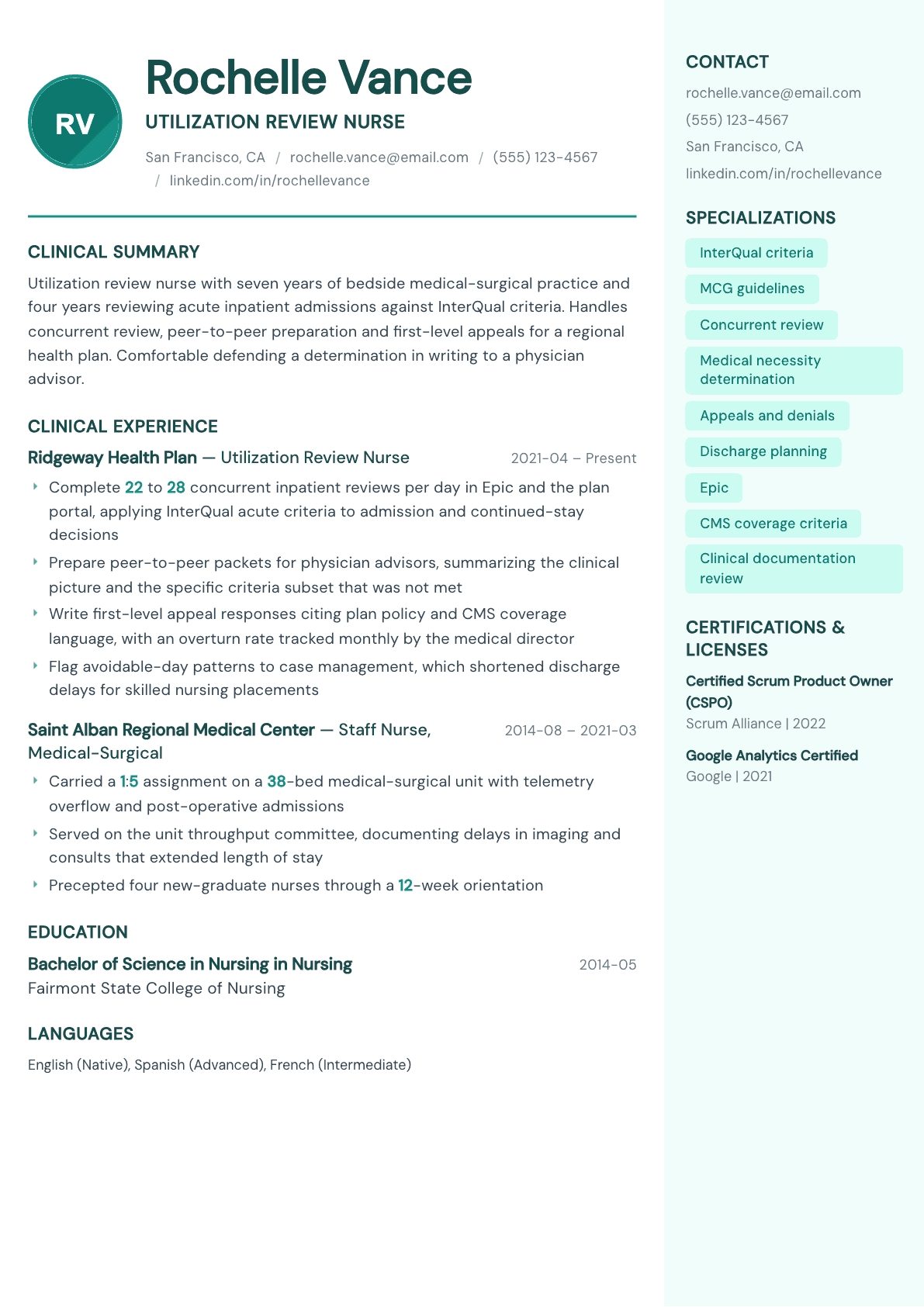
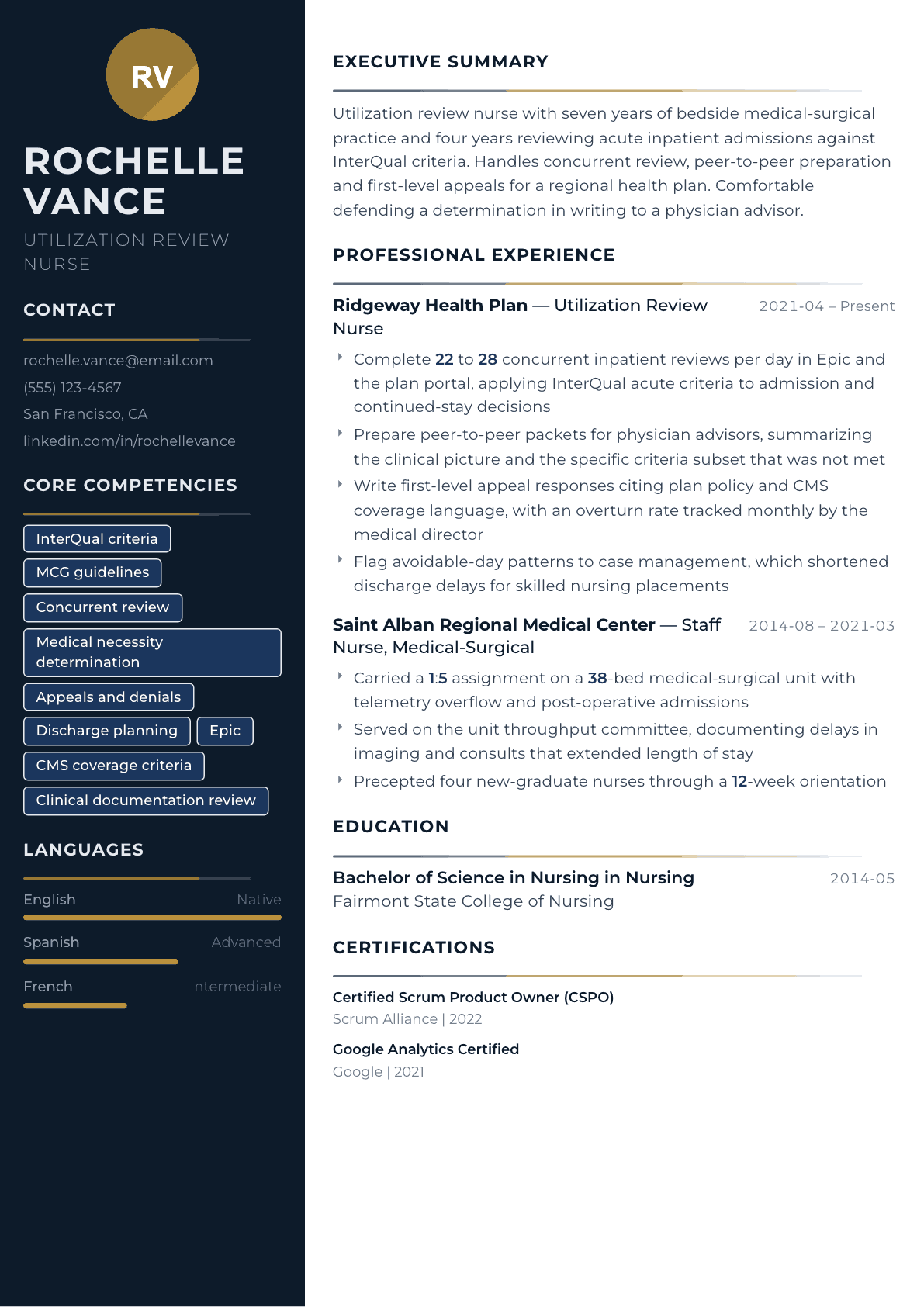
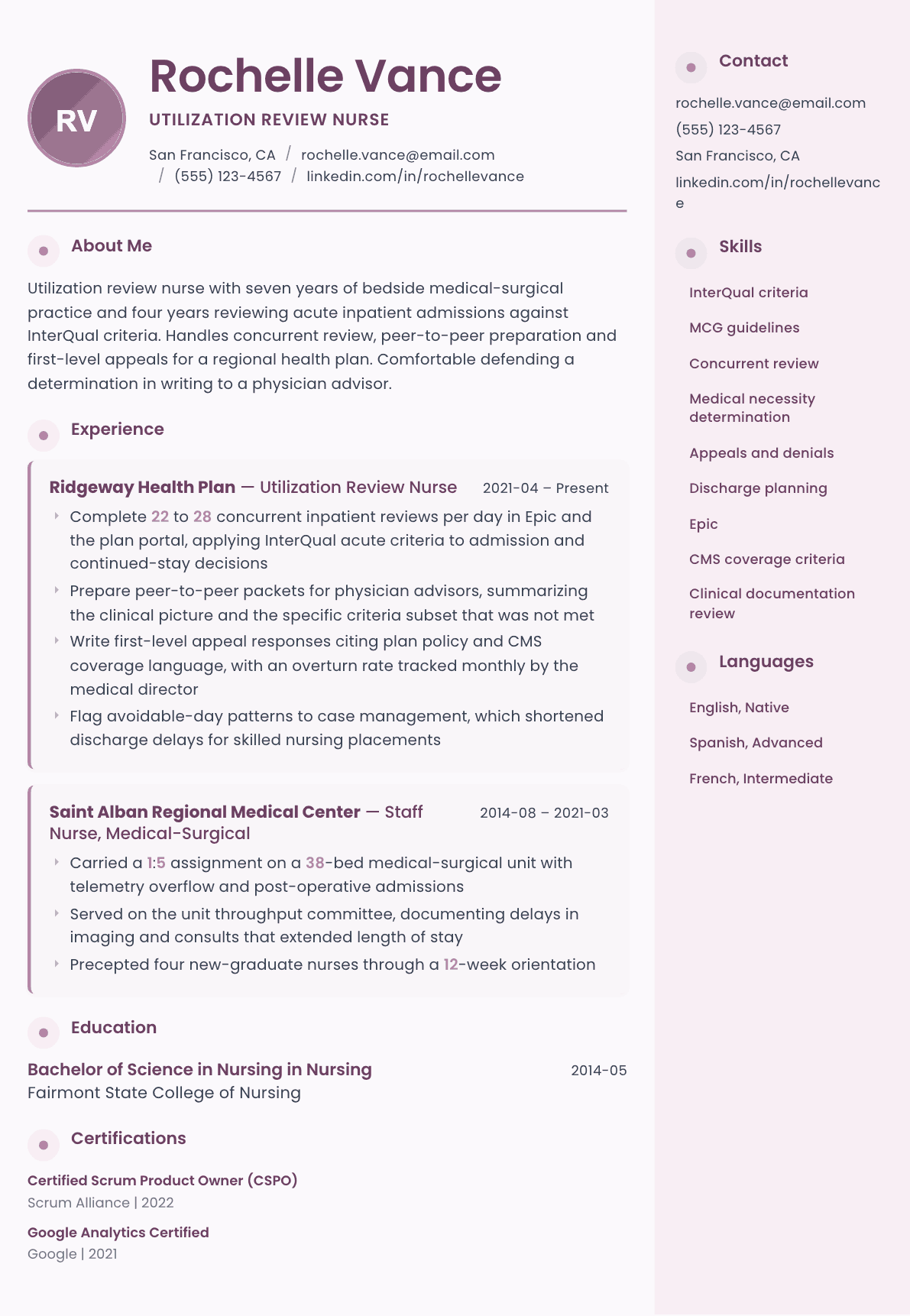
Example Utilization Review Nurse summary
Registered nurse with eleven years of clinical practice and four years of utilization review for a regional health plan. Applies InterQual acute criteria to inpatient admission and continued-stay decisions, prepares peer-to-peer referrals, and writes first-level appeal responses grounded in plan policy. Seeking a remote utilization review role covering multi-state commercial and Medicare Advantage membership.
Skills to list on a Utilization Review Nurse resume
- InterQual criteria
- MCG guidelines
- Concurrent review
- Prior authorization
- Medical necessity determination
- Appeals and denials
- Discharge planning
- Case management
- Clinical documentation review
- Epic
- Cerner
- CMS coverage criteria
- Length of stay analysis
- Peer-to-peer referral
- Managed care
What actually gets this resume read
- Name the criteria set you apply, InterQual or MCG, in the summary and again inside at least one experience bullet.
- State your daily review volume and the review type, admission, concurrent or retrospective, so a manager can size your throughput.
- Show the appeals side of the job separately from review, because many postings weight written appeal work heavily.
- List the payer systems and portals you have worked in alongside the hospital chart you read from, such as Epic or Cerner.
- Keep your bedside years visible with the unit and patient population; payers hire the clinical judgment, not just the desk skills.
- Mirror the posting language on setting, whether that is health plan, acute hospital, workers compensation or managed care.
- Add the states your compact or single-state license covers, since remote review roles are filtered on license reach.
How to write a utilization review nurse resume
A utilization review nurse resume is screened by people who never watch you at a bedside. The hiring manager at a health plan wants to know which criteria set you apply, how many reviews you close in a day, and whether your written determinations survive a physician advisor reading them. The hospital utilization management director wants the same evidence pointed the other way: can you defend a status decision to a payer without losing the day.
That is why a resume built out of general nursing language stalls here. Bullets about patient care and compassion are true and irrelevant. The reader is scanning for InterQual or MCG, for admission versus continued stay versus retrospective review, for denial and appeal work, and for the electronic health record and payer portals you have actually opened.
This guide covers the section order utilization management leaders expect, three summaries for different stages of the move from bedside to desk, before and after bullets drawn from real review work, and the questions nurses ask when they make this transition.
Format: license first, criteria set second, then the reviews
Keep the resume reverse-chronological and keep it to two pages once you have both bedside and review history. The header carries your name, credentials, city and state, and the states your license covers, because remote review roles are filtered on license reach before anything else is read.
Directly under the summary, put a short block naming the criteria sets, systems and review types you work in. A screener who has to hunt through three jobs for the word InterQual will often stop hunting.
- Header: name, RN credentials, contact, license states and compact status.
- Then: summary, criteria and systems block, utilization review experience, clinical experience, education, certifications.
- Nurses new to review keep the clinical section fuller and add a line on why the specialty maps to the payer population.
Summary: setting, criteria, review type, volume
Four lines at most. Name the setting, health plan, hospital, third party administrator or workers compensation carrier, then the criteria set, the review types you own, and your clinical background. A summary that opens with dedication and attention to detail wastes the only lines a busy reader gives you.
If you are moving off the floor for the first time, say so plainly and anchor it in the clinical population that matches the job. A cardiac step-down nurse applying to a plan with heavy cardiac membership should make that connection in writing rather than hope the reader draws it.
Experience: the review is the unit of work
Each review role needs the setting, the membership or facility type, and the daily volume. A line such as commercial and Medicare Advantage membership, acute inpatient concurrent review, 22 to 28 cases per day tells the manager your throughput and your product knowledge in one read.
Then build bullets around the parts of the job that carry risk: applying criteria to a case that does not clearly meet, escalating to a physician advisor, preparing the peer-to-peer packet, writing the denial letter, and handling the appeal that comes back. Managers hire for the judgment at the edge of criteria, not for the easy approvals.
For bedside jobs, keep the unit, bed count and ratio, and then choose the bullets closest to review work: throughput committees, documentation improvement, discharge planning, avoidable day tracking, and any interaction you had with payers or case managers.
Criteria, systems and regulatory language
Be exact. InterQual and MCG are different products with different structures, and a manager will notice if you write the wrong one for a plan that uses the other. Say which subsets you apply, such as acute adult, acute pediatric, or post-acute, and say whether you are certified in the criteria set.
Name the systems: the hospital chart you read from, the utilization management platform you document in, and the payer portals you submit through. Add the regulatory frame you work inside, whether that is Medicare coverage criteria, state Medicaid rules, or accreditation standards from an organization such as NCQA or URAC.
Certifications and the keywords the screener searches
Give certifications their own section with the issuing body and keep the license line accurate. Case management and health care quality credentials both read as evidence in this specialty, and the criteria vendor certifications count as well.
Then mirror the posting once in the summary and once in a bullet. Postings for this role reuse a small vocabulary: medical necessity, level of care, admission status, continued stay, avoidable days, discharge barriers, appeals, denials, peer-to-peer, prior authorization, and length of stay. Use the version the posting uses rather than a synonym you prefer.
Utilization Review Nurse resume summary examples
First move off the floor
Medical-surgical RN with six years on a 38-bed unit and two years on the hospital throughput committee documenting discharge delays and avoidable days. Trained in InterQual acute criteria and Epic charting. Seeking a first utilization review position with an acute care hospital.
Three years reviewing
Utilization review nurse with three years of concurrent inpatient review for a commercial and Medicare Advantage population, closing 22 to 28 cases daily against InterQual acute criteria. Prepares peer-to-peer packets and writes first-level appeal responses. Nine years of prior medical-surgical and telemetry practice.
Utilization management lead
Utilization management lead with seven years of review experience and three supervising a remote team of nine nurses across four states. Owns criteria training, inter-rater reliability audits and the appeals queue, and represents the plan in regulatory audits. Certified case manager with twelve years of prior acute care nursing.
Work experience bullets: before and after
Before: Reviewed patient charts for medical necessity.
After: Completed 22 to 28 concurrent inpatient reviews daily against InterQual acute criteria, covering admission status and continued stay for a commercial and Medicare Advantage membership.
Volume, criteria set, review type and population turn a generic verb into a measurable workload.
Before: Worked with doctors on cases that did not meet criteria.
After: Prepared peer-to-peer referral packets for physician advisors, summarizing the clinical picture and naming the exact criteria subset that was unmet, and tracked the outcome of each referral.
It shows the escalation process and the written product rather than an unspecific interaction.
Before: Handled appeals and denials.
After: Wrote first-level appeal determinations citing plan medical policy and Medicare coverage language, with overturn results reviewed monthly by the medical director.
Naming the policy sources and the review loop proves the writing stands up to scrutiny.
Before: Helped reduce length of stay.
After: Tracked avoidable days by reason code and reported skilled nursing placement delays to case management weekly, which shortened the discharge backlog on two units.
A mechanism and a reporting rhythm make an outcome believable where a bare claim does not.
Before: Trained new nurses on the review process.
After: Onboarded four new review nurses through a six-week criteria training plan and ran quarterly inter-rater reliability audits on their completed determinations.
The audit detail shows quality ownership, not just an informal hand-holding period.
Hard skills
- InterQual criteria application
- MCG guideline application
- Concurrent and admission review
- Retrospective review
- Prior authorization
- Appeals and denial letters
- Peer-to-peer referral preparation
- Discharge planning and avoidable day tracking
- Medicare and Medicaid coverage criteria
- Epic and Cerner chart review
- Utilization management platforms
- Inter-rater reliability auditing
Soft skills
- Written clinical reasoning
- Working independently at volume
- Physician communication
- Boundary setting under pressure
- Documentation discipline
- Cross-team coordination
Certifications worth listing
- Certified Case Manager (CCM) (Commission for Case Manager Certification)
- Accredited Case Manager (ACM-RN) (American Case Management Association)
- Certified Professional in Healthcare Quality (CPHQ) (National Association for Healthcare Quality)
- Health Care Quality and Management Certification (HCQM) (American Board of Quality Assurance and Utilization Review Physicians)
- Nursing Case Management Certification (CMGT-BC) (American Nurses Credentialing Center)
Mistakes that cost utilization review nurse candidates the interview
- Writing the resume as a bedside resume with one review job tacked on, so the reader never finds the criteria set.
- Saying you use evidence based criteria without naming InterQual or MCG, which is the exact term the screener searches.
- Leaving out daily review volume, which is the closest thing this role has to a productivity standard.
- Hiding appeal and denial writing inside a general bullet when many postings weight written appeals most heavily.
- Omitting the license states or compact status on an application for a remote multi-state review position.
- Claiming length of stay reductions with no mechanism, since a utilization manager will ask how in the first interview.
Utilization Review Nurse resume questions
Can I move into utilization review without prior payer experience?
Yes, and most reviewers come from the floor. Lead with the clinical population that matches the employer, name any criteria training you completed, and pull forward committee work on throughput, discharge planning or documentation improvement that shows you already think about level of care.
Should I list InterQual and MCG if I only used one?
List only the one you used, and say which subsets you applied. Claiming both is easy to test in an interview, and a manager who uses the other product would rather train an honest reviewer than correct an inflated resume in week two.
How long should a utilization review nurse resume be?
Two pages once you hold both clinical and review history. Give the review roles the fuller treatment and compress older bedside jobs to the unit, the ratio and two bullets that connect to level of care decisions or discharge barriers.
What do I put on the resume for a remote review role?
Name every state your license covers and whether you hold a compact license, confirm you have a private home workspace, and show evidence of independent volume such as daily case counts and audit results. Remote hiring managers screen hardest on autonomy.
Do certifications actually help for utilization review positions?
They help most when the posting names one. Case management and health care quality credentials from recognized bodies signal that you understand level of care and quality frameworks beyond your own hospital, and they often break a tie between two candidates with similar review volume.