Nurse Resume Examples: what a hiring manager reads first
Build a Nurse Resume That Opens Doors in Healthcare
By Mustafa Tarabya, founder of CVBooster · Published · Updated
Create a professional nursing resume with clinical skills, certifications, and patient care metrics that impress nurse recruiters.
Sample resumes for a nurse
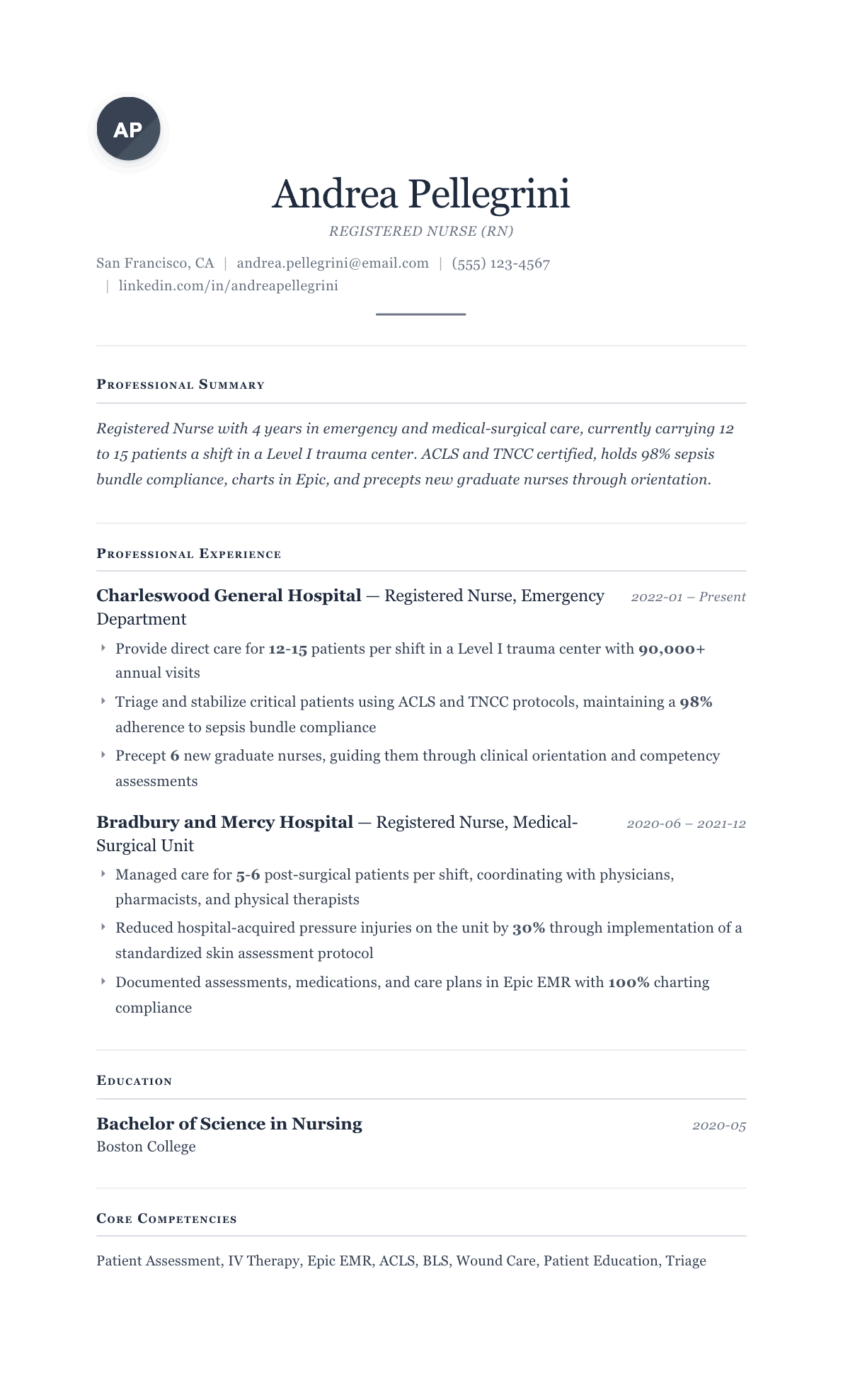
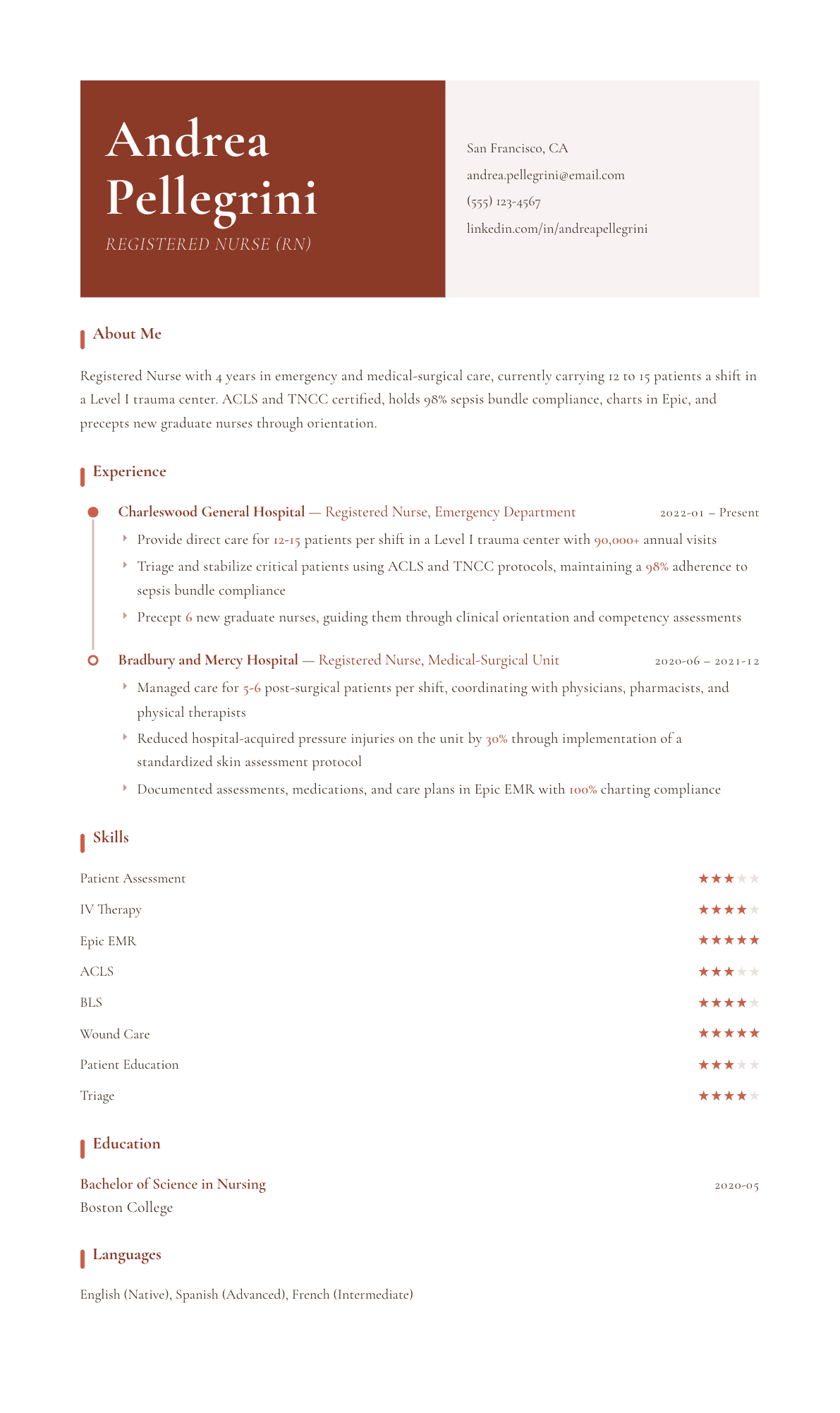
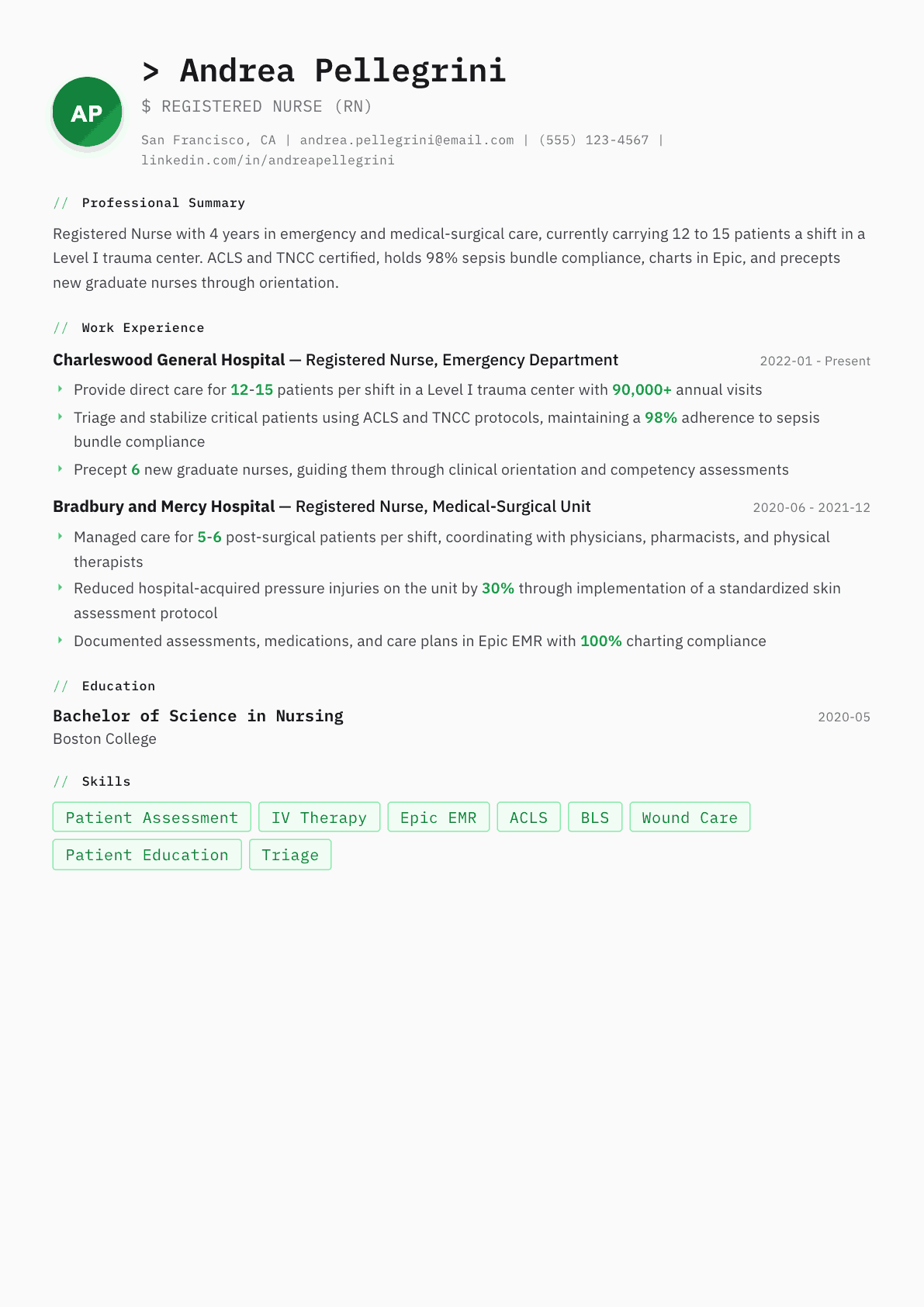
The same nurse content laid out in three CVBooster templates, so you can see what the finished document looks like before you write a word.
Example Nurse summary
Emergency department RN, 4 years, 12 to 15 patients a shift in a trauma center taking 90,000 visits a year. ACLS, BLS and TNCC certified, charts in Epic, and cut unit pressure injuries 30% on a medical-surgical floor by standardizing skin assessment. Has precepted six new graduates.
Skills to list on a Nurse resume
- Patient Assessment
- IV Therapy
- Medication Administration
- Epic EMR
- Cerner
- ACLS
- BLS
- PALS
- Wound Care
- Patient Education
- Triage
- Care Coordination
- Infection Control
- Charge Nurse
- Critical Thinking
What actually gets this resume read
- List all active licenses and certifications (RN, BLS, ACLS, PALS, TNCC) with expiration dates prominently.
- Quantify your patient load, unit size, and any quality metrics like infection rates or patient satisfaction scores.
- Mention specific EMR systems (Epic, Cerner, Meditech) because recruiters often filter by EMR experience.
- Highlight specialty experience clearly: ED, ICU, OR, L&D, or Pediatrics recruiters scan for these keywords.
- Include precepting, charge nurse duties, or committee work to show leadership potential.
- Keep formatting simple and clean; fancy designs can confuse healthcare ATS platforms.
How to write a nurse resume
A nurse resume is read by two people who want different things. The recruiter in HR runs it through an applicant tracking system and scans for the unit, the license, the certifications and the dates. The nurse manager who interviews you reads the experience section to work out whether you can carry a full patient load on her floor from week one. A resume that satisfies only one of them stalls.
The fix is not more words. It is putting the license and certifications where the ATS finds them, naming the unit and patient population in every job, and writing bullets that show clinical judgment rather than a list of tasks every nurse performs.
This guide walks through each section in the order a hiring manager reads it, with example summaries for a new graduate, a five-year nurse and a charge nurse, before-and-after bullets, and the questions nurses ask most when they sit down to write.
Format: one page for under five years, two pages after that
Use reverse-chronological order. Nursing hiring is credential-driven, so a functional resume that hides dates reads as if something is being hidden. Keep margins at a normal width, one clean font, and no columns inside the experience section, because many hospital ATS parsers read columns out of order.
Put your credentials after your name in the header, in the standard order: highest degree, then licensure, then certifications. "Maria Lopez, BSN, RN, CCRN" tells a screener in one line what took the rest of the resume to prove.
- Header: name, credentials, city and state, phone, email, and the state of your RN license.
- Sections in this order: summary, licenses and certifications, clinical experience, education, skills.
- New graduates move education above experience and add a clinical rotations section.
Summary: unit, years, population, one thing you are known for
Three lines, no more. Name the specialty and the setting, the years, the patient population, and one specific strength that the job posting asked for. A summary that says "compassionate and dedicated nurse" describes every applicant in the pile and therefore none of them.
If you are changing specialties, say so in the summary and name the transferable part. A med-surg nurse moving to the ICU should say "med-surg RN with two years of step-down experience and current ACLS, moving into critical care" rather than hoping the reader connects the dots.
Experience: the unit, the ratio, and what you handled
Every job needs the hospital or facility, the unit, the bed count or patient ratio, and the population. "Staff RN, 32-bed medical-surgical unit, 1:5 ratio, adult and geriatric" is the line a nurse manager reads first because it tells her exactly what you have carried.
Then three to five bullets. Lead with the clinical work that separates this unit from others: titrating drips, managing ventilated patients, running codes, wound care, chemotherapy administration, telemetry interpretation. Add one bullet on something beyond bedside care if you have it: precepting, charge shifts, a committee, a unit project.
Skip the bullets that describe nursing itself. "Provided patient care" and "administered medications" are true of every nurse on earth and take up the space a real bullet needs.
Licenses and certifications: their own section, near the top
List the license type, the state, and the expiry, then each certification with its issuing body. BLS and ACLS are expected in most acute settings, so list them but do not lead with them. Specialty certifications such as CCRN, CEN, PCCN or OCN are the ones that move a resume up the pile, because they prove the specialty knowledge the posting asks for.
If you hold a compact license, say "Nurse Licensure Compact" and the home state. Hospitals in compact states filter on it.
Skills: clinical first, systems second
A skills section for a nurse is a keyword section for the ATS. Use the terms the posting uses. Name the electronic health record you have charted in (Epic, Cerner, Meditech), the equipment (infusion pumps, telemetry, ventilators, CRRT), and the procedures. Soft skills belong in the experience bullets where they are shown, not in a list where they are only claimed.
Keywords the ATS is scanning for
Hospital postings are written from a job description template, so the same phrases recur: patient assessment, care planning, medication administration, patient education, interdisciplinary collaboration, infection control, the unit name, and the certifications. Mirror the exact wording once in the summary or skills and once in a bullet. Do not stuff them into a block; a human reads the resume right after the software does.
Nurse resume summary examples
New graduate
BSN graduate and newly licensed RN with 700 clinical hours across medical-surgical, pediatrics and a 180-hour capstone in a Level II emergency department. BLS and ACLS certified, Epic trained, and seeking a residency position in acute care.
Five years in
Medical-surgical RN with five years in a 36-bed unit, telemetry and step-down experience, and PCCN certification. Preceptor for six new graduates and the unit lead on a fall-reduction project. Looking to move into progressive care.
Charge nurse
Charge nurse and CCRN with eleven years in adult critical care, the last four running a 20-bed ICU night shift: staffing, bed flow, rapid response and mentoring. Experienced with CRRT, IABP and post-cardiac-surgery recovery.
Work experience bullets: before and after
Before: Responsible for patient care on a busy medical-surgical unit.
After: Carried a 1:5 assignment on a 32-bed medical-surgical unit, managing post-operative, diabetic and cardiac patients across 12-hour shifts.
The ratio, bed count and patient mix tell a manager what you can carry; "busy" tells her nothing.
Before: Administered medications and IV therapy.
After: Titrated heparin, insulin and vasoactive drips per protocol and started peripheral IVs on a unit with no IV team.
Naming the drips and the no-IV-team detail shows judgment and independence rather than a routine task.
Before: Helped train new nurses.
After: Precepted six new-graduate RNs over two years through a 12-week orientation, all six retained past their first year.
Numbers and an outcome turn a vague claim into evidence of leadership.
Before: Participated in quality improvement.
After: Led the unit fall-reduction workgroup: introduced hourly rounding and bed-alarm checks, and presented results to the nursing quality council.
The reader sees what you did and where it was heard, not that a committee existed.
Before: Good communication with patients and families.
After: Delivered discharge teaching for heart-failure patients using teach-back, and documented understanding in Epic before release.
A soft skill is only believable when it is attached to a concrete practice.
Hard skills
- Patient assessment
- Medication administration
- IV therapy and infusion pumps
- Telemetry interpretation
- Wound care
- Care planning
- Epic
- Cerner
- Infection control
- Patient education
- Rapid response
- Ventilator management
Soft skills
- Prioritization under load
- Handoff communication
- Family communication
- Precepting
- Escalation judgment
- Team coordination
Certifications worth listing
- Basic Life Support (BLS) (American Heart Association)
- Advanced Cardiovascular Life Support (ACLS) (American Heart Association)
- Pediatric Advanced Life Support (PALS) (American Heart Association)
- CCRN (Acute/Critical Care Nursing) (American Association of Critical-Care Nurses)
- PCCN (Progressive Care Nursing) (American Association of Critical-Care Nurses)
- Certified Emergency Nurse (CEN) (Board of Certification for Emergency Nursing)
- Medical-Surgical Nursing Certification (MEDSURG-BC) (American Nurses Credentialing Center)
Mistakes that cost nurse candidates the interview
- Leaving the license state and expiry off the resume, which forces the recruiter to ask and slows the file down.
- Describing nursing instead of your nursing: "provided compassionate care" is on every resume in the stack.
- Omitting the unit, bed count and ratio, so a manager cannot tell an outpatient clinic from a trauma ICU.
- Listing BLS as the headline certification while burying the CCRN or CEN that the posting actually asked for.
- Using a two-column template with icons; hospital ATS parsers often read the columns out of order and drop the dates.
- Sending the same resume to a NICU posting and a med-surg posting. Swap the summary and the first bullet for each.
Nurse resume questions
How long should a nurse resume be?
One page for a new graduate or a nurse with fewer than five years. Two pages is normal after that, especially with multiple units, certifications and precepting or charge experience. Never three.
Should I list clinical rotations on a nursing resume?
Yes if you graduated within the last two years and have no RN work history. Give each rotation the facility, the unit, the hours and one line on what you did. Drop them once you have a year of paid nursing experience.
Where do RN credentials go?
After your name in the header, in the order degree, license, certification: "Jane Kim, BSN, RN, CEN". Then repeat the license and certifications in full, with states and expiry dates, in their own section near the top.
Do I need a separate skills section?
Yes, because that is where the ATS finds the keywords. Keep it to clinical skills, equipment and charting systems. Put soft skills into the experience bullets where they are demonstrated.
How do I write a nursing resume for a specialty change?
State the move in the summary, name the transferable experience, and lead each job with the bullets closest to the new specialty. A med-surg nurse aiming for the ED leads with rapid response calls, telemetry and high-acuity admissions, not routine discharge paperwork.