Nurse Manager Resume Examples: free ATS score and gap list
Write a Nurse Manager Resume That Reads Like a Leader
By Mustafa Tarabya, founder of CVBooster · Published · Updated
Nurse manager resume example plus nursing management resume examples for supervisors and directors: staffing, budget, quality and retention detail.
Sample resumes for a nurse manager
The same nurse manager content laid out in three CVBooster templates, so you can see what the finished document looks like before you write a word.
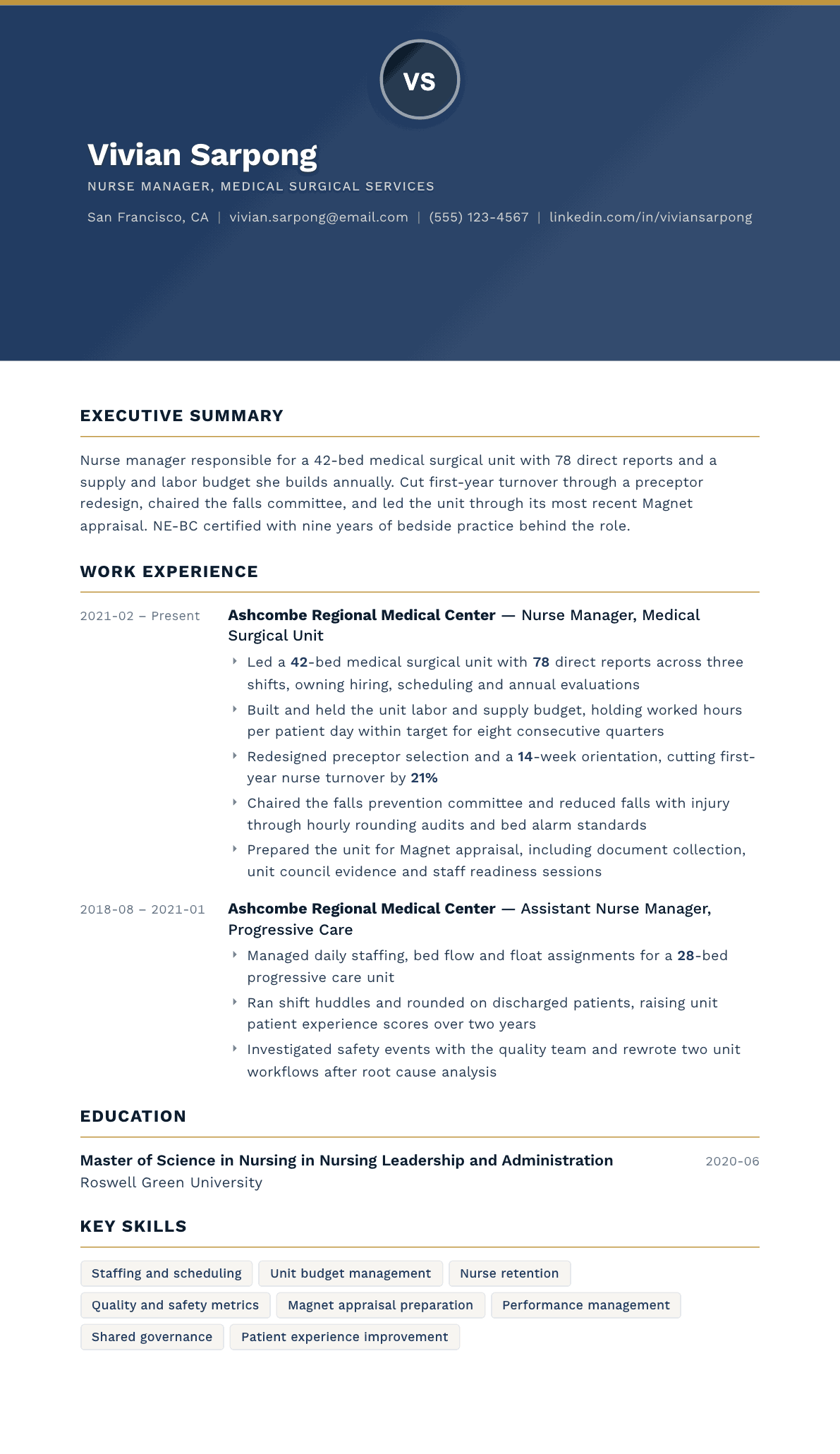
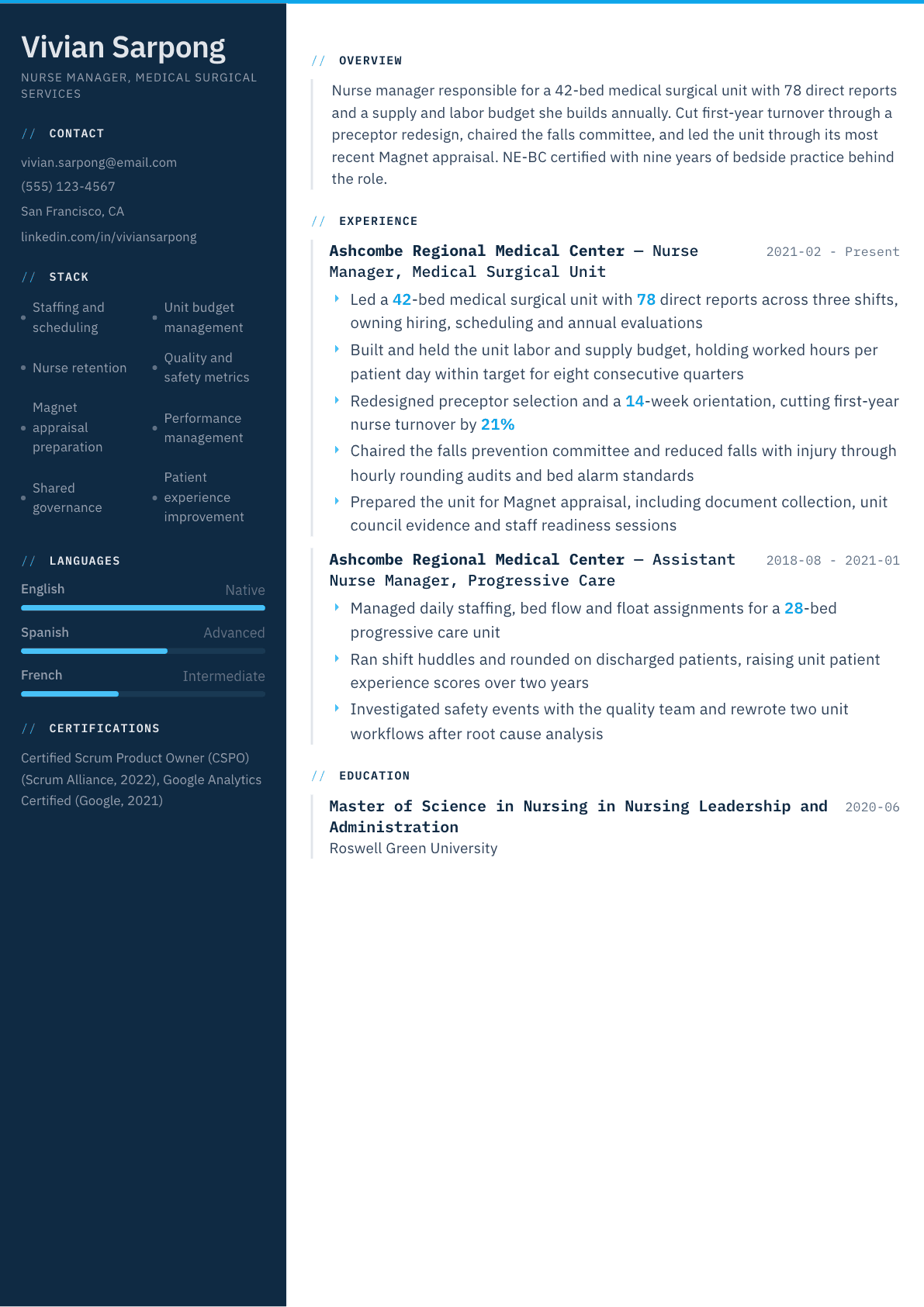
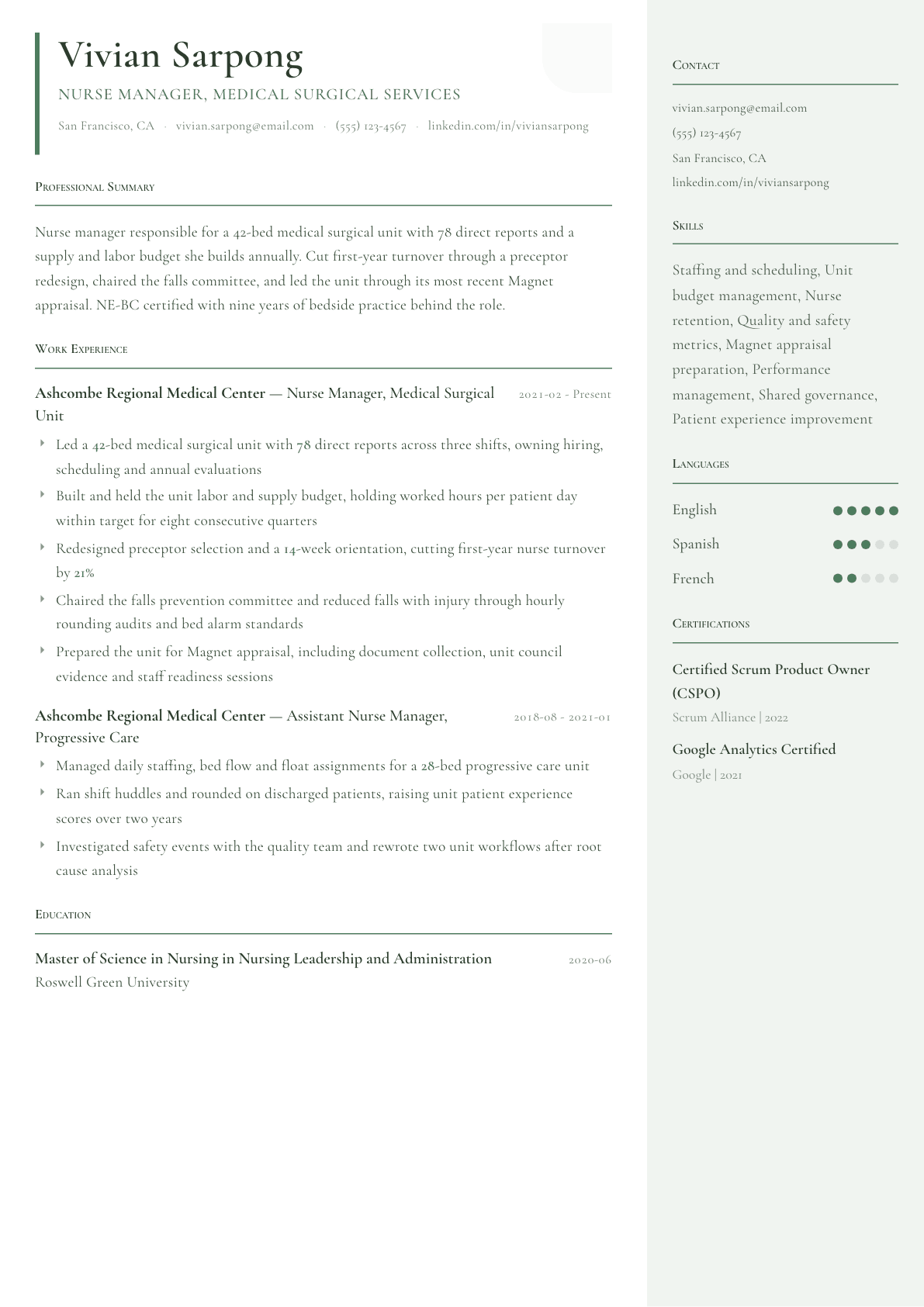
Example Nurse Manager summary
Nurse manager over a 42-bed medical surgical unit with 78 direct reports and full budget accountability. Redesigned preceptor selection and orientation to cut first-year turnover, chaired the falls committee, held worked hours per patient day inside target for two years, and led the unit through Magnet appraisal. NE-BC certified with nine bedside years behind the role. Seeking a director post over multiple units.
Skills to list on a Nurse Manager resume
- Staffing and scheduling
- Budget and productivity management
- Recruitment and retention
- Performance management
- Quality improvement
- Patient experience
- Shared governance and unit councils
- Magnet appraisal preparation
- Regulatory survey readiness
- Root cause analysis
- Labor relations and coaching
- Capacity and bed flow
- Policy development
- Interdisciplinary leadership
- Succession planning
What actually gets this resume read
- Lead every job with span of control: bed count, direct reports, shifts covered, and whether you own the budget.
- Give retention and vacancy results, because filling and holding a schedule is the core of the job.
- Name the quality measures you moved, such as falls with injury, pressure injuries, CLABSI, CAUTI or patient experience.
- Show budget literacy with the terms leaders use: worked hours per patient day, productivity targets, supply variance.
- Mention Magnet, Joint Commission or state survey preparation if you have led it, with your specific role in the work.
- Keep one short clinical block so a chief nursing officer can see the bedside years the leadership rests on.
How to write a nurse manager resume
A nurse manager resume is a leadership document that happens to sit in a clinical field, and most candidates write it as a clinical document that mentions leadership. The chief nursing officer or director reading it is hiring someone to hold a schedule, a budget and a group of people through a hard year. She reads for span of control, for the numbers you moved, and for whether you can keep nurses on a unit that other managers could not.
The clinical years still matter, but they matter as foundation rather than content. Two paragraphs of bedside bullets in a manager resume signal that the writer has not yet made the transition. One short clinical block, and the rest devoted to staffing, retention, quality, budget and regulatory readiness, signals that she has.
This guide covers the span-of-control line that opens every leadership job, the five categories of results a director looks for, how to write budget and quality bullets without inventing figures, which credentials carry weight in nursing leadership, and the questions charge nurses ask when they move into their first manager role. The same rules apply to any nursing management resume, from assistant nurse manager to nurse supervisor and director of nursing, because each one is screened on scope, staffing and results.
Format and header: lead with scope, not with a philosophy
Put your credentials after your name in the order degree, license, certification, then a licenses and certifications block with the RN license and state, nurse executive certification if you hold it, and life support cards. Skip the leadership philosophy statement, because every candidate has one and none of them differentiate.
Two pages is normal at this level and expected once you have multiple units, committee chairs and survey work. Keep it to one column so the parser does not lose your dates, and use the second page for education, certifications, committees and presentations rather than more bullets about the same unit.
- Name with credentials, city and state, phone, email.
- Certifications: license and state, NE-BC or CNML, quality or safety credentials.
- Order: summary, leadership experience, clinical foundation, education, certifications.
- Keep the bedside years to one compact block near the end.
Span of control: the first line of every leadership job
Open each role with the scope: bed count, number of direct reports, shifts covered, whether the unit runs around the clock, and whether you own the operating budget. "Nurse Manager, 42-bed medical surgical unit, 78 direct reports across three shifts, full labor and supply budget accountability" is the sentence a director looks for and rarely finds.
If you managed more than one unit, or held responsibility for a float pool, a procedure area or a service line, say so explicitly. Scope is the single strongest predictor of whether a candidate is ready for the next level, and vague wording gets read as a smaller job than you actually held.
Staffing and retention: the core of the job
Filling and holding a schedule is what a nurse manager is paid to do, so give it the most space. Write about hiring volume, vacancy rate movement, first-year turnover, orientation and preceptor design, self-scheduling implementation, float and cross-training agreements, and how you handled agency reliance.
Retention results are the most persuasive bullets available to you, and they should be attributed to a specific intervention. Redesigning preceptor selection, adding structured check-ins through the first year, or changing the shift pattern are all concrete actions a director can picture, and each one makes a turnover result believable.
Budget, productivity and quality: use the terms leaders use
Show budget literacy in the language of nursing operations: worked hours per patient day, productivity targets, overtime and premium pay control, supply variance, and capital requests. You do not need to publish dollar amounts to prove you can run a budget. Saying you built and held the unit budget and kept worked hours per patient day inside target for eight consecutive quarters is precise without disclosing anything.
For quality, name the measures you actually moved: falls with injury, hospital-acquired pressure injuries, catheter-associated urinary tract infections, central line infections, medication event reporting, patient experience scores and readmissions. Attach the intervention to each one, because a measure without a mechanism reads as a claim on someone else's work.
Regulatory readiness, governance and people development
Survey and appraisal work is a leadership differentiator. Joint Commission readiness, state survey response, plan of correction ownership, and Magnet appraisal document collection and staff preparation are all specific, verifiable projects, and you should say what your role in each one actually was rather than that the unit passed.
Then cover the people work that a director cannot see from the outside: shared governance and unit council structures, performance management and corrective action, succession planning for charge and assistant manager roles, and the number of staff you developed into new positions. A manager who has grown three charge nurses into assistant managers has proven the thing that is hardest to teach.
Nursing management resume examples: supervisor, manager, director
A nursing management resume changes emphasis with the title. A nurse supervisor or house supervisor resume leads with the shifts covered, the number of units under your watch, bed placement and how you handled staffing gaps and escalations after hours. A nurse manager resume leads with one unit, its people and its budget. A director of nursing resume leads with the number of units, total staff, the service line budget and the managers you hired and developed.
Use the exact title from the posting in your headline and summary, and keep your own job titles accurate in the experience section. If your role was called clinical manager, patient care manager or unit director, add a short scope line under it so a reader from another hospital system can see it matches the job they are filling.
Below are three nursing management resume examples written out as the top of the page: the headline, the scope line and two results bullets. The people and hospitals are invented, so replace each detail with your own units, staff and measures.
- House supervisor: Teresa Lind, RN, BSN, Nursing Supervisor, nights. Scope: 6 inpatient units and the emergency department, 210 beds, after-hours staffing and bed placement for the hospital. Results: built a night float pool that covered sick calls without agency staff on most weeks; led the overnight response for two internal disasters and wrote the debrief actions.
- Nurse manager: Andre Wallace, MSN, RN, Nurse Manager, 32-bed medical-surgical unit. Scope: 58 staff, 4 charge nurses, unit operating budget. Results: cut first-year RN turnover by rebuilding orientation around a named preceptor for every new graduate; brought the unit fall rate down after introducing hourly rounding and a bed alarm audit.
- Director of nursing: Priya Raman, DNP, RN, NE-BC, Director of Nursing, surgical services. Scope: 4 units, 5 nurse managers, more than 200 staff, service line budget. Results: opened a 12-bed surgical step-down unit, from staffing model to first patient; led the service line through a Joint Commission survey with no nursing findings.
Nurse Manager resume summary examples
First management role
Charge nurse and interim assistant manager on a 28-bed progressive care unit, covering daily staffing, bed flow and float assignments while completing a nursing leadership degree. Rebuilt the shift huddle format, investigated safety events with the quality team, and now seeking a first full nurse manager position.
Established unit manager
Nurse manager over a 42-bed medical surgical unit with 78 direct reports and full budget accountability. Redesigned preceptor selection and orientation to cut first-year turnover, chaired the falls committee, held worked hours per patient day inside target for two years, and led the unit through Magnet appraisal.
Director candidate
Nursing leader with responsibility for three inpatient units, a float pool and 210 staff across a community hospital. Consolidated orientation across the division, cut agency reliance through an internal float agreement, owned three consecutive regulatory surveys, and developed four charge nurses into assistant manager roles.
Work experience bullets: before and after
Before: Managed a busy medical surgical unit.
After: Led a 42-bed medical surgical unit with 78 direct reports across three shifts, owning hiring, scheduling, annual evaluations and the unit labor and supply budget.
Beds, reports, shifts and budget ownership define the job in one line, which the word busy never does.
Before: Worked on improving nurse retention.
After: Redesigned preceptor selection and rebuilt orientation into a fourteen-week structured program with monthly check-ins, cutting first-year nurse turnover by 21%.
The intervention is described before the result, so the improvement reads as something you caused rather than observed.
Before: Responsible for the unit budget.
After: Built and held the annual labor and supply budget, keeping worked hours per patient day within target for eight consecutive quarters while covering two extended leaves.
Operational vocabulary and a sustained result prove budget control without disclosing internal financial figures.
Before: Led quality improvement projects on the unit.
After: Chaired the falls prevention committee and reduced falls with injury through hourly rounding audits, a bed alarm standard and a post-fall huddle within one hour of every event.
Naming the specific interventions makes the quality outcome attributable and repeatable at a new hospital.
Before: Helped prepare the unit for accreditation.
After: Prepared the unit for Magnet appraisal, owning document collection, unit council evidence and staff readiness sessions ahead of the site visit.
Stating your specific deliverables separates real ownership from having worked somewhere during an appraisal year.
Hard skills
- Staffing and schedule management
- Labor and supply budget development
- Productivity and worked hours per patient day
- Recruitment, hiring and onboarding
- Retention and turnover analysis
- Quality and safety measure improvement
- Patient experience improvement
- Regulatory survey readiness
- Magnet appraisal preparation
- Root cause analysis and event review
- Performance management and corrective action
- Capacity and bed flow management
Soft skills
- Difficult conversations with staff
- Coaching charge nurses into leadership
- Negotiating with other departments
- Holding a standard when it is unpopular
- Transparent communication during change
- Physician and provider partnership
Certifications worth listing
- NE-BC (Nurse Executive) (American Nurses Credentialing Center)
- CNML (Certified Nurse Manager and Leader) (AONL Credentialing Center)
- CENP (Certified in Executive Nursing Practice) (AONL Credentialing Center)
- CPHQ (Certified Professional in Healthcare Quality) (National Association for Healthcare Quality)
- CPPS (Certified Professional in Patient Safety) (Institute for Healthcare Improvement)
Mistakes that cost nurse manager candidates the interview
- Writing a clinical resume with a manager title on top, so the reader never learns the span of control.
- Claiming quality results without naming the intervention, which reads as credit taken for the unit's work.
- Leaving out direct report counts and budget accountability, the two facts a director uses to size the role.
- Filling the page with bedside bullets that belong in a single compact clinical foundation block.
- Describing survey participation vaguely instead of naming what you personally owned in the preparation.
- Omitting people development, when growing charge nurses and assistant managers is the hardest thing to prove.
Nurse Manager resume questions
How do I move from charge nurse to nurse manager?
Rewrite your charge experience as operations: staffing decisions you made, bed flow you managed, events you investigated, and staff you coached. Then add any interim manager coverage, committee chair roles and leadership coursework, because those are what a director screens for.
Do I need a master's degree to be a nurse manager?
Many hospitals hire unit managers with a bachelor of science in nursing and require a graduate degree for director roles, though Magnet organizations often prefer it earlier. If you are enrolled, list the program and expected completion date in the education section.
How do I describe budget responsibility without sharing internal figures?
Use operational measures rather than dollar amounts: worked hours per patient day held inside target, overtime and premium pay reduced, supply variance closed, or a capital request approved. That language proves financial control and keeps your former employer's numbers private.
How much clinical detail belongs on a nurse manager resume?
One compact block listing your bedside roles, units and years, with a single line each. The reader needs to know the leadership rests on real practice, but every clinical bullet you add takes space from the staffing, budget and quality evidence that decides the hire.
What results should a nurse manager resume show?
Pick from five categories: vacancy and turnover, budget and productivity, a named quality measure, patient experience, and regulatory or appraisal readiness. Two solid results per category, each tied to an intervention you led, is stronger than a long list of committees you attended.