Healthcare Administrator Resume Examples: free ATS score
Create a Healthcare Administrator Resume That Leads
By Mustafa Tarabya, founder of CVBooster · Published · Updated
Build a compelling healthcare administration resume with management-focused templates, operational examples, and leadership tips.
Sample resumes for a healthcare administrator
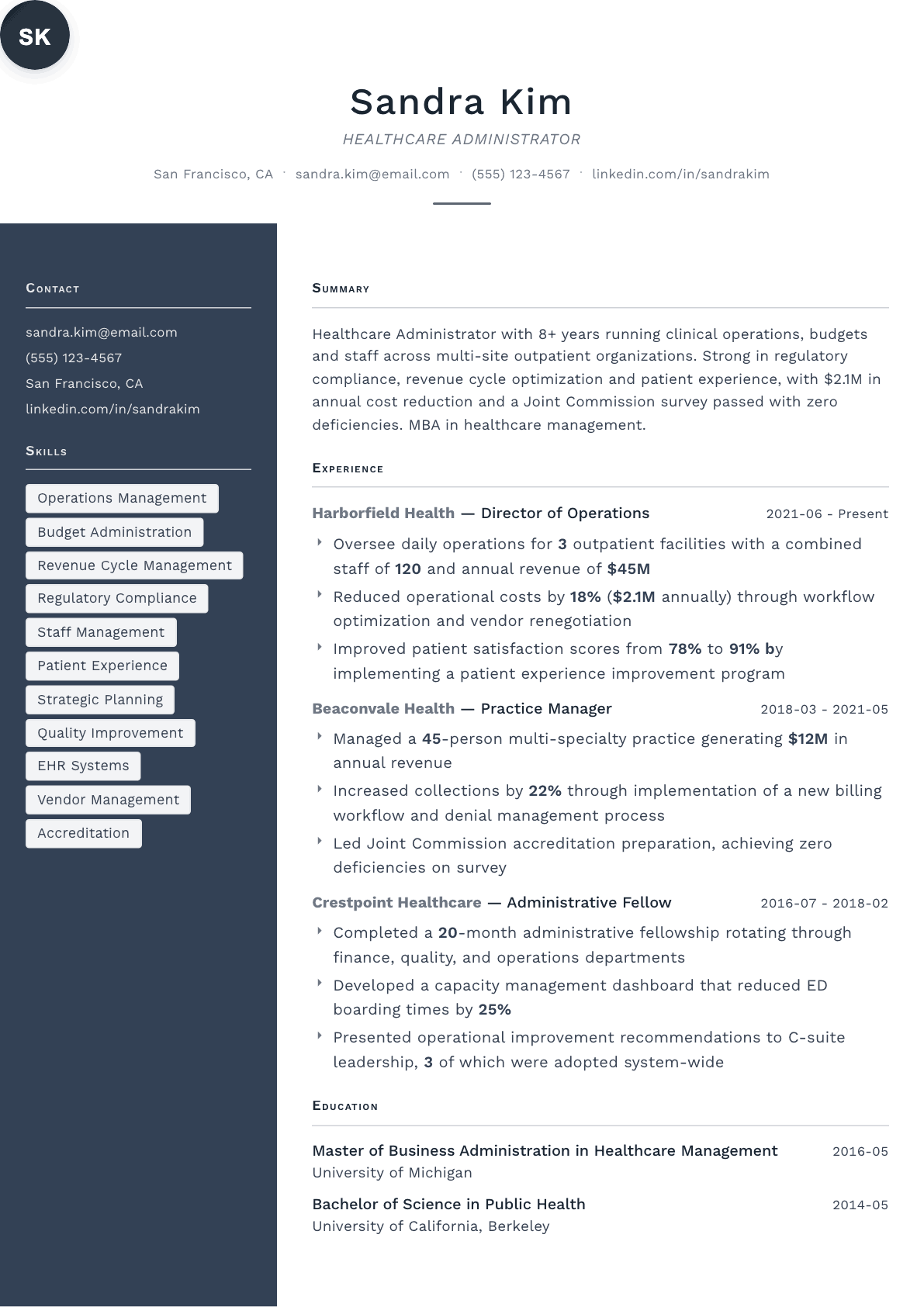
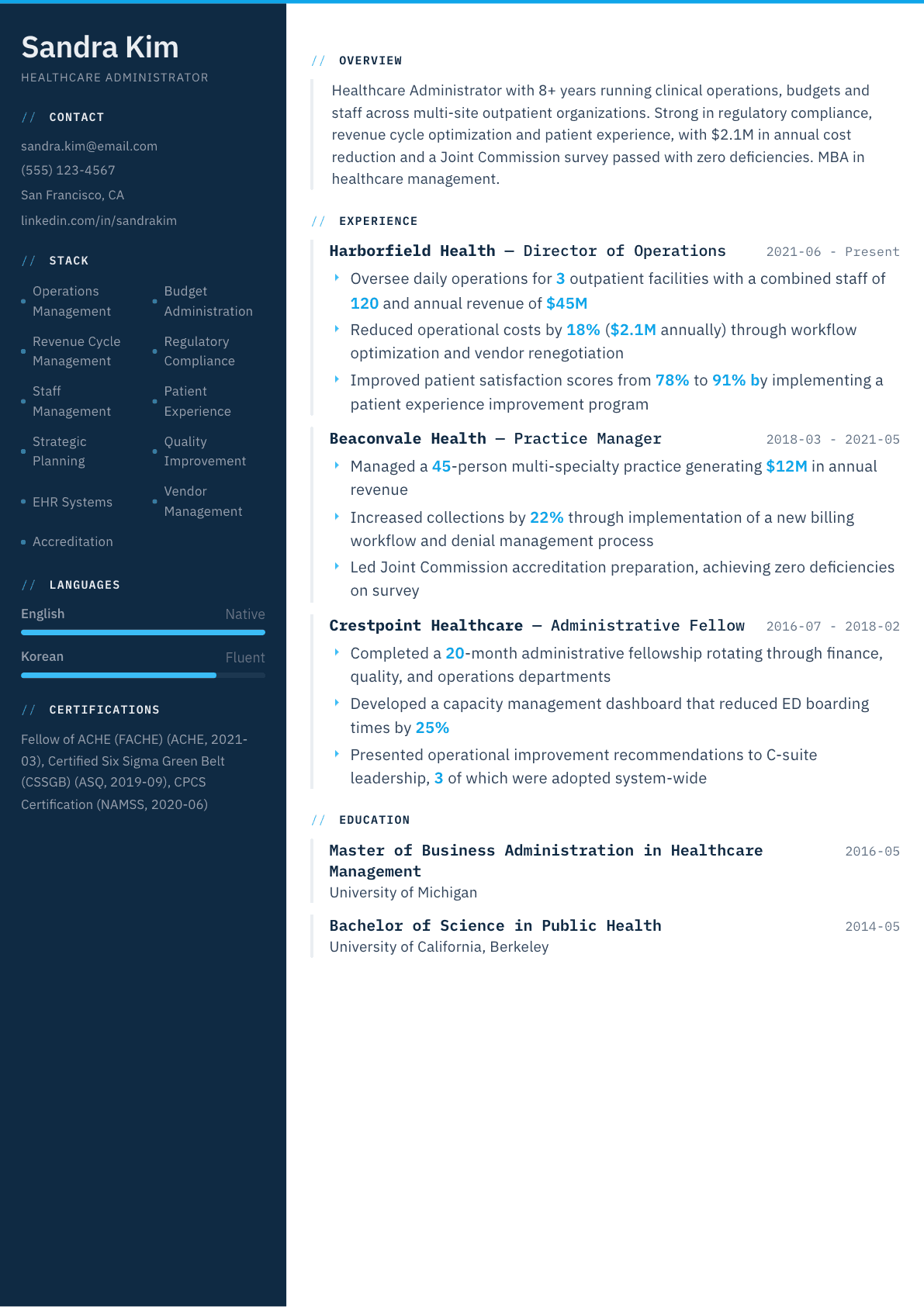
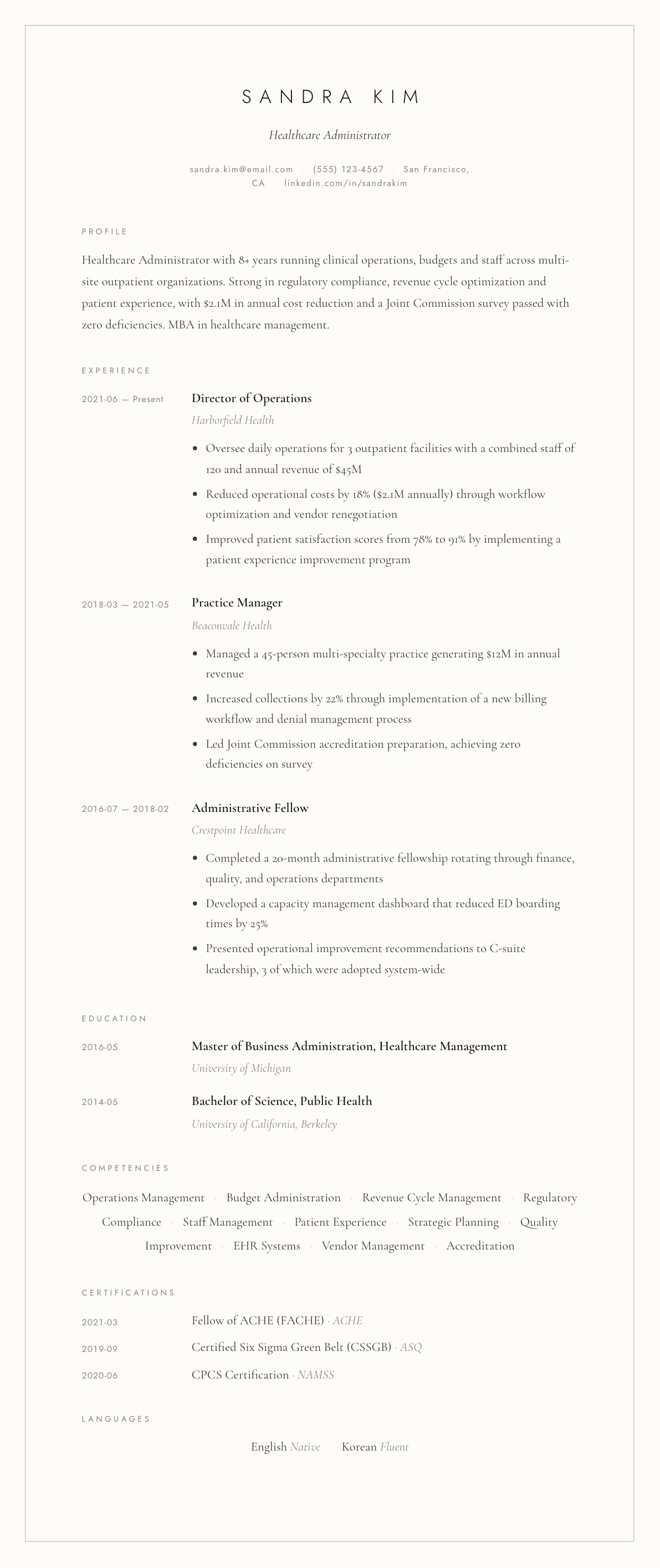
The same healthcare administrator content laid out in three CVBooster templates, so you can see what the finished document looks like before you write a word.
Example Healthcare Administrator summary
Healthcare Administrator with 8 years of experience managing multi-site clinical operations and $45M+ in annual revenue. FACHE-certified with a track record of reducing costs by 18% and improving patient satisfaction from 78% to 91%. Seeking a VP of Operations role in a growing health system.
Skills to list on a Healthcare Administrator resume
- Operations Management
- Budget Administration
- Revenue Cycle
- Regulatory Compliance
- Staff Management
- Patient Experience
- Strategic Planning
- Quality Improvement
- Change Management
- EHR Implementation
- Vendor Negotiation
- Accreditation
- Financial Analysis
- Process Improvement
- Stakeholder Relations
What actually gets this resume read
- Lead with financial impact: quantify revenue, cost savings, and budget sizes.
- Highlight regulatory and accreditation experience (Joint Commission, CMS, state).
- Include staff management scope with team sizes and direct reports.
- Show patient experience improvements with specific metric changes.
- List healthcare-specific certifications like FACHE or CPCS.
- Demonstrate strategic planning and C-suite presentation experience.
How to write a healthcare administrator resume
Healthcare administrator is a title stretched across very different jobs: practice manager for a single specialty group, director of operations for a set of ambulatory clinics, service line administrator inside a health system, and administrator of a skilled nursing or behavioral health facility. The first job of the resume is to say which of these you have done, because the reader is matching you to a span of control, not to a title.
Once that is clear, the evaluation is operational. How many sites, how many staff, how many providers, what was the visit or case volume, which regulatory bodies surveyed you, what did you do to access, cost per unit of service, revenue cycle performance and staff turnover. Administrators who write about leadership philosophy instead of these numbers get filtered out by readers who manage against a dashboard every week.
This guide sets out how to structure the file, how to size your scope so it is instantly readable, three summaries from a practice manager through to a system director, and rewrites of the vague operations bullets that appear on most healthcare administration resumes.
Format: a scope line under every job title
Reverse chronological, two pages once you have real management history. Under each title write a scope line before the bullets: number of sites, direct and indirect reports, providers supported, annual visit or case volume, and the departments in your remit. A reader can then compare your span of control against the open role in about five seconds.
Do not lead the resume with a philosophy statement. Lead with a summary that names setting, scope and the two or three operational levers you are strongest on, then let the scope lines carry the rest. Certifications and degree go in a compact block, since a masters in health administration or business and a professional fellowship are frequently screening criteria.
- Header: name with degree and any fellowship designation, city and state, phone, email.
- Order: summary, education and credentials, professional experience with scope lines, operational achievements, systems, board and community service.
- Administrative fellows and early career candidates give the rotations, the projects and the executive sponsors by function rather than by name.
Summary: setting, span of control, and your operating strengths
Three sentences. Name the care setting, the span you currently hold, and the levers you are known for: access and scheduling redesign, revenue cycle performance, provider productivity and compensation models, staffing and retention, regulatory readiness, or facility and service line growth.
Be exact about setting. Managing a twelve provider orthopedic practice is a different operating problem from running six primary care clinics inside a health system, which is different again from administering a skilled nursing facility with its own survey regime. Naming it prevents a mismatch that would surface in the first interview anyway.
Operations: access, throughput and productivity
The core of an ambulatory or practice administration resume is access. Third next available appointment, new patient wait time, template utilization, no show rate, cycle time in clinic, and provider schedule fill are the measures leaders live on. Say which you moved, what you changed to move them, and over what period.
Provider productivity is the other half. Work relative value units per provider, visits per session, panel size, and the compensation plan you administered or redesigned. Administrators who have negotiated or operated a productivity based compensation plan should say so plainly, since it is a skill many candidates lack.
Include staffing operations honestly: recruitment cycle time, vacancy and turnover rates, float pool or cross training design, and the ratios you staffed to. Turnover is the cost most healthcare operations leaders are asked about first.
Revenue cycle, budget and compliance
Write budget scope as headcount, sites and service volume rather than currency, so it reads consistently across markets and public and private employers. Then describe what you did to the cost structure: supply standardization, vendor consolidation, staffing model change, space utilization, or reduction in outsourced services.
Revenue cycle belongs in its own bullets: clean claim rate, denial rate and the denial categories you attacked, days in accounts receivable, point of service collections, prior authorization workflow, and coding and documentation improvement with the clinical teams. These are the numbers a chief operating officer will ask about in an interview.
Compliance and accreditation need naming rather than implying. Which surveys you prepared for and hosted, the outcome, any plans of correction you wrote, and the ongoing programs you own such as infection prevention, credentialing, privacy and security training, or licensure renewals.
Patient experience, projects and the keywords screeners use
Patient experience is measured through standardized survey instruments in most settings, so name the instrument, the domains you targeted and what changed. Access, communication with providers and staff courtesy are the domains most responsive to operational work, and saying which one you moved is more credible than a single overall score.
For project work, give the outcome and the constraint: a clinic opening with the square footage and provider count, a record conversion, a merger integration, a call center consolidation, or a service line launch. Mirror the vocabulary postings use: operations management, revenue cycle, regulatory compliance, patient access, provider relations, budget administration, quality improvement and staff development.
Healthcare Administrator resume summary examples
Practice manager
Practice manager for a nine provider multispecialty clinic with 24 staff and about 34 thousand annual visits. Rebuilt scheduling templates to cut third next available appointment from 19 days to 6, and moved point of service collections from 41% to 68% within one year.
Director of operations
Director of operations for six ambulatory clinics with 120 staff, 38 providers and 190 thousand annual visits. Owns access, staffing models, revenue cycle performance and regulatory readiness, and reduced clinical staff turnover from 31% to 18% over two years through a career ladder and float pool.
System service line administrator
Service line administrator with fifteen years in ambulatory and specialty operations, leading four directors across 21 sites, 640 staff and 145 providers. Built the access and productivity dashboard used by system leadership and integrated two acquired physician groups without a decrease in visit volume.
Work experience bullets: before and after
Before: Managed daily operations of multiple healthcare facilities.
After: Directed operations for six ambulatory clinics with 120 staff, 38 providers and 190 thousand annual visits, covering scheduling, staffing, supply, facilities and regulatory readiness.
Sites, headcount, provider count and volume define the span of control that a title alone leaves ambiguous.
Before: Improved patient access to care.
After: Redesigned provider templates and added a same day slot block, cutting third next available appointment from 19 days to 6 and lifting schedule fill to 92% across the group.
A named access measure with a before and after is the language ambulatory leaders use to evaluate each other.
Before: Worked to reduce costs across the department.
After: Standardized clinical supply to two vendors, consolidated three outsourced services in house and rebuilt the medical assistant staffing ratio, lowering cost per visit for two consecutive years.
Naming the specific levers shows how the savings were produced rather than asserting that they were.
Before: Oversaw billing and collections.
After: Rebuilt the denial workflow around the top four denial categories and added front desk eligibility checks, lifting clean claim rate to 96% and cutting days in accounts receivable from 52 to 34.
Revenue cycle claims need the mechanism and the standard metrics, since every administrator says they oversaw billing.
Before: Prepared the organization for accreditation surveys.
After: Led readiness for an accreditation survey across six sites, running mock tracers and closing 47 environment of care findings in advance, with the survey completed without a condition level deficiency.
The preparation method and the survey outcome make regulatory work verifiable instead of assumed.
Hard skills
- Ambulatory operations management
- Patient access and scheduling design
- Revenue cycle management
- Denial management
- Budget development and variance analysis
- Provider productivity and compensation models
- Staffing models and workforce planning
- Regulatory and accreditation readiness
- Credentialing and privileging oversight
- Vendor and contract management
- Quality and patient experience improvement
- Practice management and record systems
Soft skills
- Physician relationship management
- Difficult staffing conversations
- Cross functional negotiation
- Executive reporting
- Change leadership
- Coaching frontline supervisors
Certifications worth listing
- Fellow of the American College of Healthcare Executives (FACHE) (American College of Healthcare Executives)
- Certified Medical Practice Executive (CMPE) (American College of Medical Practice Executives)
- Fellow, American College of Medical Practice Executives (FACMPE) (American College of Medical Practice Executives)
- Certified Professional in Healthcare Quality (CPHQ) (National Association for Healthcare Quality)
- Certified Revenue Cycle Representative (CRCR) (Healthcare Financial Management Association)
- Certified Six Sigma Green Belt (CSSGB) (American Society for Quality)
Mistakes that cost healthcare administrator candidates the interview
- Writing a title with no scope line, leaving the reader to guess whether you managed eight people or eight hundred.
- Opening with a leadership philosophy paragraph when the reader is scanning for span of control and operating metrics.
- Describing operations generically instead of naming the access, productivity and revenue cycle measures you moved.
- Omitting turnover and vacancy figures, which are usually the first questions asked of an operations leader in interview.
- Treating accreditation as a passing mention rather than naming the survey, your role in readiness and the result.
- Blurring an ambulatory practice role with an inpatient facility role, when the operating problems and regulations differ substantially.
- Listing systems as a technology inventory without saying what you actually configured, reported on or converted.
Healthcare Administrator resume questions
How do I show budget responsibility without listing salary or revenue figures?
Describe scope through headcount, sites, providers supported and annual service volume, then explain what you changed in the cost structure: supply standardization, staffing model redesign, insourcing, space utilization or contract consolidation. That travels across markets better than any currency figure.
What metrics belong on a healthcare administrator resume?
Access measures such as third next available appointment and schedule fill, productivity measures such as work relative value units per provider, revenue cycle measures such as clean claim rate, denial rate and days in accounts receivable, plus turnover, vacancy rate and patient experience domain scores.
Is a masters degree necessary for healthcare administration roles?
A masters in health administration, public health or business is expected for system director and executive positions and often listed as required. Practice manager and clinic supervisor roles are commonly filled on operational track record plus a professional credential such as CMPE.
How should an administrative fellow write a first resume?
Structure the fellowship as rotations with the function, duration and a deliverable for each: a capacity analysis, a business case, a workflow redesign or an implementation. Give the sponsor by function rather than name, and state which recommendations were adopted and at what scale.
Should clinical experience stay on the resume after moving into administration?
Yes, but compressed. Two or three lines showing the clinical background give you credibility with physicians and staff, which is a genuine advantage in operations. Keep the detail proportionate so the current management scope still occupies most of the first page.