Cover Letter vs Personal Statement: 6 Side-by-Side Examples
By CVBooster Team · Published · Updated
8 min read
The difference between a cover letter vs a personal statement is the reader. A cover letter goes to an employer and argues that you can do one specific job. A personal statement goes to an admissions or selection committee and explains who you are, why you chose the field, and why their program fits. Same person, same facts, two different questions. Below are six complete examples, written in pairs by the same applicants, so you can see the switch in practice.
Sending a cover letter where a personal statement was asked for is like being asked why you want to study the subject and replying that you are available to start Monday. True. Also not the question.
The short answer in one table
| Cover letter | Personal statement | |
|---|---|---|
| Reader | Hiring manager or recruiter | Admissions, scholarship or selection committee |
| Question it answers | Can you do this job? | Why this field, why this program, why you? |
| Format | Business letter with greeting and sign-off | Essay, no greeting |
| Length | One page | Whatever the program sets, exactly |
| Content | Skills, results, fit with the role | Motivation, path, goals, fit with the program |
| Tone | Professional and direct | Reflective, still specific |
Pair 1: a biology graduate applies for a job and a master's program
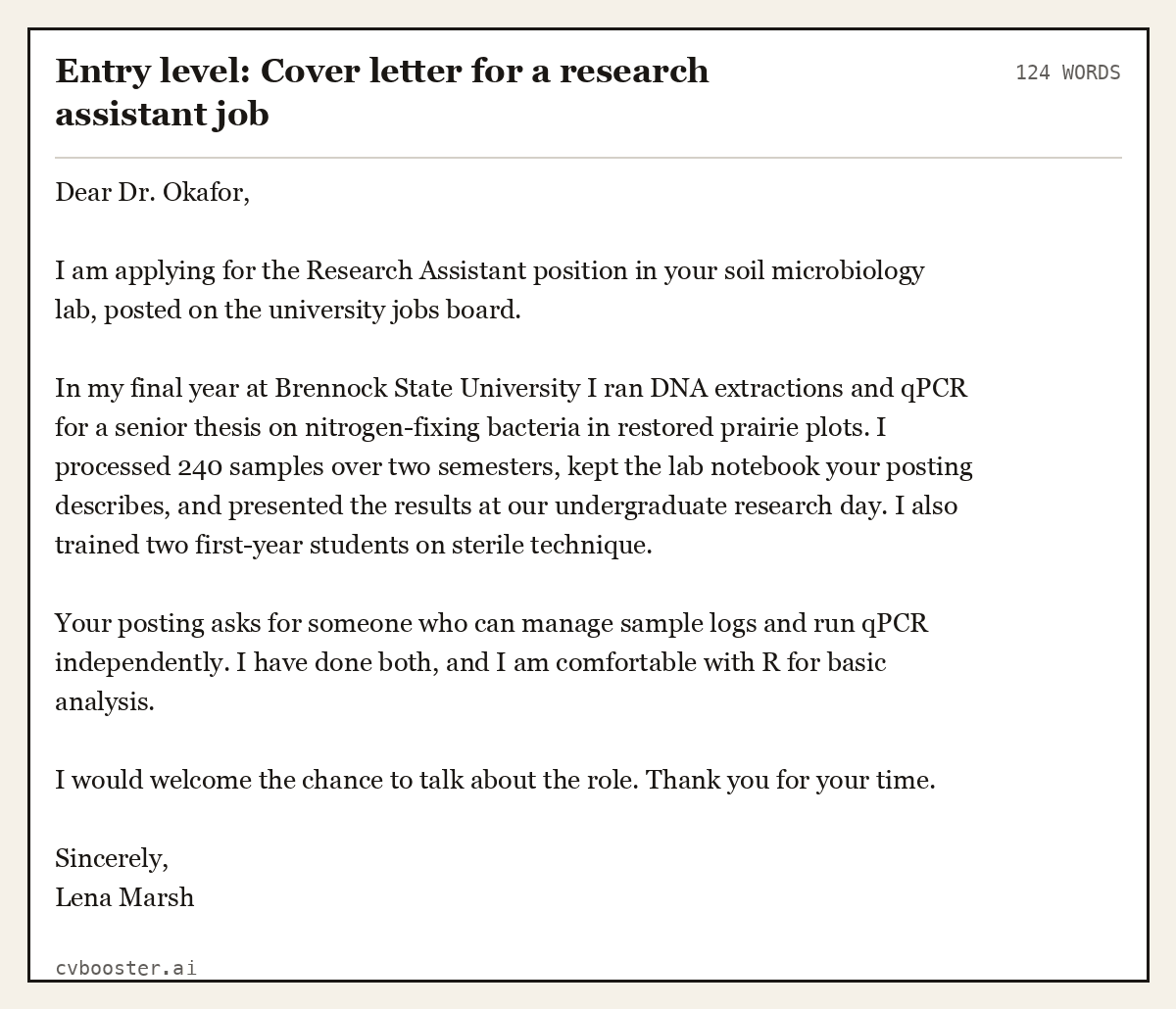
Entry level: Cover letter for a research assistant job (124 words)
Dear Dr. Okafor,
I am applying for the Research Assistant position in your soil microbiology lab, posted on the university jobs board.
In my final year at Brennock State University I ran DNA extractions and qPCR for a senior thesis on nitrogen-fixing bacteria in restored prairie plots. I processed 240 samples over two semesters, kept the lab notebook your posting describes, and presented the results at our undergraduate research day. I also trained two first-year students on sterile technique.
Your posting asks for someone who can manage sample logs and run qPCR independently. I have done both, and I am comfortable with R for basic analysis.
I would welcome the chance to talk about the role. Thank you for your time.
Sincerely, Lena Marsh
Create my CV
Or start from one of our free resume templates
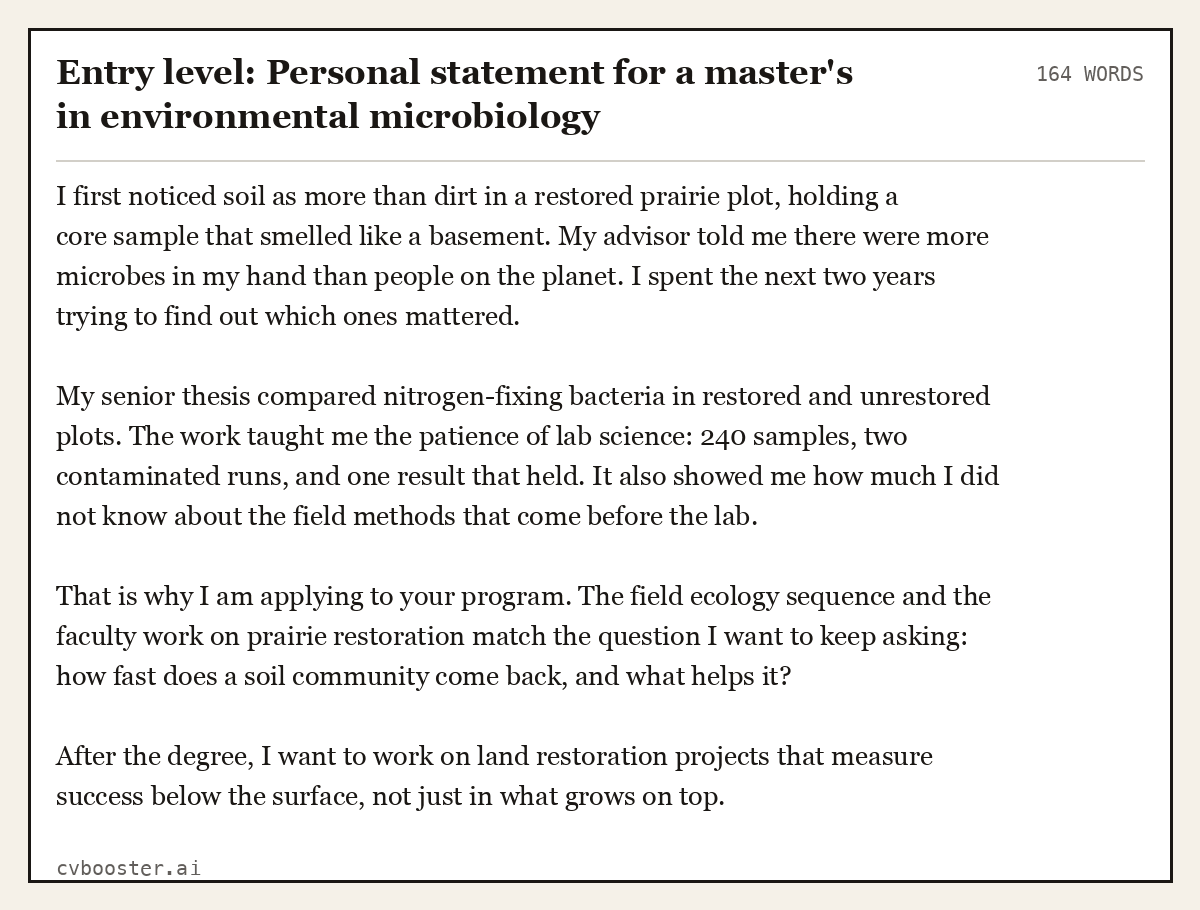
Entry level: Personal statement for a master's in environmental microbiology (164 words)
I first noticed soil as more than dirt in a restored prairie plot, holding a core sample that smelled like a basement. My advisor told me there were more microbes in my hand than people on the planet. I spent the next two years trying to find out which ones mattered.
My senior thesis compared nitrogen-fixing bacteria in restored and unrestored plots. The work taught me the patience of lab science: 240 samples, two contaminated runs, and one result that held. It also showed me how much I did not know about the field methods that come before the lab.
That is why I am applying to your program. The field ecology sequence and the faculty work on prairie restoration match the question I want to keep asking: how fast does a soil community come back, and what helps it?
After the degree, I want to work on land restoration projects that measure success below the surface, not just in what grows on top.
Same facts. The letter leads with tasks and the job post. The statement leads with motivation and the program.
What the universities say each one is for
MIT's career office defines the letter by its target: "An effective cover letter is directed towards a specific position or company, and describes examples from your experience that highlight your skills related to the role." It also sets the length: "A cover letter should be no longer than one page with a font size between 10-12 points." See MIT's cover letter guide.
The University of North Carolina's Writing Center says the personal statement "should reflect how you arrived at your professional goals, why the program is ideal for you, and what you bring to the program." On length, it is blunt: "Make sure you follow page and word limits exactly," and when in doubt, "err on the side of shortness, not length." See the UNC guide to application essays.
UT Austin's career services adds a third term you will meet on graduate applications. It says of the personal statement and the statement of purpose: "While the terms might be used interchangeably, the two are subtly distinct from one another." Its page on personal statements and statements of purpose describes the statement of purpose as focused on preparation, research experience and career goals.
Pair 2: a teacher applies to a school that asks for both
Some school districts and independent schools ask for a cover letter and a separate personal statement or statement of teaching philosophy. Read the prompt; it is not one document saved twice.
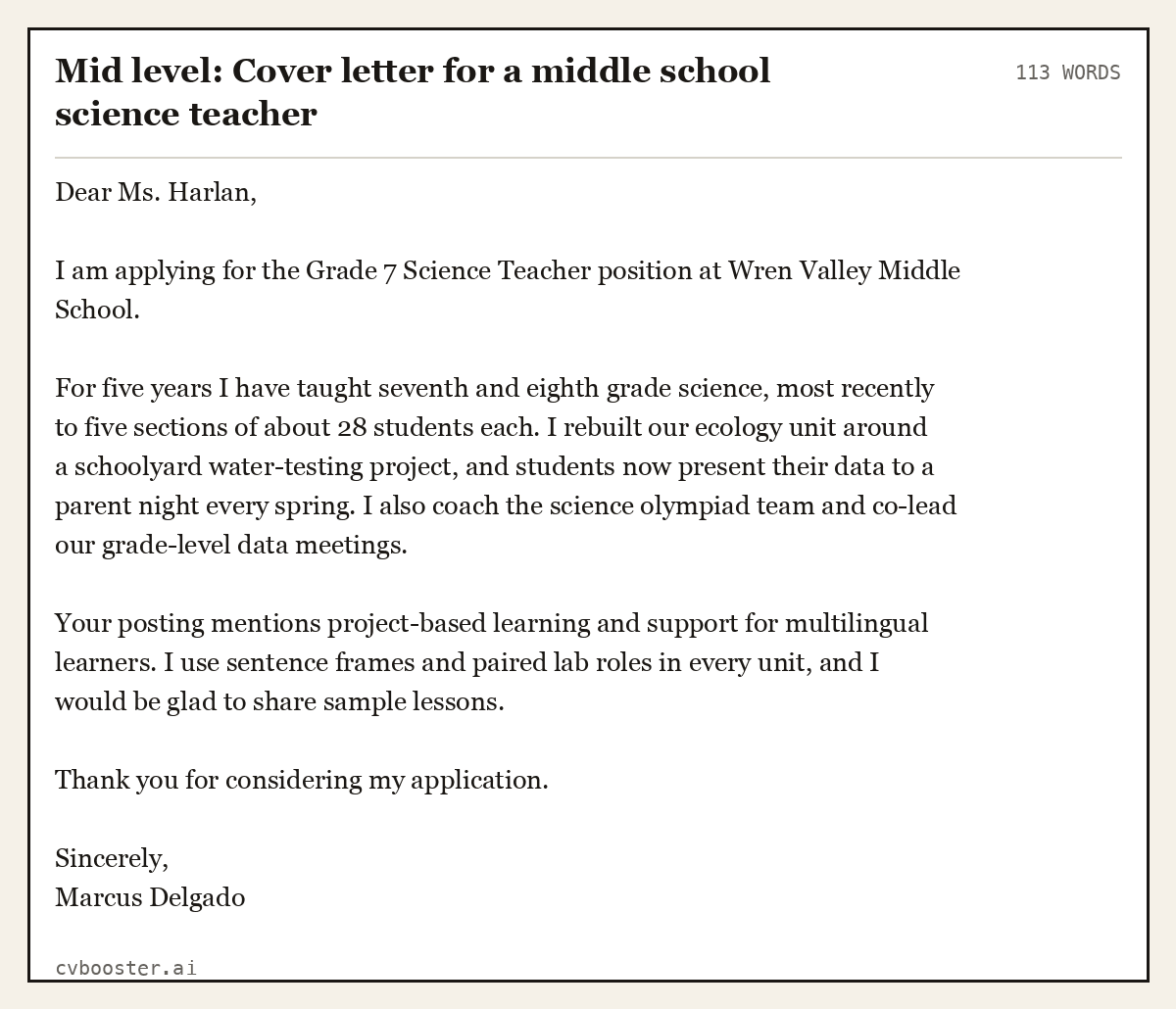
Mid level: Cover letter for a middle school science teacher (113 words)
Dear Ms. Harlan,
I am applying for the Grade 7 Science Teacher position at Wren Valley Middle School.
For five years I have taught seventh and eighth grade science, most recently to five sections of about 28 students each. I rebuilt our ecology unit around a schoolyard water-testing project, and students now present their data to a parent night every spring. I also coach the science olympiad team and co-lead our grade-level data meetings.
Your posting mentions project-based learning and support for multilingual learners. I use sentence frames and paired lab roles in every unit, and I would be glad to share sample lessons.
Thank you for considering my application.
Sincerely, Marcus Delgado
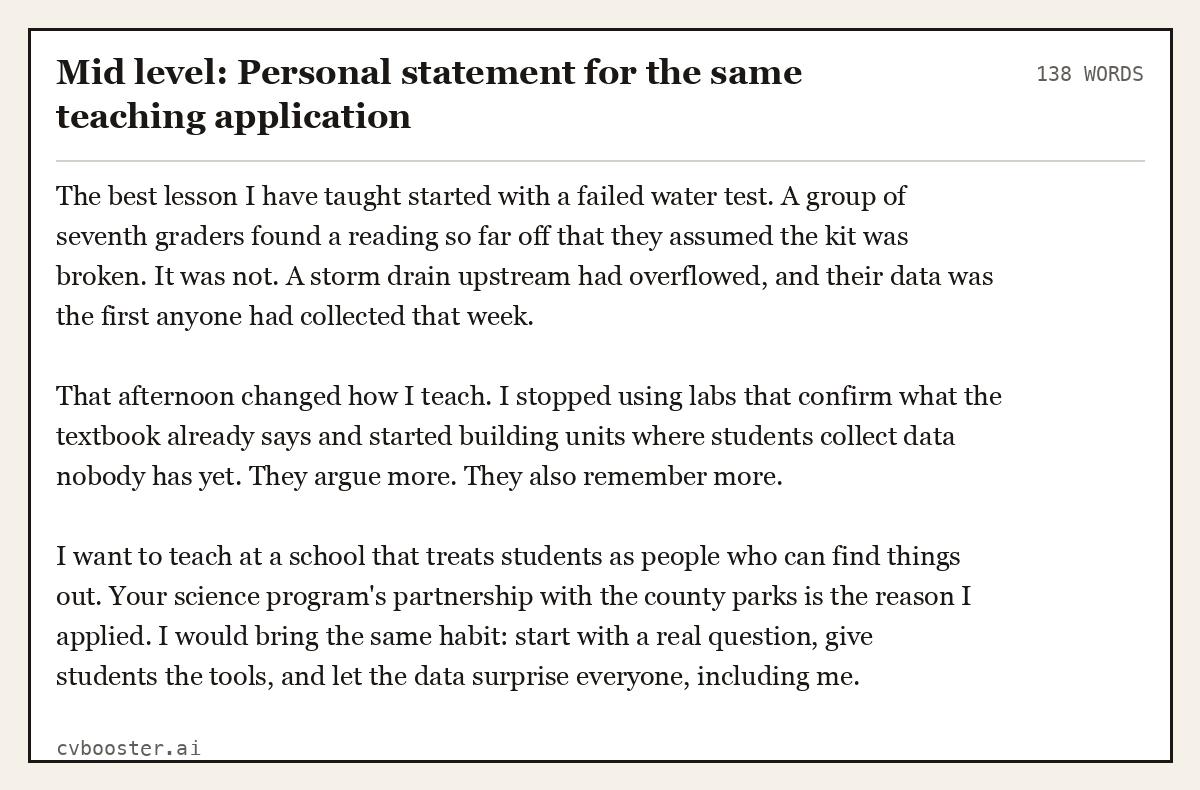
Mid level: Personal statement for the same teaching application (138 words)
The best lesson I have taught started with a failed water test. A group of seventh graders found a reading so far off that they assumed the kit was broken. It was not. A storm drain upstream had overflowed, and their data was the first anyone had collected that week.
That afternoon changed how I teach. I stopped using labs that confirm what the textbook already says and started building units where students collect data nobody has yet. They argue more. They also remember more.
I want to teach at a school that treats students as people who can find things out. Your science program's partnership with the county parks is the reason I applied. I would bring the same habit: start with a real question, give students the tools, and let the data surprise everyone, including me.
Pair 3: a nurse applies for a job and a graduate nursing program
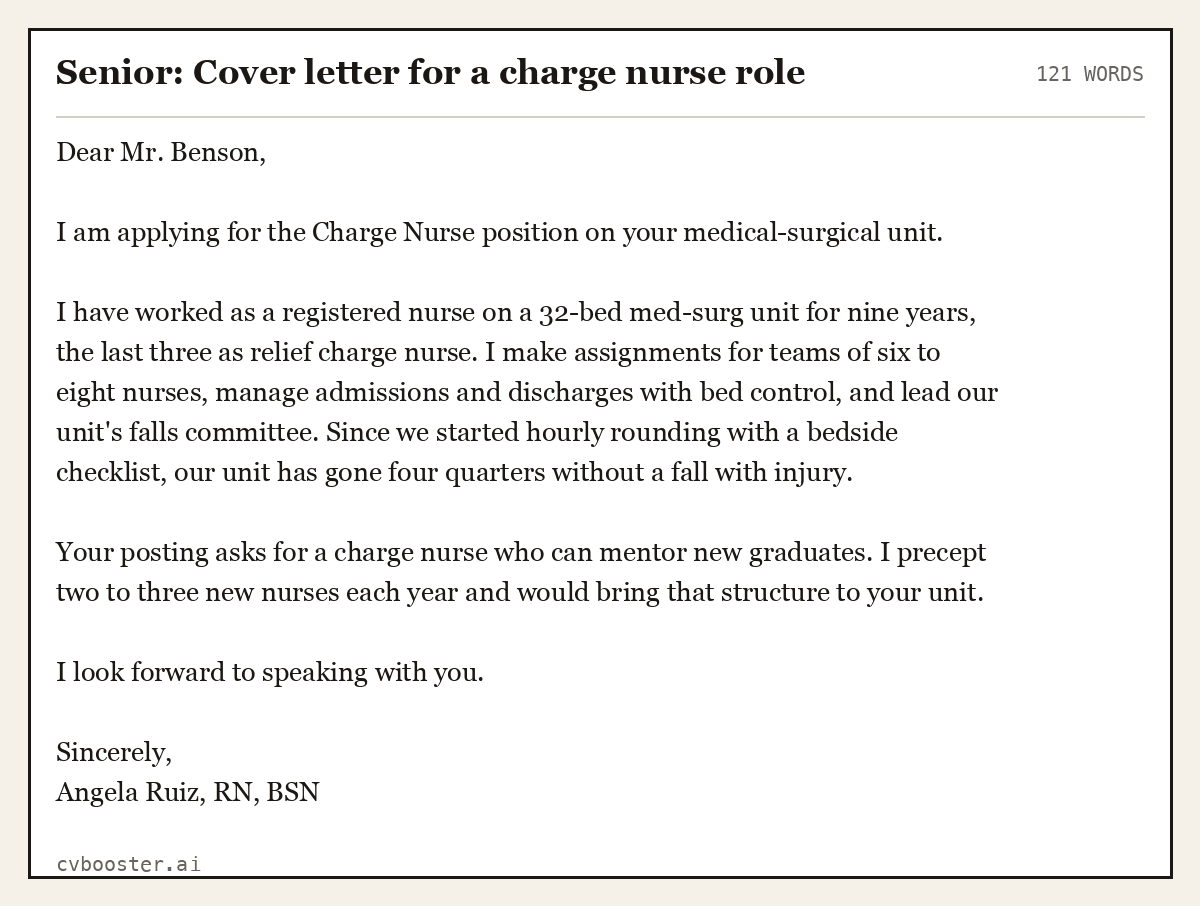
Senior: Cover letter for a charge nurse role (121 words)
Dear Mr. Benson,
I am applying for the Charge Nurse position on your medical-surgical unit.
I have worked as a registered nurse on a 32-bed med-surg unit for nine years, the last three as relief charge nurse. I make assignments for teams of six to eight nurses, manage admissions and discharges with bed control, and lead our unit's falls committee. Since we started hourly rounding with a bedside checklist, our unit has gone four quarters without a fall with injury.
Your posting asks for a charge nurse who can mentor new graduates. I precept two to three new nurses each year and would bring that structure to your unit.
I look forward to speaking with you.
Sincerely, Angela Ruiz, RN, BSN
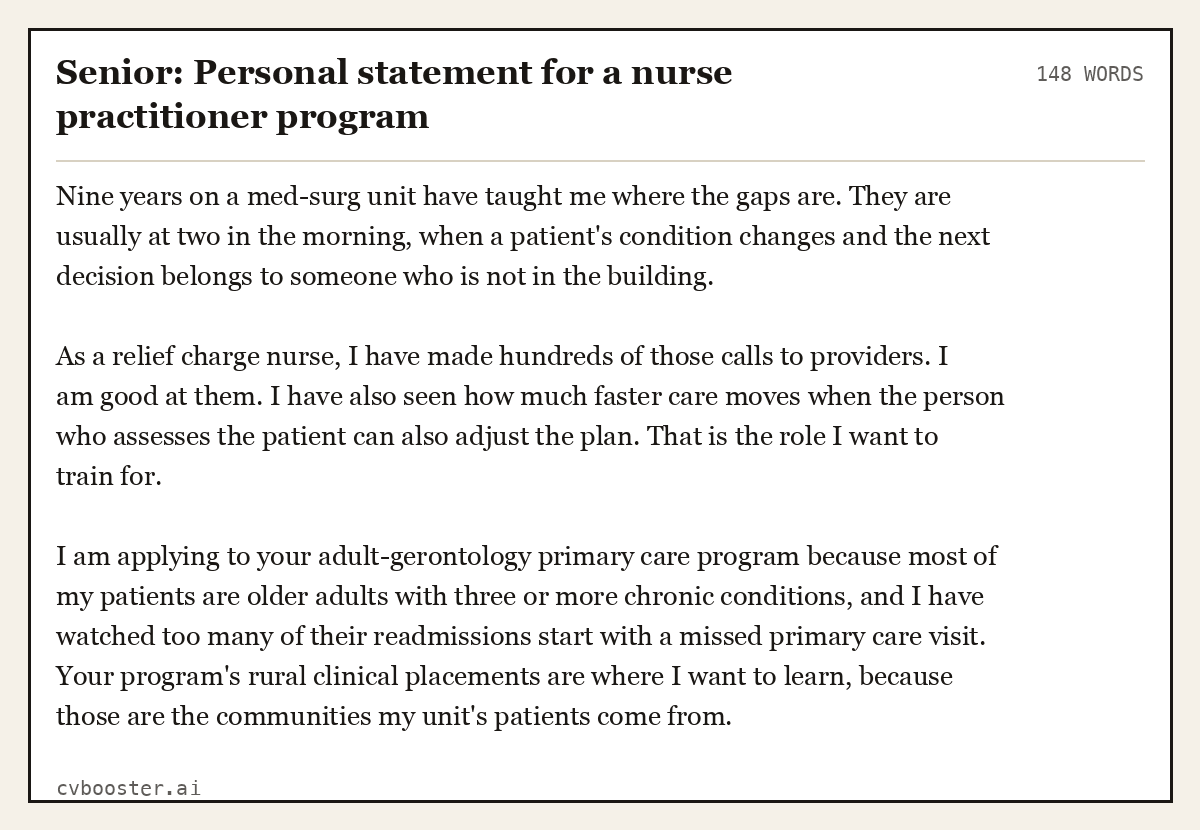
Senior: Personal statement for a nurse practitioner program (148 words)
Nine years on a med-surg unit have taught me where the gaps are. They are usually at two in the morning, when a patient's condition changes and the next decision belongs to someone who is not in the building.
As a relief charge nurse, I have made hundreds of those calls to providers. I am good at them. I have also seen how much faster care moves when the person who assesses the patient can also adjust the plan. That is the role I want to train for.
I am applying to your adult-gerontology primary care program because most of my patients are older adults with three or more chronic conditions, and I have watched too many of their readmissions start with a missed primary care visit. Your program's rural clinical placements are where I want to learn, because those are the communities my unit's patients come from.
How to turn one into the other
- Change the reader. A letter starts with "Dear" and the job title. A statement starts with a story or a question.
- Swap the evidence. The letter uses results that match the job post. The statement uses moments that explain your choice of field.
- Swap the ending. A letter asks for an interview. A statement says what you will do with the degree, award or place.
- Follow the prompt. If the program asks two questions, answer two questions, in its order.
If the job asks for a supporting statement instead, read cover letter vs supporting statement. For the resume side of the same choice, see cover letter vs resume. For a full letter from scratch, use how to write a cover letter. For graduate admissions, our master's personal statement guide goes deeper. For the short profile at the top of a CV, which is also called a personal statement in some countries, see personal statement examples, and for a job version see how to write a personal statement for a job.
Mistakes that show up in both
- The same text in both boxes. Committees and employers both notice when the letter is the statement with a greeting.
- Repeating the resume. UNC's guide says: "Don't waste space with information you have provided in the rest of the application."
- No program or company name. If the document works for any reader, it convinces none of them.
- Ignoring the limit. A one-page letter is one page. A statement with a word limit is that many words or fewer.
Frequently asked questions
What is the difference between a cover letter and a personal statement?
A cover letter is a one-page business letter to an employer about a specific job. A personal statement is an essay for a program, scholarship or selection panel about your motivation, path and goals.
Can I use my cover letter as a personal statement?
No. Reuse the facts, but rewrite the opening, the evidence and the ending for the new reader and its prompt.
Is a personal statement the same as a statement of purpose?
Programs sometimes use the terms interchangeably. When they are different, the statement of purpose leans on research and academic preparation, and the personal statement leans on motivation and background.
Do jobs ever ask for a personal statement?
Yes, some do, especially in teaching, healthcare and public sector applications. Write it to the prompt they give, in essay form, and keep a separate cover letter if they ask for one too.
How long should each one be?
A cover letter should fit on one page. A personal statement should follow the program's page or word limit exactly.
Related articles
- Art Teacher Cover Letter: 7 Examples From K-12 to Studio
- Customer Success Manager Cover Letter: 7 Examples by Level
- Food Service Cover Letter: 7 Examples Beyond Restaurants
- Journalist Cover Letter: 7 Examples That Lead With Clips
More articles
- Cover Letter vs Resume: What's the Difference?
- Cover Letter vs Supporting Statement: UK Rules
- Cover Letter Writing Service: When It Pays and How to Pick
Looking for a worked example for your job title? Browse the resume examples by job title.