CV Personal Statement Examples: 12 Written for Real Jobs
By Mustafa Tarabya, founder of CVBooster · Published · Updated
14 min read
The twelve cv personal statement examples below are complete, counted and written for a named job, because a statement that could sit on anyone's CV is worth nothing. The constraint is length: this is the block under your name, so 60 to 120 words is the whole budget, which is less than you have already spent staring at the empty box. The National Careers Service calls it your introduction and describes it as "a few short lines that sum up who you are and what you hope to do". Each example names the role it targets and carries one line on why it works. The rules that produced all twelve follow them. Written by Mustafa Tarabya, who hired for his own company, read every application himself and now writes CVBooster's guides.
What is a personal statement on a CV?
A personal statement on a CV is the short paragraph under your name and contact details that says which job you want, what you offer it and one fact that proves it. It runs three to five sentences, and templates also call it a profile. It is not a biography or a cover letter. It is the first thing read, and its only job is to make the reader carry on to your work history. If you are applying for a postgraduate course rather than a job, the master's personal statement is a different document of about 500 words. If you have no jobs to list yet, the six CV examples with no work experience show the whole page around the statement.
The National Careers Service CV guidance puts the position plainly.
Quoted from nationalcareers.service.gov.uk: "Employers get lots of CVs to look at and have to decide quickly who they're going to interview." On the introduction itself: "Make your introduction sound like you're the right person for the job."
Two instructions fall out of that. Name the job. Then prove one thing about yourself that the job needs, with a number or a place attached to it.
Starting out: school leaver, graduate, changer, returner
These four have the same problem. There is not much history to point at, so the statement has to do more work than it does for anyone else.
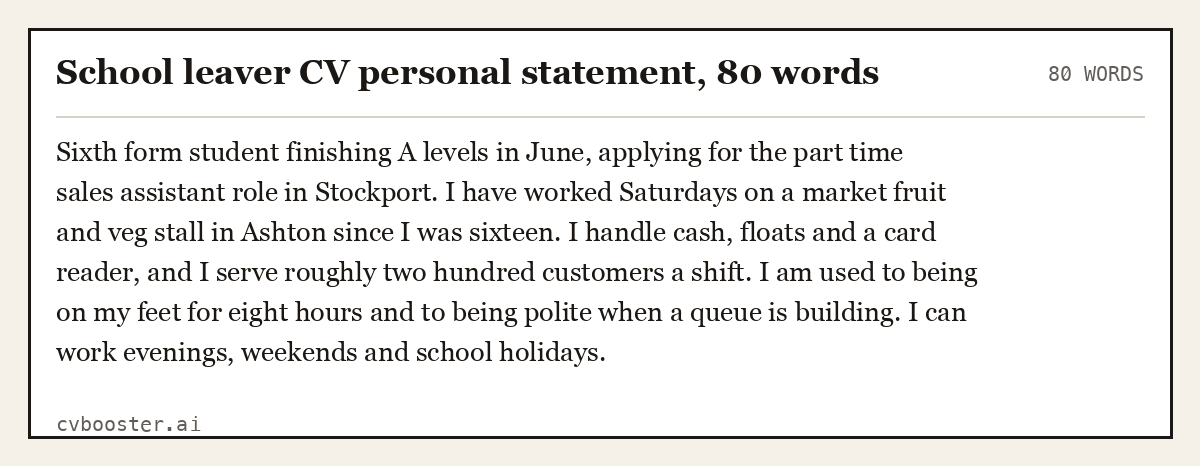
Targets: Sales Assistant, Home Bargains, Stockport (part time, no experience required)
School leaver CV personal statement, 80 words (80 words)
Sixth form student finishing A levels in June, applying for the part time sales assistant role in Stockport. I have worked Saturdays on a market fruit and veg stall in Ashton since I was sixteen. I handle cash, floats and a card reader, and I serve roughly two hundred customers a shift. I am used to being on my feet for eight hours and to being polite when a queue is building. I can work evenings, weekends and school holidays.
Why it works: it answers the only two questions this employer has, which are whether you can face customers and when you can work.
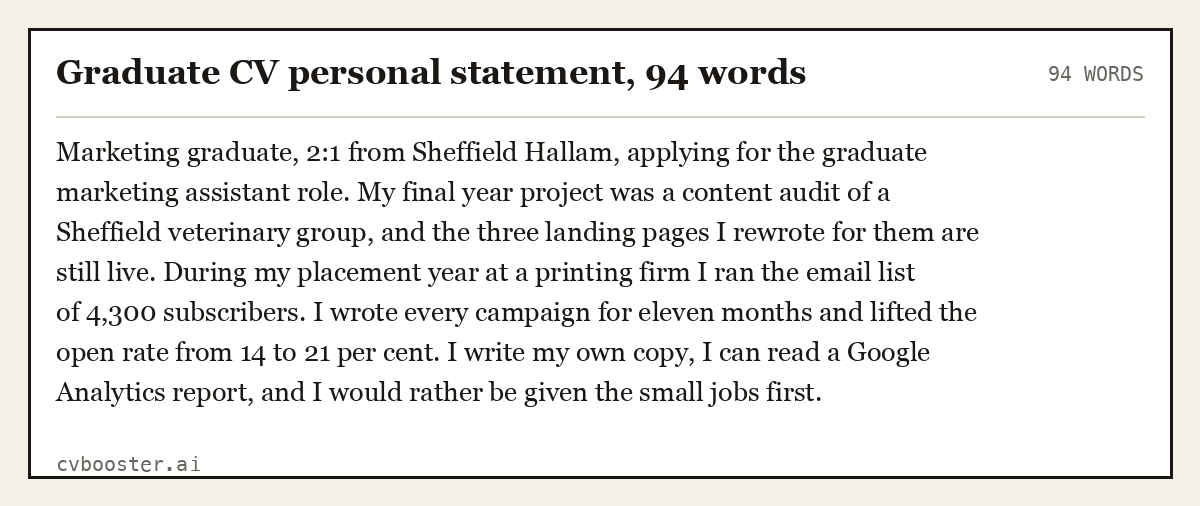
Targets: Graduate Marketing Assistant, a 40-person software business in Leeds
Graduate CV personal statement, 94 words (94 words)
Marketing graduate, 2:1 from Sheffield Hallam, applying for the graduate marketing assistant role. My final year project was a content audit of a Sheffield veterinary group, and the three landing pages I rewrote for them are still live. During my placement year at a printing firm I ran the email list of 4,300 subscribers. I wrote every campaign for eleven months and lifted the open rate from 14 to 21 per cent. I write my own copy, I can read a Google Analytics report, and I would rather be given the small jobs first.
Why it works: the degree is one clause, and the rest is work that exists outside the degree.
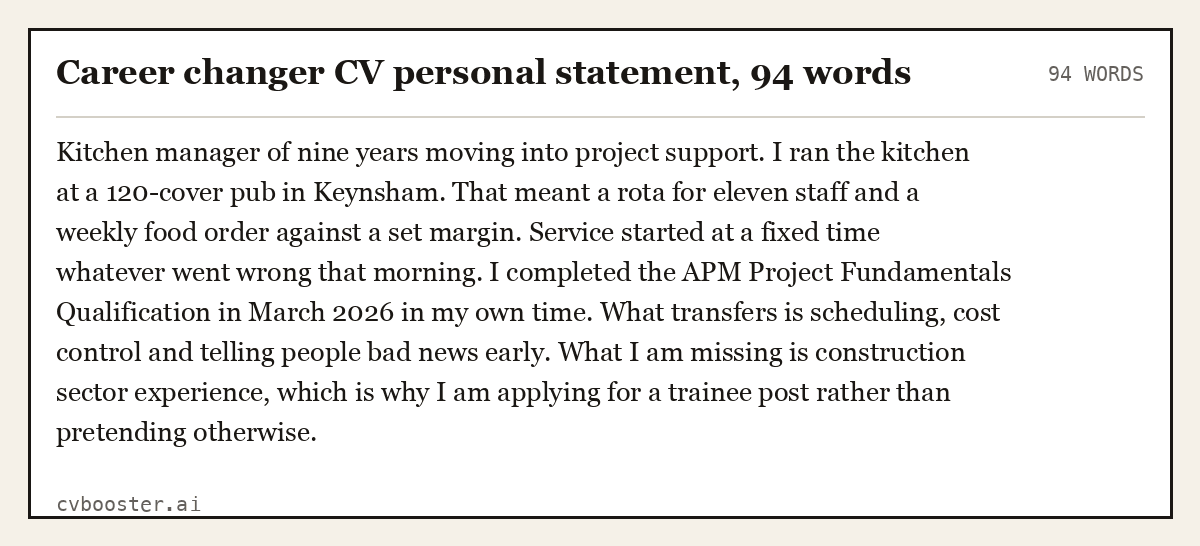
Targets: Trainee Project Support Officer, a construction consultancy in Bristol
Career changer CV personal statement, 94 words (94 words)
Kitchen manager of nine years moving into project support. I ran the kitchen at a 120-cover pub in Keynsham. That meant a rota for eleven staff and a weekly food order against a set margin. Service started at a fixed time whatever went wrong that morning. I completed the APM Project Fundamentals Qualification in March 2026 in my own time. What transfers is scheduling, cost control and telling people bad news early. What I am missing is construction sector experience, which is why I am applying for a trainee post rather than pretending otherwise.
Why it works: it translates the old job into the new job's vocabulary and names the gap before the reader does.
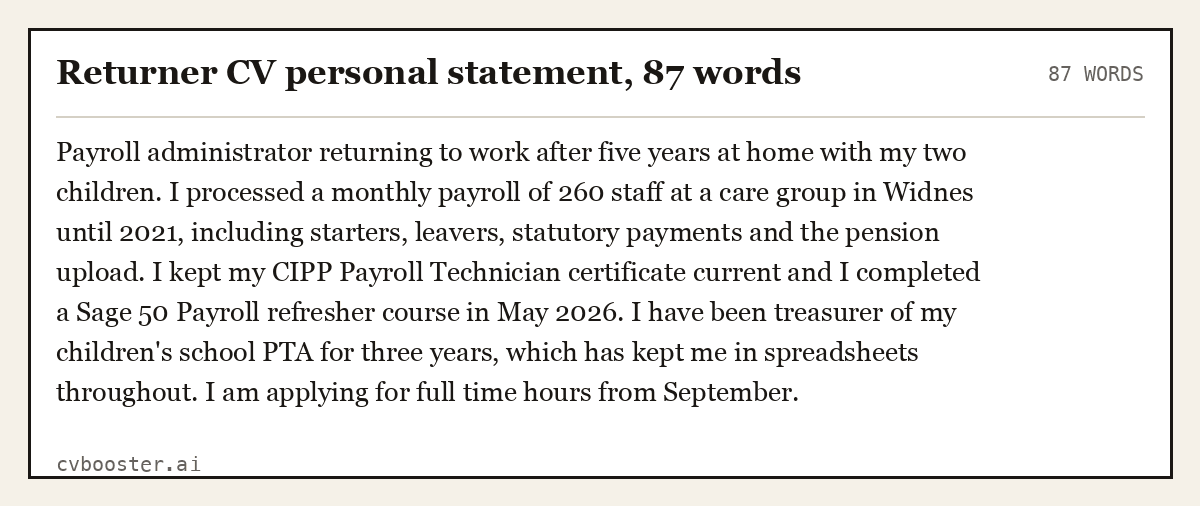
Targets: Payroll Administrator, a haulage company in Warrington
Returner CV personal statement, 87 words (87 words)
Payroll administrator returning to work after five years at home with my two children. I processed a monthly payroll of 260 staff at a care group in Widnes until 2021, including starters, leavers, statutory payments and the pension upload. I kept my CIPP Payroll Technician certificate current and I completed a Sage 50 Payroll refresher course in May 2026. I have been treasurer of my children's school PTA for three years, which has kept me in spreadsheets throughout. I am applying for full time hours from September.
Why it works: it states the break in one clause, without apology, and then shows the skill did not stop.
Frontline roles: retail, care, warehouse
Targets: Retail Supervisor, an independent garden centre in Shrewsbury
Retail supervisor CV personal statement, 87 words (87 words)
Retail supervisor with six years on the shop floor, four of them keyholding. I currently run the afternoon shift at a homeware store in Telford, opening and cashing up three days a week and supervising four colleagues. Last spring I rebuilt our seasonal bay plan and the department finished the quarter 9 per cent up on the previous year. I have trained six new starters through their first month. I want to move to a garden centre because the seasonal buying cycle is the part I enjoy.
Why it works: keyholding, headcount and a figure, in that order, then a reason for this employer specifically.
Targets: Care Assistant, a 30-bed residential home in Carlisle
Care assistant CV personal statement, 84 words (84 words)
Care assistant with three years in a residential setting, holding a Level 2 Diploma in Health and Social Care and working towards Level 3. I currently support eight named residents through personal care, meals and medication prompts on an early shift, seven of whom live with dementia. I am trained in moving and handling, safeguarding and first aid, all refreshed in 2026. I am applying to a smaller home because I want to know every resident by name. I can cover nights and weekends.
Why it works: it gives the caseload as a number and finishes with availability, which is what a care manager checks first.
Targets: Warehouse Operative, a food distribution depot in Wakefield
Warehouse operative CV personal statement, 73 words (73 words)
Warehouse operative with four years in chilled distribution and a current counterbalance forklift licence renewed in February 2026. I pick to voice at a depot near Castleford and average 1,150 cases a shift against a target of 1,000. No pick error has been recorded against me in eleven months. I am a trained first aider and I have worked permanent nights for two years. I am looking for a depot closer to home.
Why it works: the licence, the rate and the error record are the three facts that shortlist a picker.
Office and technical roles: admin and IT support
Targets: School Office Administrator, a two-form entry primary school in Norwich
Administrator CV personal statement, 91 words (91 words)
School administrator with five years in a primary front office, currently first point of contact for 420 families. I run the morning absence line, log every call on Arbor before nine, chase the unexplained absences, and sit on the safeguarding admin rota. I book supply cover, process trip payments through ParentPay and manage the visitor signing-in system and DBS checks for volunteers. I have an enhanced DBS on the update service. I am applying because the school is closer to home and I want to stay in a setting this size.
Why it works: it names the actual systems, which is how a school business manager tells a school administrator from a general one.
Targets: IT Service Desk Analyst, a housing association in Cardiff
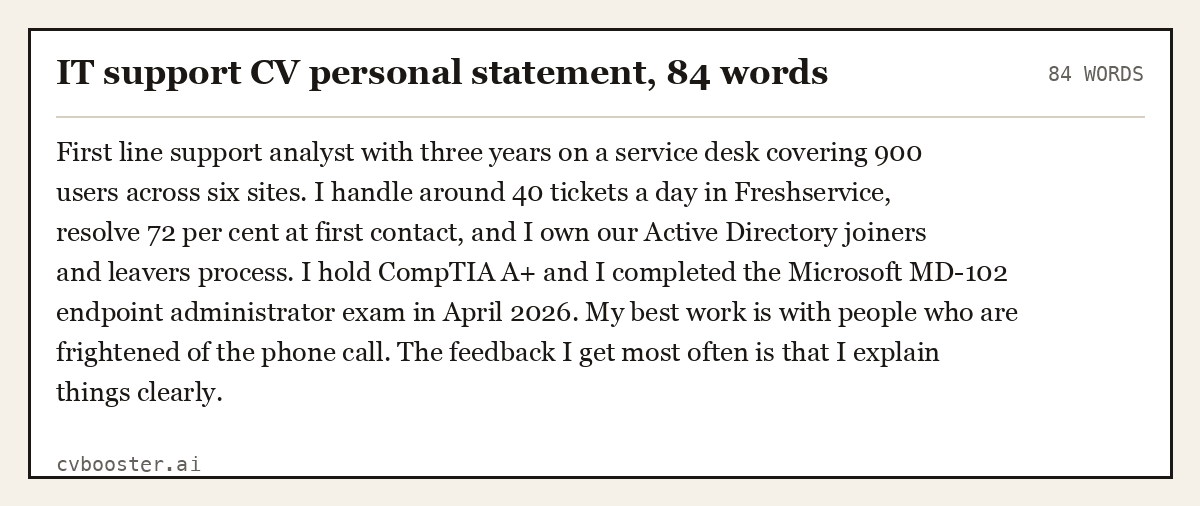
IT support CV personal statement, 84 words (84 words)
First line support analyst with three years on a service desk covering 900 users across six sites. I handle around 40 tickets a day in Freshservice, resolve 72 per cent at first contact, and I own our Active Directory joiners and leavers process. I hold CompTIA A+ and I completed the Microsoft MD-102 endpoint administrator exam in April 2026. My best work is with people who are frightened of the phone call. The feedback I get most often is that I explain things clearly.
Why it works: ticket volume, first contact resolution and one named process beat any list of technologies.
Registered and senior roles: nurse, teacher, manager
Targets: Band 5 Theatre Practitioner, a district general hospital in Derby
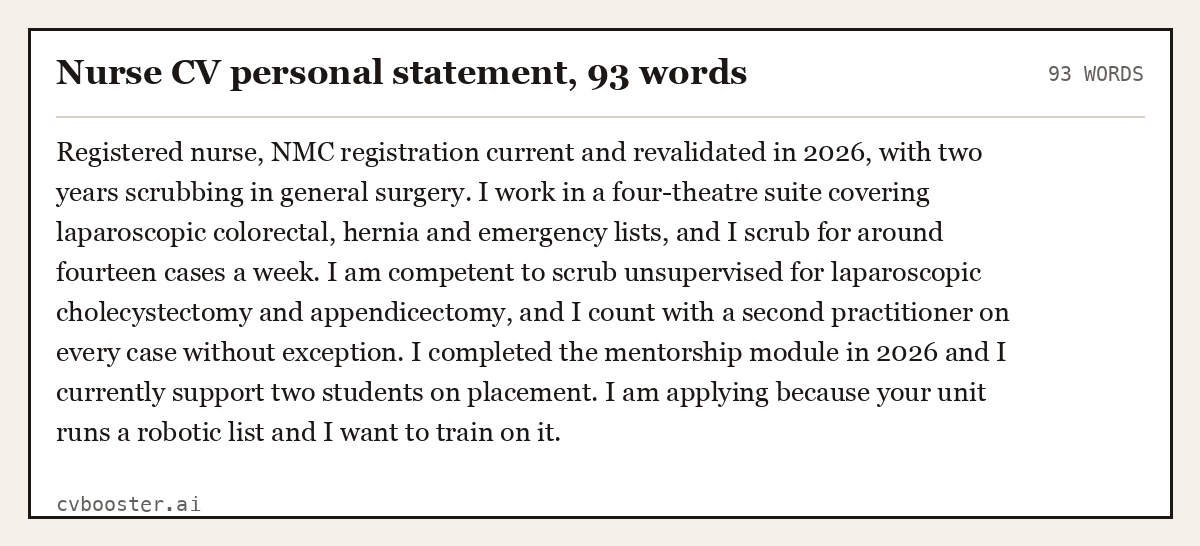
Nurse CV personal statement, 93 words (93 words)
Registered nurse, NMC registration current and revalidated in 2026, with two years scrubbing in general surgery. I work in a four-theatre suite covering laparoscopic colorectal, hernia and emergency lists, and I scrub for around fourteen cases a week. I am competent to scrub unsupervised for laparoscopic cholecystectomy and appendicectomy, and I count with a second practitioner on every case without exception. I completed the mentorship module in 2026 and I currently support two students on placement. I am applying because your unit runs a robotic list and I want to train on it.
Why it works: the registration, the specialty and the case volume are stated before anything subjective.
Targets: Year 4 Class Teacher, a three-form entry primary in Coventry
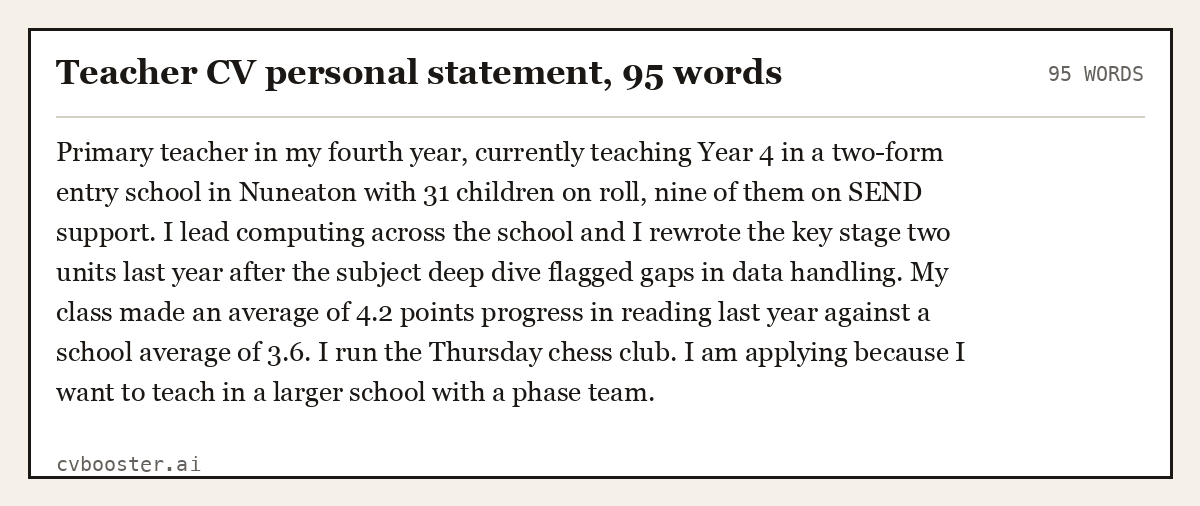
Teacher CV personal statement, 95 words (95 words)
Primary teacher in my fourth year, currently teaching Year 4 in a two-form entry school in Nuneaton with 31 children on roll, nine of them on SEND support. I lead computing across the school and I rewrote the key stage two units last year after the subject deep dive flagged gaps in data handling. My class made an average of 4.2 points progress in reading last year against a school average of 3.6. I run the Thursday chess club. I am applying because I want to teach in a larger school with a phase team.
Why it works: a year group, a cohort size, a subject lead and one measured outcome. That is what a head teacher shortlists on.
Targets: Operations Manager, a regional facilities company in Glasgow
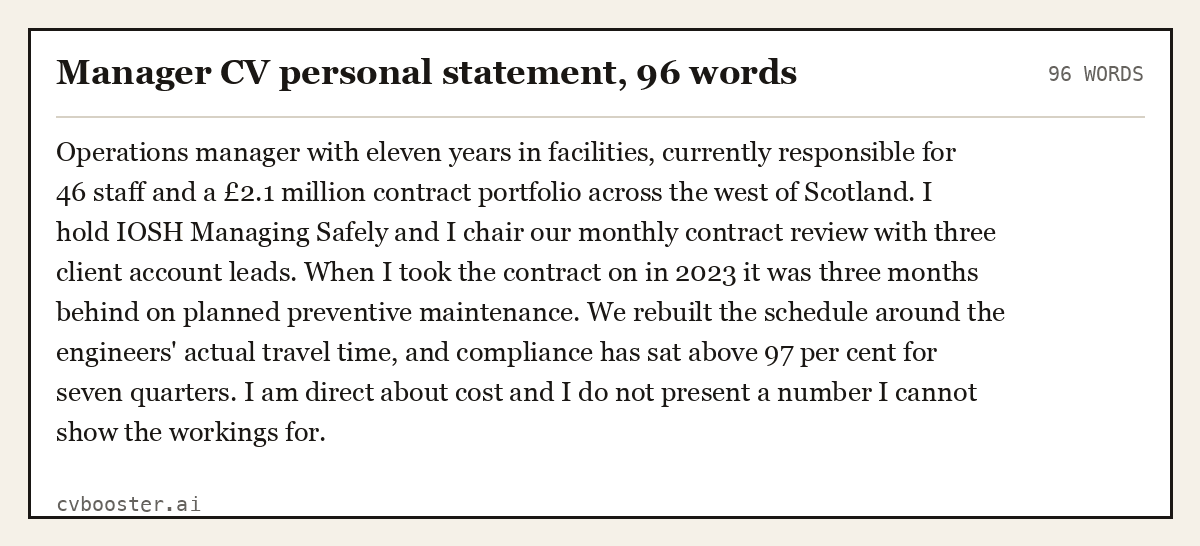
Manager CV personal statement, 96 words (96 words)
Operations manager with eleven years in facilities, currently responsible for 46 staff and a £2.1 million contract portfolio across the west of Scotland. I hold IOSH Managing Safely and I chair our monthly contract review with three client account leads. When I took the contract on in 2023 it was three months behind on planned preventive maintenance. We rebuilt the schedule around the engineers' actual travel time, and compliance has sat above 97 per cent for seven quarters. I am direct about cost and I do not present a number I cannot show the workings for.
Why it works: headcount, contract value and one turnaround with a mechanism, not an adjective.
What makes a good CV personal statement: four rules
A good CV personal statement is short, names one job and proves one thing. These are the four rules that produced all twelve examples above.
- Name the job in the first line. Every statement above does. A statement that does not name a job was written for no job.
- Spend your second sentence on evidence, not character. A number, a place, a caseload, a licence. Adjectives are free, so they carry no information.
- Say the awkward thing yourself. The career break, the missing sector experience, the qualification in progress. Stated plainly it costs you nothing. Discovered later it costs you the interview.
- Finish on fit or availability. Why this employer, or when you can start. Both are useful to the reader. Neither is about you.
The step-by-step method behind this is set out in the jobs.ac.uk guide how do I write a supporting statement for my application, which recommends building your evidence with the STAR technique before you write a word.
Tip: write the statement last. You cannot summarise a CV you have not finished. The best line in a statement is usually lifted from further down the page.
Personal summary on a CV: one block, four names
A personal summary on a CV is the same three to five sentences as a personal statement, a personal profile or a career summary. UK employers and recruitment agencies use all four names, and none of them expects a different block. The National Careers Service guidance linked above simply calls it your introduction. Whatever the job advert or the template calls it, it sits directly under your name and contact details and follows the same rules: the job you want, one or two facts you can prove, and nothing that would be true of every other applicant.
The only time the name changes the content is when a template splits the block in two, with a short "profile" line and a longer "summary" below it. Do not write both. Keep one block of 60 to 120 words, call it what the template calls it, and spend the space you saved on your work history.
A quick test for a personal summary you have already written: cover your name and read it. If it could belong to anyone applying for the same job, replace one adjective with a number, a system or a qualification from your own history. The twelve examples above all pass that test, so borrow their shape, never their facts.
The openings that lose the reader
| Weak opening | Why it fails | Rewritten |
|---|---|---|
| "I am a passionate and highly motivated individual." | True of every applicant, so it separates nobody. | "Care assistant with three years in a residential setting, working towards Level 3." |
| "I am seeking a challenging role in a dynamic organisation." | It describes what you want, in a document about what you offer. | "Applying for the payroll administrator post advertised on 3 September." |
| "I have excellent communication skills." | A claim with no evidence behind it. | "I am first point of contact for 420 families on the school absence line." |
| "Throughout my career I have gained a wide range of skills." | Vague, and it burns the one line the reader definitely reads. | "Eleven years in facilities, currently responsible for 46 staff." |
If you are writing a longer statement for an application form rather than a CV, the rules change, because the form gives you a word limit and a set of criteria to answer. That is covered in how to write a personal statement for a job and, for public sector forms, in how to write a supporting statement.
Civil Service adverts are the clearest case. The civil-service-careers.gov.uk guidance on personal statements asks candidates to "keep to the word limit" and warns that "if your statement is too brief it will not provide the required depth of detail and evidence to be assessed fully". That is a different document from the twelve above.
Before you paste it in
- Read it aloud. If you would not say it to the person interviewing you, cut it.
- Check the job title in the first line matches the advert word for word.
- Count the words. Over 120 and it stops being an introduction.
- Delete every adjective, then put back only the ones you have evidence for.
- Check the tense. You are doing the current job, you did the previous ones.
More worked material: CV examples by role, a CV personal statement with no experience and supporting statement examples. Medical students applying through ERAS will also need letters; the residency recommendation letter samples show what a strong one contains.
Frequently asked questions
What is a good example of a personal statement on a CV?
A good one names the job, gives one piece of hard evidence, and stops. The warehouse example above is typical. It gives four years in chilled distribution, a current forklift licence, a pick rate against target, and a clean error record. Every clause is checkable. Nothing in it describes a personality. That is the test to apply to your own.
How long should a CV personal statement be?
Sixty to 120 words, or roughly three to five sentences. The twelve examples on this page run from 76 to 104 words. The National Careers Service describes the CV introduction as "a few short lines". Longer than about 120 words and it competes with your work history for attention, which is the section the reader actually wants.
How do I start a personal statement for a CV?
Write your work history first, then find the three most specific facts in it. A number, a system you run, a qualification with a date. Put the job title in sentence one, those three facts in sentences two and three, and a line on availability or fit at the end. Then cut every word that would be true of any other applicant.
What is a personal statement on a CV?
It is the opening paragraph of a UK CV, placed directly under your name and contact details, also called a personal profile or personal summary. In three to five sentences it names the job you are applying for, your most relevant experience or qualification and one fact with a number in it. Rewrite it for every application.
What is a good personal statement to put on a resume?
The same thing, under an American name. A resume summary and a UK CV personal statement follow identical rules: name the job, give evidence with numbers, stay between 60 and 120 words. The only difference worth noting is that US resumes more often drop the first-person pronoun entirely, so "Operations manager with eleven years in facilities" is the standard opening on both sides.
Should a CV personal statement be written in the first or third person?
First person, and drop the pronoun where it reads cleanly. "Retail supervisor with six years on the shop floor" is stronger than "I am a retail supervisor who has six years on the shop floor". Third person reads as though someone else wrote your CV. Stay consistent either way, because mixing the two inside one paragraph is the most common error.
More in this series: Supporting statements
- CV Personal Statement With No Experience: 8 UK Examples
- Care Worker Supporting Statement Example: 3 Full Statements
- How to Write a Personal Statement for a Job Application
- How to Write a Supporting Statement: One Built Step by Step
- NHS Supporting Statement Examples: Band 3, Band 5, Band 6
- Supporting Statement Example: 5 Full Statements, Annotated
- Teaching Assistant Supporting Statement: 3 Full Examples
Related articles
- How to Write a Personal Statement for a Job Application
- Statement of Suitability Civil Service Example: EO and HEO
- Teaching Supporting Statements That Get Shortlisted
- Sample MBA Recommendation Letters: 6 Examples That Work
More articles
- Pharma Resume Examples: 7 Samples From Lab Bench to Sales
- Pharmacist Interview Questions and Answers: UK Guide
- Physician Cover Letter Sample: 6 Letters for Every Stage
Looking for a worked example for your job title? Browse the resume examples by job title.