How to Write a Personal Statement for a Job Application
By Mustafa Tarabya, founder of CVBooster · Published · Updated
14 min read
Learning how to write a personal statement for a job comes down to one move: turn the employer's criteria into your paragraph headings, then put one piece of evidence under each. The constraint that changes everything is which of the three documents you have been asked for, because a CV profile is 100 words and a Civil Service statement is 500 or more. The wording that follows is quoted from civil-service-careers.gov.uk and the National Careers Service by name. Three complete rewrites are below, each shown weak first and then strong, with the changes listed after it. Written by Mustafa Tarabya, who hired for his own company, read every application himself and now writes CVBooster's guides.
Three documents share this name
Read the advert before you write. The word "statement" is doing three different jobs in UK recruitment.
- The CV profile. The block under your name, 60 to 120 words. The National Careers Service calls this your introduction: "a few short lines that sum up who you are and what you hope to do".
- The application form personal statement. A text box on the form, usually capped at 250 to 500 words, asking you to show how you meet the criteria. Careers Wales describes it as "usually a blank box asking you to write about your skills, strengths, experience and explain why you are right for the job".
- The Civil Service personal statement. Uploaded with a CV against an advert that lists essential criteria, behaviours and technical requirements. Usually 500 to 1,250 words.
Get this wrong and nothing else helps. A 100-word profile pasted into a 1,000-word box reads as a candidate who did not read the advert.
Rewrite one: the CV profile
The advert is a Customer Service Adviser post with a water utility in Warrington. The essential criteria are contact centre experience, handling difficult calls, and accurate record keeping.
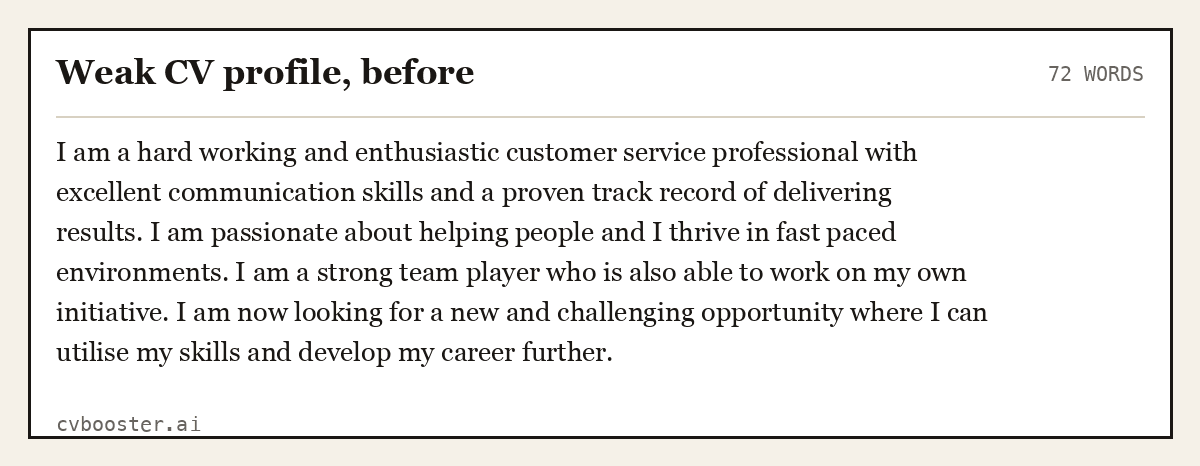
Weak CV profile, before (72 words)
I am a hard working and enthusiastic customer service professional with excellent communication skills and a proven track record of delivering results. I am passionate about helping people and I thrive in fast paced environments. I am a strong team player who is also able to work on my own initiative. I am now looking for a new and challenging opportunity where I can utilise my skills and develop my career further.
Nothing in that is checkable. Every clause would be equally true of the other 200 applicants. Here is the same person, with the evidence put back in.
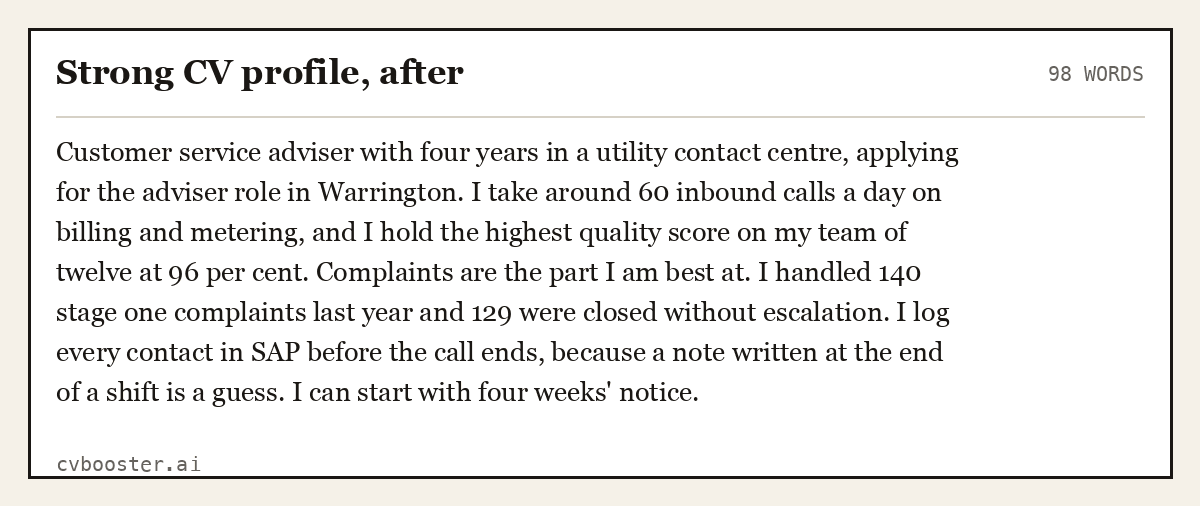
Strong CV profile, after (98 words)
Customer service adviser with four years in a utility contact centre, applying for the adviser role in Warrington. I take around 60 inbound calls a day on billing and metering, and I hold the highest quality score on my team of twelve at 96 per cent. Complaints are the part I am best at. I handled 140 stage one complaints last year and 129 were closed without escalation. I log every contact in SAP before the call ends, because a note written at the end of a shift is a guess. I can start with four weeks' notice.
What the sifter is scoring
- Criterion answered (contact centre experience): four years, the call type, and a daily volume. The weak version claimed experience without naming a sector.
- Criterion answered (handling difficult calls): 140 complaints with the escalation rate, not the word "resilient".
- Criterion answered (accurate record keeping): the named system and the moment the record is made.
- What changed: eight adjectives were deleted. Four numbers were added. The job title moved into the first line.
The method, in four steps
Every rewrite on this page was produced the same way.
Step one: build the criteria list. Copy the person specification into a document and delete everything that is not an essential or desirable criterion. What is left is your marking scheme. The jobs.ac.uk guide how do I write a supporting statement for my application recommends using "sub-headings, ideally linked to those used in the person specification", so the reader can cross-reference.
Step two: put one example against each criterion. Careers Wales puts the same instruction as a question you answer per skill, for example "When have you come across a problem and been successful in working out a solution?" Use one example each, not two. A criterion with two thin examples scores worse than a criterion with one detailed one.
Step three: divide the word count. Do this before you write a sentence, in a table. There is a worked budget in the next section.
Step four: write the evidence, then the opening. The first sentence is easiest to write once you know what follows it.
Tip: if an example fits two criteria, use it once and name the second criterion in a clause. Repeating a story reads as a candidate with only one story.
The word budget, by document
| Document | Total words | Opening | Evidence per criterion | Closing |
|---|---|---|---|---|
| CV profile | 60 to 120 | 1 sentence | 1 or 2 facts, no story | 1 sentence on availability |
| Application form statement | 250 to 500 | 40 | 60 to 80 across 3 to 5 criteria | 40 |
| Civil Service statement | 500 to 1,250 | 60 | 90 to 120 across 4 to 6 criteria | 60 |
The civil-service-careers guidance is direct about the limit. It tells candidates to "keep to the word limit" and warns that "if your statement is too brief it will not provide the required depth of detail and evidence to be assessed fully". Under-running is a real risk. A 300-word answer in a 750-word box is read as a candidate who had nothing more to say.
Rewrite two: the 300-word application form statement
The advert is a Housing Options Officer post with a district council in Nottinghamshire. The form asks: "Please tell us how you meet the criteria for this post" with a 300-word limit. The essential criteria are homelessness legislation, casework under pressure, and working with partner agencies.
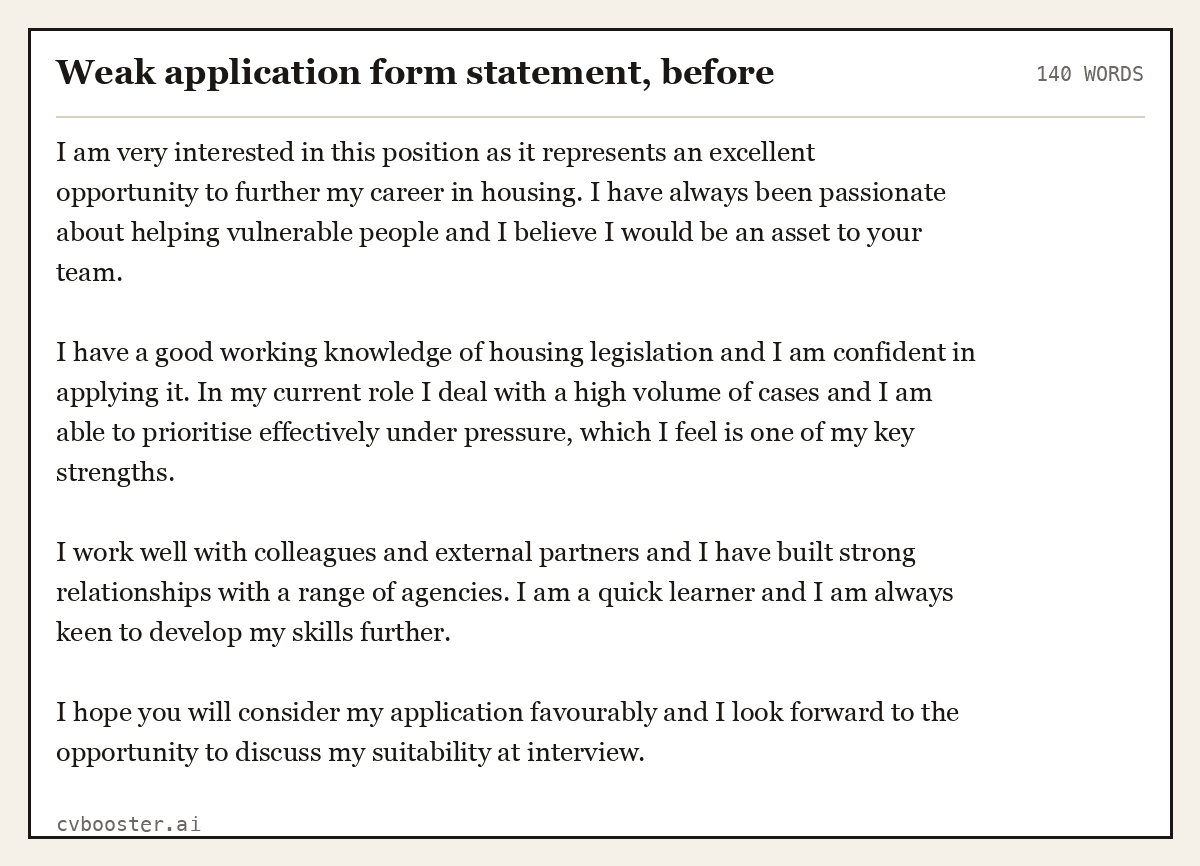
Weak application form statement, before (140 words)
I am very interested in this position as it represents an excellent opportunity to further my career in housing. I have always been passionate about helping vulnerable people and I believe I would be an asset to your team.
I have a good working knowledge of housing legislation and I am confident in applying it. In my current role I deal with a high volume of cases and I am able to prioritise effectively under pressure, which I feel is one of my key strengths.
I work well with colleagues and external partners and I have built strong relationships with a range of agencies. I am a quick learner and I am always keen to develop my skills further.
I hope you will consider my application favourably and I look forward to the opportunity to discuss my suitability at interview.
That is 148 words of the 300, and roughly 30 of them carry information. The rewrite uses the criteria as headings and spends the full budget.
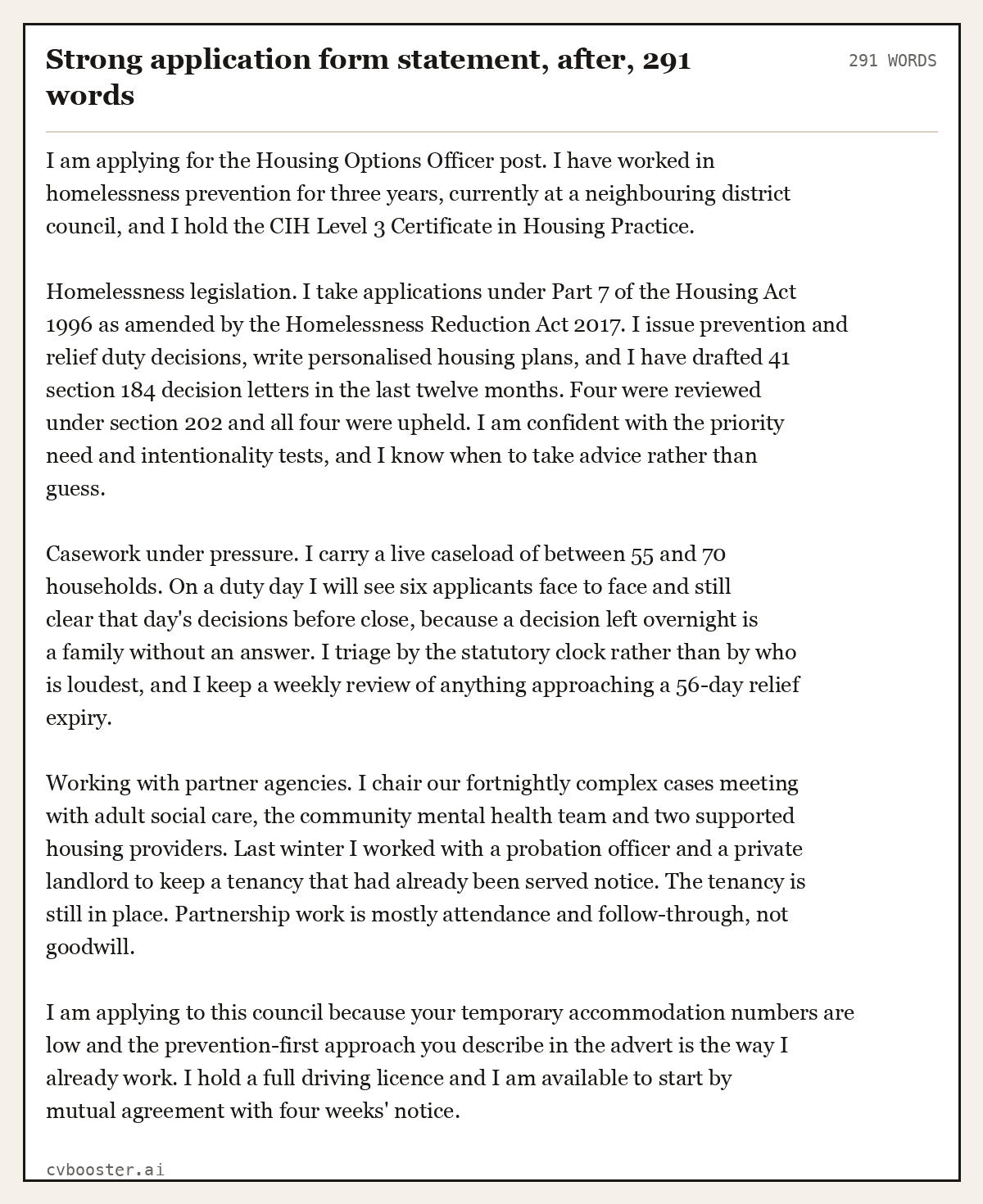
Strong application form statement, after, 291 words (291 words)
I am applying for the Housing Options Officer post. I have worked in homelessness prevention for three years, currently at a neighbouring district council, and I hold the CIH Level 3 Certificate in Housing Practice.
Homelessness legislation. I take applications under Part 7 of the Housing Act 1996 as amended by the Homelessness Reduction Act 2017. I issue prevention and relief duty decisions, write personalised housing plans, and I have drafted 41 section 184 decision letters in the last twelve months. Four were reviewed under section 202 and all four were upheld. I am confident with the priority need and intentionality tests, and I know when to take advice rather than guess.
Casework under pressure. I carry a live caseload of between 55 and 70 households. On a duty day I will see six applicants face to face and still clear that day's decisions before close, because a decision left overnight is a family without an answer. I triage by the statutory clock rather than by who is loudest, and I keep a weekly review of anything approaching a 56-day relief expiry.
Working with partner agencies. I chair our fortnightly complex cases meeting with adult social care, the community mental health team and two supported housing providers. Last winter I worked with a probation officer and a private landlord to keep a tenancy that had already been served notice. The tenancy is still in place. Partnership work is mostly attendance and follow-through, not goodwill.
I am applying to this council because your temporary accommodation numbers are low and the prevention-first approach you describe in the advert is the way I already work. I hold a full driving licence and I am available to start by mutual agreement with four weeks' notice.
What the sifter is scoring
- What changed: the three essential criteria became three bold paragraph headings, so the reader can tick them without hunting.
- Evidence added: the legislation is named with the section numbers, the caseload is a range, and the decisions carry a review outcome.
- Deleted: "passionate", "asset to your team", "quick learner", and the entire closing paragraph asking for consideration.
- Budget: 298 words against a 300-word limit. The weak version used half the box.
Rewrite three: the 500-word Civil Service personal statement
The advert is an Executive Officer Compliance Caseworker post at HMRC. Civil Service adverts set out what the statement must cover. The civil-service-careers.gov.uk guidance states the purpose in one line: "The purpose of a personal statement is to showcase your relevant skills and experience against the job requirements."
It also tells candidates to "outline the skills and experience that you have that are relevant to the job and use examples to help demonstrate this" and to "try to include specific facts and figures that demonstrate the tangible results of your work".
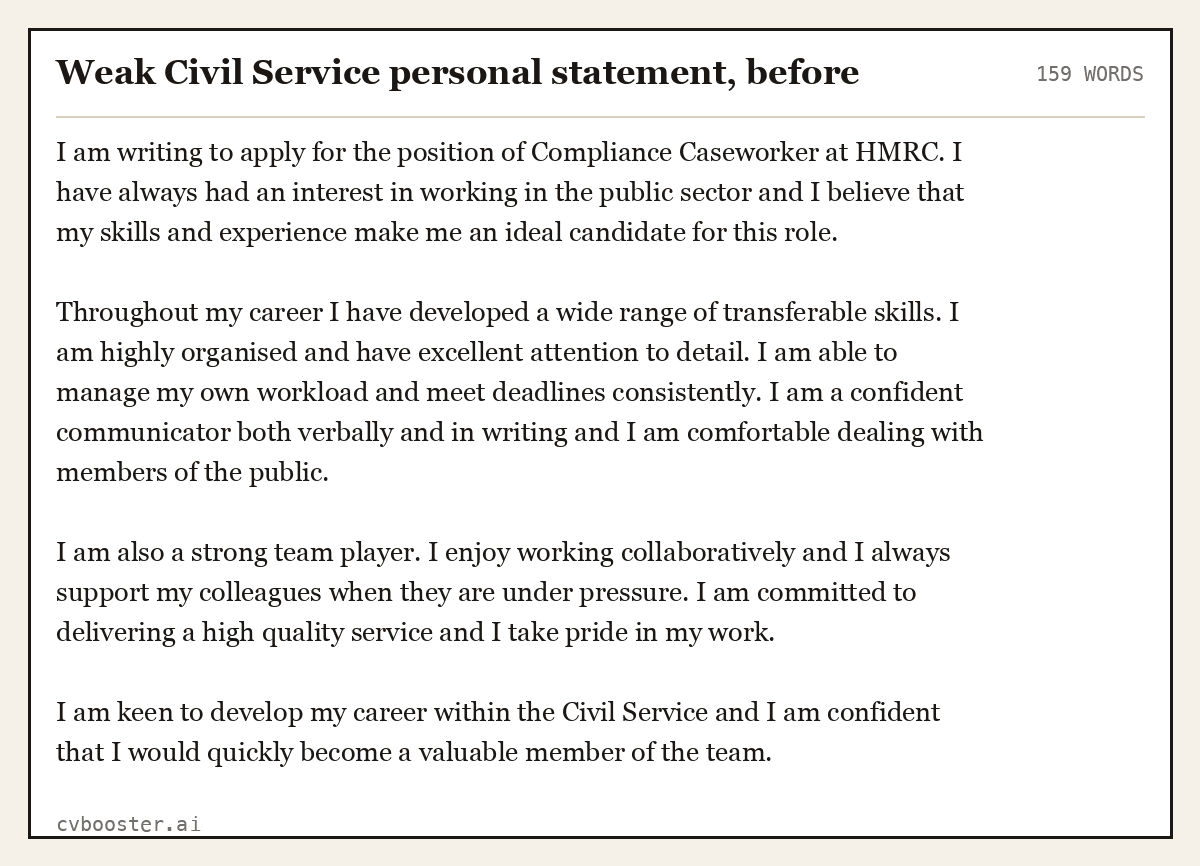
Weak Civil Service personal statement, before (159 words)
I am writing to apply for the position of Compliance Caseworker at HMRC. I have always had an interest in working in the public sector and I believe that my skills and experience make me an ideal candidate for this role.
Throughout my career I have developed a wide range of transferable skills. I am highly organised and have excellent attention to detail. I am able to manage my own workload and meet deadlines consistently. I am a confident communicator both verbally and in writing and I am comfortable dealing with members of the public.
I am also a strong team player. I enjoy working collaboratively and I always support my colleagues when they are under pressure. I am committed to delivering a high quality service and I take pride in my work.
I am keen to develop my career within the Civil Service and I am confident that I would quickly become a valuable member of the team.
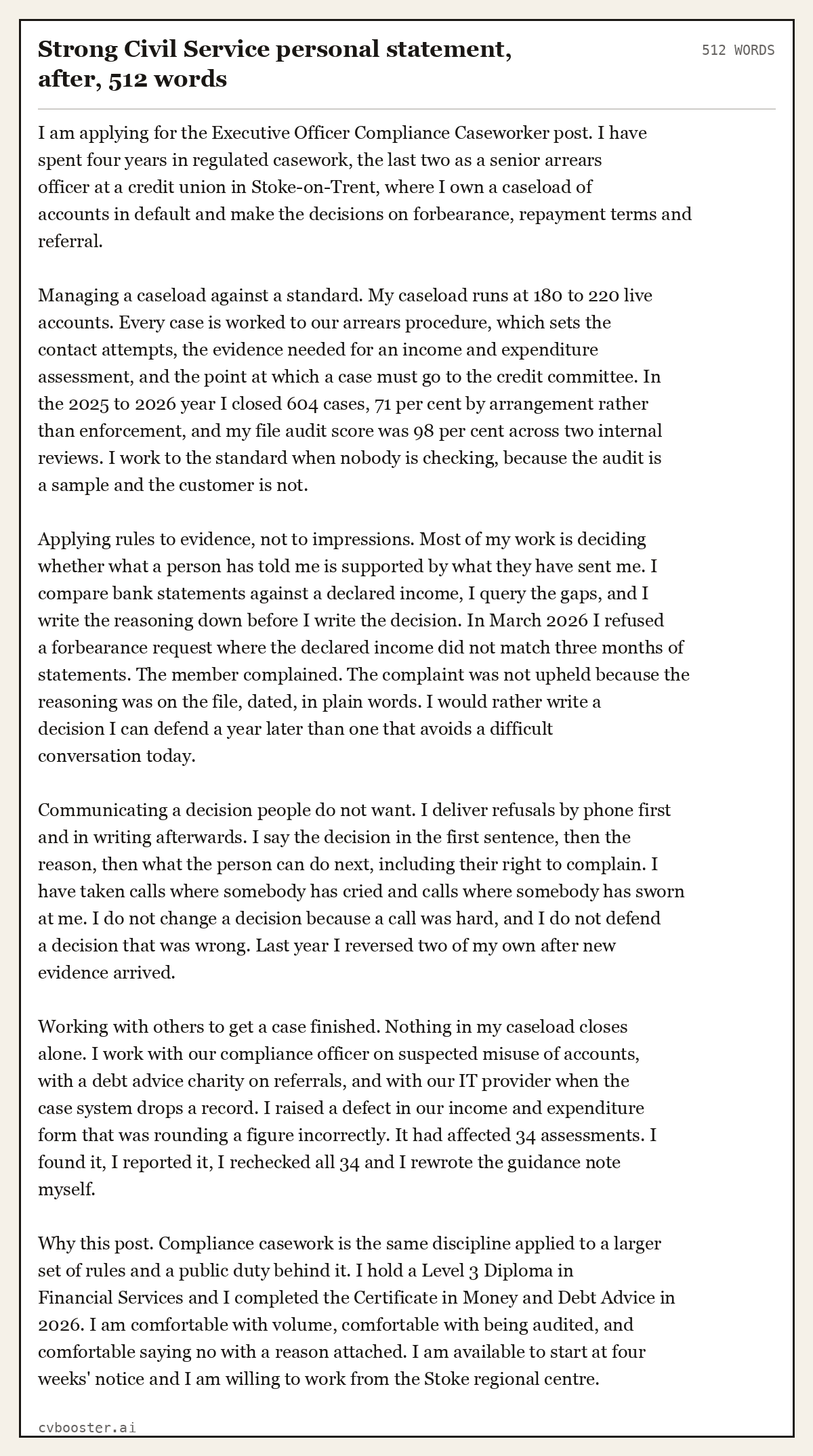
Strong Civil Service personal statement, after, 512 words (512 words)
I am applying for the Executive Officer Compliance Caseworker post. I have spent four years in regulated casework, the last two as a senior arrears officer at a credit union in Stoke-on-Trent, where I own a caseload of accounts in default and make the decisions on forbearance, repayment terms and referral.
Managing a caseload against a standard. My caseload runs at 180 to 220 live accounts. Every case is worked to our arrears procedure, which sets the contact attempts, the evidence needed for an income and expenditure assessment, and the point at which a case must go to the credit committee. In the 2025 to 2026 year I closed 604 cases, 71 per cent by arrangement rather than enforcement, and my file audit score was 98 per cent across two internal reviews. I work to the standard when nobody is checking, because the audit is a sample and the customer is not.
Applying rules to evidence, not to impressions. Most of my work is deciding whether what a person has told me is supported by what they have sent me. I compare bank statements against a declared income, I query the gaps, and I write the reasoning down before I write the decision. In March 2026 I refused a forbearance request where the declared income did not match three months of statements. The member complained. The complaint was not upheld because the reasoning was on the file, dated, in plain words. I would rather write a decision I can defend a year later than one that avoids a difficult conversation today.
Communicating a decision people do not want. I deliver refusals by phone first and in writing afterwards. I say the decision in the first sentence, then the reason, then what the person can do next, including their right to complain. I have taken calls where somebody has cried and calls where somebody has sworn at me. I do not change a decision because a call was hard, and I do not defend a decision that was wrong. Last year I reversed two of my own after new evidence arrived.
Working with others to get a case finished. Nothing in my caseload closes alone. I work with our compliance officer on suspected misuse of accounts, with a debt advice charity on referrals, and with our IT provider when the case system drops a record. I raised a defect in our income and expenditure form that was rounding a figure incorrectly. It had affected 34 assessments. I found it, I reported it, I rechecked all 34 and I rewrote the guidance note myself.
Why this post. Compliance casework is the same discipline applied to a larger set of rules and a public duty behind it. I hold a Level 3 Diploma in Financial Services and I completed the Certificate in Money and Debt Advice in 2026. I am comfortable with volume, comfortable with being audited, and comfortable saying no with a reason attached. I am available to start at four weeks' notice and I am willing to work from the Stoke regional centre.
What the sifter is scoring
- Guidance quoted: "try to include specific facts and figures that demonstrate the tangible results of your work" (civil-service-careers.gov.uk). Where the statement shows it: 604 cases closed, 71 per cent by arrangement, a 98 per cent audit score, 34 assessments rechecked.
- Guidance quoted: "outline the skills and experience that you have that are relevant to the job and use examples to help demonstrate this" (civil-service-careers.gov.uk). Where the statement shows it: four bold headings, each one a requirement of the advert with a single dated example under it.
- What changed: the weak version named no employer, no number and no decision. The rewrite names all three in every paragraph.
- Closing: the weak version asks to be appointed. The rewrite states availability and location, which is information the reader needs.
Openings and closings that work
The opening has one job: tell the reader what you currently are and what you are applying for. Nothing else fits.
| Weak | Strong |
|---|---|
| "I am writing to apply for the above position." | "I am applying for the Executive Officer Compliance Caseworker post." |
| "I have always been passionate about helping people." | "I have worked in homelessness prevention for three years." |
| "I believe I would be an asset to your team." | "I carry a live caseload of between 55 and 70 households." |
| "I am a highly motivated individual." | "I take around 60 inbound calls a day on billing and metering." |
Closings fail the same way. "I look forward to hearing from you" is a cover letter ending stapled to a statement. Close on one line of fit and one line of practical fact: notice period, location, availability, licence.
Before you submit
- Count the words and get within 5 per cent of the limit. Under-running loses marks that over-running cannot lose.
- Check every criterion in the advert appears somewhere in your statement. Tick them off on paper.
- Read the first sentence of every paragraph on its own. They should read as a summary of the person specification.
- Remove any claim that has no number, date, place or name attached to it.
- Write it in a separate document and paste it in, because forms time out.
Related worked pages: supporting statement examples, how to write a supporting statement, NHS supporting statement examples and CV personal statement examples.
Frequently asked questions
How do I write a personal statement example?
Start from the advert, not from a template. List the essential criteria, put one dated example against each, then write 60 to 120 words per criterion in the order the advert lists them. Write the opening last. The three rewrites above were built that way, and each one shows the weak draft first so you can see what was removed rather than only what was added.
How do I start writing my personal statement?
Open a blank document and paste the person specification into it, then delete everything that is not a criterion. That list is your structure. Under each line, write the single most specific thing you have done that proves it, including a date and a number. You now have the statement in note form, and the writing is only tidying.
What is a good starting sentence for a personal statement?
One that names your current role and the post you are applying for, with no adjective in it. "I am applying for the Executive Officer Compliance Caseworker post" works because the reader immediately knows they are in the right document. "I am a highly motivated individual seeking a challenging role" works for nobody, because it describes a category rather than a person.
What is the difference between a personal statement and a supporting statement?
Mostly the employer's vocabulary. A supporting statement almost always answers a published person specification and is marked against it criterion by criterion. A personal statement can mean that, or it can mean the 100-word block under your name on a CV. Read the advert, and if it lists essential criteria, write to those criteria whichever word it uses. The method is set out in how to write a supporting statement.
How long should a personal statement be for a job application?
It depends on the box. A CV profile is 60 to 120 words. An application form statement is usually capped between 250 and 500 words. A Civil Service personal statement is commonly 500 to 1,250. Always use at least 90 per cent of the limit the advert gives you, because unused words are scored as missing evidence rather than as brevity.
More in this series: Supporting statements
- CV Personal Statement Examples: 12 Written for Real Jobs
- Care Worker Supporting Statement Example: 3 Full Statements
- How to Write a Supporting Statement: One Built Step by Step
- NHS Supporting Statement Examples: Band 3, Band 5, Band 6
- Supporting Statement Example: 4 Full Statements, Annotated
Related articles
- Statement of Suitability Civil Service Example: EO and HEO
- Changing and Improving Civil Service Example: AO to G7
- Civil Service Behaviours Framework: All 9, Level by Level
- Civil Service Judgement Test: 8 Questions and Answers
More articles
- How to Write a Supporting Statement: One Built Step by Step
- How to Write an Internship Cover Letter (With Examples)
- Irish CV Conventions: Referees, Garda Vetting and Permits
Looking for a worked example for your job title? Browse the resume examples by job title.