Master's Personal Statement: 6 UK Examples and a Structure
By Mustafa Tarabya, founder of CVBooster · Published · Updated
14 min read
A master's personal statement is about 500 words that tell one admissions tutor why you want this specific course, what in your degree or work has prepared you for it, and what you will do with it afterwards. That is the whole job. It is not a life story and it is not your undergraduate statement with "MSc" pasted in. UCAS puts the difference simply: "Universities will be looking for postgraduate students who are able to demonstrate expertise in a particular subject". Below are six complete master's personal statement examples, tagged by level, from a final year student to a professional returning after ten years, plus the length rules and a paragraph structure. Written by Mustafa Tarabya, who hired for his own company, read every application himself and now writes CVBooster's guides.
Master's personal statement examples for final year students
Most applicants write their master's statement in the final year of a bachelor's degree. The strongest evidence you have is your dissertation, a module that changed your direction, or a project with a result. Name it, say what you found, and connect it to a module or a research group on the new course.
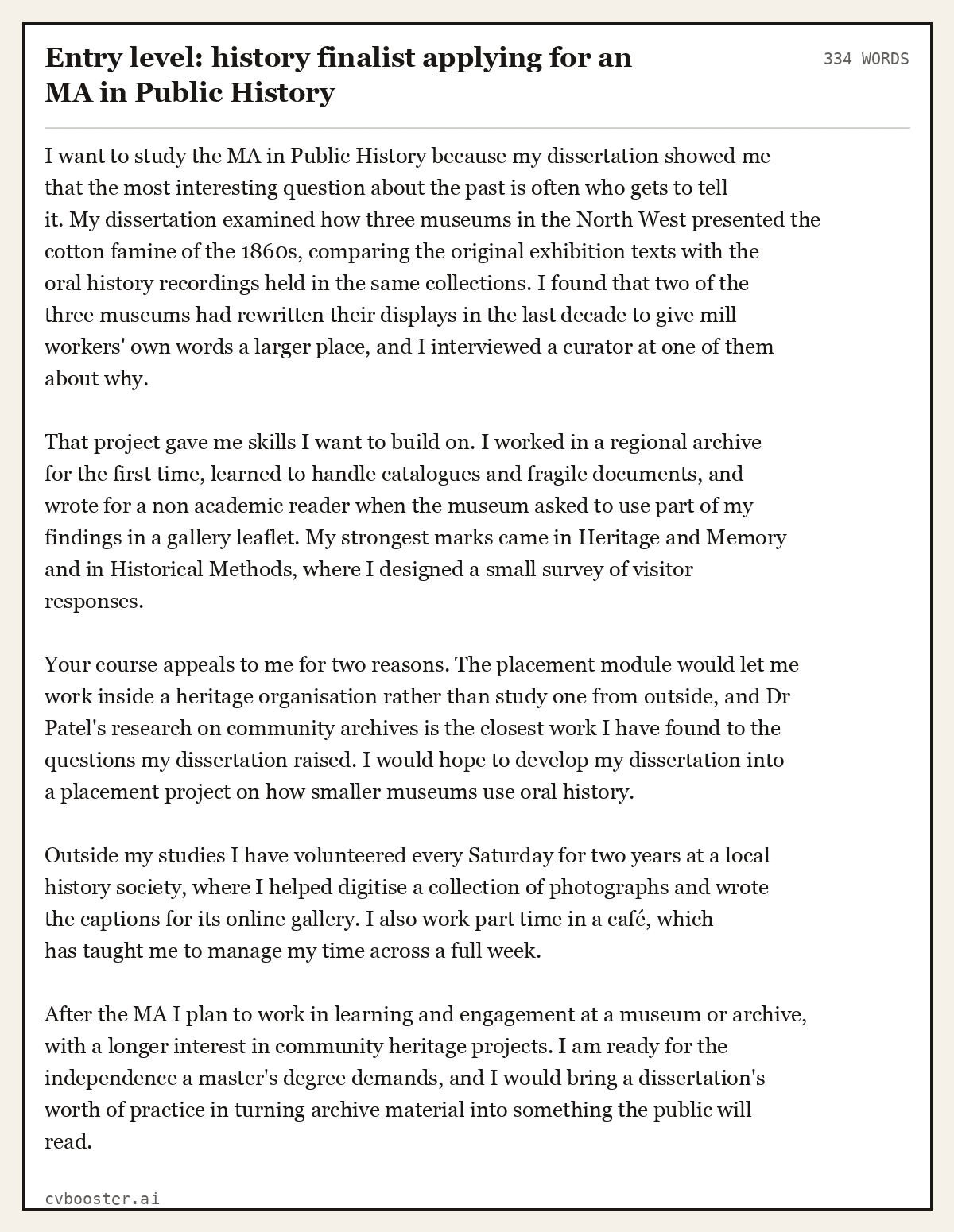
Entry level: history finalist applying for an MA in Public History (334 words)
I want to study the MA in Public History because my dissertation showed me that the most interesting question about the past is often who gets to tell it. My dissertation examined how three museums in the North West presented the cotton famine of the 1860s, comparing the original exhibition texts with the oral history recordings held in the same collections. I found that two of the three museums had rewritten their displays in the last decade to give mill workers' own words a larger place, and I interviewed a curator at one of them about why.
That project gave me skills I want to build on. I worked in a regional archive for the first time, learned to handle catalogues and fragile documents, and wrote for a non academic reader when the museum asked to use part of my findings in a gallery leaflet. My strongest marks came in Heritage and Memory and in Historical Methods, where I designed a small survey of visitor responses.
Your course appeals to me for two reasons. The placement module would let me work inside a heritage organisation rather than study one from outside, and Dr Patel's research on community archives is the closest work I have found to the questions my dissertation raised. I would hope to develop my dissertation into a placement project on how smaller museums use oral history.
Outside my studies I have volunteered every Saturday for two years at a local history society, where I helped digitise a collection of photographs and wrote the captions for its online gallery. I also work part time in a café, which has taught me to manage my time across a full week.
After the MA I plan to work in learning and engagement at a museum or archive, with a longer interest in community heritage projects. I am ready for the independence a master's degree demands, and I would bring a dissertation's worth of practice in turning archive material into something the public will read.
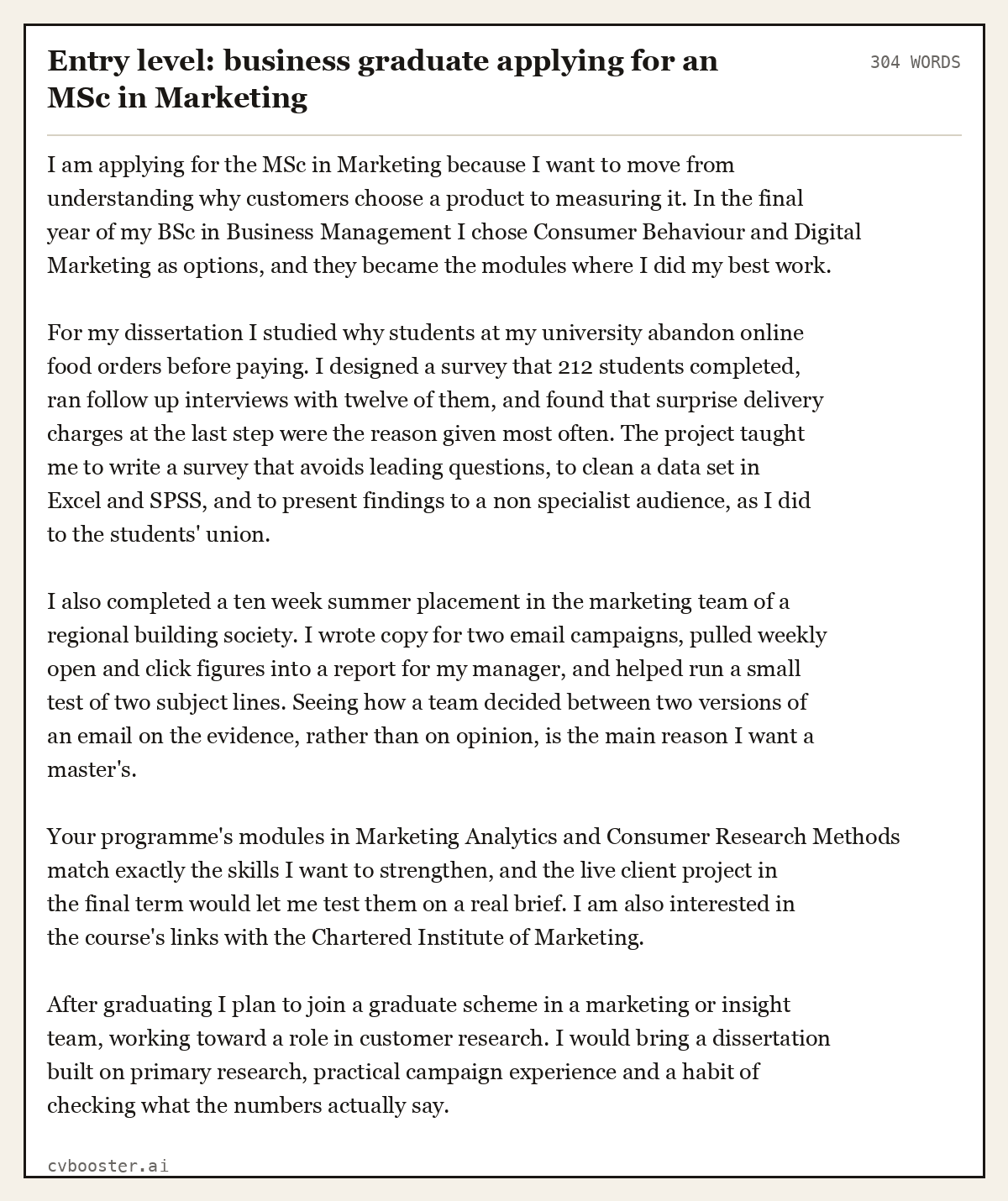
Entry level: business graduate applying for an MSc in Marketing (304 words)
I am applying for the MSc in Marketing because I want to move from understanding why customers choose a product to measuring it. In the final year of my BSc in Business Management I chose Consumer Behaviour and Digital Marketing as options, and they became the modules where I did my best work.
For my dissertation I studied why students at my university abandon online food orders before paying. I designed a survey that 212 students completed, ran follow up interviews with twelve of them, and found that surprise delivery charges at the last step were the reason given most often. The project taught me to write a survey that avoids leading questions, to clean a data set in Excel and SPSS, and to present findings to a non specialist audience, as I did to the students' union.
I also completed a ten week summer placement in the marketing team of a regional building society. I wrote copy for two email campaigns, pulled weekly open and click figures into a report for my manager, and helped run a small test of two subject lines. Seeing how a team decided between two versions of an email on the evidence, rather than on opinion, is the main reason I want a master's.
Your programme's modules in Marketing Analytics and Consumer Research Methods match exactly the skills I want to strengthen, and the live client project in the final term would let me test them on a real brief. I am also interested in the course's links with the Chartered Institute of Marketing.
After graduating I plan to join a graduate scheme in a marketing or insight team, working toward a role in customer research. I would bring a dissertation built on primary research, practical campaign experience and a habit of checking what the numbers actually say.
How long a master's personal statement should be
Check the course page first, because universities set their own limits and the application portal will cut you off at theirs. The University of Edinburgh is explicit: "Your personal statement should be no more than 3,500 characters (approximately 500 words) in length." Prospects, the UK graduate careers site, gives the same default: "Word count: typically 500 words (unless the university specifies otherwise)."
If a course gives no limit, write 500 to 700 words on one side of A4. If it asks specific questions in separate boxes, answer each box directly instead of pasting a single statement across them.
How to structure a master's personal statement
Five paragraphs fit almost every course. Each one answers a question the tutor is asking, in the order they ask it.
- Why this subject and this course: the specific question or interest that brought you here, in one or two sentences.
- Academic preparation: your dissertation, key modules, marks you are proud of and the methods you used.
- Practical experience: a placement, job, volunteering or research assistant work, with what you did and what it taught you.
- Why this university: named modules, a research group, a placement or a facility. The University of Sussex tells applicants: "Your personal statement should show us that you are the right person for the course."
- Your plans: the job or the PhD you are aiming for, and how this course gets you there.
Keep each paragraph to one idea. A tutor reading forty statements for one course will forgive a plain opening line long before a clever one that takes three sentences to reach the point.
Personal statement for a conversion master's
A conversion master's takes graduates from another subject into a new field, such as psychology, law or computer science. The tutor's question is whether you can handle the subject from a standing start, so show the bridge: a module you took, a course you completed independently, or work where you used the new subject.
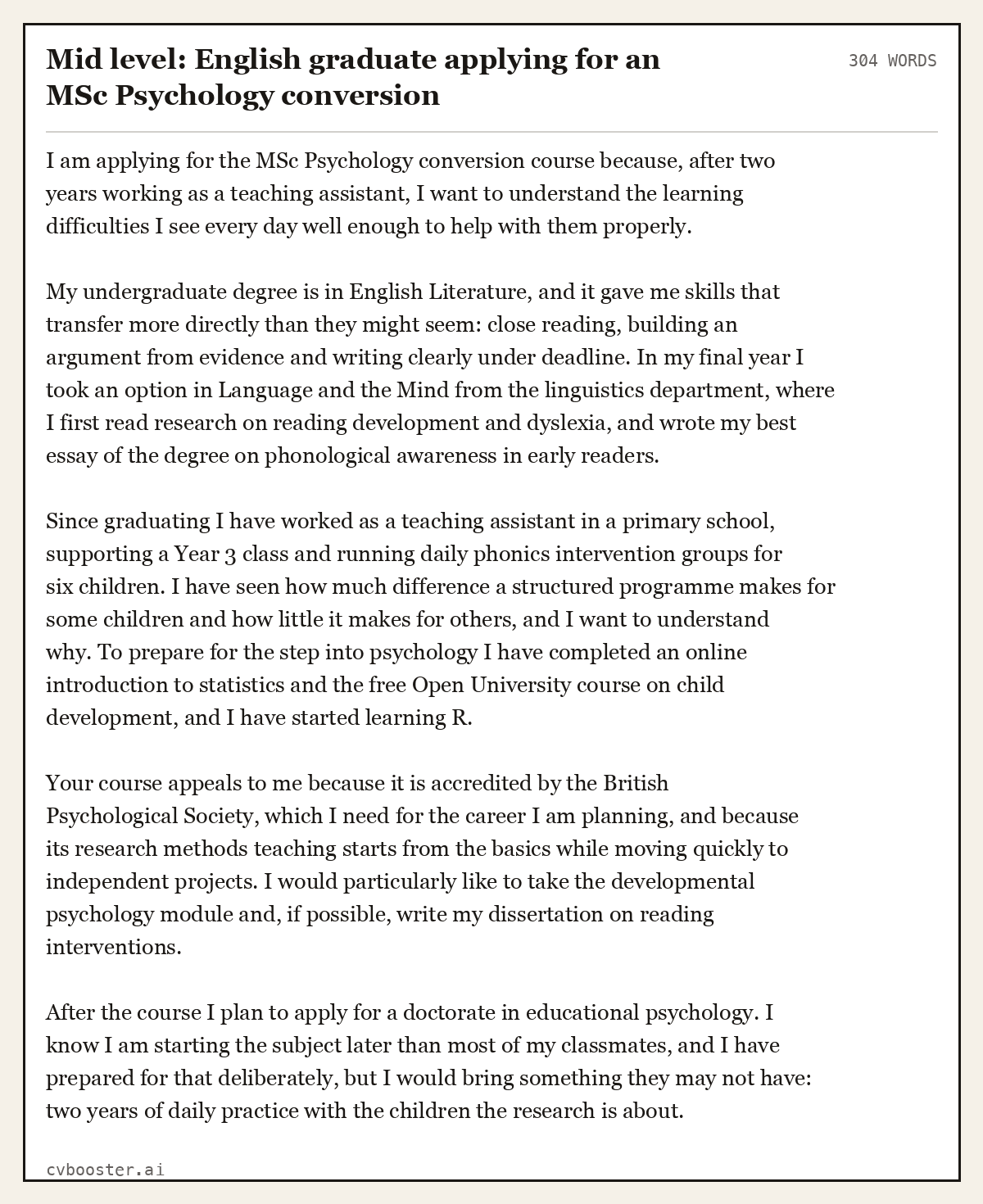
Mid level: English graduate applying for an MSc Psychology conversion (304 words)
I am applying for the MSc Psychology conversion course because, after two years working as a teaching assistant, I want to understand the learning difficulties I see every day well enough to help with them properly.
My undergraduate degree is in English Literature, and it gave me skills that transfer more directly than they might seem: close reading, building an argument from evidence and writing clearly under deadline. In my final year I took an option in Language and the Mind from the linguistics department, where I first read research on reading development and dyslexia, and wrote my best essay of the degree on phonological awareness in early readers.
Since graduating I have worked as a teaching assistant in a primary school, supporting a Year 3 class and running daily phonics intervention groups for six children. I have seen how much difference a structured programme makes for some children and how little it makes for others, and I want to understand why. To prepare for the step into psychology I have completed an online introduction to statistics and the free Open University course on child development, and I have started learning R.
Your course appeals to me because it is accredited by the British Psychological Society, which I need for the career I am planning, and because its research methods teaching starts from the basics while moving quickly to independent projects. I would particularly like to take the developmental psychology module and, if possible, write my dissertation on reading interventions.
After the course I plan to apply for a doctorate in educational psychology. I know I am starting the subject later than most of my classmates, and I have prepared for that deliberately, but I would bring something they may not have: two years of daily practice with the children the research is about.
Master's personal statement for career changers and professionals
If you have been working for several years, your job is the evidence. Name the work, the problem you kept running into, and what the course will let you do about it. Tutors on professional master's courses are often looking for exactly this kind of applicant, so do not apologise for the gap since your degree.
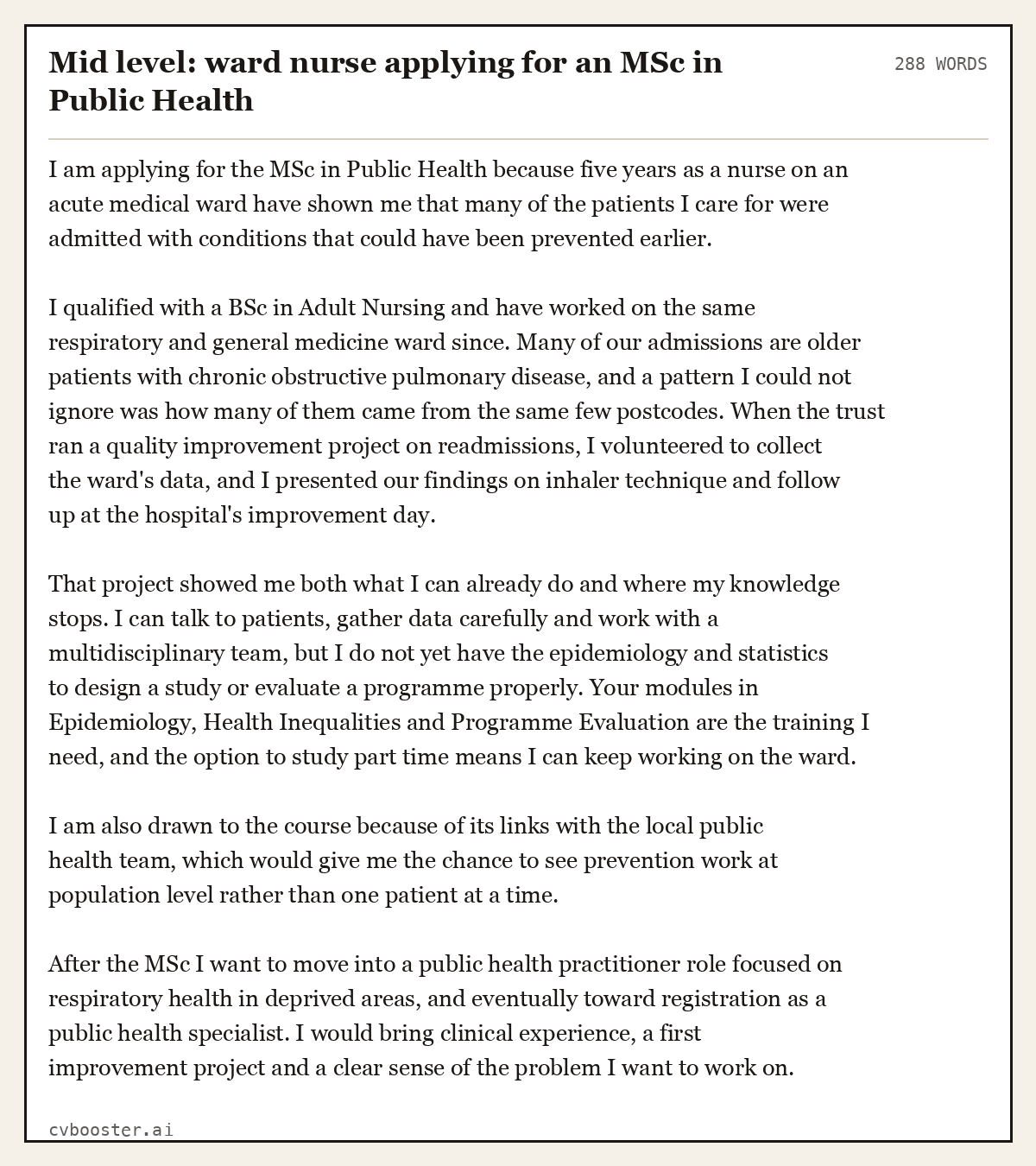
Mid level: ward nurse applying for an MSc in Public Health (288 words)
I am applying for the MSc in Public Health because five years as a nurse on an acute medical ward have shown me that many of the patients I care for were admitted with conditions that could have been prevented earlier.
I qualified with a BSc in Adult Nursing and have worked on the same respiratory and general medicine ward since. Many of our admissions are older patients with chronic obstructive pulmonary disease, and a pattern I could not ignore was how many of them came from the same few postcodes. When the trust ran a quality improvement project on readmissions, I volunteered to collect the ward's data, and I presented our findings on inhaler technique and follow up at the hospital's improvement day.
That project showed me both what I can already do and where my knowledge stops. I can talk to patients, gather data carefully and work with a multidisciplinary team, but I do not yet have the epidemiology and statistics to design a study or evaluate a programme properly. Your modules in Epidemiology, Health Inequalities and Programme Evaluation are the training I need, and the option to study part time means I can keep working on the ward.
I am also drawn to the course because of its links with the local public health team, which would give me the chance to see prevention work at population level rather than one patient at a time.
After the MSc I want to move into a public health practitioner role focused on respiratory health in deprived areas, and eventually toward registration as a public health specialist. I would bring clinical experience, a first improvement project and a clear sense of the problem I want to work on.
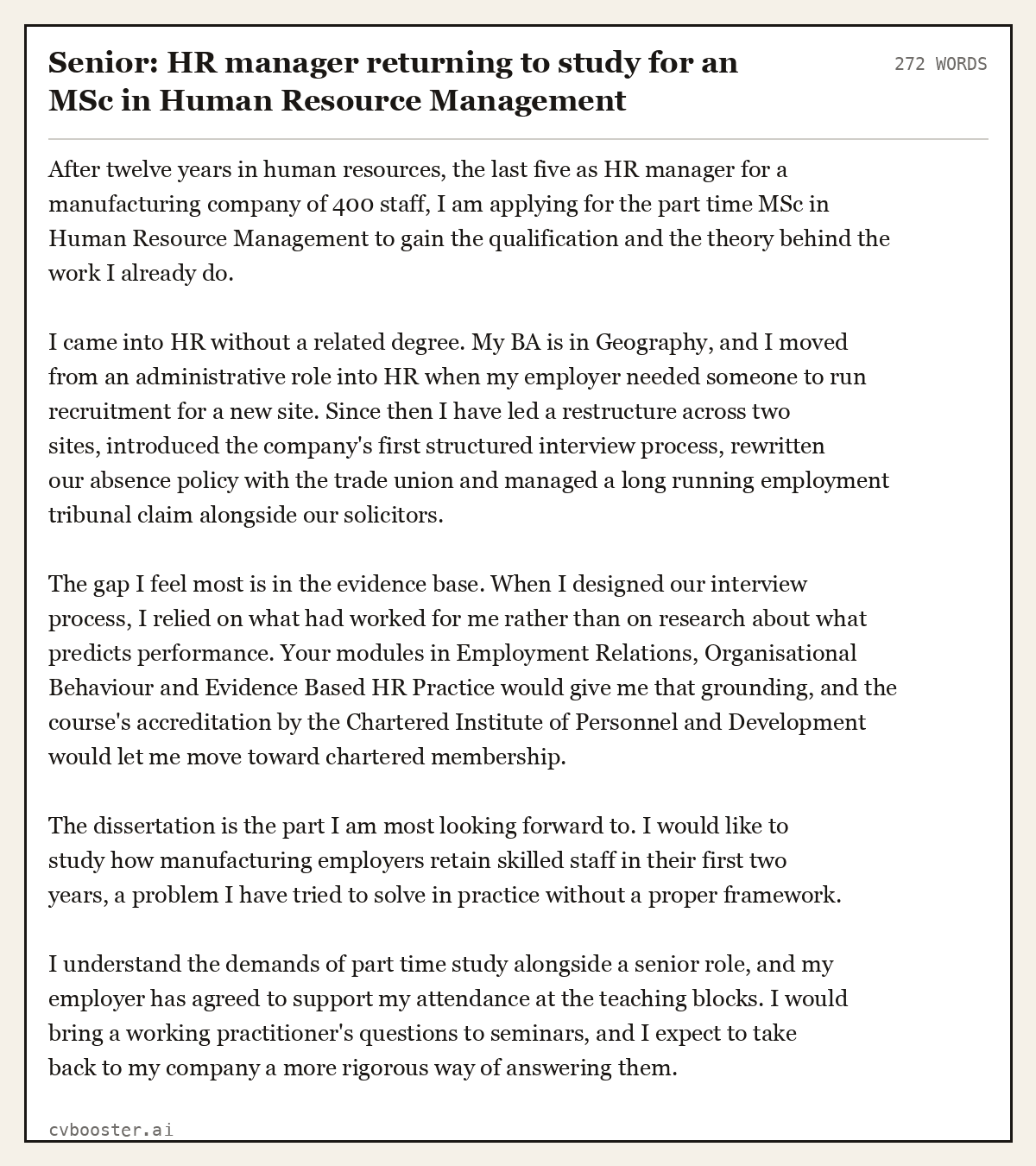
Senior: HR manager returning to study for an MSc in Human Resource Management (272 words)
After twelve years in human resources, the last five as HR manager for a manufacturing company of 400 staff, I am applying for the part time MSc in Human Resource Management to gain the qualification and the theory behind the work I already do.
I came into HR without a related degree. My BA is in Geography, and I moved from an administrative role into HR when my employer needed someone to run recruitment for a new site. Since then I have led a restructure across two sites, introduced the company's first structured interview process, rewritten our absence policy with the trade union and managed a long running employment tribunal claim alongside our solicitors.
The gap I feel most is in the evidence base. When I designed our interview process, I relied on what had worked for me rather than on research about what predicts performance. Your modules in Employment Relations, Organisational Behaviour and Evidence Based HR Practice would give me that grounding, and the course's accreditation by the Chartered Institute of Personnel and Development would let me move toward chartered membership.
The dissertation is the part I am most looking forward to. I would like to study how manufacturing employers retain skilled staff in their first two years, a problem I have tried to solve in practice without a proper framework.
I understand the demands of part time study alongside a senior role, and my employer has agreed to support my attendance at the teaching blocks. I would bring a working practitioner's questions to seminars, and I expect to take back to my company a more rigorous way of answering them.
Master's personal statement for international applicants
International applicants write the same statement, with two additions: show that you understand how UK teaching works, with independent study and coursework, and connect the course to your plans at home or abroad. Mention your English test only if the course asks for it in the statement; it usually belongs elsewhere on the form.
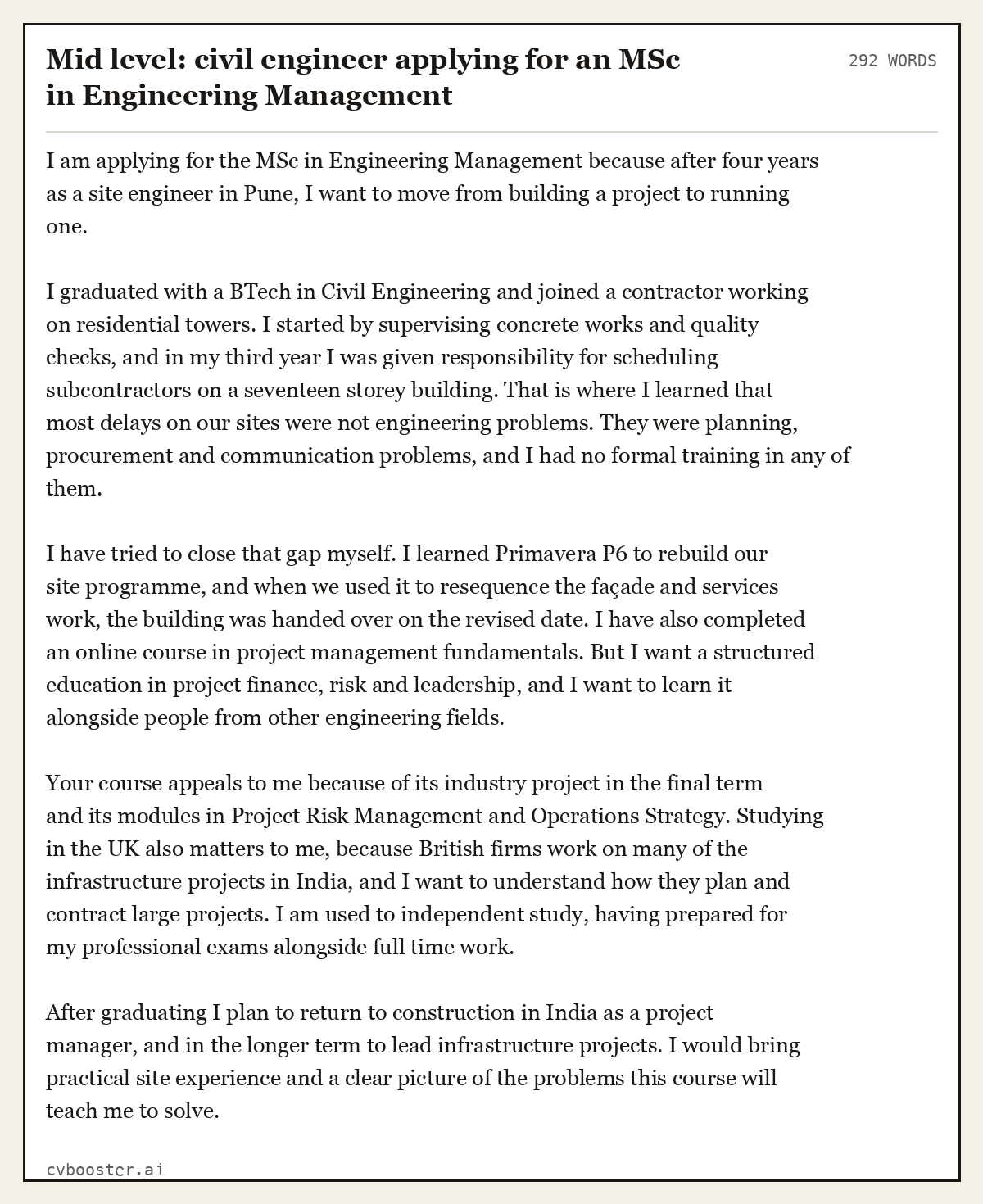
Mid level: civil engineer applying for an MSc in Engineering Management (292 words)
I am applying for the MSc in Engineering Management because after four years as a site engineer in Pune, I want to move from building a project to running one.
I graduated with a BTech in Civil Engineering and joined a contractor working on residential towers. I started by supervising concrete works and quality checks, and in my third year I was given responsibility for scheduling subcontractors on a seventeen storey building. That is where I learned that most delays on our sites were not engineering problems. They were planning, procurement and communication problems, and I had no formal training in any of them.
I have tried to close that gap myself. I learned Primavera P6 to rebuild our site programme, and when we used it to resequence the façade and services work, the building was handed over on the revised date. I have also completed an online course in project management fundamentals. But I want a structured education in project finance, risk and leadership, and I want to learn it alongside people from other engineering fields.
Your course appeals to me because of its industry project in the final term and its modules in Project Risk Management and Operations Strategy. Studying in the UK also matters to me, because British firms work on many of the infrastructure projects in India, and I want to understand how they plan and contract large projects. I am used to independent study, having prepared for my professional exams alongside full time work.
After graduating I plan to return to construction in India as a project manager, and in the longer term to lead infrastructure projects. I would bring practical site experience and a clear picture of the problems this course will teach me to solve.
What admissions tutors cut from a master's statement
The Prospects guide says to "focus on why you want to study a particular programme and your potential to successfully complete the course." Everything that does neither can go.
- Childhood stories. "Ever since I was young" tells the tutor nothing about your readiness for postgraduate study.
- Quotations from famous people. Use the space for your own evidence.
- Lists of every module you took. Pick two or three and say what you did in them.
- A statement written for five universities. If a tutor can swap their course name for a rival's without changing a sentence, it reads as generic.
- Claims without proof. "I am passionate about data" is weaker than "I taught myself R to analyse my dissertation survey."
A master's statement shares a lot with a job application: both need evidence before adjectives. If you are applying for work at the same time, our guide on how to write a personal statement for a job covers the version employers ask for, and the CV personal statement examples show the short profile that sits at the top of a CV. For roles that ask for a longer statement against criteria, see how to write a supporting statement.
Frequently asked questions
How long should a master's personal statement be?
Usually about 500 words, or around 3,500 characters, which is one side of A4. Always follow the limit on the course page or in the application portal, because universities set their own and the form will cut off anything longer. If no limit is given, stay between 500 and 700 words.
How do I start a personal statement for a master's?
Start with the specific reason you want this course: a question from your dissertation, a problem from your job, or a module that changed your direction. Put it in one or two plain sentences. Avoid opening with a quotation, a dictionary definition or a childhood memory, because they delay the point the tutor is reading for.
What should I include in a master's personal statement?
Why you want this subject and this course, the academic preparation you have such as your dissertation and key modules, any relevant work or volunteering, what attracts you to this particular university, and your plans after graduating. Back each point with something specific you did, not an adjective about yourself.
Is a master's personal statement different from an undergraduate one?
Yes. An undergraduate statement shows interest and potential across a whole subject. A master's statement shows depth in a particular area, names the course's modules or research groups, and explains how the degree fits a specific career or research plan. Tutors expect you to sound like someone who already knows the subject.
Can I use the same personal statement for different universities?
You can keep the same core paragraphs about your degree and experience, but rewrite the course and university paragraph for each application. Name the modules, staff research, placements or facilities that drew you to that course. A statement that would fit any university reads as one that was not written for theirs.
Related articles
- Accountancy CV Example: 6 UK Accounts CVs by Career Level
- Accounting Interview Questions and Answers: 7 Full Examples
- Activity Resume Example: 6 Samples for College Applications
- Administration CV Example: 6 Admin CVs from Entry to Senior
More articles
- Sample MBA Recommendation Letters: 6 Examples That Work
- Medical Cover Letter Examples: 7 Samples by Role and Level
- Medical CV Template: 5 UK Examples, Student to Consultant
Looking for a worked example for your job title? Browse the resume examples by job title.