How to Address a Cover Letter: Salutations and 8 Openings
By Mustafa Tarabya, founder of CVBooster · Published · Updated
7 min read
Address your cover letter to a named person whenever you can find one, in the form "Dear Ms. Alvarez" or "Dear Dr. Chen". When no name exists, "Dear Hiring Manager" is the safe fallback, and a team greeting is better still when you know the department. The salutation is the first line the reader sees, so it should show you did a little homework. Below is how to find the name, what to write when you cannot, and eight complete openings, each with the greeting and first lines that follow. Written by Mustafa Tarabya, who hired for his own company, read every application himself and now writes CVBooster's guides.
I opened hundreds of applications myself. A letter with my name on it got read first. A letter to "Dear Sir or Madam" got read the way you read a flyer.
The best way to address a cover letter: use a name
The graduate careers service Prospects says: "Always try and address your cover letter directly to the person who will be reading it." It also gives the reason: "you're more likely to receive a reply if you send it to the right person."
Here is what a letter looks like when the name is known. A software support role, name taken from the job ad.
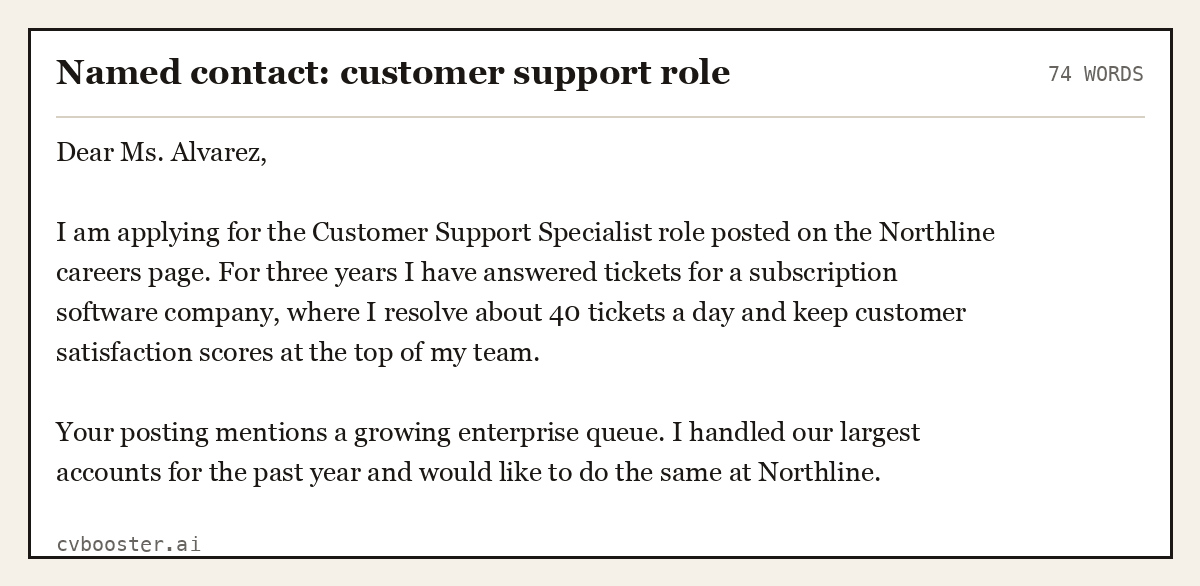
Named contact: customer support role (74 words)
Dear Ms. Alvarez,
I am applying for the Customer Support Specialist role posted on the Northline careers page. For three years I have answered tickets for a subscription software company, where I resolve about 40 tickets a day and keep customer satisfaction scores at the top of my team.
Your posting mentions a growing enterprise queue. I handled our largest accounts for the past year and would like to do the same at Northline.
Create my CV
Or start from one of our free resume templates
Three details make it work. The title is correct, the surname is spelled as the employer spells it, and the first line names the exact role.
Where to find the name
Work down this list and stop when you find it.
- The job posting. Prospects notes that "for advertised roles, the person to address the application to is often named in the job description." Check the contact line, the "apply to" line and the footer.
- The company website. Look at the team, about or careers pages for a head of the department or a recruiter.
- LinkedIn. Search the company and the job title, such as Marketing Manager at the company.
- A phone call. Prospects says "there's nothing wrong with giving the organisation a call to ask who to address your cover letter to." Ask the front desk who is handling applications for the role.
- The agency consultant. If a recruitment agency posted the job, write to the consultant named on the posting.
Check the spelling and the title before you send. If you cannot tell whether someone is Ms., Mr. or Dr., use the full name instead: "Dear Jordan Lee". That is accepted and avoids a guess.
How to address a cover letter without a name
If you have tried every step above, use a general greeting. Prospects lists "Dear Sir/Madam", "Dear Hiring manager" and "Dear Human resources director", and adds that "general greetings should only be used once you have exhausted all other methods of finding a named contact." In the United States, "Dear Hiring Manager" is the most common and the least risky of these.
Better options, from strongest to weakest:
- A team or department. A greeting to the Finance Team or the Marketing Hiring Team shows you know where the job sits.
- The role's likely manager. Hiring Manager, Operations, works when the posting names the department.
- Dear Hiring Manager. The standard fallback.
- Dear Sir or Madam. Acceptable, but it reads as old-fashioned in the US. Skip it unless the employer is formal, such as a law firm or a public body.
- To Whom It May Concern. Avoid it for job applications. We explain why, and when it is still right, in our guide to To Whom It May Concern letters.
For more on the Hiring Manager greeting, see Dear HR Manager cover letters. This page does not repeat it.
Never skip the greeting and never write "Hi [Company]" or "Hey there". Both look careless in a formal application.
Punctuation and sign-off
In US business letters, put a comma after the salutation in an email and a colon in a printed formal letter; both are accepted, and the comma is the usual choice for a cover letter sent online. Close with "Sincerely," in the US.
British guidance links the sign-off to the greeting. The University of York's careers service says to use "Yours sincerely" when the letter "is addressed to a person" and "Yours faithfully" when it is addressed to the organisation or Sir/Madam. The University of Manchester's Careers Service says the same: a letter that starts with a named person should finish "Yours sincerely", and otherwise should end "Yours faithfully". If you are applying to a UK employer, follow that rule. If you are in the US, "Sincerely" is the standard either way.
Eight complete cover letter openings
Each opening below gives the greeting and the first lines. Copy the structure, then swap in your own details.
1. Named hiring manager
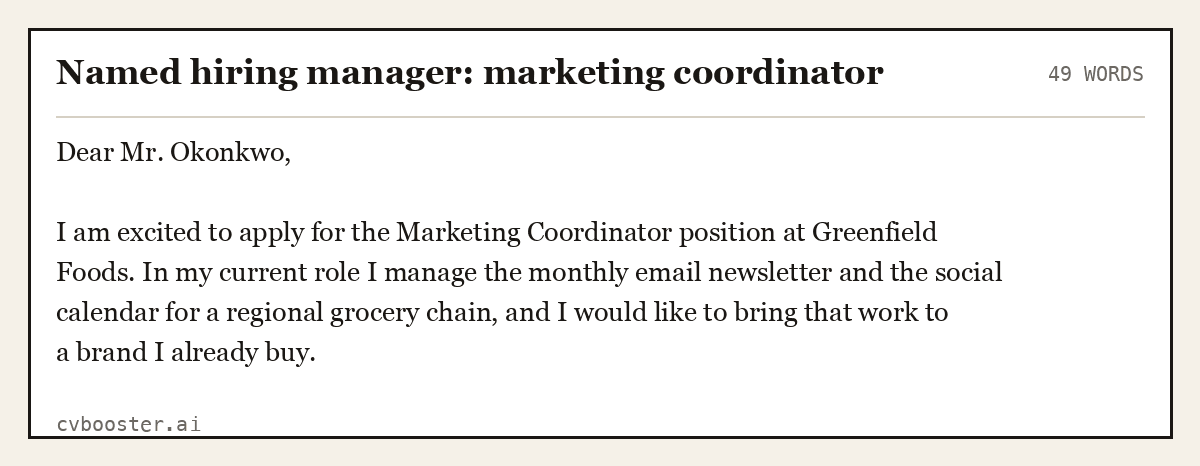
Named hiring manager: marketing coordinator (49 words)
Dear Mr. Okonkwo,
I am excited to apply for the Marketing Coordinator position at Greenfield Foods. In my current role I manage the monthly email newsletter and the social calendar for a regional grocery chain, and I would like to bring that work to a brand I already buy.
2. Name found on LinkedIn
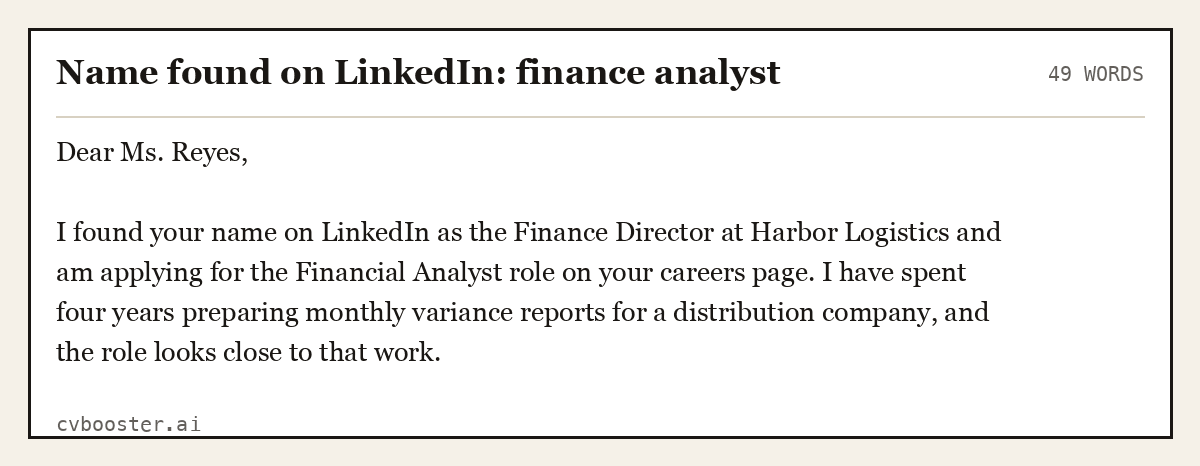
Name found on LinkedIn: finance analyst (49 words)
Dear Ms. Reyes,
I found your name on LinkedIn as the Finance Director at Harbor Logistics and am applying for the Financial Analyst role on your careers page. I have spent four years preparing monthly variance reports for a distribution company, and the role looks close to that work.
3. Gender unknown, full name used
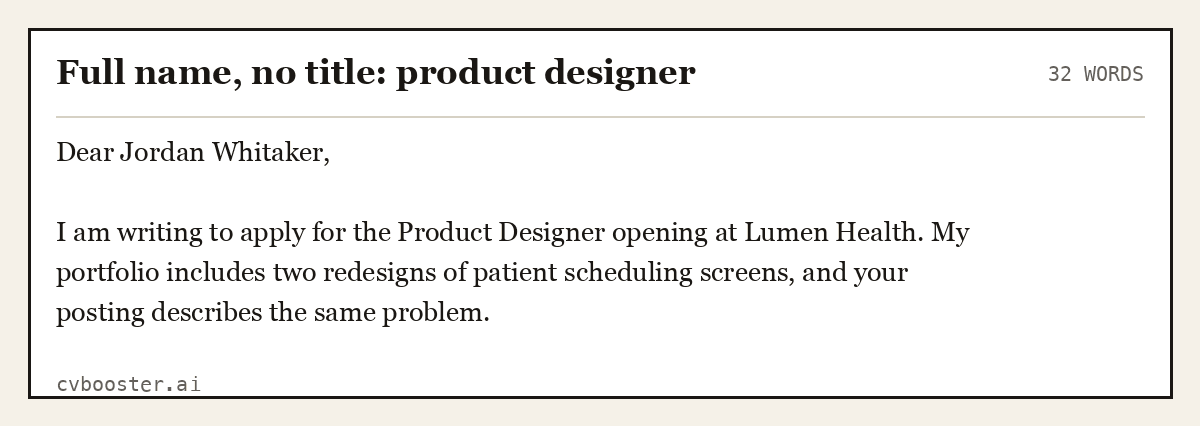
Full name, no title: product designer (32 words)
Dear Jordan Whitaker,
I am writing to apply for the Product Designer opening at Lumen Health. My portfolio includes two redesigns of patient scheduling screens, and your posting describes the same problem.
4. Department team
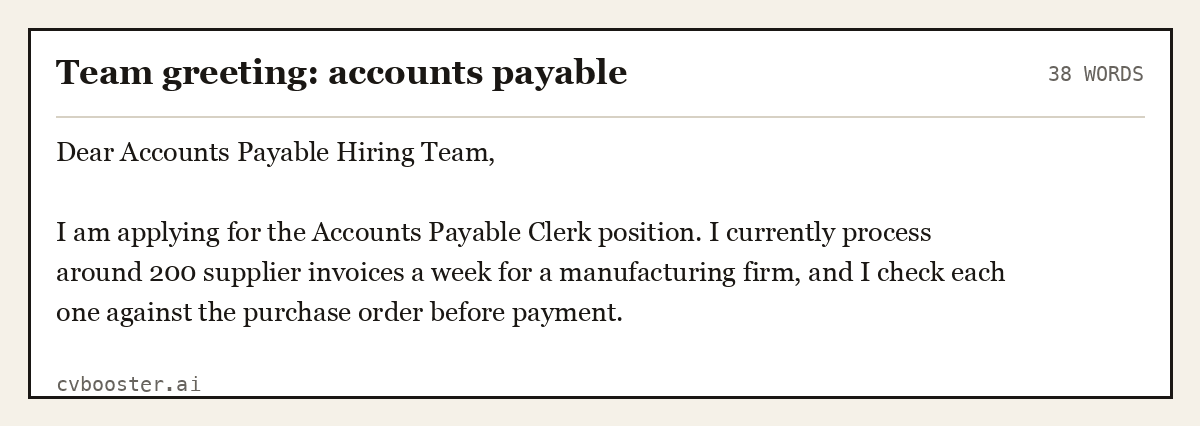
Team greeting: accounts payable (38 words)
Dear Accounts Payable Hiring Team,
I am applying for the Accounts Payable Clerk position. I currently process around 200 supplier invoices a week for a manufacturing firm, and I check each one against the purchase order before payment.
5. Dear Hiring Manager, with role named
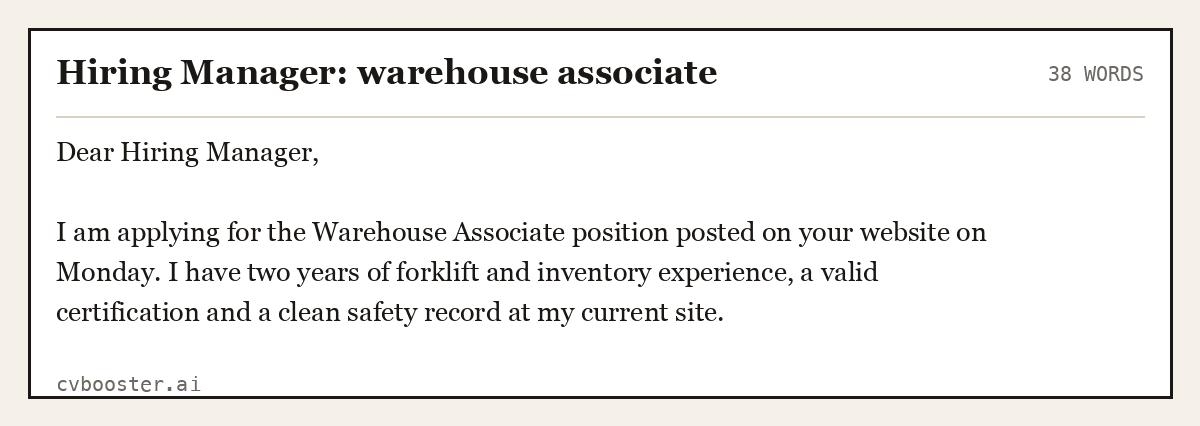
Hiring Manager: warehouse associate (38 words)
Dear Hiring Manager,
I am applying for the Warehouse Associate position posted on your website on Monday. I have two years of forklift and inventory experience, a valid certification and a clean safety record at my current site.
6. Speculative letter to a named lead
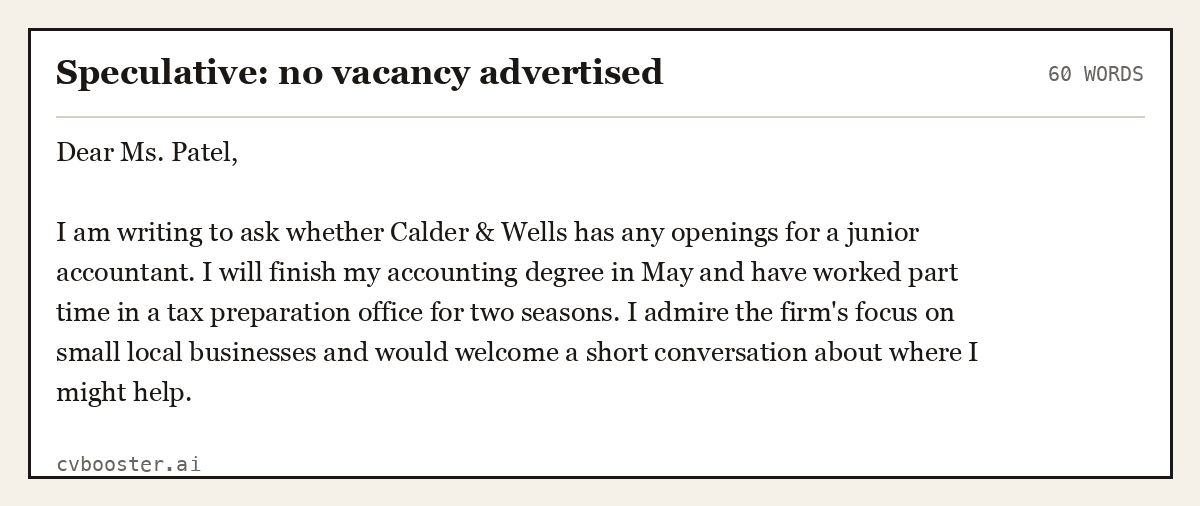
Speculative: no vacancy advertised (60 words)
Dear Ms. Patel,
I am writing to ask whether Calder & Wells has any openings for a junior accountant. I will finish my accounting degree in May and have worked part time in a tax preparation office for two seasons. I admire the firm's focus on small local businesses and would welcome a short conversation about where I might help.
7. Recruiter or agency consultant
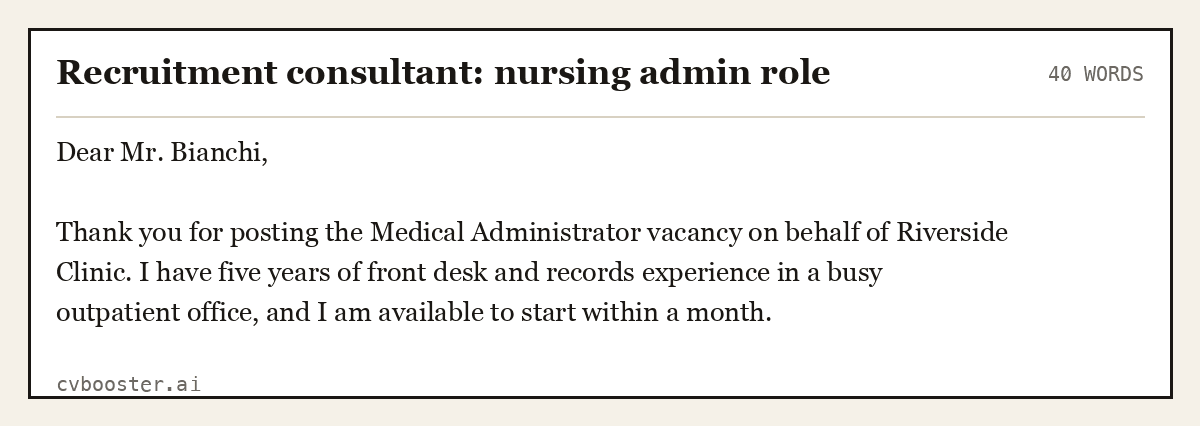
Recruitment consultant: nursing admin role (40 words)
Dear Mr. Bianchi,
Thank you for posting the Medical Administrator vacancy on behalf of Riverside Clinic. I have five years of front desk and records experience in a busy outpatient office, and I am available to start within a month.
8. Referral from an employee
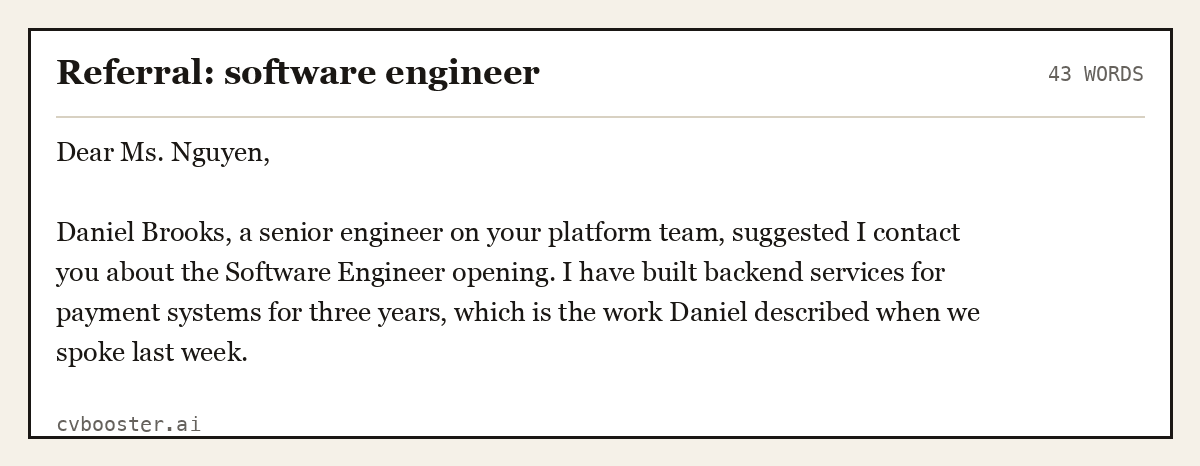
Referral: software engineer (43 words)
Dear Ms. Nguyen,
Daniel Brooks, a senior engineer on your platform team, suggested I contact you about the Software Engineer opening. I have built backend services for payment systems for three years, which is the work Daniel described when we spoke last week.
A referral name belongs in the first sentence. It is the single strongest thing an opener can carry.
Common mistakes in cover letter greetings
- Wrong name or title. A misspelled surname is worse than no name. Check the source.
- Old contact. If the name is from an old post, confirm the person still works there.
- Too casual. A chatty hi to the team belongs in a chat, not an application.
- Gendered guess. If you are unsure, use the full name.
- Generic subject line. In an email, put the job title and reference in the subject. Manchester advises using the job reference number so it is "clear which opportunity you're interested in."
For the layout of the whole letter, see our cover letter format guide.
Frequently asked questions
Is it okay to use "Dear Hiring Manager"?
Yes. It is the standard fallback when you cannot find a name. Use it only after you have checked the job posting, the company website and LinkedIn.
Should I use Mr., Ms. or Mrs.?
Use Ms. for a woman when you do not know her preference, and Mr. for a man. If you are unsure of the person's gender or title, write the full name: "Dear Alex Morgan". Use Dr. or Prof. when the person holds that title.
Can I address a cover letter to a company?
You can write a greeting to the company hiring team when you have no individual name. It is a better choice than "To Whom It May Concern" because it shows you are applying to a specific employer.
Do I need a comma or a colon after the greeting?
Either is accepted. A comma is the usual choice for an email or an online application. A colon is more formal and suits a printed letter.
What if the job ad says to address it to a specific title?
Do exactly what the ad says. If it asks for "Dear Selection Panel" or names a reference code, use those words in the greeting or subject line.
Related articles
- Dear HR Manager Cover Letter: 6 Samples and When to Use It
- Designer Cover Letter: 7 Examples for UX, Product, Web
- Finance Cover Letter: 7 Examples for Analysts and Grads
- How Long Should a Cover Letter Be? UK Guide and Examples
More articles
- How to Cancel an Interview: 7 Emails That Keep Doors Open
- How to Change Careers at 30, 40 or 50: A Method, Not a Pep Talk
- How to Decline a Job Offer: 7 Emails That Keep the Door Open
Looking for a worked example for your job title? Browse the resume examples by job title.