How to Get Into the Police in the UK: 6 Entry Routes
By Mustafa Tarabya, founder of CVBooster · Published · Updated
9 min read
You get into the police by applying to one force, on one of six routes, and you are a paid constable from day one on four of them. Your existing qualification level decides the route, nothing else. The College of Policing states that "To join the police, you need to apply to a local force, who decide which entry routes they offer", and on 12 September 2026 the Home Office site recorded that "28 police forces in England and Wales are currently recruiting." Every requirement below is quoted from the College of Policing, a force's own recruitment page or the National Careers Service, with the CV section that suits that route. Written by Mustafa Tarabya, who hired for his own company, read every application himself and now writes CVBooster's guides.
The six routes, and the qualification each one assumes
| Route | Length | What you need before you apply | Award at the end |
|---|---|---|---|
| 1. Police Constable Degree Apprenticeship | Three years | Level 3, or the force's own equivalent | Degree in professional policing |
| 2. Police Constable Entry Programme | Two years | Level 3, no degree study during probation | Constable, qualification optional |
| 3. Degree Holder Entry Programme | Two years | Any degree | Level 6 Graduate Diploma |
| 4. Degree in Professional Policing | Two or three years first | UCAS entry, self-funded | Degree, then apply to a force |
| 5. Special constable, then paid officer | Minimum four hours a week | Nothing beyond force eligibility | The same core training |
| 6. Police Scotland direct entry | 18 weeks then two years probation | No formal qualifications | Constable at £34,001 rising |
Route 1: the Police Constable Degree Apprenticeship, three years
The College of Policing route page says: "You'll get a fully funded degree in professional policing practice when you complete your three-year initial training programme." It adds that "You will specialise in your final year in either response, neighbourhoods, investigation, intelligence or roads policing."
This is the route for a school leaver with Level 3 qualifications and no money for university.
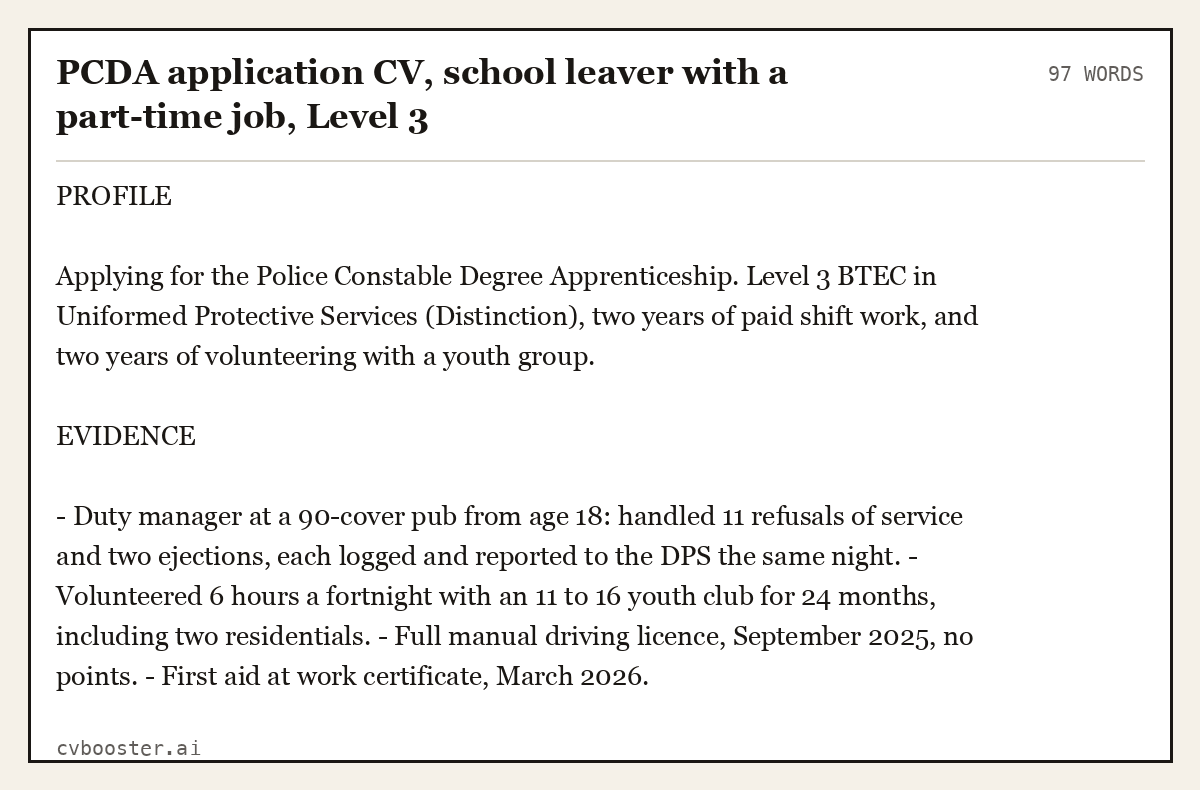
PCDA application CV, school leaver with a part-time job, Level 3 (97 words)
PROFILE
Applying for the Police Constable Degree Apprenticeship. Level 3 BTEC in Uniformed Protective Services (Distinction), two years of paid shift work, and two years of volunteering with a youth group.
EVIDENCE
- Duty manager at a 90-cover pub from age 18: handled 11 refusals of service and two ejections, each logged and reported to the DPS the same night. - Volunteered 6 hours a fortnight with an 11 to 16 youth club for 24 months, including two residentials. - Full manual driving licence, September 2025, no points. - First aid at work certificate, March 2026.
Route 2: the Police Constable Entry Programme, two years and no degree study
The baseline qualification for England and Wales is published on the Home Office's own ways in to policing page: "The minimum education requirement for joining the police is a Level 3 Qualification. This is defined as two A-Levels, but there are other qualifications that are equivalent". The same site adds: "We welcome applications from people of all backgrounds, cultures and experiences and you don’t need a degree to join."
This is the shortest route for someone without one. The College of Policing states: "The PCEP is a two-year programme. It can be entirely force delivered, with or without leading to a professional policing qualification." It is honest about the trade: "By design, this route does not cover all the advanced specialist experience and development included in the other routes."
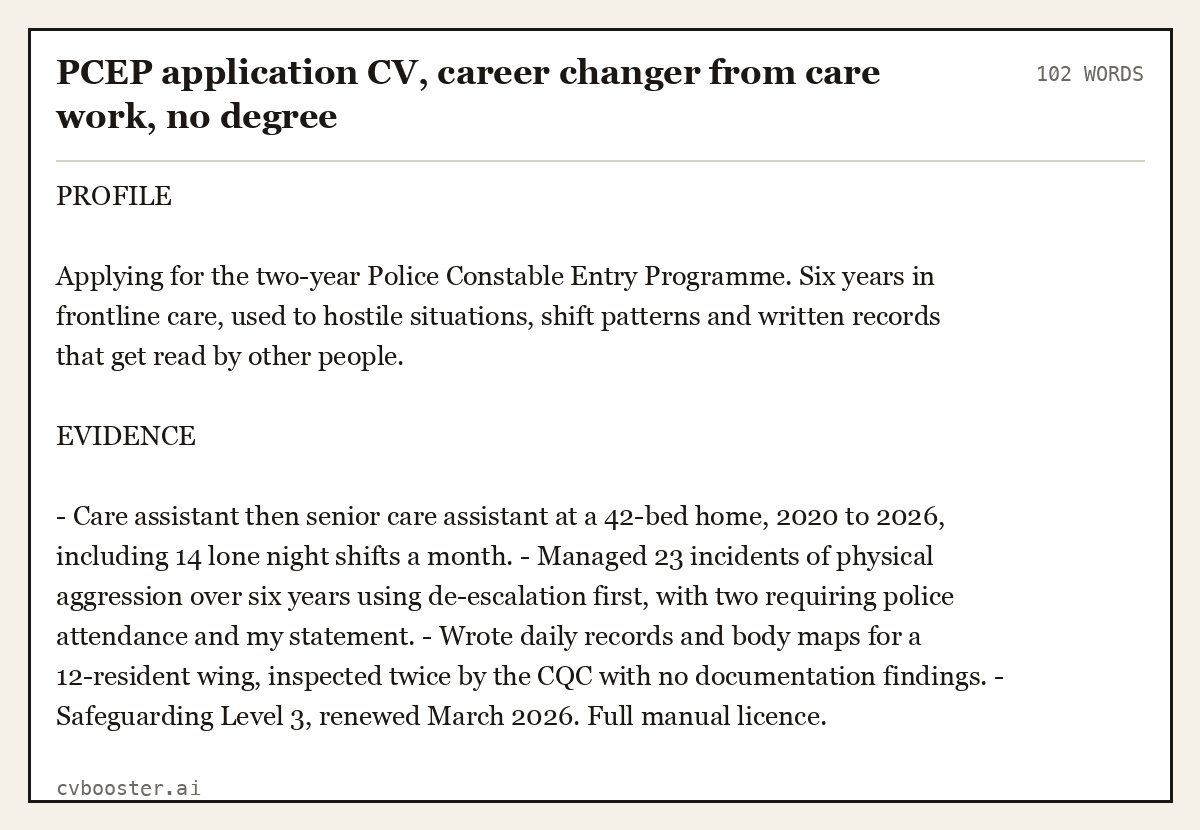
PCEP application CV, career changer from care work, no degree (102 words)
PROFILE
Applying for the two-year Police Constable Entry Programme. Six years in frontline care, used to hostile situations, shift patterns and written records that get read by other people.
EVIDENCE
- Care assistant then senior care assistant at a 42-bed home, 2020 to 2026, including 14 lone night shifts a month. - Managed 23 incidents of physical aggression over six years using de-escalation first, with two requiring police attendance and my statement. - Wrote daily records and body maps for a 12-resident wing, inspected twice by the CQC with no documentation findings. - Safeguarding Level 3, renewed March 2026. Full manual licence.
Route 3: the Degree Holder Entry Programme, for graduates in any subject
If you hold a degree, this route runs two years and pays for a further qualification: "You will be awarded a Level 6 Graduate Diploma in Professional Policing Practice on completion." The programme is "designed to take advantage of the critical thinking skills you have already developed through previous study".
Your subject does not matter. Evidence of judgement under pressure does, and most graduates have it from work rather than study.
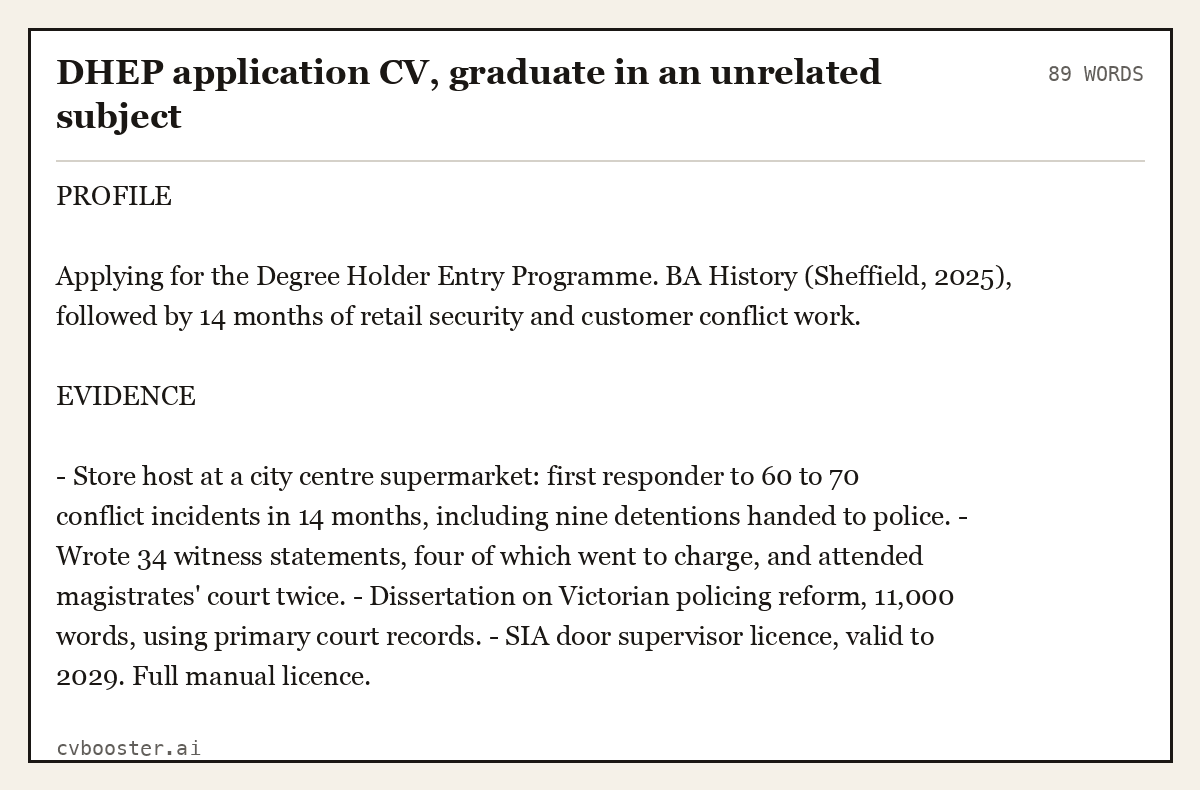
DHEP application CV, graduate in an unrelated subject (89 words)
PROFILE
Applying for the Degree Holder Entry Programme. BA History (Sheffield, 2025), followed by 14 months of retail security and customer conflict work.
EVIDENCE
- Store host at a city centre supermarket: first responder to 60 to 70 conflict incidents in 14 months, including nine detentions handed to police. - Wrote 34 witness statements, four of which went to charge, and attended magistrates' court twice. - Dissertation on Victorian policing reform, 11,000 words, using primary court records. - SIA door supervisor licence, valid to 2029. Full manual licence.
Route 4: the Degree in Professional Policing, studied before you apply
The one route where you pay. The College of Policing explains: "If you'd like to study at university before joining the police, you can take a degree in professional policing. You can apply through the UCAS process and study is self-funded." It also warns what it does not buy: "After completing a two- or three-year course, you'll need to apply to join the police."
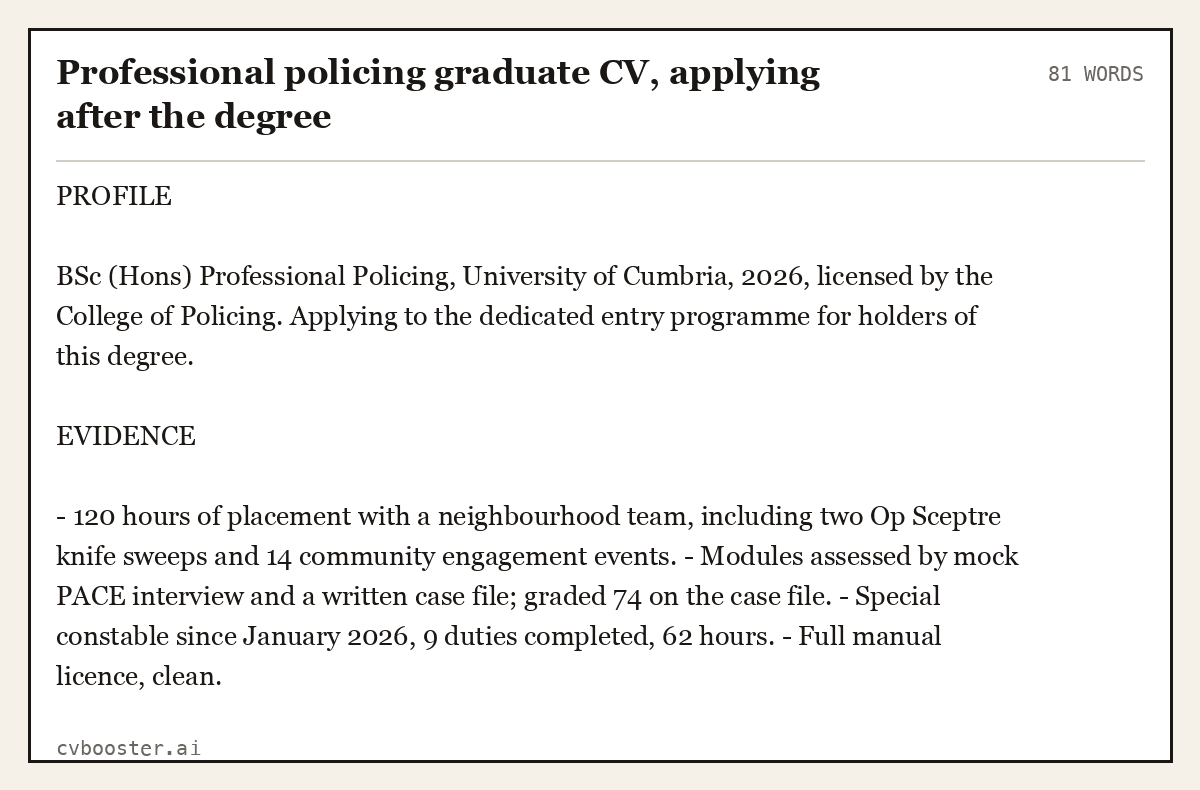
Professional policing graduate CV, applying after the degree (81 words)
PROFILE
BSc (Hons) Professional Policing, University of Cumbria, 2026, licensed by the College of Policing. Applying to the dedicated entry programme for holders of this degree.
EVIDENCE
- 120 hours of placement with a neighbourhood team, including two Op Sceptre knife sweeps and 14 community engagement events. - Modules assessed by mock PACE interview and a written case file; graded 74 on the case file. - Special constable since January 2026, 9 duties completed, 62 hours. - Full manual licence, clean.
Route 5: the special constable, and then the paid seat
The cheapest way to find out whether you want this job. The Home Office site sets the commitment: "You can volunteer as a Special Constable, where you'll undertake the same training as a regular paid Police Constable, while committing to a minimum of four hours a week." It notes the reward later: "Some forces have dedicated entry programmes for people who already volunteer." Nothing on a police application beats duties already performed under the same powers.
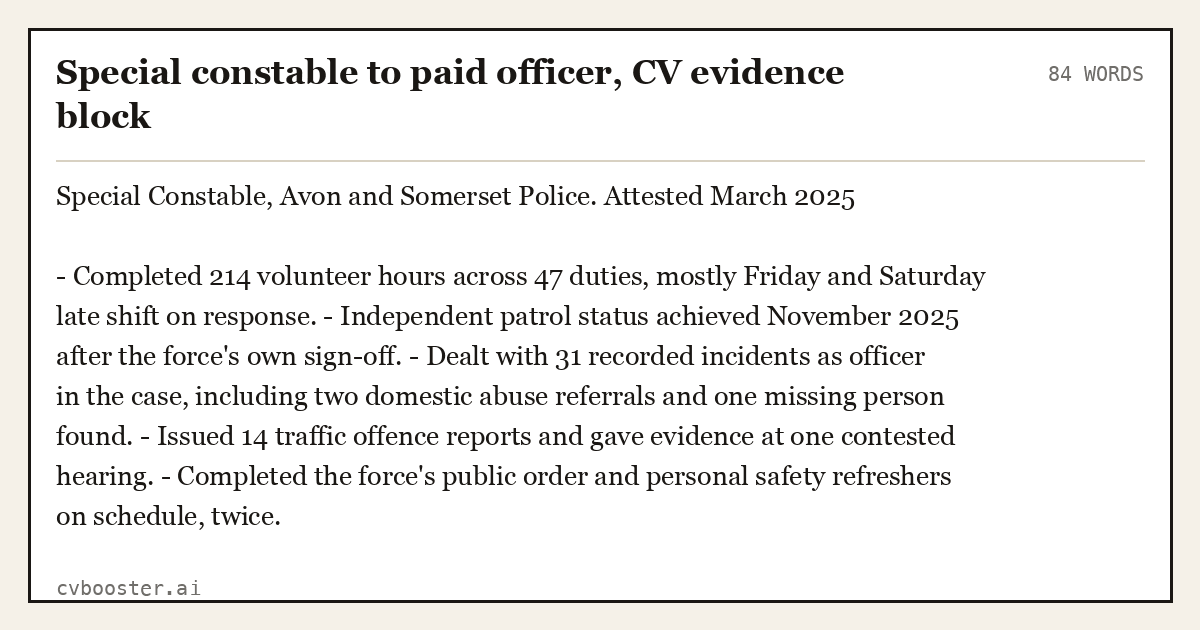
Special constable to paid officer, CV evidence block (84 words)
Special Constable, Avon and Somerset Police. Attested March 2025
- Completed 214 volunteer hours across 47 duties, mostly Friday and Saturday late shift on response. - Independent patrol status achieved November 2025 after the force's own sign-off. - Dealt with 31 recorded incidents as officer in the case, including two domestic abuse referrals and one missing person found. - Issued 14 traffic offence reports and gave evidence at one contested hearing. - Completed the force's public order and personal safety refreshers on schedule, twice.
Route 6: Police Scotland, where no formal qualifications are required
Scotland runs its own system, and its entry bar is the lowest in the UK. Police Scotland's own recruitment page states: "To apply to become a police officer, you don't need any formal qualifications. What matters most is the relevant skills you might already have." The eligibility list is specific: you must be 18 or over, physically fit, "have lived in the UK for at least three years", hold "a manual driving license" and meet the national eyesight standard.
The pay and the training length are both published: "We offer a competitive starting salary of £34,001. You will receive yearly pay increments over 11 years up to £54,597", and "The overall initial training period has been extended to 18 weeks."
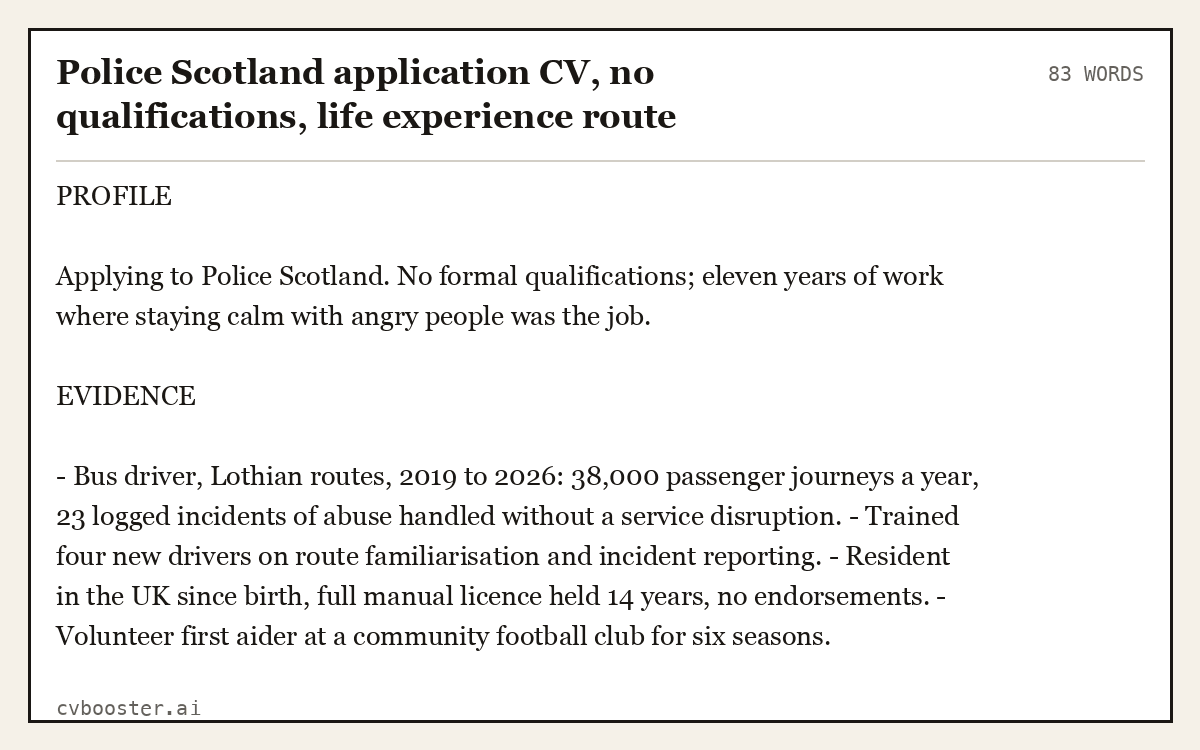
Police Scotland application CV, no qualifications, life experience route (83 words)
PROFILE
Applying to Police Scotland. No formal qualifications; eleven years of work where staying calm with angry people was the job.
EVIDENCE
- Bus driver, Lothian routes, 2019 to 2026: 38,000 passenger journeys a year, 23 logged incidents of abuse handled without a service disruption. - Trained four new drivers on route familiarisation and incident reporting. - Resident in the UK since birth, full manual licence held 14 years, no endorsements. - Volunteer first aider at a community football club for six seasons.
What to put on the CV when you have none
- Use the eligibility list as a checklist. Age, residency, eyesight, driving licence, fitness. Police Scotland publishes all five, and a CV that answers them all removes the recruiter's first reason to stop reading.
- Write incidents, not adjectives. The Home Office page on whether policing suits you asks whether you "Can handle traumatic situations and be able to communicate information sensitively". Name one such situation and what you did.
- Count the written work. Statements drafted, records kept, court appearances. The same page asks whether you "Can give clear and accurate evidence in court".
- Declare shift availability. Every force expects it: "Yes, there will likely be times when you're needed for shifts working evenings and/or weekends."
- Prepare for the national assessment, not the CV alone. The College of Policing lists the exercises as "a competency-based interview (CBI)", a written exercise and a briefing exercise. Rehearse all three.
Write the document with how to make a CV, then build the competency answers using the STAR method with examples and competency based questions. If you are moving across from care or retail, the career change CV handles the translation.
Frequently asked questions
How to get into?
Apply to one force, on one route, and expect three stages: the national sift, the online assessment process and the force's own fitness, medical and vetting checks. The National Careers Service records police officer pay as £30,000 starter to £48,000 experienced, on 37 to 40 hours a week including shifts.
How do i get into?
Match your qualification level to the route. No degree and Level 3 qualifications means PCDA or PCEP. A degree in any subject means DHEP. No qualifications at all means Police Scotland, which requires none. Then check which of the 28 recruiting forces in England and Wales covers where you can live.
What qualifications do I need to become a police officer?
For England and Wales the minimum is a Level 3 qualification, defined on the Home Office site as two A-Levels or an accepted equivalent. Some forces add their own requirements, so check the force page. Police Scotland requires no formal qualifications at all, only the eligibility criteria.
Do I need a degree to join the police?
No. The Home Office recruitment site states that you do not need a degree to join, and two of the four England and Wales routes assume you have none. The apprenticeship gives you a funded degree while you work, and the PCEP leads to no degree requirement at all.
Do I need a driving licence?
It depends on the force. The Home Office site says whether a licence is "essential or desirable will vary by force", so check before applying. Police Scotland is explicit and requires a manual licence plus DVLA group 2 medical driving standards, because you must drive police vehicles.
Does a criminal record stop me applying?
Not automatically. The Home Office guidance says there is no blanket answer, because the severity and the age of a conviction both matter, and advises speaking to the force before you apply. Police Scotland publishes a separate list of offences that mean an application will be rejected.
More in this series: Getting in without experience
- Entry Level Project Manager: 5 Routes In With No Degree
- Entry Level Roles With No Experience: 6 Routes That Work
- Entry Level Sales Jobs With No Experience: 5 Routes
Related articles
- Entry Level Project Manager: 5 Routes In With No Degree
- Entry Level Roles With No Experience: 6 Routes That Work
- Entry Level Sales Jobs With No Experience: 5 Routes
- APS Statement of Claims Example: APS4, APS5 and APS6
More articles
- How to Make a Resume: A Complete Step by Step Guide
- How to Negotiate Salary: Scripts for a New Offer and for a Raise
- How to Prepare for an Interview: A Week Out to the Hour Before
Looking for a worked example for your job title? Browse the resume examples by job title.