Competency Based Questions and Six Full UK Answers
By Mustafa Tarabya, founder of CVBooster · Published · Updated
9 min read
Competency based questions ask for one real event and score your answer against a written standard, not against how likeable you sound. That is still how most UK panels work in 2026. Prospects, the UK graduate careers service, defines them plainly: "each question targets a skill needed for the job", and your answers "will be compared against pre-determined criteria and marked accordingly". That is the constraint that changes everything, because a panel with a marking sheet cannot give you credit for anything you did not say out loud. Six full answers follow, each written to be said in about 90 seconds. Written by Mustafa Tarabya, who hired for his own company, read every application himself and now writes CVBooster's guides.
Here is what a complete answer sounds like. Note how much of it is the action, and how the result carries a number.
Tell me about a time you dealt with a difficult customer or member of the public.
Situation: In March 2025 a resident's family came to our office to complain that their mother's visits had been late four days running, and wanted to escalate to the local authority that afternoon. Task: Hold the complaint in the room, get the facts straight, and protect the care package while the rota problem was fixed. Action: I took them into a private room and wrote down the four dates and the actual arrival times from our call monitoring before saying anything about causes. I agreed a single point of contact, me, and a 5pm call each day for a week. The cause turned out to be a new round built with fifteen minutes of travel between two addresses eleven minutes apart. I rebuilt the round with twenty-five minutes and moved one visit to another carer. Result: Visits ran within ten minutes of schedule for the next six weeks and the family withdrew the escalation. The same travel error affected two other rounds, which I corrected before anyone complained.
What a competency based interview is, and what it is not
Prospects describes them as "structured, behavioural or situational interviews" that work "on the principle that past behaviour is the best indicator of future performance". An unstructured interview, by contrast, asks "a set of random, open-ended questions relevant to the job".
The list of competencies is not infinite. Prospects records the ones employers most commonly use: "adaptability, commercial awareness, communication, conflict resolution, decisiveness, independence, flexibility, leadership, problem solving, organisation, resilience, teamwork." Find the four or five on the advert and prepare two examples each.
Two answers on working with people
Give an example of a time you handled conflict in the workplace.
Situation: Two carers on my rota had stopped speaking to each other in August 2024 after a disputed handover, and one had started refusing shifts that overlapped with the other. Task: I needed the rota to work and I needed the dispute dealt with properly rather than worked around. Action: I spoke to each separately for twenty minutes and wrote down only what they said happened, not what they thought of each other. The accounts disagreed on one point: whether a medication chart was signed before or after the visit. The chart showed it was signed late by the second carer, which I handled as a supervision matter. I then brought them together with one agenda item, the handover process, not the argument. Result: We agreed a two-minute verbal handover at the door, which I added to the round sheet. Both were back on overlapping shifts within a fortnight, with no repeat in the eighteen months I stayed.
Describe a situation in which you led a team.
Situation: When we took on a block contract in January 2025 I had three weeks to stand up a seven-person round, having led only two people before. Task: Recruit or redeploy seven carers, train them on the client's care plan system, and start on the contract date without dropping existing rounds. Action: I redeployed four carers who wanted the hours and recruited three, interviewing eleven applicants against the same four questions. I ran the care plan training in two sessions so nobody lost a shift, and paired each new starter with an experienced carer for four shifts. One sheet on the office wall showed who had completed which training. Result: All seven were signed off before the start date, the round began on time, and six were still in post a year later. The pairing approach was used on the next two rounds.
Two answers on delivery and judgement
Tell us about a time when you identified an issue that needed to be addressed or an opportunity that others hadn't seen.
Situation: Reviewing our 2024 mileage claims, one round was claiming almost double the mileage of a geographically similar round. Task: Establish whether it was a claiming problem or a routing problem, before accusing anyone of anything. Action: I mapped both visit orders against postcodes. The high-mileage round was visiting in booking order, crossing town twice each morning. I rebuilt it geographically, kept the two time-critical medication calls in place, and asked the carer to trial it for two weeks. Result: Mileage on that round fell by roughly a third, the carer finished around forty minutes earlier, and I applied the same check to the remaining four rounds, two of which had the same problem.
Describe a time you had to deliver to a deadline with limited resources.
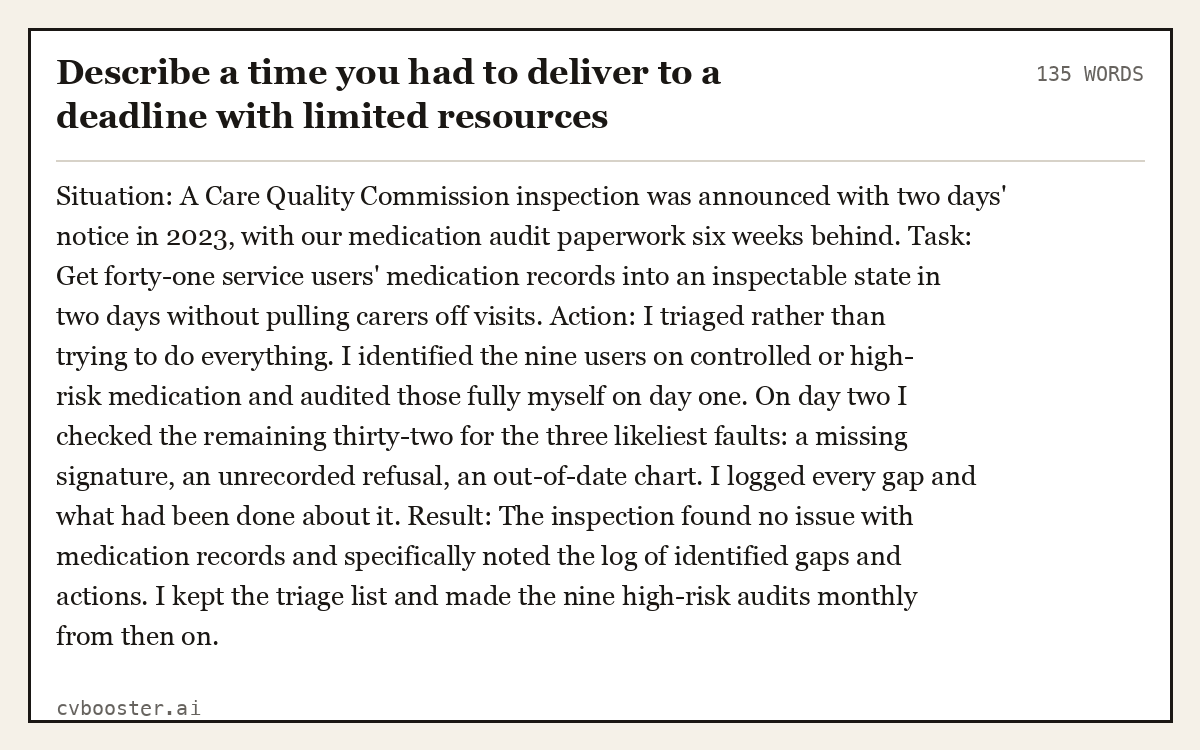
Situation: A Care Quality Commission inspection was announced with two days' notice in 2023, with our medication audit paperwork six weeks behind. Task: Get forty-one service users' medication records into an inspectable state in two days without pulling carers off visits. Action: I triaged rather than trying to do everything. I identified the nine users on controlled or high-risk medication and audited those fully myself on day one. On day two I checked the remaining thirty-two for the three likeliest faults: a missing signature, an unrecorded refusal, an out-of-date chart. I logged every gap and what had been done about it. Result: The inspection found no issue with medication records and specifically noted the log of identified gaps and actions. I kept the triage list and made the nine high-risk audits monthly from then on.
Two answers on learning and change
Talk us through something you've learnt in the past 12 months that's had a positive effect on your work.
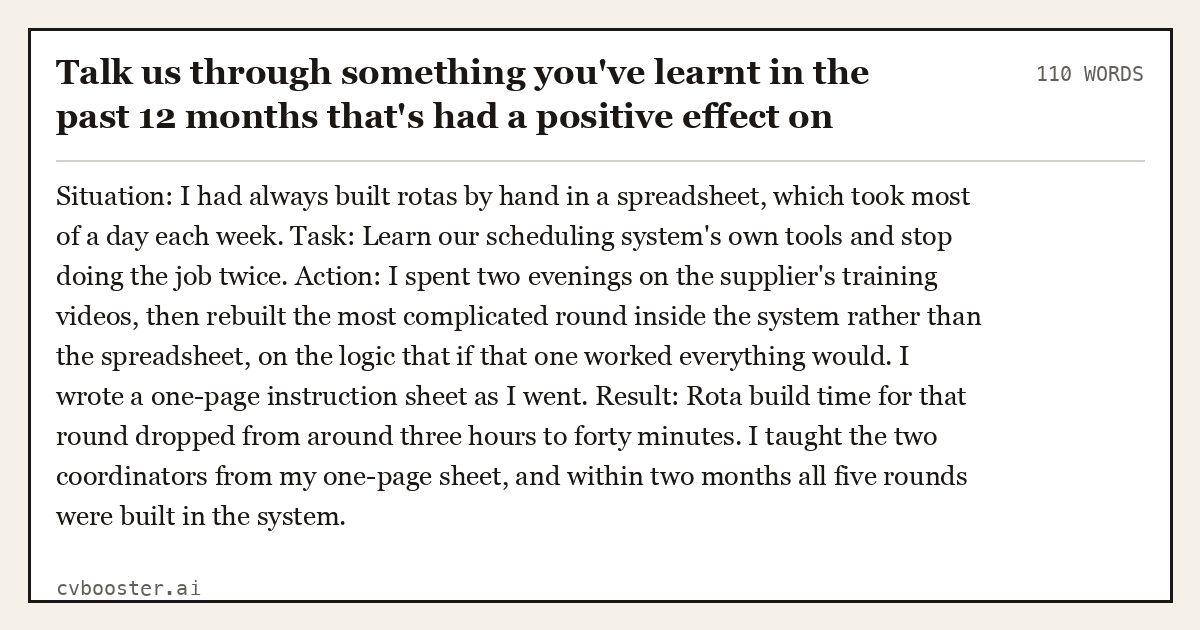
Situation: I had always built rotas by hand in a spreadsheet, which took most of a day each week. Task: Learn our scheduling system's own tools and stop doing the job twice. Action: I spent two evenings on the supplier's training videos, then rebuilt the most complicated round inside the system rather than the spreadsheet, on the logic that if that one worked everything would. I wrote a one-page instruction sheet as I went. Result: Rota build time for that round dropped from around three hours to forty minutes. I taught the two coordinators from my one-page sheet, and within two months all five rounds were built in the system.
Describe a time when you helped someone else adapt to change at work.
Situation: When we introduced electronic care plans in 2024, our most experienced carer, twenty-two years in the job, told me she was not going to use a tablet. Task: Get her onto the system without losing her, because she knew our long-standing service users better than anyone. Action: I asked what specifically she disliked rather than assuming it was the technology. It was the signature box, which would not register with a fingertip. I got her a stylus, changed the font size, then had her enter one visit while I watched and said nothing. I then asked her to teach the next carer. Result: She was recording all her own visits within a week and became the person the others asked for help. Adoption across the team reached every carer inside a month, with no leavers.
The scoring frames behind the questions
The frame tells you what the marker wants.
| Employer | Frame | What it means for your answer |
|---|---|---|
| Civil Service | Success Profiles: behaviours, strengths, ability, experience, technical | Answer the named behaviour, at the grade's level |
| CII member firms | The Professional Map: curiosity, customer focus, drive to deliver, impact, inclusivity, insight, integrity | Expect three probes after the main question |
| NHS trusts | Values based recruitment, which "will help you find people whose personal values match with your organisation" | Expect scenarios, role play or written responses too |
| Graduate recruiters | A competency framework inside an assessment centre | The same competency is tested twice |
The Cabinet Office states that "The Civil Service recruits using Success Profiles" and defines behaviours as "the actions and activities that people do which result in effective performance in a job". For a Civil Service post, read the Success Profiles publication and our Success Profiles guide first.
The CII's published examples show the probing pattern most employers copy: "How did you identify the issue/opportunity? What did you do to address it? What was the outcome?" Prepare those three for every story.
The six things that lose marks
- No result. An answer that stops at what you did scores in the bottom band on almost every frame.
- "We" throughout. The panel is marking you, so say what you did.
- A hypothetical. "I would" is not an answer to "tell me about a time".
- Too much situation. Two sentences of context, then the action.
- No number anywhere. Volume, value, time saved, people affected.
- The same story for four competencies. Prospects says to "try to relate your answers to the role", and a recycled story stops relating quickly.
Prospects recommends STARR, adding reflection: "What you learned from the experience and how it shaped you afterward." Add one sentence of it, because most candidates do not.
Work through the STAR method examples and the longer competency based interview questions and answers next, and use competency examples to build your bank of ten stories. The Prospects guide, the CII example questions and NHS Employers on values based recruitment are the three source documents worth reading in full.
Frequently asked questions
What are competency based questions?
Questions that ask for one real past event and score it against a written standard. They open with "tell us about a time when", "give an example of" or "describe how you", and your answer is marked against pre-determined criteria rather than judged on general impression.
What are competency based interview questions?
The same questions asked inside a structured interview where every candidate gets the same list. Prospects notes each question "targets a skill needed for the job", so the questions you get are readable in advance from the competencies named in the job advert.
What is competency based interview questions?
A set of behavioural questions built from an employer's competency framework. The Civil Service uses Success Profiles, CII member firms use the Professional Map, and NHS trusts add values based recruitment. Find the framework named on the advert and you know the question list.
What is a competency based interview questions?
It is a marked question, not a conversation. The panel has a sheet with the competency, the criteria and a score range, and they can only award marks for what you say. Silence about the result costs you marks even if the result was excellent.
What is a competency based interview question?
One question covering one competency, usually with two or three follow-up probes. The CII's published examples show the pattern: the main question, then how you identified it, what you did, and what the outcome was. Answer in about 90 seconds and let them probe.
How to answer competency based questions?
Use STARR: situation, task, action, result, reflection. Keep the situation to two sentences, spend most of the answer on the action in the first person, and finish with a number. Prepare ten stories mapped to the competencies on the advert rather than memorising scripts.
Related articles
- Competency-Based Interview Questions and 15 Answers, Ireland
- STAR Interview Questions: 12 Full Answers and the Budget
- Competency Based Interview Questions and 20 Answers
- NHS Interview Questions and 15 Full Answers, Band 2 to 6
More articles
- Competency Examples: 12 Definitions and Worked Proof
- Computer Skills: 30 With the Resume Line for Each Level
- Cover Letter Australia Sample: 4 Full Letters, Annotated
Looking for a worked example for your job title? Browse the resume examples by job title.