STAR Method Answers Examples: 12 Weak Answers Rewritten
By Mustafa Tarabya, founder of CVBooster · Published · Updated
17 min read
The fastest way to learn STAR method answers examples is to read the bad version first, because the gap between the two is where the score lives. The constraint is time: most behavioral answers run ninety seconds spoken, so roughly 160 words, and the weak version wastes half of that on context. MIT's Career Advising and Professional Development office splits the four parts by share of that time, and the National Careers Service defines what each letter means. Twelve questions follow, each with a weak answer and then the same story rebuilt and labeled. Written by Mustafa Tarabya, who hired for his own company, read every application himself and now writes CVBooster's guides.
What STAR stands for, word for word
The National Careers Service STAR page defines the four parts:
- Situation - "the situation you had to deal with"
- Task - "the task you were given to do"
- Action - "the action you took"
- Result - "what happened as a result of your action and what you learned from the experience"
MIT CAPD gives the split of speaking time: "Situation (20%)", "Task (10%)", "Action (60%)", "Result (10%)". Its note on the Action section is the one worth taping to your desk: "The most important thing to keep in mind is that most of your response should focus on your Actions."
The MIT Career Advising and Professional Development office also says why the interview is built this way at all: "The purpose of behavioral interviewing is to objectively measure a potential employee's past behaviors as a predictor of future results."
Teamwork and conflict questions
Tell me about a time you worked with someone difficult
Weak answer: working with a difficult coworker (71 words)
I've worked with a lot of personalities over the years, and I'd say I'm pretty adaptable. There was one coworker at my last job who was tough to deal with, kind of negative about everything. I just tried to stay positive and not let it get to me. Eventually things got better between us. I think the key is communication and not taking things personally. I get along with almost everyone.
STAR answer: working with a difficult coworker (165 words)
Situation: I was a scheduler at a regional home health agency in Toledo. A nurse on my roster refused every visit I assigned after 3pm and copied my supervisor each time.
Task: I had to fill the late slots without escalating a personnel issue I had no authority over.
Action: I stopped emailing and asked her for fifteen minutes. She told me her daughter's school pickup was at 3:30 and nobody had ever asked. I rebuilt her block so her last visit started at 2:15, and moved two late visits to a nurse who wanted evening hours. I wrote the constraint into the scheduling notes so the next person would not repeat my mistake. I told my supervisor what I changed and why, in two sentences.
Result: Her declined-visit count went from about eight a month to zero. The evening nurse picked up four extra visits a week, which she wanted. I now ask every new hire what their hard stop is on day one.
Describe a time you gave a coworker critical feedback
Weak answer: giving critical feedback (69 words)
I believe feedback should always be constructive. A teammate was making mistakes on reports, so I pulled him aside and let him know in a respectful way. I made sure to lead with something positive first. He took it well and improved after that. I think being direct but kind is the right approach, and I try to give feedback in private rather than in front of the team.
STAR answer: giving critical feedback (156 words)
Situation: I was a senior claims examiner on a six-person auto team at an insurance carrier in Des Moines.
Task: A colleague hired four months earlier was closing files without the adjuster's photos attached, and the rework was landing on me.
Action: I checked before I spoke: seven of his last twenty files were missing attachments, and all seven were on days he handled over fifteen claims. So the problem was volume, not care. I showed him the seven file numbers rather than describing the pattern. Then I showed him the batch-attach shortcut I use, which nobody had covered in his onboarding. I asked our lead to add it to the training checklist rather than naming him in the meeting.
Result: His next forty files had zero missing attachments. The shortcut went into onboarding in February and two other new examiners have used it since. My own rework queue dropped by about three files a week.
Tell me about a time you disagreed with your manager
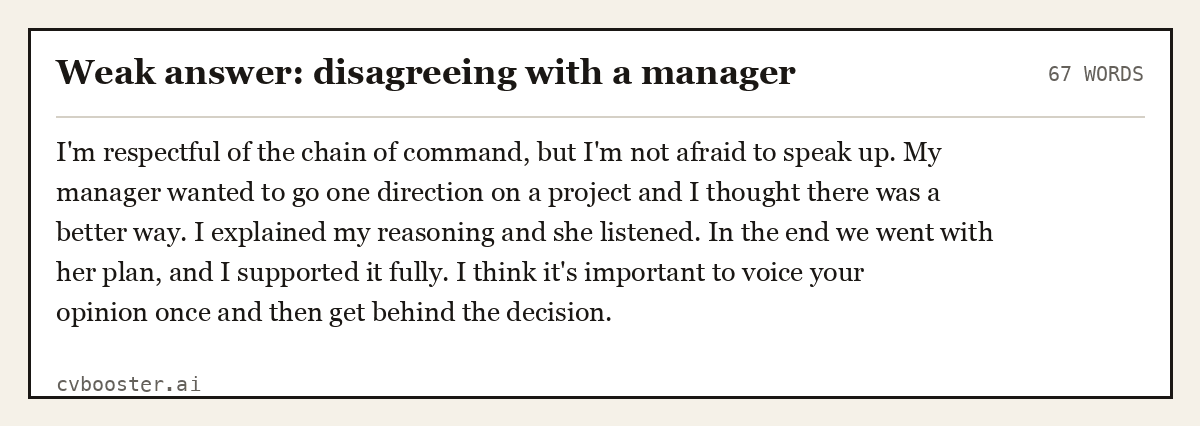
Weak answer: disagreeing with a manager (67 words)
I'm respectful of the chain of command, but I'm not afraid to speak up. My manager wanted to go one direction on a project and I thought there was a better way. I explained my reasoning and she listened. In the end we went with her plan, and I supported it fully. I think it's important to voice your opinion once and then get behind the decision.
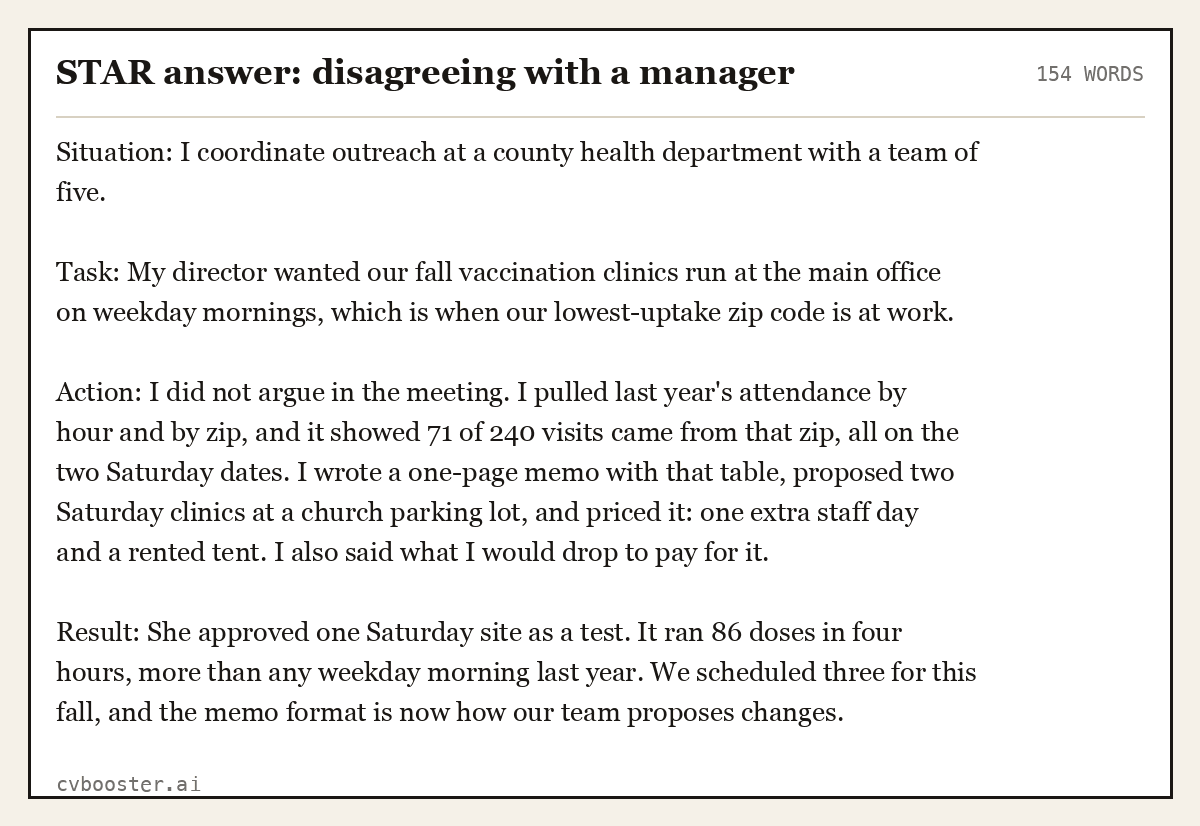
STAR answer: disagreeing with a manager (154 words)
Situation: I coordinate outreach at a county health department with a team of five.
Task: My director wanted our fall vaccination clinics run at the main office on weekday mornings, which is when our lowest-uptake zip code is at work.
Action: I did not argue in the meeting. I pulled last year's attendance by hour and by zip, and it showed 71 of 240 visits came from that zip, all on the two Saturday dates. I wrote a one-page memo with that table, proposed two Saturday clinics at a church parking lot, and priced it: one extra staff day and a rented tent. I also said what I would drop to pay for it.
Result: She approved one Saturday site as a test. It ran 86 doses in four hours, more than any weekday morning last year. We scheduled three for this fall, and the memo format is now how our team proposes changes.
Give an example of a time you helped a new team member get up to speed
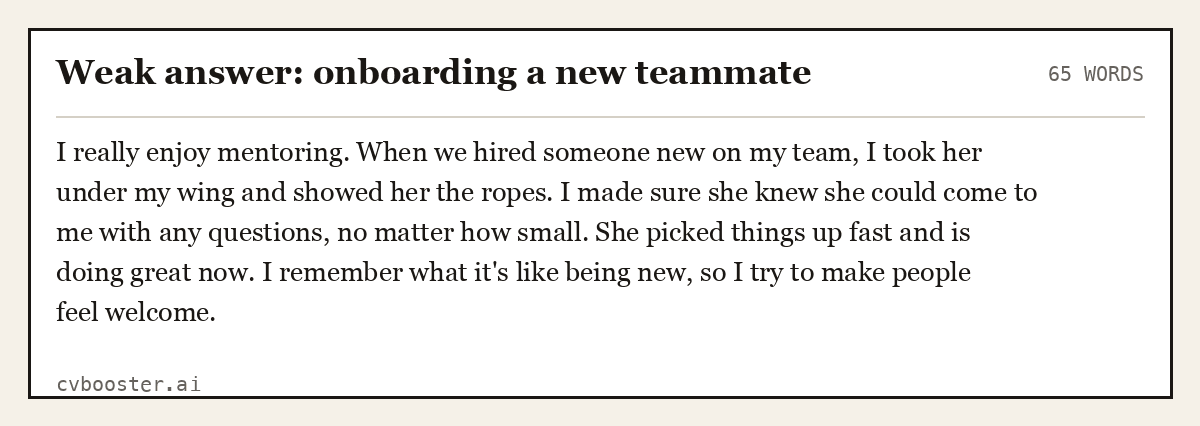
Weak answer: onboarding a new teammate (65 words)
I really enjoy mentoring. When we hired someone new on my team, I took her under my wing and showed her the ropes. I made sure she knew she could come to me with any questions, no matter how small. She picked things up fast and is doing great now. I remember what it's like being new, so I try to make people feel welcome.
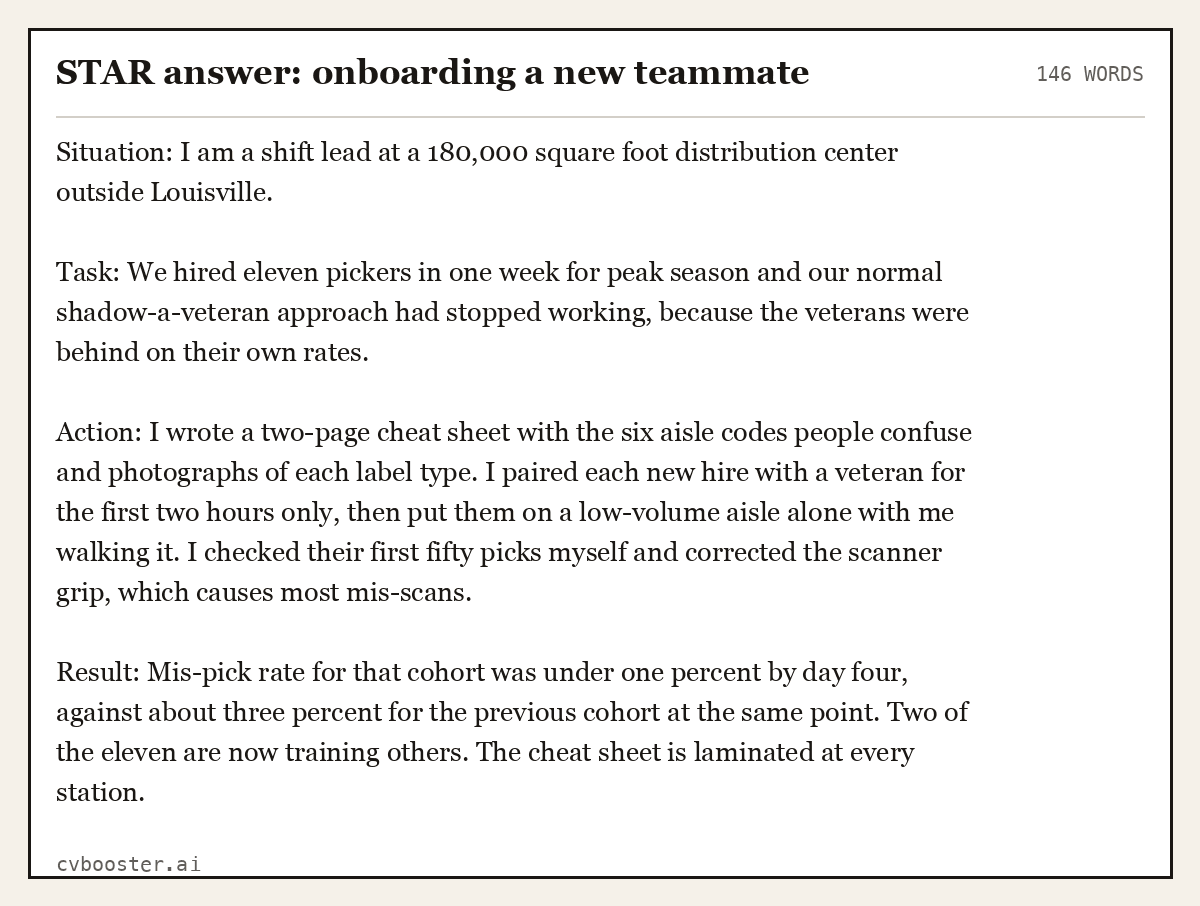
STAR answer: onboarding a new teammate (146 words)
Situation: I am a shift lead at a 180,000 square foot distribution center outside Louisville.
Task: We hired eleven pickers in one week for peak season and our normal shadow-a-veteran approach had stopped working, because the veterans were behind on their own rates.
Action: I wrote a two-page cheat sheet with the six aisle codes people confuse and photographs of each label type. I paired each new hire with a veteran for the first two hours only, then put them on a low-volume aisle alone with me walking it. I checked their first fifty picks myself and corrected the scanner grip, which causes most mis-scans.
Result: Mis-pick rate for that cohort was under one percent by day four, against about three percent for the previous cohort at the same point. Two of the eleven are now training others. The cheat sheet is laminated at every station.
Problem solving and pressure questions
Tell me about a time you solved a problem with limited resources
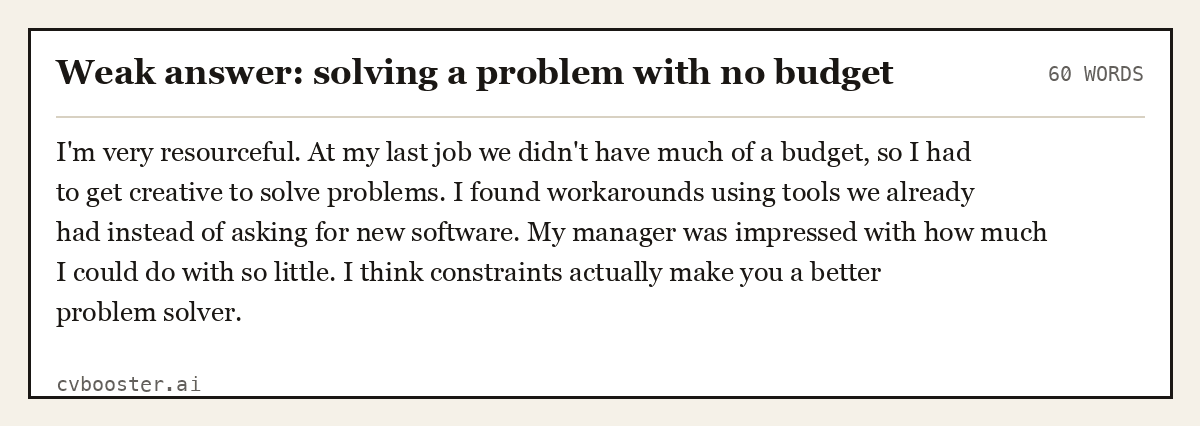
Weak answer: solving a problem with no budget (60 words)
I'm very resourceful. At my last job we didn't have much of a budget, so I had to get creative to solve problems. I found workarounds using tools we already had instead of asking for new software. My manager was impressed with how much I could do with so little. I think constraints actually make you a better problem solver.
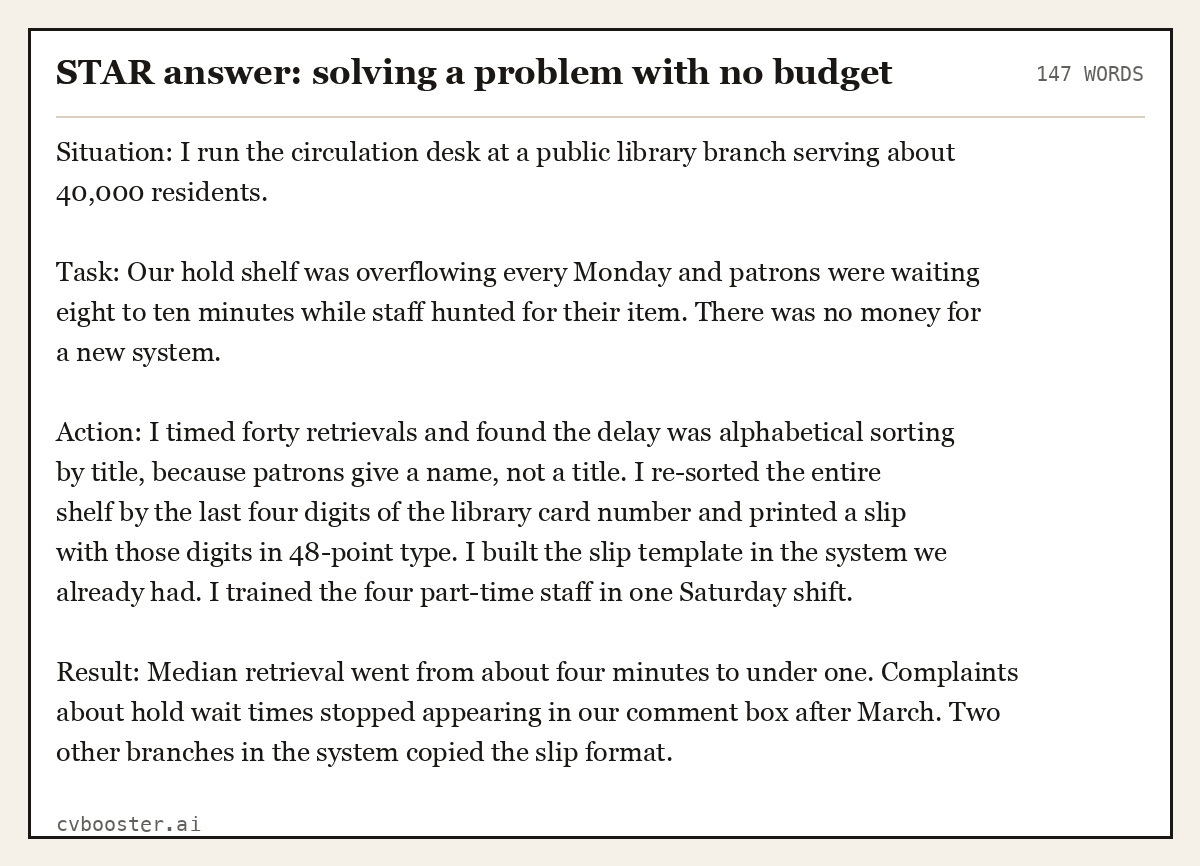
STAR answer: solving a problem with no budget (147 words)
Situation: I run the circulation desk at a public library branch serving about 40,000 residents.
Task: Our hold shelf was overflowing every Monday and patrons were waiting eight to ten minutes while staff hunted for their item. There was no money for a new system.
Action: I timed forty retrievals and found the delay was alphabetical sorting by title, because patrons give a name, not a title. I re-sorted the entire shelf by the last four digits of the library card number and printed a slip with those digits in 48-point type. I built the slip template in the system we already had. I trained the four part-time staff in one Saturday shift.
Result: Median retrieval went from about four minutes to under one. Complaints about hold wait times stopped appearing in our comment box after March. Two other branches in the system copied the slip format.
Describe a time you juggled multiple deadlines at once
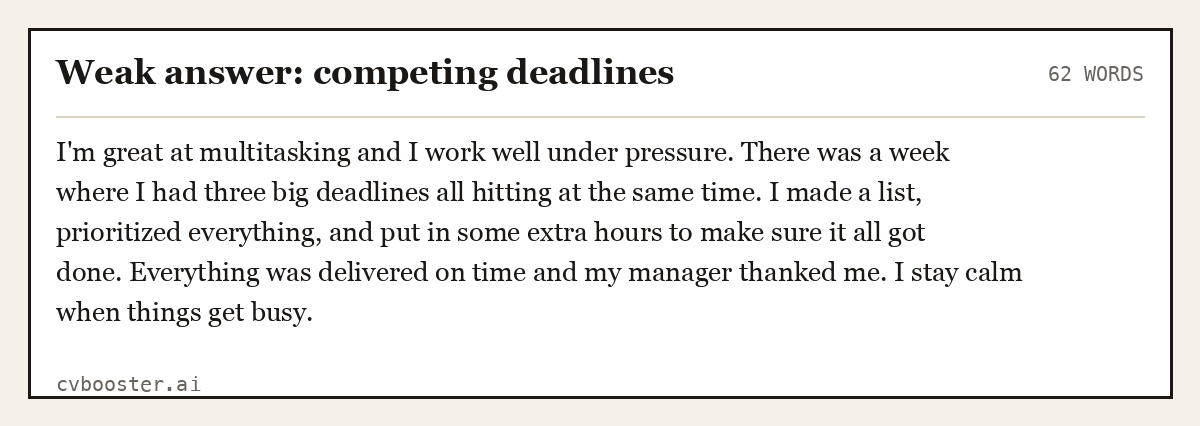
Weak answer: competing deadlines (62 words)
I'm great at multitasking and I work well under pressure. There was a week where I had three big deadlines all hitting at the same time. I made a list, prioritized everything, and put in some extra hours to make sure it all got done. Everything was delivered on time and my manager thanked me. I stay calm when things get busy.
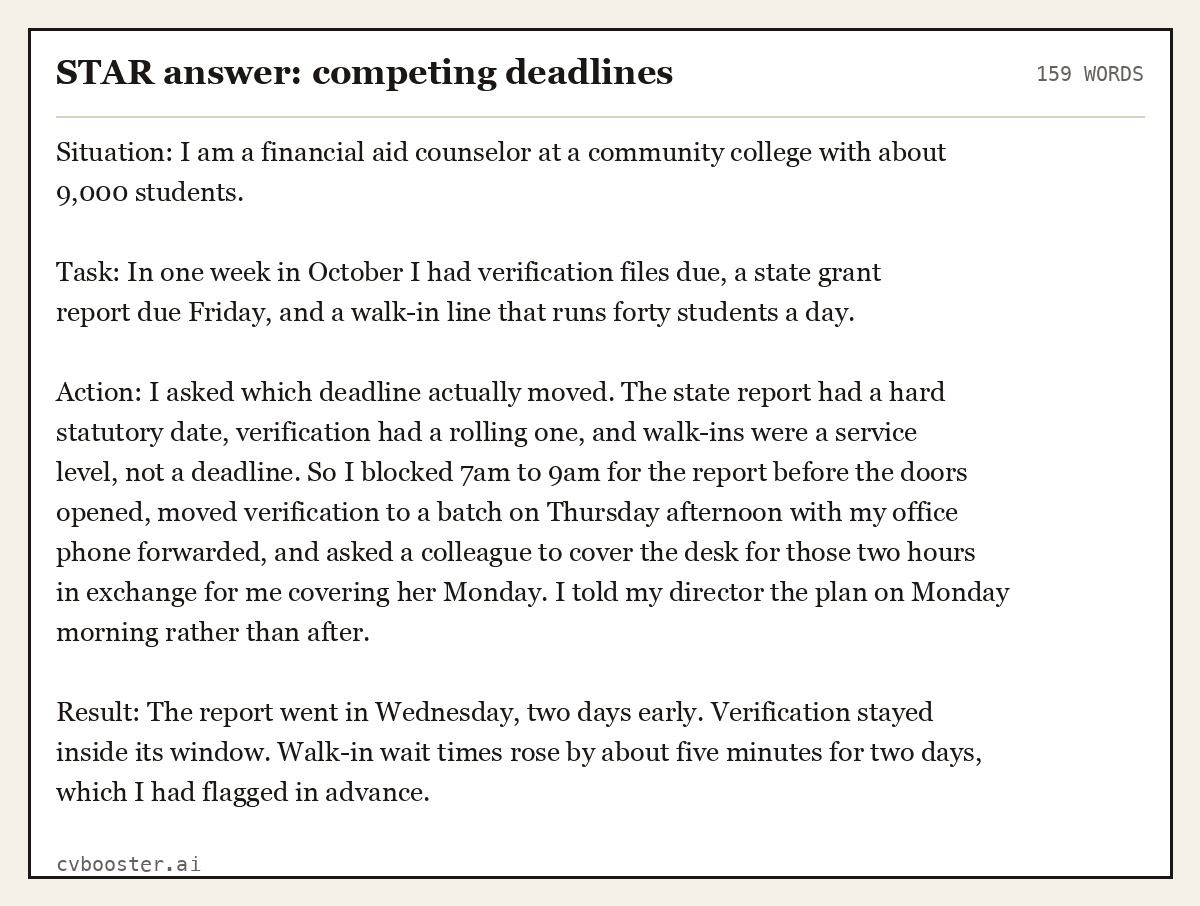
STAR answer: competing deadlines (159 words)
Situation: I am a financial aid counselor at a community college with about 9,000 students.
Task: In one week in October I had verification files due, a state grant report due Friday, and a walk-in line that runs forty students a day.
Action: I asked which deadline actually moved. The state report had a hard statutory date, verification had a rolling one, and walk-ins were a service level, not a deadline. So I blocked 7am to 9am for the report before the doors opened, moved verification to a batch on Thursday afternoon with my office phone forwarded, and asked a colleague to cover the desk for those two hours in exchange for me covering her Monday. I told my director the plan on Monday morning rather than after.
Result: The report went in Wednesday, two days early. Verification stayed inside its window. Walk-in wait times rose by about five minutes for two days, which I had flagged in advance.
Tell me about a time you caught an error before it reached a customer
Weak answer: catching an error (59 words)
I have really strong attention to detail. I caught a mistake in a document before it went out to a client, which could have been embarrassing for the company. I flagged it to my manager and we fixed it in time. I always double-check my work and other people's work too. Small errors can cost a lot of credibility.
STAR answer: catching an error (144 words)
Situation: I am a billing analyst for a three-hospital system in western Pennsylvania.
Task: We were about to release a batch of 1,400 patient statements after a charge master update.
Action: I sample fifteen statements from every batch before release, and I read the line items out loud. Two of the fifteen showed an observation charge billed at the inpatient rate. I stopped the release, which I have standing authority to do, and rebuilt the query against the prior month. The update had mapped one revenue code to the wrong rate table, affecting 212 accounts. I sent the account list to the charge master analyst with the specific code rather than a description of the symptom.
Result: Zero incorrect statements went out. The fix took two days. We added a rate-table check to the post-update checklist, and it has caught one similar issue since.
Give an example of a time you handled an angry customer
Weak answer: an angry customer (60 words)
I stay calm no matter how upset someone is. A customer came in yelling about an order that went wrong. I listened, apologized, and did everything I could to make it right. By the end he was actually smiling and thanked me. I think most people just want to feel heard. I never take it personally when someone is frustrated.
STAR answer: an angry customer (162 words)
Situation: I manage the service counter at a grocery store in Tucson with about ninety employees.
Task: A customer whose catering order for a funeral had been made for the wrong day was shouting at a nineteen-year-old clerk in front of a full line.
Action: I moved the conversation first. I took him to the end of the counter, sent the clerk to the back, and said one sentence: we got your date wrong and I am going to fix it now. I called the bakery lead directly instead of promising a callback, and she confirmed we could rebuild two of the four trays within ninety minutes. I comped the order and drove the trays to the church myself at the end of my shift.
Result: He came back the following week and asked for me by name for another order. I changed our order form so the event date sits above the pickup date, because that is where the error started.
Leadership, failure and change questions
Tell me about a time you led a project
Weak answer: leading a project (57 words)
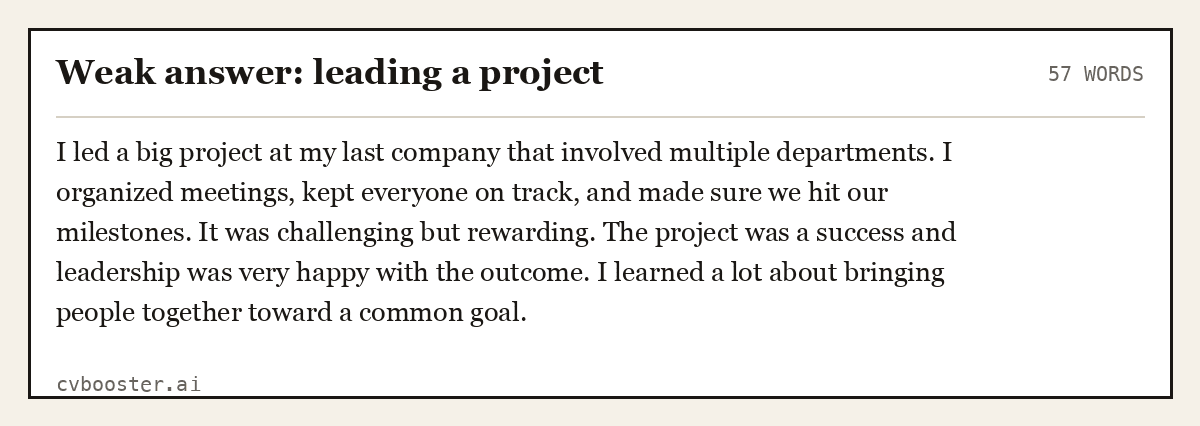
I led a big project at my last company that involved multiple departments. I organized meetings, kept everyone on track, and made sure we hit our milestones. It was challenging but rewarding. The project was a success and leadership was very happy with the outcome. I learned a lot about bringing people together toward a common goal.
STAR answer: leading a project (141 words)
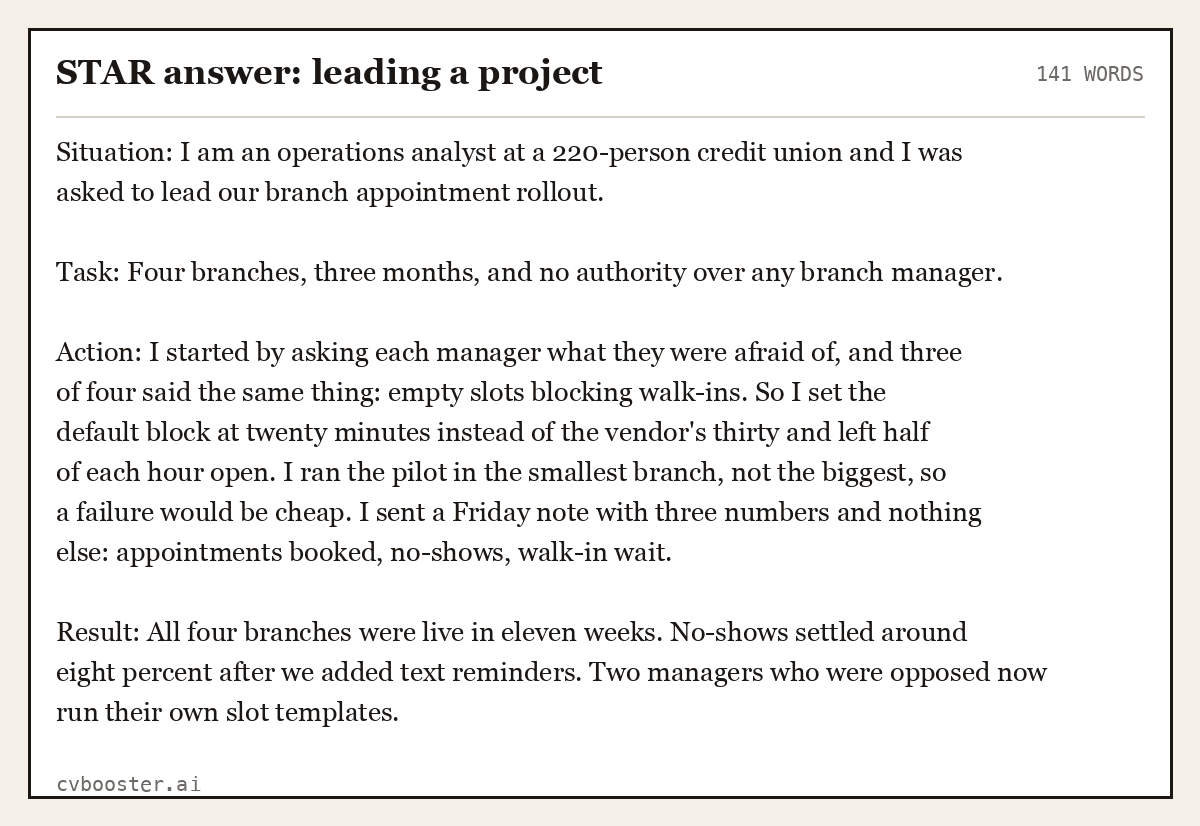
Situation: I am an operations analyst at a 220-person credit union and I was asked to lead our branch appointment rollout.
Task: Four branches, three months, and no authority over any branch manager.
Action: I started by asking each manager what they were afraid of, and three of four said the same thing: empty slots blocking walk-ins. So I set the default block at twenty minutes instead of the vendor's thirty and left half of each hour open. I ran the pilot in the smallest branch, not the biggest, so a failure would be cheap. I sent a Friday note with three numbers and nothing else: appointments booked, no-shows, walk-in wait.
Result: All four branches were live in eleven weeks. No-shows settled around eight percent after we added text reminders. Two managers who were opposed now run their own slot templates.
Tell me about a time you failed
Weak answer: a failure (59 words)
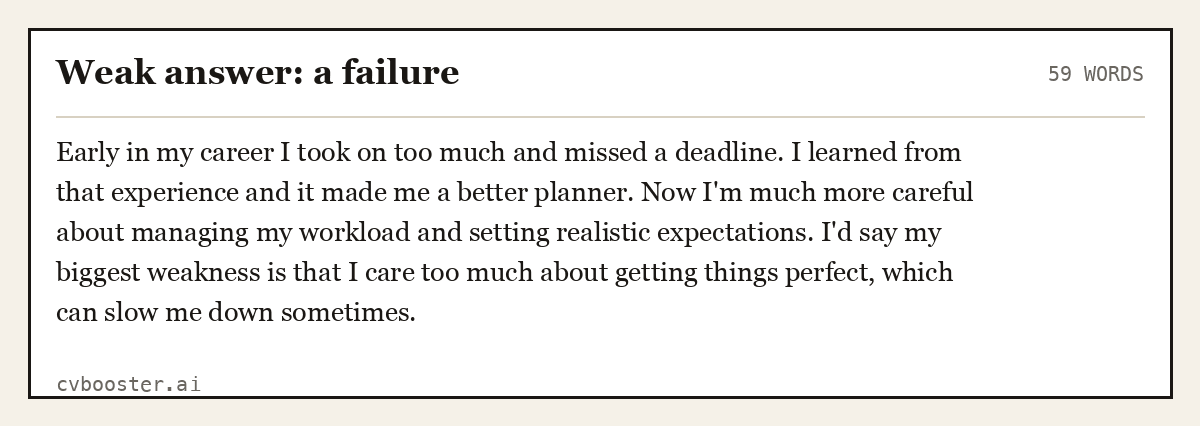
Early in my career I took on too much and missed a deadline. I learned from that experience and it made me a better planner. Now I'm much more careful about managing my workload and setting realistic expectations. I'd say my biggest weakness is that I care too much about getting things perfect, which can slow me down sometimes.
STAR answer: a failure (148 words)
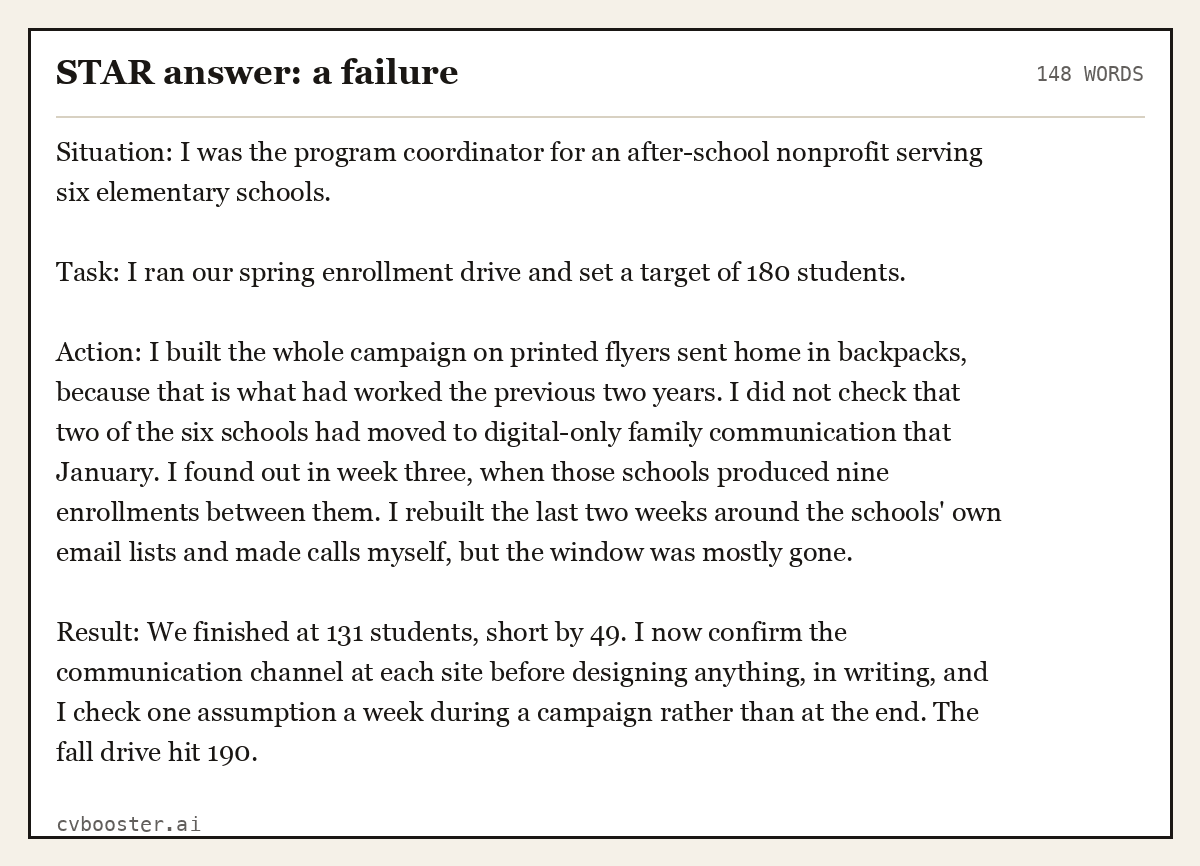
Situation: I was the program coordinator for an after-school nonprofit serving six elementary schools.
Task: I ran our spring enrollment drive and set a target of 180 students.
Action: I built the whole campaign on printed flyers sent home in backpacks, because that is what had worked the previous two years. I did not check that two of the six schools had moved to digital-only family communication that January. I found out in week three, when those schools produced nine enrollments between them. I rebuilt the last two weeks around the schools' own email lists and made calls myself, but the window was mostly gone.
Result: We finished at 131 students, short by 49. I now confirm the communication channel at each site before designing anything, in writing, and I check one assumption a week during a campaign rather than at the end. The fall drive hit 190.
Describe a time you persuaded someone to change their mind
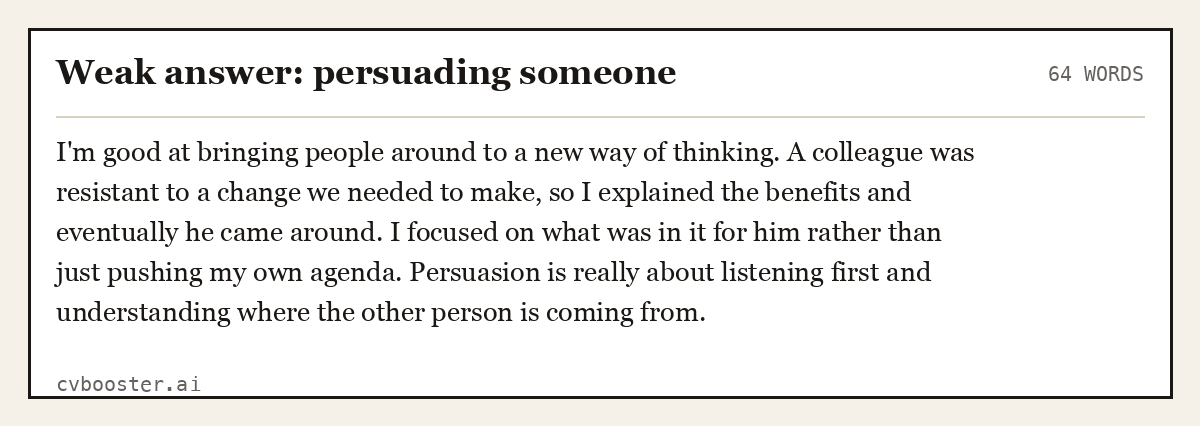
Weak answer: persuading someone (64 words)
I'm good at bringing people around to a new way of thinking. A colleague was resistant to a change we needed to make, so I explained the benefits and eventually he came around. I focused on what was in it for him rather than just pushing my own agenda. Persuasion is really about listening first and understanding where the other person is coming from.
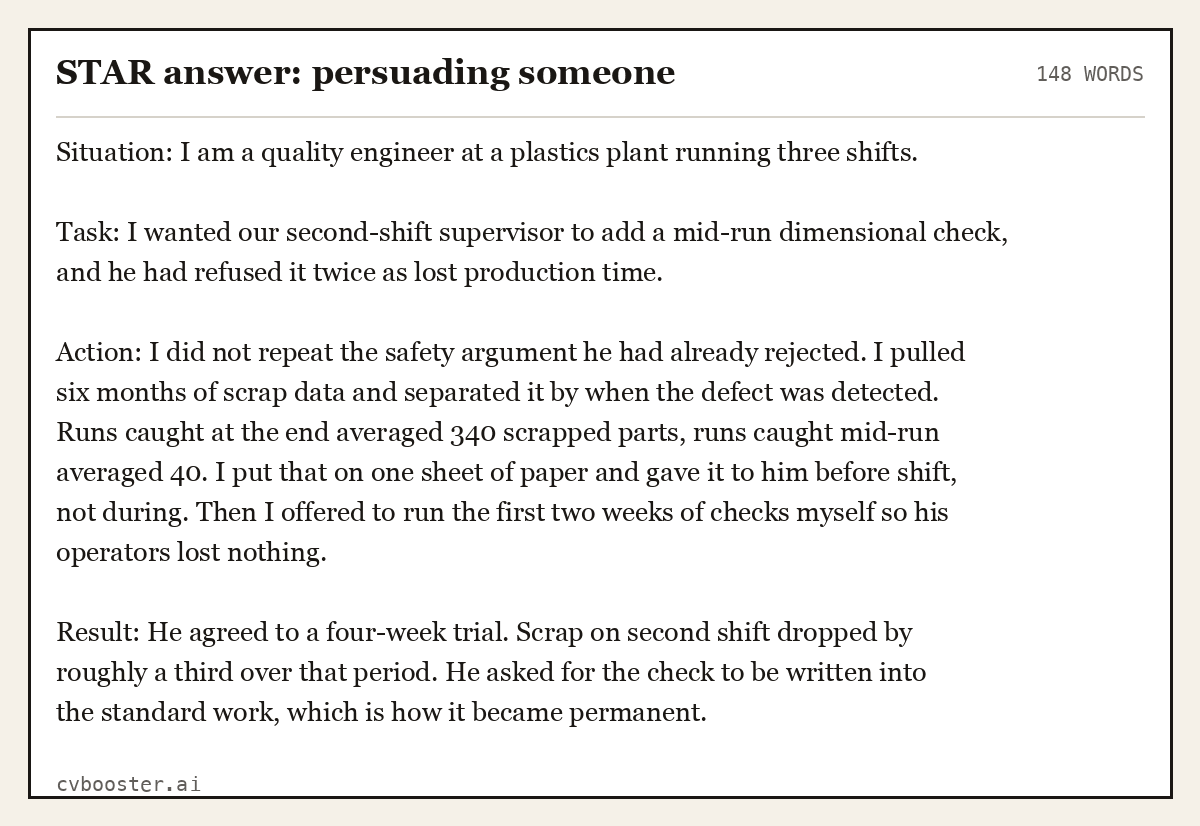
STAR answer: persuading someone (148 words)
Situation: I am a quality engineer at a plastics plant running three shifts.
Task: I wanted our second-shift supervisor to add a mid-run dimensional check, and he had refused it twice as lost production time.
Action: I did not repeat the safety argument he had already rejected. I pulled six months of scrap data and separated it by when the defect was detected. Runs caught at the end averaged 340 scrapped parts, runs caught mid-run averaged 40. I put that on one sheet of paper and gave it to him before shift, not during. Then I offered to run the first two weeks of checks myself so his operators lost nothing.
Result: He agreed to a four-week trial. Scrap on second shift dropped by roughly a third over that period. He asked for the check to be written into the standard work, which is how it became permanent.
Tell me about a time you had to learn something quickly
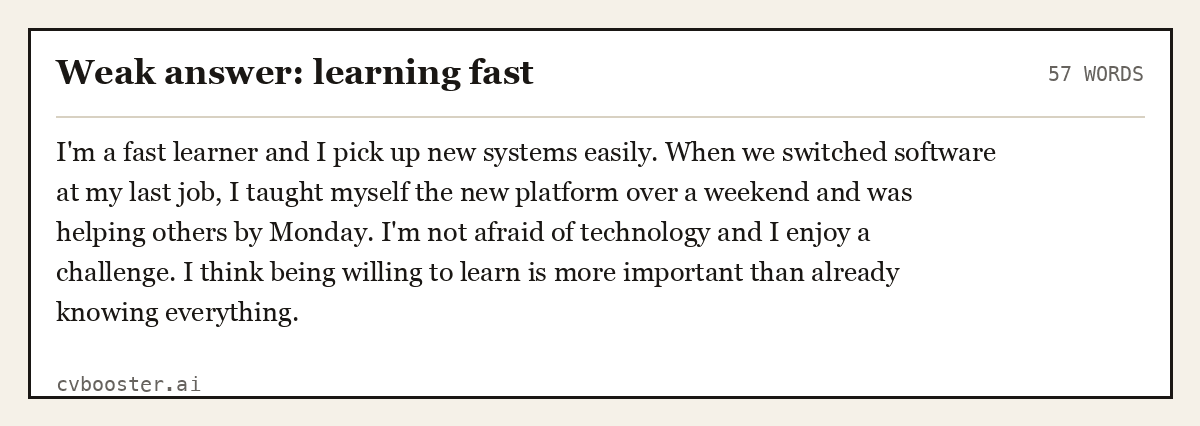
Weak answer: learning fast (57 words)
I'm a fast learner and I pick up new systems easily. When we switched software at my last job, I taught myself the new platform over a weekend and was helping others by Monday. I'm not afraid of technology and I enjoy a challenge. I think being willing to learn is more important than already knowing everything.
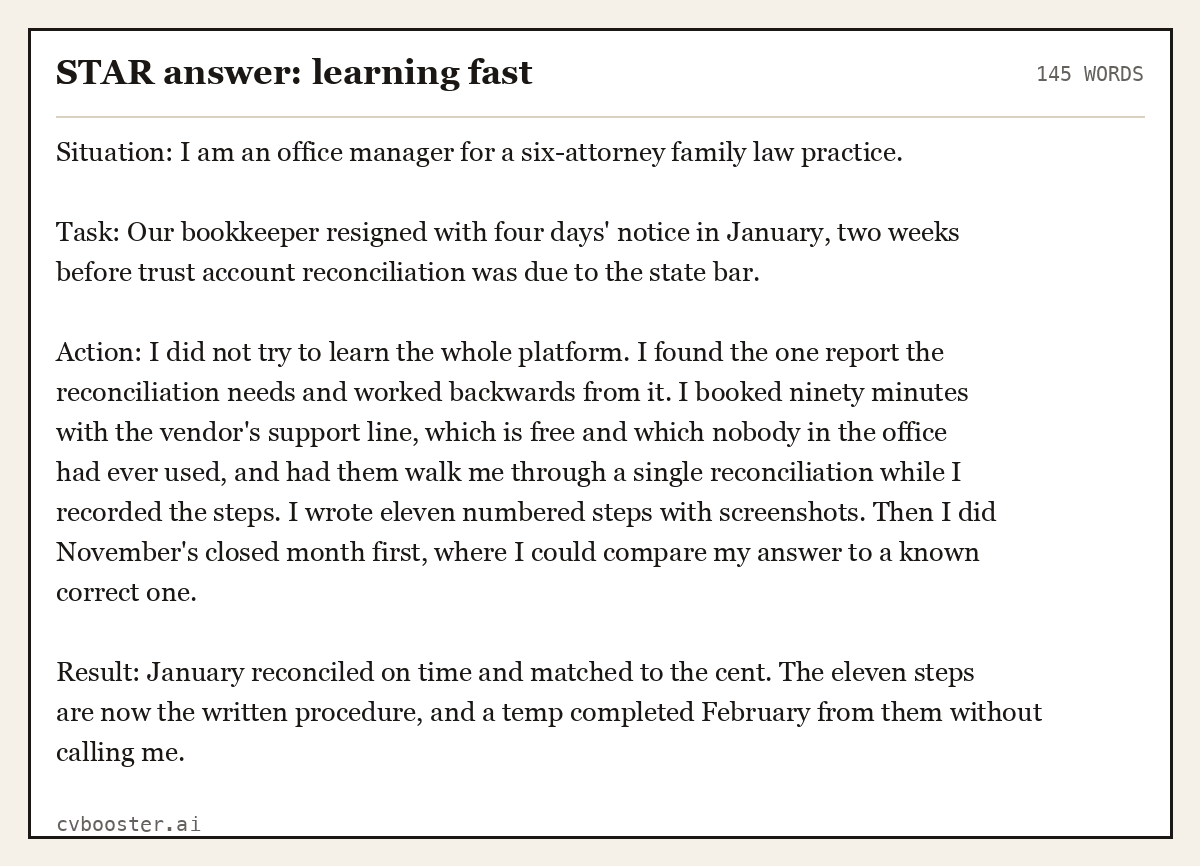
STAR answer: learning fast (145 words)
Situation: I am an office manager for a six-attorney family law practice.
Task: Our bookkeeper resigned with four days' notice in January, two weeks before trust account reconciliation was due to the state bar.
Action: I did not try to learn the whole platform. I found the one report the reconciliation needs and worked backwards from it. I booked ninety minutes with the vendor's support line, which is free and which nobody in the office had ever used, and had them walk me through a single reconciliation while I recorded the steps. I wrote eleven numbered steps with screenshots. Then I did November's closed month first, where I could compare my answer to a known correct one.
Result: January reconciled on time and matched to the cent. The eleven steps are now the written procedure, and a temp completed February from them without calling me.
The question, the competency, and the number to bring
Behavioral questions are not random. Each one maps to a competency, and each competency has a number that makes the Result land. Bring the number to the room.
| Question | Competency it tests | The number to bring |
|---|---|---|
| Working with someone difficult | Interpersonal effectiveness | How often the friction happened before and after |
| Giving critical feedback | Candor and coaching | Error count before, error count after |
| Disagreeing with a manager | Judgment and upward influence | The data point that changed the decision |
| Helping a new hire | Developing others | Time to competence, or error rate by day |
| Solving with no budget | Resourcefulness | Time or cost saved, measured not estimated |
| Competing deadlines | Prioritization | What you moved, and by how long |
| Catching an error | Attention to detail | Accounts, dollars or customers protected |
| Angry customer | Service recovery | Whether they came back |
| Leading a project | Leadership without authority | Timeline, adoption, and one rate |
| A failure | Accountability | The size of the miss, stated plainly |
| Persuading someone | Influence | The before and after figure you showed them |
| Learning quickly | Adaptability | The deadline you still hit |
Tip: If you cannot name a number, name a changed process instead. "It is now the written procedure" is a Result.
The five mistakes that flatten a STAR answer
- Spending forty percent of the answer on Situation. MIT's split gives it 20 percent. Two sentences of context is usually enough.
- Saying "we" throughout. MIT is blunt about this: "using 'we' statements can make it difficult for an employer to have a clear understanding of what your skills are."
- Answering in the conditional. "I would always make sure to" is not a past example, and behavioral interviewing exists to measure past behavior.
- Ending on the action. The Result is where the interviewer writes their note. The National Careers Service includes "what you learned from the experience" inside the Result.
- Bringing one story for twelve questions. Prepare six stories that can each answer two or three questions, not one story you force everywhere.
The same structure carries into competency interviews, which ask for the same evidence under a named framework. See our competency based interview questions and answers page for that version, and common interview questions and answers for the non-behavioral half of the interview. If you are applying to a federal role, the Result section is also what a KSA narrative needs, which the federal resume example page covers.
Frequently asked questions
What's a good example of a STAR answer?
A good one spends two sentences on the situation, one on the task, most of the answer on what you personally did, and closes with a result you can quantify. The twelve rewritten answers above are each 140 to 180 words, which is about ninety seconds spoken. Compare any of them to the weak version directly above it: the story is the same, the detail and the ownership are not.
How to answer a STAR method question?
Name the situation in one or two sentences, state the task you owned, then spend the bulk of the answer on your specific actions in order, and finish with the outcome and what you learned. MIT CAPD recommends the split as Situation 20 percent, Task 10 percent, Action 60 percent, Result 10 percent. Use "I", not "we", when describing the actions.
What are 10 common STAR interview questions?
Ten that cover most interviews: working with a difficult person, giving critical feedback, disagreeing with a manager, helping a new hire, solving something with no budget, handling competing deadlines, catching an error, calming an angry customer, leading a project, and describing a failure. All ten are answered in full above. Prepare six stories rather than ten, because good stories stretch across several questions.
What is the best answer to tell me about yourself?
Ninety seconds in three parts: what you do now with one concrete proof, the thread that connects your last two roles, and why this job is the next step. It is not a STAR question, so do not force the labels onto it. Keep it factual and end on the role you are interviewing for rather than on your personal background.
How long should a STAR answer be?
About 140 to 180 words, or ninety seconds spoken. That is long enough for two sentences of context and five or six specific actions, and short enough that the interviewer can ask a follow-up. If you run past two minutes you are almost certainly still describing the situation. Practice out loud with a timer, not silently on paper.
More in this series: Interview answers
- Care Assistant Interview Questions and 15 Full Answers
- Competency Based Interview Questions and 20 Answers
- Interview Questions and Answers: the 20 You Will Be Asked
- Support Worker Interview Questions and 15 Model Answers
Related articles
- Competency Based Interview Questions and 20 Answers
- Competency-Based Interview Questions and 15 Answers, Ireland
- Competency Examples: 12 Definitions and Worked Proof
- NHS Interview Questions and 15 Full Answers, Band 2 to 6
More articles
- Statement of Suitability Civil Service Example: EO and HEO
- Support Worker Interview Questions and 15 Model Answers
- Supporting Statement Example: 4 Full Statements, Annotated
Looking for a worked example for your job title? Browse the resume examples by job title.