Associate Attorney Resume Examples: the lines they read
Build an Associate Attorney Resume Firms Move Forward
By Mustafa Tarabya, founder of CVBooster · Published · Updated
Associate attorney resume examples with practice group keywords, plus a guide to law school credentials, billables and matter descriptions.
Sample resumes for a associate attorney
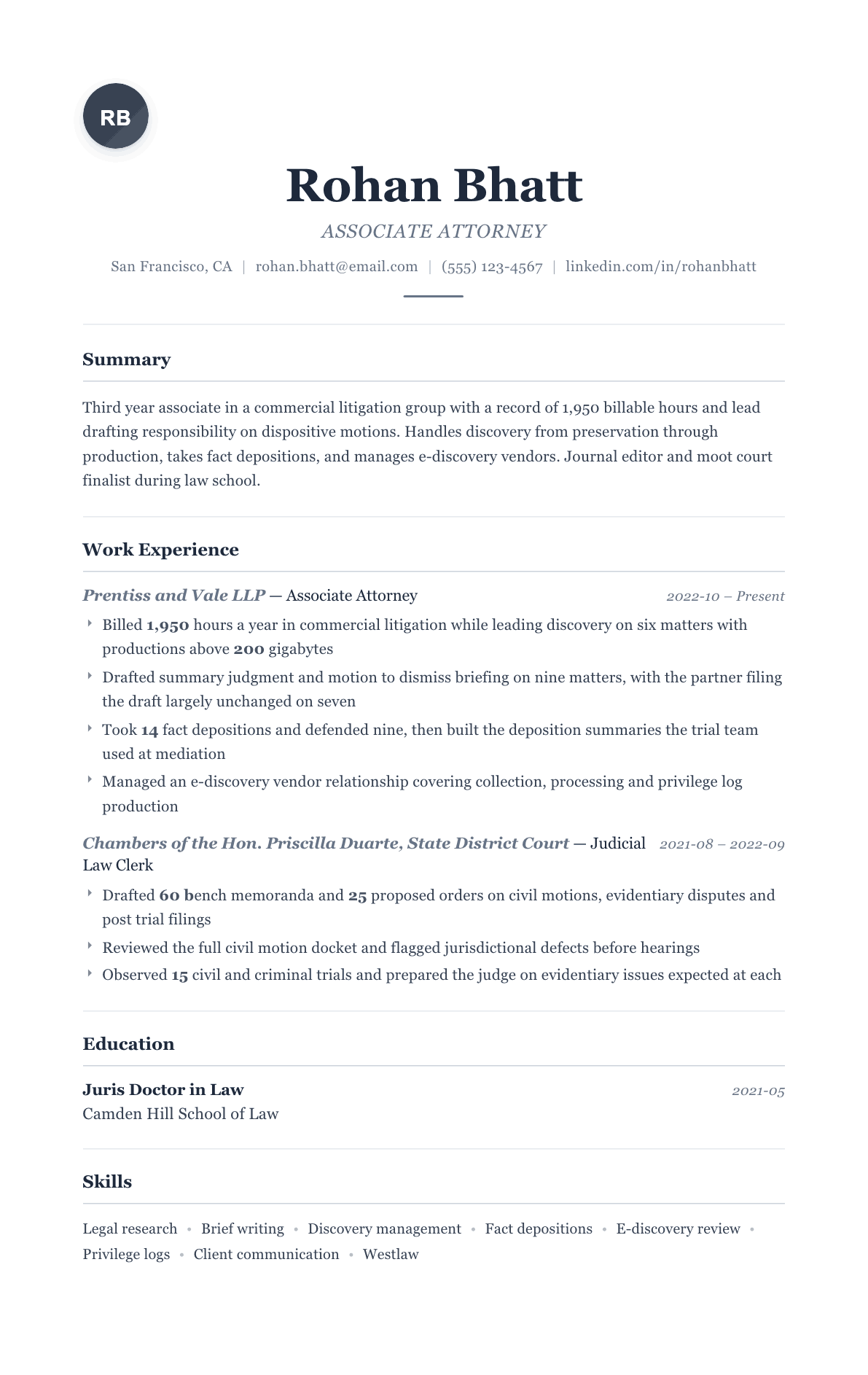
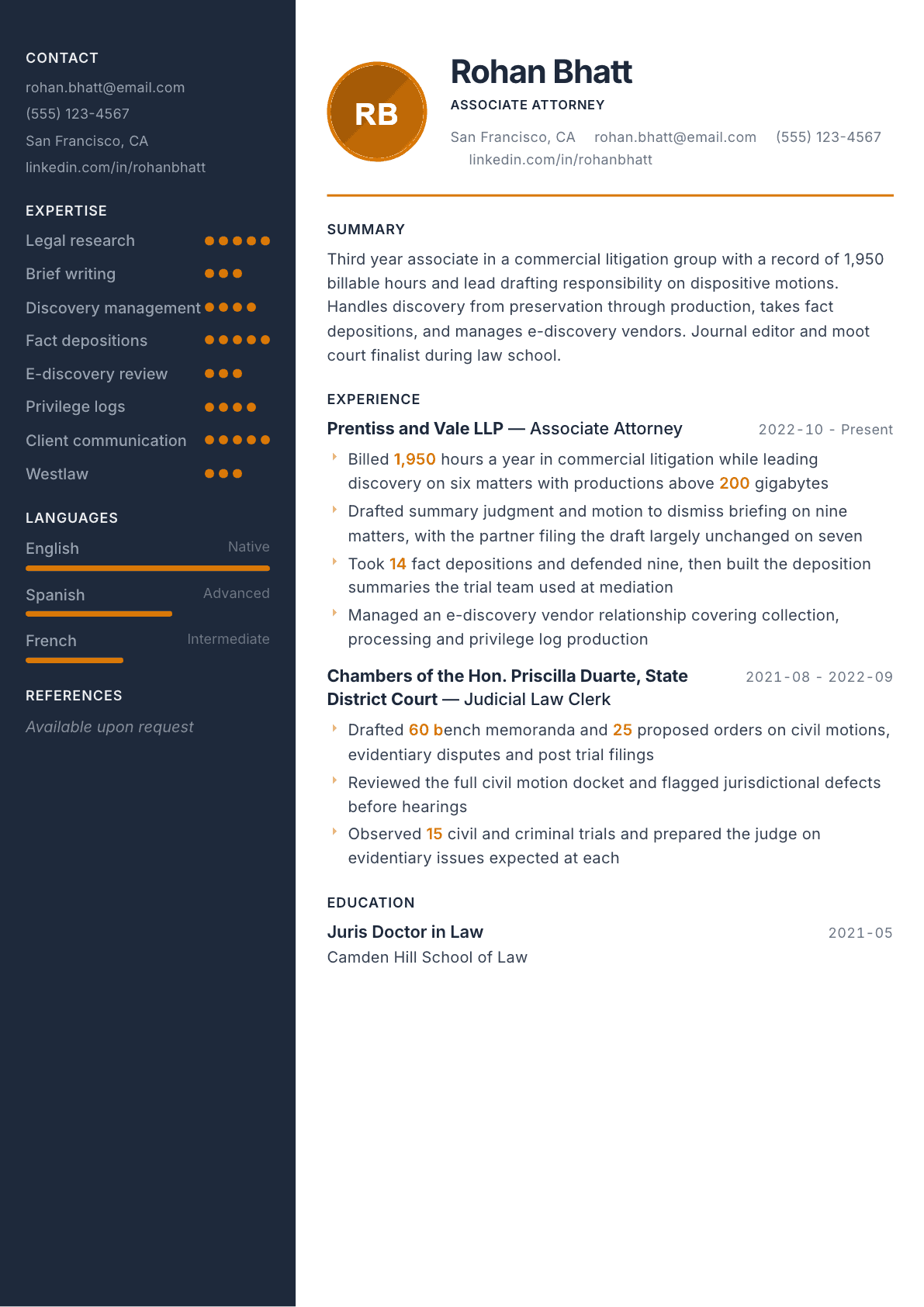
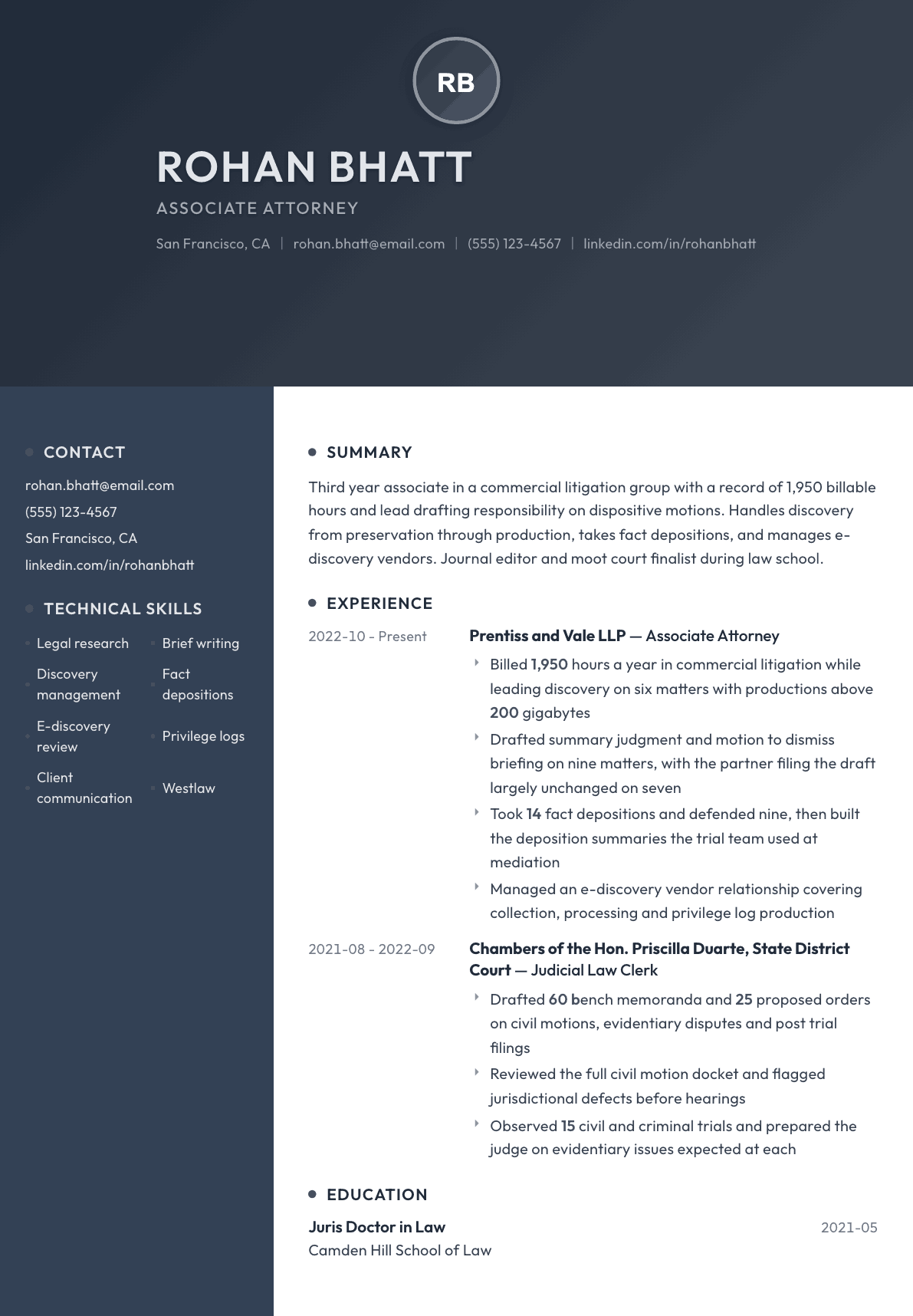
The same associate attorney content laid out in three CVBooster templates, so you can see what the finished document looks like before you write a word.
Example Associate Attorney summary
Associate attorney with three years in a commercial litigation group, billing close to two thousand hours a year while leading discovery on six active matters. Drafts dispositive briefing that partners file largely unchanged, has taken 14 fact depositions, and manages e-discovery vendors through production. Former judicial law clerk and journal editor seeking a midlevel associate seat in a litigation practice.
Skills to list on a Associate Attorney resume
- Legal research
- Brief and memorandum drafting
- Motion practice
- Discovery and document review
- E-discovery platforms
- Privilege review
- Fact depositions
- Contract review
- Due diligence
- Client correspondence
- Cite checking
- Westlaw and Lexis
- Billable time management
- Trial support
What actually gets this resume read
- Name the practice group by its real label, such as commercial litigation or fund formation, not just the word law.
- Give billable hours if they are healthy, because a firm reading an associate resume is estimating your ramp time.
- Show ownership: what you drafted first, what you argued, which depositions you took rather than merely attended.
- Keep law school details until your fifth year: journal, moot court, class rank if strong, and any clerkship.
- List the document review platform and case management tools you have actually run, not everything you have opened.
- Describe matters by industry and posture so a hiring partner can match you against their current client roster.
How to write a associate attorney resume
An associate attorney resume is evaluated against a class year. A recruiting partner reading a lateral file already knows roughly what a third year in a litigation group should be able to do without supervision, and she is checking whether your resume shows it. Class year is the frame; everything you write is either consistent with it or quietly below it.
The second thing she checks is ramp cost. Every lateral associate has a period where the firm pays for training rather than billing for it, and the resume that shortens that period wins. Practice group match, platform fluency, the depositions you have already taken and the briefs you have already written are all evidence about how quickly you become profitable.
This guide covers how to present class year and hours, how to describe matters in a way that maps to a firm practice group, what to do about law school credentials as an associate, and how to handle a move between firm sizes or between a firm and an agency.
Format: class year visible, education still earning its space
One page is standard for an associate through roughly the sixth year. Put admissions directly under contact details, then experience, then education. An associate resume that runs two pages usually contains a paragraph that should have been three bullets.
Make the class year unambiguous. Graduation date, admission year and the start date at your first legal position together tell a recruiter where you sit, and any gap between them should be explained rather than left to inference.
- Header: name, city and state, phone, email.
- Bar admissions with jurisdictions and years, plus any pending application.
- Experience with the practice group named for each position.
- Education with journal, moot court, clinics, honors and any clerkship.
Name the practice group the way the firm names it
Firms staff by group, and a resume that says general practice makes a reader work to place you. Write the group label the industry uses: commercial litigation, labor and employment, fund formation, capital markets, health care regulatory, insurance coverage, white collar defense. Then add the industries of the clients you served.
If your work has spanned groups, order the bullets so the group you are applying into comes first under each employer. A recruiter reading a coverage posting should see coverage work in the first bullet, not in the fourth after a general discovery description.
Hours, ownership and the evidence of independence
Include billable hours when they are healthy, because a firm is estimating your capacity and your work habits. Give the annual figure and, if useful, the realization or the split between billable and pro bono. If your hours were low for a structural reason such as a small firm with lean staffing, leave the number out and let matter descriptions carry the weight.
Then show independence. A third year associate who has taken fact depositions, argued a discovery motion, run a due diligence workstream or led a closing checklist is describing a different lawyer from one who assisted with those things. Use the verb that reflects what you actually held.
Where a partner filed your draft with light revision, say so plainly. It is a claim about writing quality that a hiring partner understands immediately and can test with a writing sample.
Platforms, because retraining is a real cost
Name the document review platform, the case or matter management system, the research service and the document assembly tools you have used. A firm reading your file is deciding whether you can be staffed on a live matter in week two or whether someone has to sit with you first.
For transactional associates, list virtual data rooms, closing checklist and signature management tools, and entity management systems. For litigators, list review platforms, transcript management, trial presentation software and legal hold or preservation tools.
- Research: the services you use daily and any specialty databases.
- Review: the platform, and whether you have run search terms and privilege workflows.
- Matter management: time entry, docketing and calendaring systems.
- Practice specific: data rooms, transcript tools, trial presentation software.
Law school, clerkships and the pro bono line
Associate resumes keep law school detail longer than partner resumes do, because a firm still uses it to calibrate. Keep journal position, moot court results, clinics, teaching assistantships and honors through your fifth year. A judicial clerkship stays permanently and belongs in experience, not education.
Pro bono deserves one or two lines when it produced real responsibility. An associate who tried an asylum case or argued a housing matter has courtroom experience that the billable docket may not have offered yet, and firms with pro bono commitments read that line closely.
Associate Attorney resume summary examples
First year associate
First year litigation associate and former judicial law clerk, admitted this year. Drafted 60 bench memoranda and 25 proposed orders during the clerkship and has since second chaired two hearings and run document review on three matters. Law journal editor with a writing sample available on request.
Third year associate
Third year associate in a commercial litigation group billing close to two thousand hours a year. Leads discovery on six matters, has taken 14 fact depositions, and drafts dispositive briefing that partners file with light revision. Manages an e-discovery vendor through collection, processing and privilege log production.
Senior associate
Senior associate with seven years in labor and employment, running matters from intake through resolution with partner oversight only at strategy points. Handles agency responses, workplace investigations and single plaintiff trials, and supervises two junior associates and a paralegal on every active file.
Work experience bullets: before and after
Before: Assisted partners with litigation matters.
After: Led discovery on six commercial matters including preservation, search term negotiation and productions above 200 gigabytes, reporting to the partner only at strategy checkpoints.
Leading a workstream and naming its parts shows the independence a class year is expected to have.
Before: Drafted motions and briefs.
After: Drafted summary judgment and motion to dismiss briefing on nine matters, with the partner filing the draft largely unchanged on seven of them.
The filed largely unchanged detail is a concrete claim about writing quality rather than a self assessment.
Before: Attended depositions.
After: Took 14 fact depositions and defended nine, then wrote the deposition summaries the trial team relied on at mediation.
Taking and defending are different from attending, and the follow through shows the work product mattered.
Before: Worked on document review.
After: Managed an e-discovery vendor across collection, processing and privilege log production, and ran the first level review protocol for a team of contract reviewers.
Managing the workflow and the vendor is a supervisory skill firms staff for, not a task they assign a beginner.
Before: Did pro bono work.
After: Represented two asylum applicants through merits hearings, preparing the declarations, country conditions evidence and direct examination for each.
Naming the posture and the work shows hearing experience the billable docket may not yet have provided.
Hard skills
- Legal research
- Brief and memorandum drafting
- Motion practice
- Discovery planning and management
- E-discovery review platforms
- Privilege review and logs
- Fact depositions
- Contract review and markup
- Due diligence workstreams
- Closing checklist management
- Cite checking and record citation
- Legal research platforms
- Time entry and billing narratives
- Trial and hearing preparation
Soft skills
- Working to partner expectations
- Receiving and applying edits
- Managing competing deadlines
- Client correspondence
- Supervising junior colleagues
- Asking for scope early
Certifications worth listing
- State Bar Admission (State Bar Association)
- Admission to the United States District Court (United States District Court)
- Relativity Certified Administrator (Relativity)
- Certified Information Privacy Professional (CIPP/US) (International Association of Privacy Professionals)
Mistakes that cost associate attorney candidates the interview
- Leaving the class year ambiguous so a recruiter cannot tell whether you are a second year or a fifth year lateral.
- Using assisted and supported for work you actually owned, which reads as a quieter class year than yours.
- Describing your practice as general when firms staff by named group and search by that label.
- Omitting billable hours when they are strong, since a firm is sizing your capacity and will ask anyway.
- Listing platforms you have opened once alongside the ones you run, which invites a question you cannot answer well.
- Filling a second page with law school activities that a hiring partner stopped weighting after your first year.
Associate Attorney resume questions
Should an associate attorney resume include billable hours?
Include them when they are solid, because a firm evaluating a lateral is estimating both capacity and work habits. If your hours were structurally low at a small firm or in a government role, leave the figure out and let your matter descriptions do the work.
How do I show class year on the resume?
Let the graduation date, admission year and first legal position dates align so the reader can count. If there is a gap for a clerkship, a fellowship, a bar delay or caregiving, name it briefly rather than letting a screener assume the worst.
How much law school detail should stay on an associate resume?
Keep journal, moot court, clinics and honors through about your fifth year, since firms still use them for calibration. A judicial clerkship belongs in the experience section permanently because it is professional practice, not a school activity.
How do I present a move from a large firm to a smaller one?
Show what the move gave you: earlier ownership of matters, direct client contact, first chair hearings. Firms hiring laterals care far more about the responsibility you carried than about the letterhead you carried it under.
Is pro bono work worth a line on the resume?
Yes, when it produced responsibility your billable docket had not yet offered, such as a hearing, a trial or direct client representation. Describe the posture and your role rather than simply noting participation in a pro bono program.