Summer Associate Resume Examples: the lines they read
Write a Summer Associate Resume for Firm Recruiting
By Mustafa Tarabya, founder of CVBooster · Published · Updated
Summer associate resume example with journal, clinic and research keywords, plus a guide to the one-page format law firm recruiting committees expect.
Sample resumes for a summer associate
The same summer associate content laid out in three CVBooster templates, so you can see what the finished document looks like before you write a word.
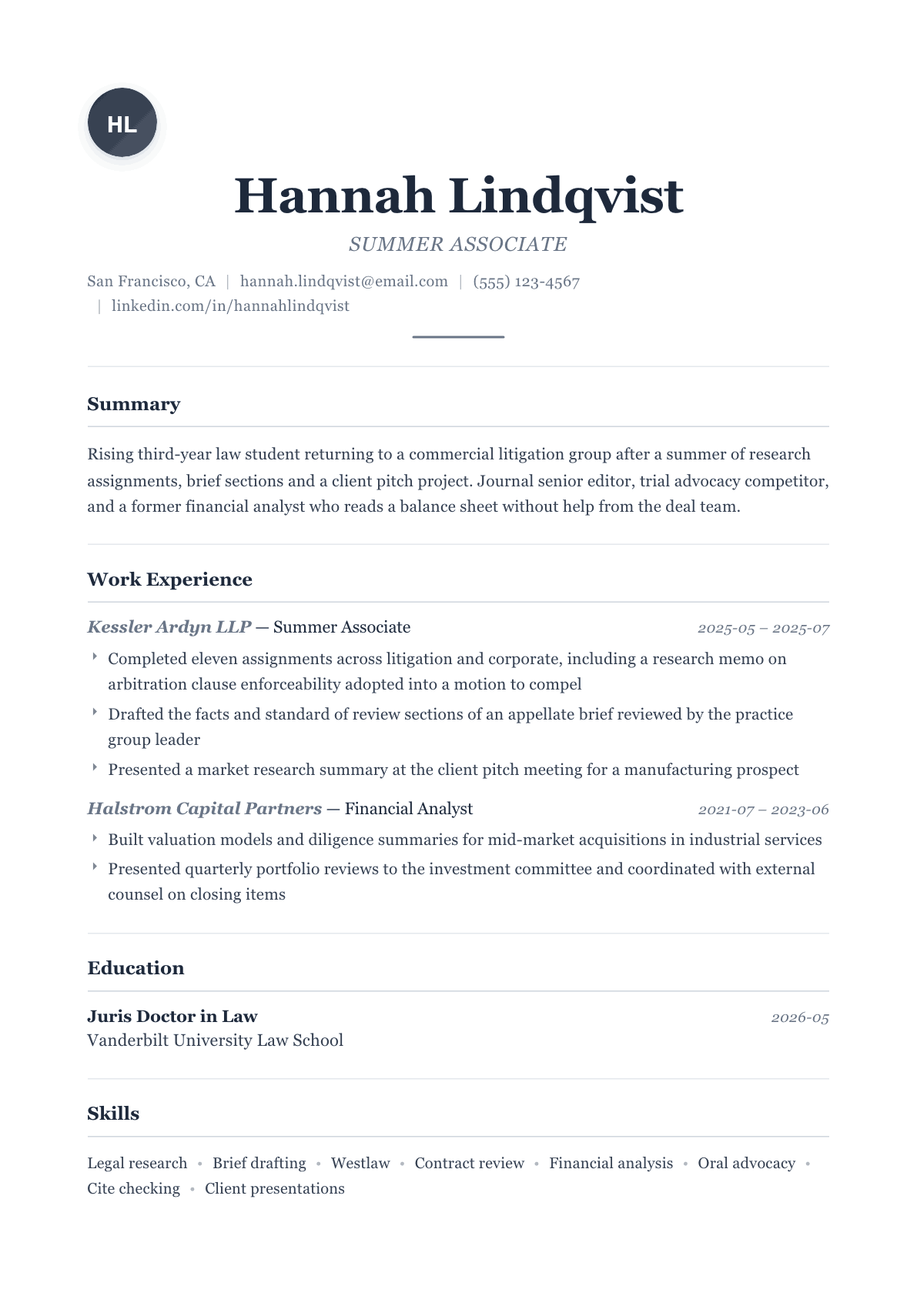
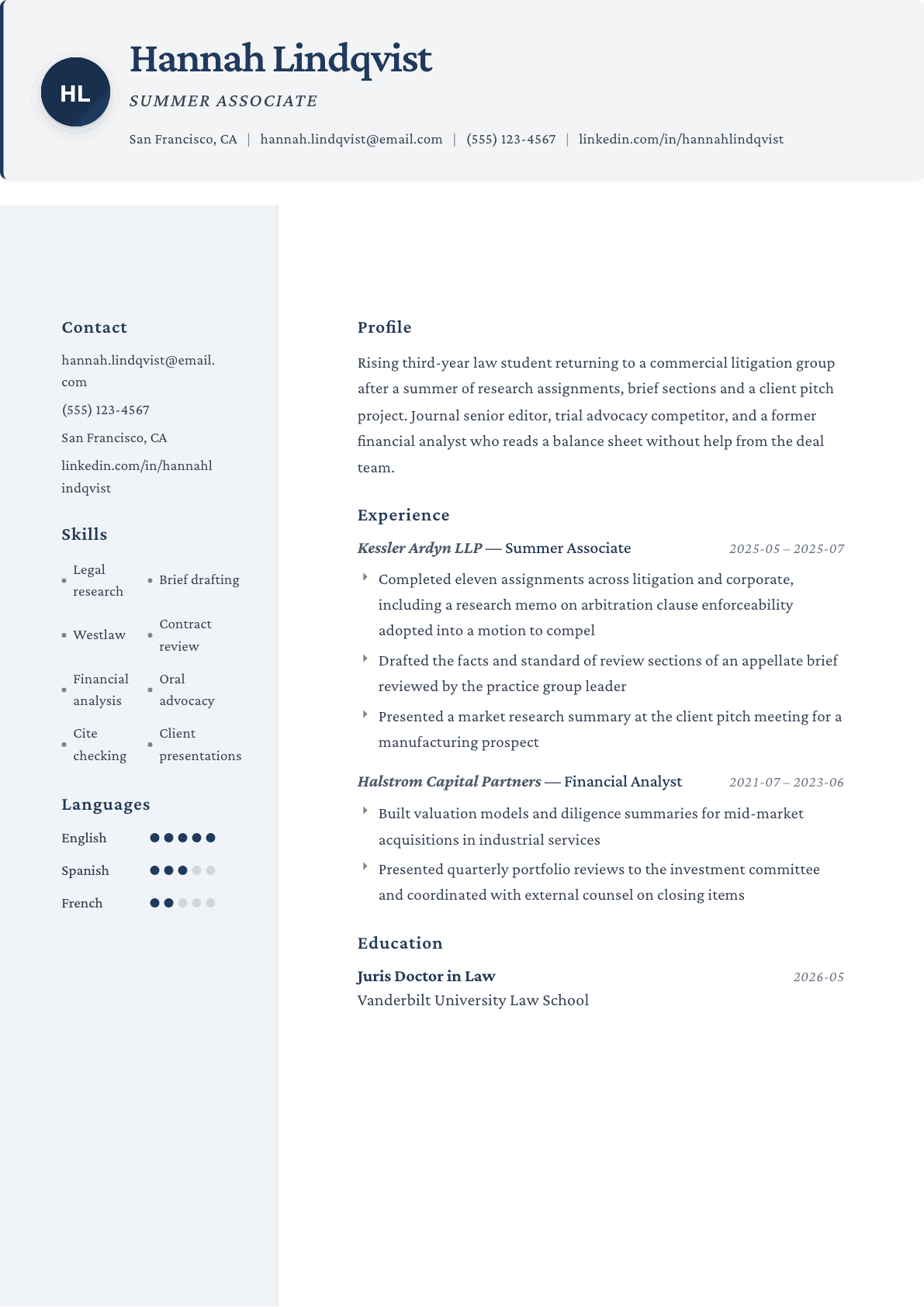
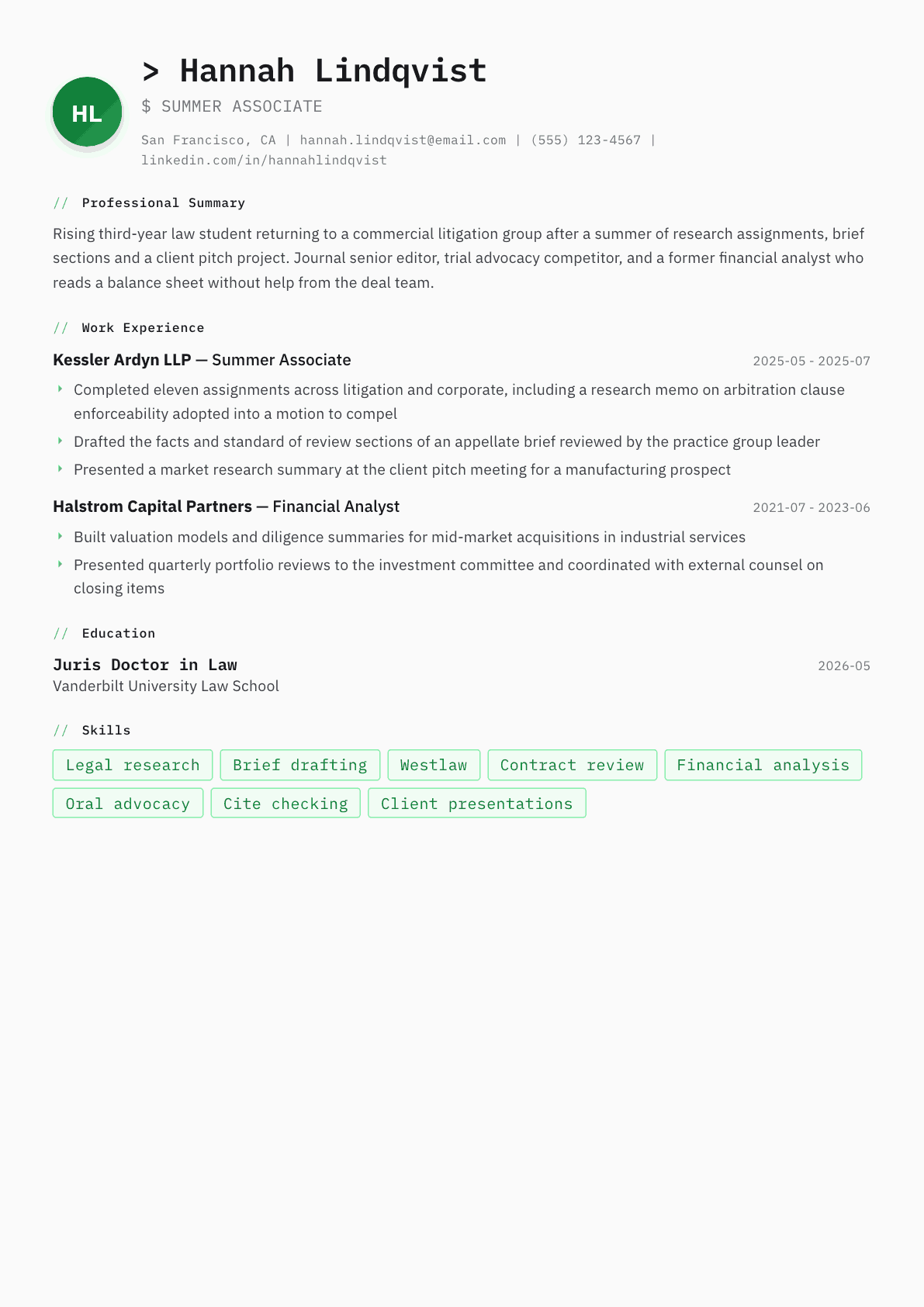
Example Summer Associate summary
Rising third-year law student and returning summer associate in a commercial litigation group, with eleven completed assignments including a research memo adopted into a motion to compel and drafted sections of an appellate brief. Journal senior editor and trial advocacy competitor with two years as a financial analyst before law school. Targeting a litigation associate offer.
Skills to list on a Summer Associate resume
- Legal research
- Legal memoranda
- Brief section drafting
- Westlaw and Lexis
- Bluebook citation
- Contract review
- Document review
- Due diligence support
- Oral advocacy
- Client presentation support
- Case law analysis
- Financial statement analysis
What actually gets this resume read
- One page, education first, and the journal or moot court line high enough that a recruiting committee sees it immediately.
- Describe your summer assignments by practice group and output, because firms want to know what you actually produced.
- Keep prior career experience if it gives you an industry the firm serves, and translate it into terms a partner recognizes.
- Mention the callback practice areas you are targeting in a short interests or objective line only if the firm asks for one.
- Use consistent date formatting and full firm names, since recruiting coordinators screen dozens of these in a sitting.
- Have a writing sample from a real assignment ready and make sure any confidential material in it has been cleared.
How to write a summer associate resume
A summer associate resume is a recruiting document. It is screened by a recruiting coordinator against a set of criteria the firm decided months earlier, then read by two or three attorneys on a hiring committee who have twenty minutes between meetings and a stack of nearly identical pages from the same handful of schools.
That process rewards a specific kind of page: one screen of information, no ambiguity about class year or availability, and an experience section where each entry describes something produced rather than somewhere attended. The differences that survive that reading are the concrete ones, which is why a prior career, a technical background or a language is often worth more than another honors line.
This guide covers the format firms expect during recruiting, how to describe summer assignments and journal work so an interviewer has something to ask about, summaries for a student seeking a first summer, a returning summer associate and a rising graduate, and the questions students ask about writing samples and callbacks.
Format: one page built for a fast reader
One page, education first, full firm and organization names, right aligned dates and a single typeface. Recruiting coordinators screen these in batches and a page that deviates from the expected shape costs you attention rather than earning it.
Make class year and availability unmistakable. Expected graduation goes with your law school entry, and if your availability window is unusual because of a joint degree, a transfer or an evening program, say so in one short line rather than letting a coordinator work it out.
- Header: name, city and state, phone, email, and nothing else.
- Order: education with honors and journal, experience, activities, skills and languages, interests.
- Give each employer its full legal name and the office city, since firms track placement by office.
Describing summer assignments a firm will recognize
A returning summer associate has the best material on the page and usually wastes it. Describe the assignments by practice group and by product: a research memorandum on a specific question, a section of a brief, a diligence chart, a client alert, a pitch research summary. Then say what happened to the work.
Assignment counts are useful because they show throughput across a short program. Eleven assignments across litigation and corporate in ten weeks says something an interviewer can weigh, particularly if one of them was adopted into a filed document.
Where you worked with a partner or practice group leader on something visible, such as a client pitch or a filed brief, say so. Firms hire summer associates who can be put in front of a client without supervision anxiety, and evidence of that is rare on a student page.
Journal, moot court and the academic signals
Firms use journal membership and competition results as proxies for writing and stamina, so give both substance. Your editorial title, the volume you handled, your note topic and whether it is published all belong. For moot court or trial competitions, give the result and what you personally wrote or argued.
Honors should use the exact names your school awards, and any dean's list or book award should say the subject where relevant. A book award in contracts is a talking point for a transactional group and an argument for an assignment you would enjoy.
Prior careers and industry knowledge
A previous career is the most efficient differentiator available to a law student, provided you translate it. An analyst who can read financial statements, an engineer who understands a manufacturing process, a nurse who can read a medical chart: each of those saves a partner explanation time on a real matter.
Write the entry for a legal reader. Keep two or three bullets, name the output and the audience, and connect it to the kind of work the firm does. What matters is not the seniority you left behind but the specific ability that follows you into the summer program.
Writing samples, references and the callback stage
Have a writing sample ready before you apply, matched to the practice you are targeting and cleared of anything confidential. A memo you wrote for a prior position needs your supervisor's permission and careful redaction, and a journal note excerpt is a safe alternative when nothing else is clean.
Prepare for the callback while you write the resume, because every line invites a question. If a bullet mentions an arbitration research memo, be ready to describe the question, the authority you found and the answer you gave. Interviewers reward a student who can talk about their own page in detail.
Summer Associate resume summary examples
Seeking a first summer
First-year law student with a research assistant position in contracts, a legal writing section grade in the top band, and two years as a financial analyst building valuation models for mid-market acquisitions. Seeking a summer associate position in a corporate or commercial litigation group.
Returning summer associate
Rising third-year student returning to a commercial litigation group after eleven assignments across litigation and corporate, including a memo on arbitration clause enforceability adopted into a motion to compel and drafted sections of an appellate brief. Journal senior editor and trial advocacy competitor.
Rising graduate with an offer
Third-year student holding a litigation offer, spending the final year in a trial practice clinic and a judicial externship on a civil calendar. Journal note published on arbitration waiver, two moot court finals, and a prior career in industrial services diligence. Preparing for the bar examination and a fall start date.
Work experience bullets: before and after
Before: Completed research assignments for attorneys in multiple practice groups.
After: Completed eleven assignments across litigation and corporate in a ten week program, including a memo on arbitration clause enforceability that was adopted into a filed motion to compel.
A count, a period and one assignment that reached a court turn a generic program line into evidence of throughput.
Before: Helped draft an appellate brief.
After: Drafted the facts and standard of review sections of an appellate brief, working from the record and revising through two rounds with the practice group leader.
Naming the sections and the revision process shows how you work with a partner rather than that you touched a document.
Before: Attended a client pitch meeting.
After: Researched a manufacturing prospect's regulatory exposure and presented the summary at the client pitch meeting alongside two partners.
Presenting rather than attending is the distinction a hiring committee is looking for on a student page.
Before: Financial analyst before law school.
After: Built valuation models and diligence summaries for mid-market industrial services acquisitions and presented quarterly portfolio reviews to an investment committee.
Concrete deliverables and an executive audience show the transferable ability instead of just naming a former job.
Before: Senior editor on the law journal.
After: Senior editor overseeing four staff editors through source verification on three articles, and author of a published note on arbitration waiver.
Supervision scope and a published piece give a firm the writing and management evidence the title alone implies.
Hard skills
- Legal research
- Legal memoranda
- Brief section drafting
- Westlaw and Lexis
- Bluebook citation and source verification
- Contract review
- Due diligence support
- Document review
- Case law and record analysis
- Client research and pitch support
- Oral advocacy
- Financial statement analysis
Soft skills
- Assignment scoping questions
- Delivering ahead of the deadline
- Taking partner edits gracefully
- Professional presence with clients
- Working across practice groups
- Clear status updates
Mistakes that cost summer associate candidates the interview
- Describing a summer program by the groups you rotated through instead of the assignments you delivered.
- Leaving expected graduation and availability ambiguous when a recruiting coordinator sorts on exactly those fields.
- Deleting a prior career for space when it is the one line a hiring committee will remember from the page.
- Listing a journal or competition title with no volume, note topic or result attached to it.
- Applying without a cleared writing sample, then scrambling when a firm asks for one within a day.
- Writing bullets you cannot discuss in detail, which turns your own resume into the hardest part of the callback.
Summer Associate resume questions
What do firms look for in a summer associate resume?
Academic signals first, then evidence you produce usable work and behave well around clients. That means journal or competition results, a legal writing record, and experience entries describing documents you drafted. A distinctive prior background helps once those boxes are checked.
How long should a summer associate resume be?
One page, no exceptions during law school. Firms compare students on a narrow set of criteria and expect them in familiar positions on the page. Compress earlier work to two lines each rather than letting the document run onto a second sheet.
How do I describe my summer assignments without breaching confidentiality?
Describe the legal question and the document, never the client or the facts. A memorandum on arbitration clause enforceability is safe. The name of the party, the industry detail that identifies them and the outcome of their matter are not, unless the matter is public record.
Does a career before law school help or hurt?
It helps when it is translated. Firms value someone who can read a financial statement, a technical specification or a medical chart without a tutorial. Keep the entry short, write it for a legal reader, and connect the skill to the practice group you are targeting.
What writing sample should I use for firm recruiting?
Something in the register of the work: a memo or a brief section rather than a seminar paper. Keep it around ten pages, get written permission for anything from a prior employer, redact identifying detail, and be ready to explain how much editing you received on it.