Law Clerk Resume Examples: free ATS score and gap list
Write a Law Clerk Resume That Proves Research and Drafting
By Mustafa Tarabya, founder of CVBooster · Published · Updated
Law clerk resume example with legal research, memo drafting and citation keywords, plus a guide to writing for firms and government offices.
Sample resumes for a law clerk
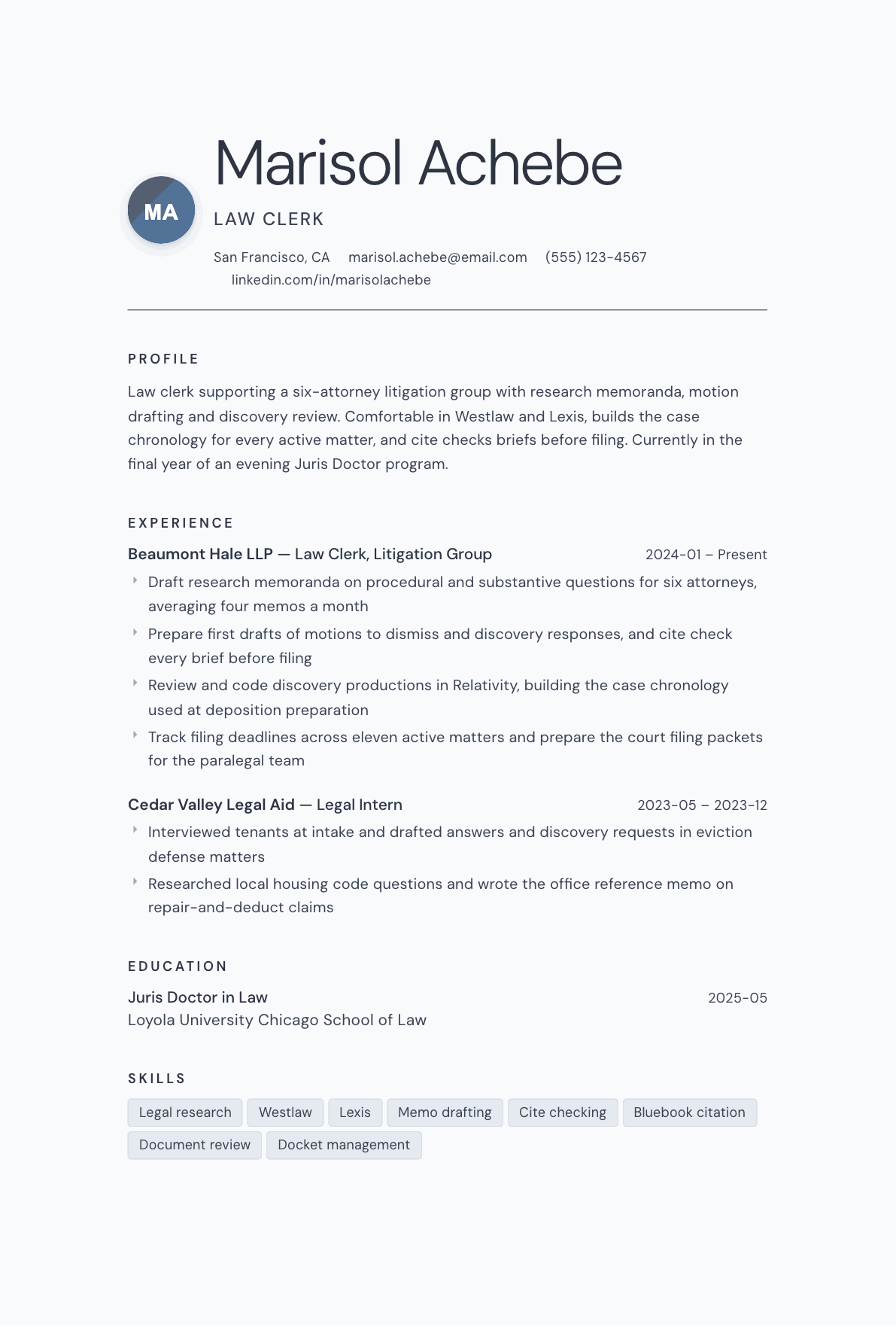
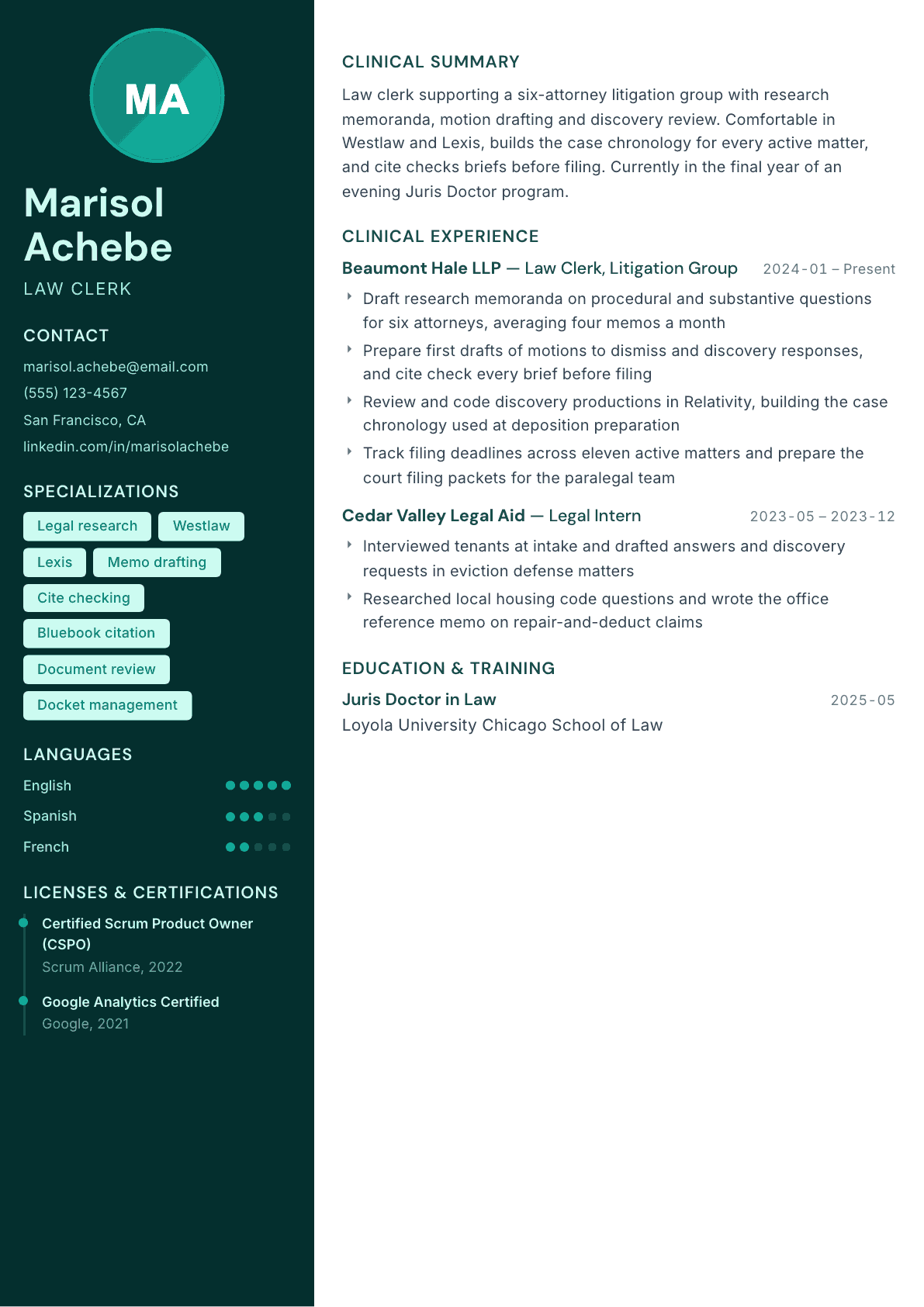
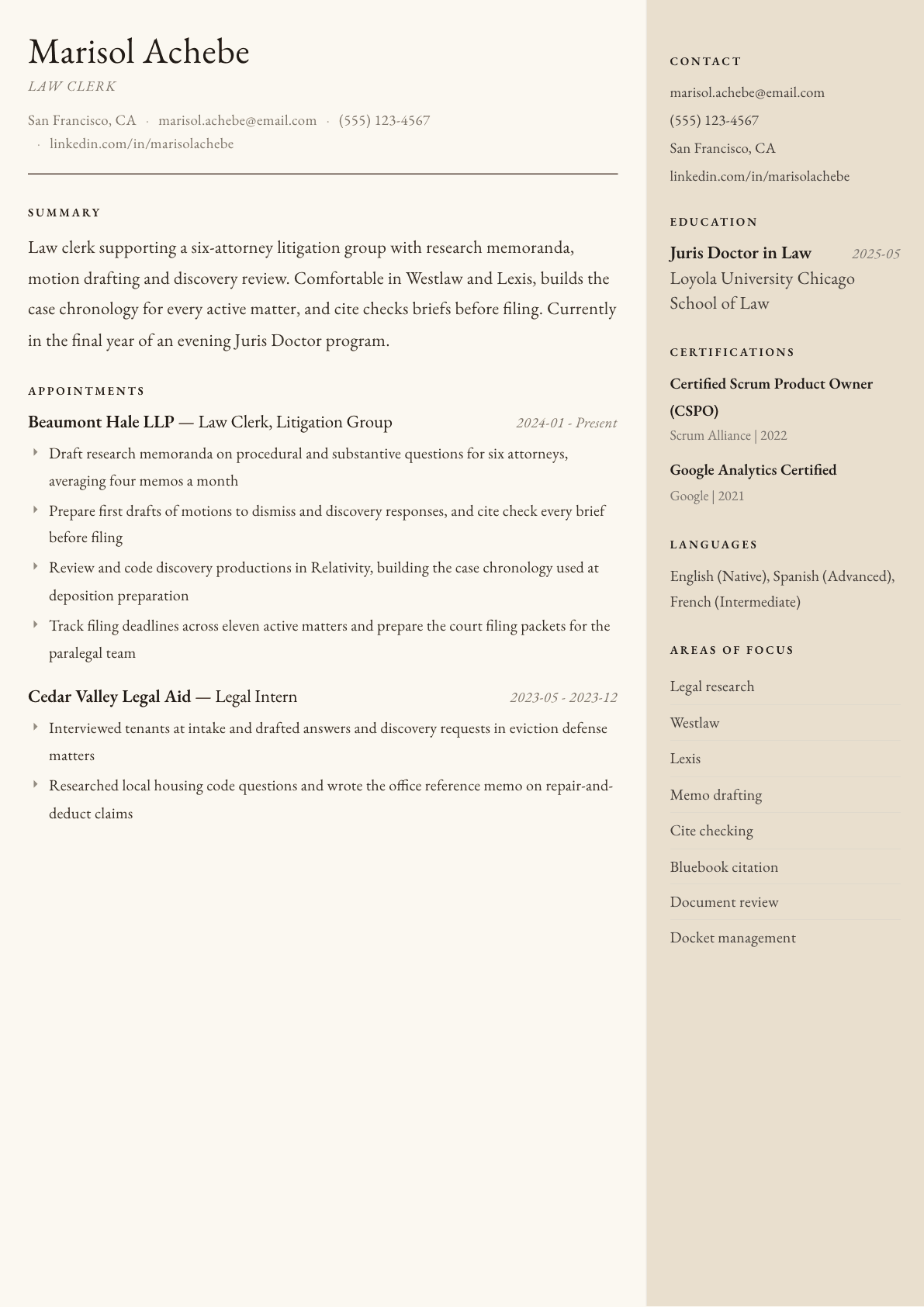
The same law clerk content laid out in three CVBooster templates, so you can see what the finished document looks like before you write a word.
Example Law Clerk summary
Law clerk supporting a six-attorney litigation group with research memoranda, motion drafts and discovery review in Relativity. Writes roughly four memos a month, cite checks every brief before filing, and tracks deadlines across eleven active matters. Previously an intern in eviction defense at a legal aid office. Completing an evening Juris Doctor and seeking an associate track position.
Skills to list on a Law Clerk resume
- Legal research
- Westlaw and Lexis
- Legal memoranda
- Motion drafting
- Bluebook citation
- Cite checking
- Document review
- Relativity
- Discovery response drafting
- Case chronology building
- Court filing procedures
- Docket and deadline tracking
- Client intake interviewing
- Statutory and regulatory analysis
What actually gets this resume read
- Lead with research and writing output: how many memos, on what questions, and for how many attorneys.
- Name the research platforms and the review tool you actually used, because those appear word for word in the posting.
- Show that you understand deadlines by describing docket tracking and filing preparation, not just substantive work.
- List your citation experience explicitly, since cite checking and Bluebook accuracy are what a supervising attorney tests first.
- Put your law school status and expected graduation date near the top when you are still enrolled.
- Attach a writing sample reference on the resume and make sure the sample matches the practice area you are applying to.
How to write a law clerk resume
The title law clerk covers two very different jobs. In a firm, a government office or a corporate legal department it is a research and drafting role usually filled by a law student or a recent graduate. In a court it is a clerkship in chambers. This guide is about the first one, and the resume that wins it proves you can turn a question into a usable memo without a partner rewriting it.
The person reading is a supervising attorney or a legal administrator with a queue of unassigned research. They are checking three things: whether you can find the law, whether you can write it down clearly, and whether you will hit a filing deadline without being chased. Everything else on the page is secondary.
This guide sets out the format, shows how to describe research output so it reads as real work, gives summaries for a first clerk position, a settled clerk and a senior clerk moving toward an associate role, and answers the questions students ask when their only writing so far was graded rather than filed.
Format: one page, education and status at the top
A law clerk resume stays on one page until you have several years of substantive work. Put your law school, expected graduation and any journal or honors near the top, because enrollment status determines what work an office can assign you and whether they can bill for it.
If you are already admitted, or admitted in a different state, say so plainly. A supervising attorney needs to know whether your drafting requires a signature above yours, and a resume that leaves the question open gets set aside rather than clarified.
- Header: name, city and state, phone, email, and admission or expected admission status.
- Order: summary, education with graduation date, legal experience, research and writing, skills, other work.
- Add a line naming your available writing sample and the practice area it comes from.
Research and writing: describe the output, not the activity
The weakest line on a law clerk resume is a claim to have conducted legal research. Every applicant writes it. Replace it with output: how many memoranda you produced, for how many attorneys, on what kinds of questions, and what happened to the work afterward. A memo that was adopted into a filed brief is worth more than three that sat in a folder.
Name the practice areas of the questions you handled. Personal jurisdiction, arbitration enforceability, statute of limitations, landlord obligations, licensing conditions: any concrete subject shows a supervising attorney that you have read real authority rather than casebook excerpts.
Drafting deserves its own bullets. Motions, discovery responses, demand letters, engagement letters and pleadings each require a different register, and listing the documents you have drafted tells the reader what they can assign in your first week.
Systems, citation and the deadline half of the role
Name the research platforms you have used and the document review tool if you have touched one. These are matched literally by applicant tracking systems and by the administrator screening the stack, so write them out rather than describing them as legal research databases.
Cite checking is the task most new clerks are tested on first, so give it real space. Say that you cite check briefs before filing, that you work in a specific citation manual, and that you verify quotations and subsequent history rather than only format. Add docket and deadline tracking, because a clerk who watches a calendar is worth more than one who only writes well.
Discovery, files and the unglamorous work
Litigation clerks spend real hours in document review, chronology building, exhibit assembly and deposition preparation. These are not filler. A clerk who has coded a production, built a case chronology and prepared a deposition binder saves an associate days, and that is a hiring argument.
Say what the work produced. A chronology used at deposition preparation, a privilege log you drafted, a summary chart the trial team used: each of those turns hours of review into an artifact somebody relied on.
Prior work, languages and the transition story
Keep pre-law employment when it shows responsibility, an industry the office serves or a skill the role uses, such as accounting, healthcare, construction or technical writing. Cut retail and hospitality once you have two legal entries, unless it fills a gap that would otherwise raise a question.
If you are an evening student or changing careers, use the summary to say so and to name what you bring across. A supervising attorney is happy to hire someone who already knows how to run a client relationship, provided the resume connects that experience to the legal work rather than leaving it as unexplained history.
Law Clerk resume summary examples
First clerk position
First-year law student with strong legal writing marks, a research assistant position with a civil procedure professor, and a summer at a legal aid intake desk. Comfortable in Westlaw and Lexis, careful with citation format, and looking for a term-time law clerk role in litigation.
Working clerk
Law clerk supporting a six-attorney litigation group with research memoranda, motion drafts and discovery review in Relativity. Writes about four memos a month, cite checks every brief before filing, and tracks deadlines across eleven active matters. Previously an intern in eviction defense at a legal aid office.
Senior clerk moving to associate
Senior law clerk in a plaintiff-side firm, drafting complaints, written discovery and opposition briefs reviewed by two partners. Manages the document review workflow on a wage and hour matter across nine custodians and prepares deposition outlines. Awaiting bar results and seeking an associate track position.
Work experience bullets: before and after
Before: Conducted legal research for attorneys in the office.
After: Wrote research memoranda for six litigation attorneys at a rate of roughly four a month, covering personal jurisdiction, arbitration clause enforceability and statute of limitations questions.
Volume, audience and subject matter turn a phrase every applicant uses into a description of work someone relied on.
Before: Helped prepare documents for filing.
After: Prepared court filing packets for eleven active matters, assembling exhibits, checking local rule formatting and confirming e-filing acceptance the same day.
Naming the rules, the assembly work and the confirmation step shows you understand filing as a process with failure points.
Before: Reviewed documents in discovery.
After: Coded a document production in Relativity across nine custodians, flagged privileged material for attorney review, and built the case chronology used in deposition preparation.
The tool, the scope and the artifact produced make review work sound like a contribution instead of a task list.
Before: Checked citations in briefs.
After: Cite checked every brief before filing, verifying quotations, pin cites and subsequent history, and rebuilt the table of authorities for two appellate submissions.
Verification detail is what a supervising attorney tests first, so specifying what you check separates you from format-only clerks.
Before: Worked with clients during intake.
After: Interviewed tenants at intake in eviction defense, drafted answers and discovery requests from those interviews, and wrote the office reference memo on repair-and-deduct claims.
Following the intake through to the documents produced shows the reader you can work a matter rather than a form.
Hard skills
- Legal research
- Westlaw and Lexis
- Legal memoranda drafting
- Motion and pleading drafting
- Bluebook citation and cite checking
- Discovery response drafting
- Document review platforms
- Case chronology and privilege logs
- Court e-filing and local rules
- Docket and deadline tracking
- Statutory and regulatory analysis
- Client intake interviewing
Soft skills
- Written clarity
- Following instructions precisely
- Asking scoping questions early
- Deadline reliability
- Discretion with client files
- Working across several attorneys
Mistakes that cost law clerk candidates the interview
- Claiming legal research as a skill with no memo count, subject matter or destination for the work.
- Leaving expected graduation and admission status off the page, which decides what an office can assign you.
- Listing research platforms as generic databases instead of naming them the way the posting does.
- Treating document review and filing as too minor to mention, when they are most of the assignable work.
- Offering a graded seminar paper as a writing sample for a litigation role without a practice-shaped alternative.
- Filling the page with unrelated jobs once two legal positions exist to describe in depth.
Law Clerk resume questions
What is the difference between a law clerk and a judicial clerk?
A law clerk in a firm or agency researches and drafts for practicing attorneys and is often a current student. A judicial clerk works in chambers for a judge, drafting bench memoranda and opinions after graduation. The titles overlap, so name the setting on your resume to avoid confusion.
How do I write a law clerk resume with no legal jobs yet?
Use coursework and academic work as evidence. A legal writing grade, a research assistant position, a moot court brief, a journal note and a clinic all show research and drafting. Describe them by output and subject rather than by course title, and offer a matching writing sample.
What writing sample should I send with a law clerk application?
Send something in the register of the job: a memo or a brief section rather than a seminar essay when the role is litigation. Keep it under ten pages, redact anything confidential, and confirm your supervisor is comfortable with you using work produced in a prior position.
Do I list my law school grade point average?
Include it when it helps and when the office asks for it, along with class rank if your school publishes one. Leave it off if it is unremarkable and put the space into research output, drafting experience and any journal or competition results instead.
How do I show I can meet deadlines on a resume?
Describe the calendar work directly. Say how many active matters you tracked, that you managed filing deadlines and court dates, and that you prepared submissions ahead of local rule cutoffs. Concrete deadline mechanics read as reliability far better than the word dependable.