Barber Resume Examples: what a hiring manager reads first
Build a Barber Resume That Proves Chair Speed and Skill
By Mustafa Tarabya, founder of CVBooster · Published · Updated
A barber resume guide with license placement, clipper and razor service lists, chair economics and sample bullets shops actually respond to.
Sample resumes for a barber
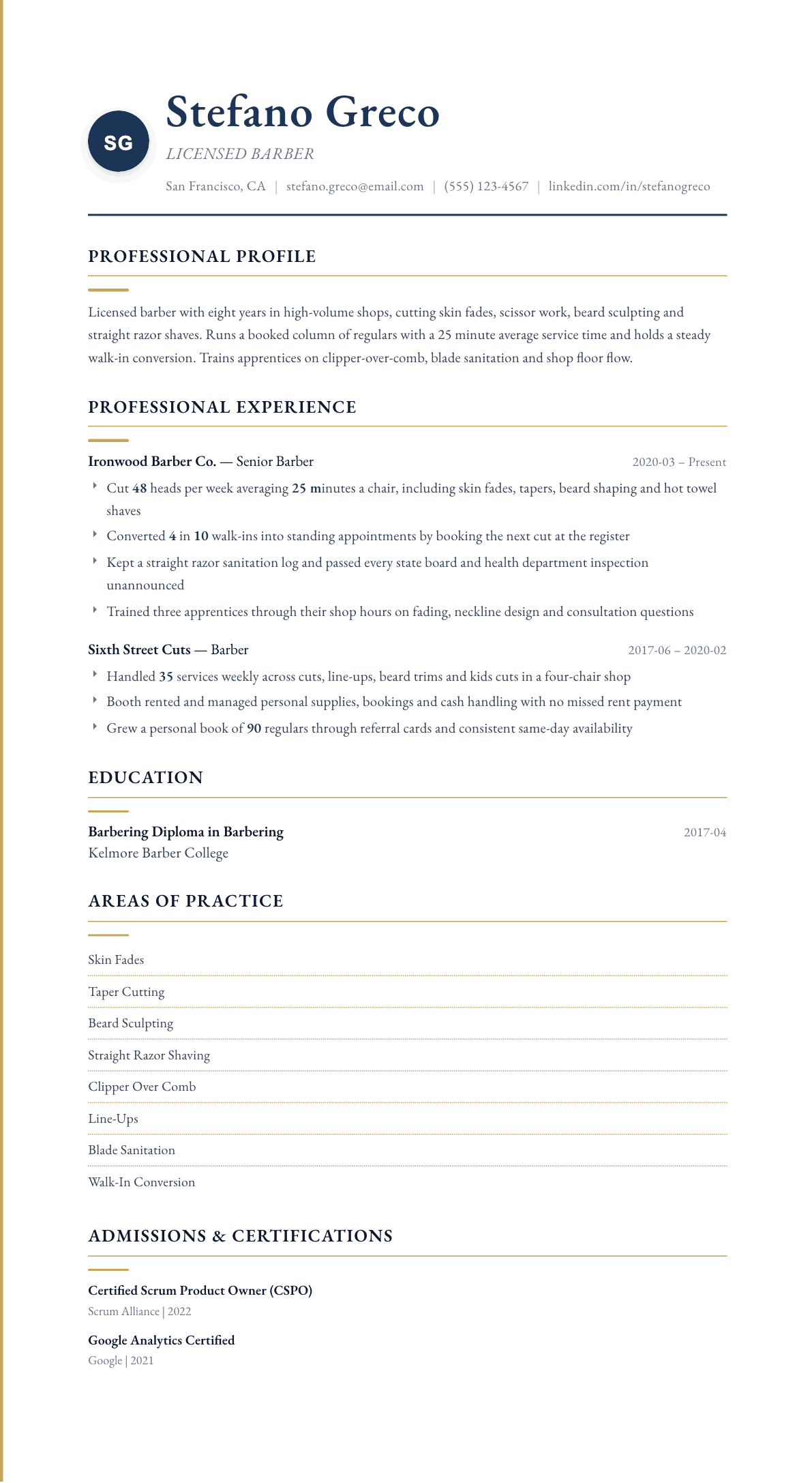
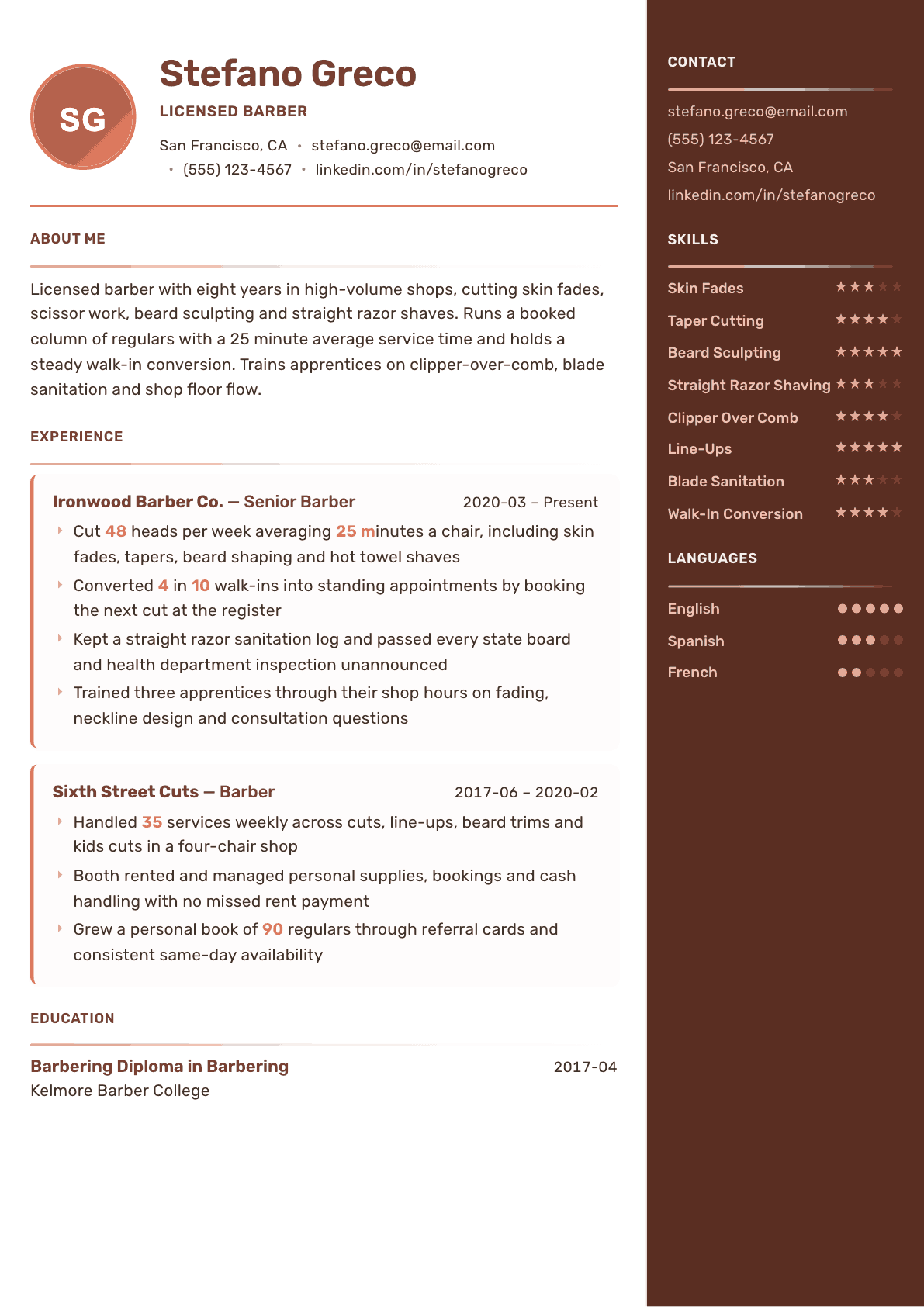
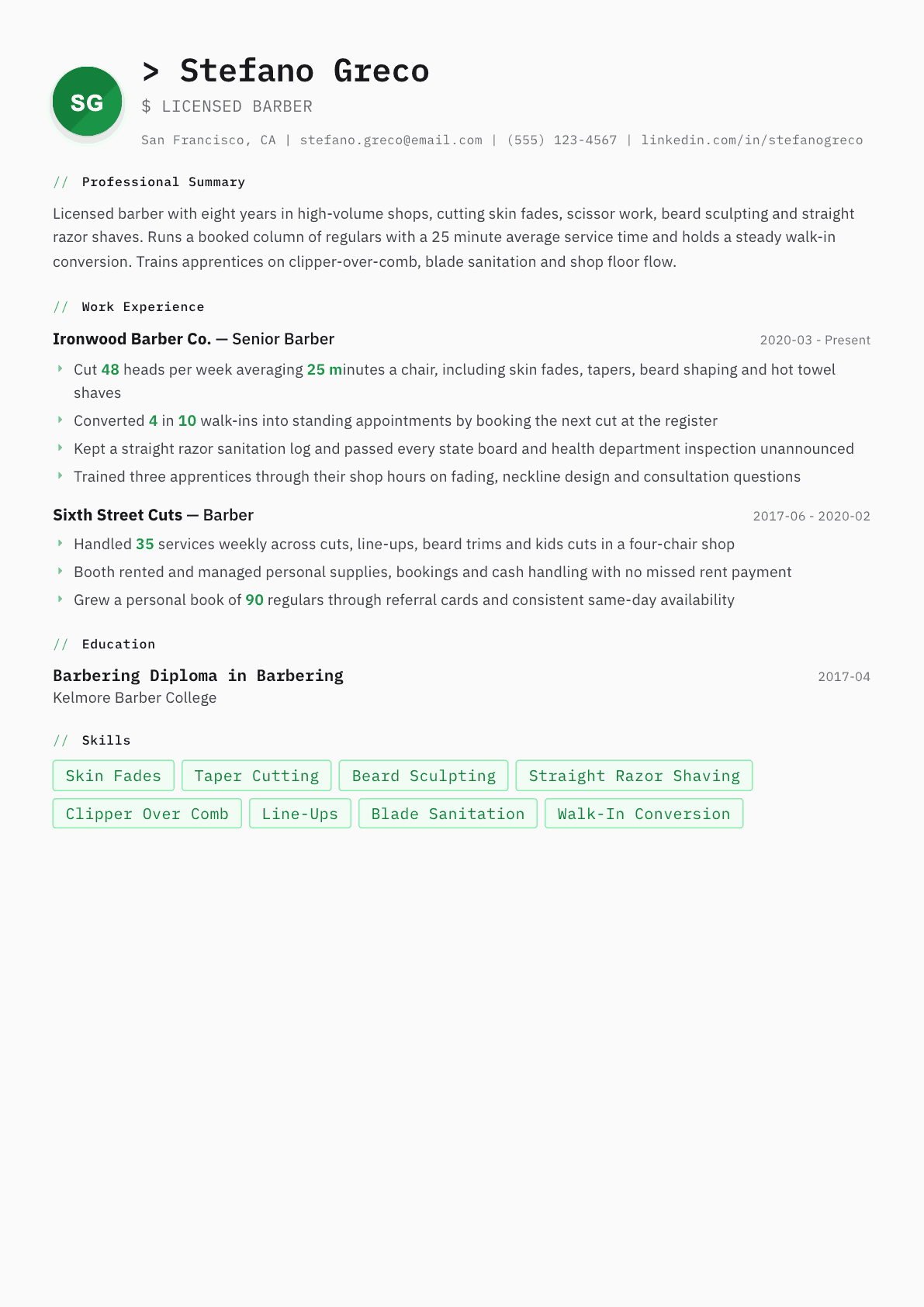
The same barber content laid out in three CVBooster templates, so you can see what the finished document looks like before you write a word.
Example Barber summary
Licensed barber with eight years in high-volume shops, strong on skin fades, tapers, beard sculpting and straight razor work. Keeps a full column of regulars with a tight average chair time and turns a solid share of walk-ins into standing appointments. Runs sanitation logs that clear inspections and trains apprentices through their shop hours. Seeking a senior chair in a busy shop with weekend traffic.
Skills to list on a Barber resume
- Skin Fades
- Taper and Blowout Cuts
- Scissor Cutting
- Clipper Over Comb
- Beard Sculpting
- Straight Razor Shaving
- Hot Towel Service
- Line-Ups and Edge Work
- Hair Design and Enhancements
- Client Consultation
- Blade Sanitation
- Booth Rental Management
- Walk-In Conversion
- Apprentice Training
What actually gets this resume read
- Put your barber license and state at the top, and say whether you also hold a barber instructor credential.
- Give your cuts per week and average chair time, since shop owners hire on throughput as much as on style.
- Separate clipper work, scissor work and razor services so the shop sees exactly which chair you can fill.
- Name whether you were booth rent or commission, because that tells an owner how you handle your own book.
- Show sanitation discipline with the log or inspection detail, not the generic phrase maintained a clean station.
- Mention any apprentice training you did, because shops with barber colleges nearby need people who can teach.
How to write a barber resume
Barbering is measured in chair time. A shop owner reading an application is working out how many heads you can cut in a day, whether the cuts hold up, and whether guests come back for you specifically or just for whoever is free. Those three answers decide the offer, and they are exactly what most barber resumes leave off.
The second thing an owner checks is the license and the sanitation record, because a straight razor makes a shop a regulated environment. Blade handling, single-use guards, disinfection between guests and clean inspection history are not filler, they are the difference between a barber who can work a Saturday alone and one who cannot.
This guide covers the license block, how to write about throughput without sounding like you rush, how to separate clipper work from scissor and razor work, and how to present booth rent, commission and a portable book so a shop can price the chair honestly.
Format: one page, license first, services second
Barbering hires move fast, often from a walk-in conversation. Keep the document to one page, single column, reverse chronological, and put the barber license, the state and the expiration under your name. If you hold a barber instructor credential or a dual cosmetology license, that goes on the same line because it widens what a shop can staff you for.
Then a service block. Fades, tapers, scissor work, beard sculpting, straight razor shaves, line-ups, hair design, kids cuts. An owner scanning that block is checking whether you can cover the chair that just opened, and a vague list of "men's grooming services" fails that check.
- License line: barber license with state and expiration, plus instructor or dual license where you hold one.
- Service block split into clipper work, scissor work, razor services and beard services.
- Pay structure worked under: commission, hourly plus tips, or booth rent with your own supply and tax handling.
- Booking method, whether shop software, a walk-in queue app, or a personal appointment book you managed yourself.
Throughput: cuts per week and average chair time
Say how many heads you cut in an average week and how long a standard cut takes you. A shop with a waiting bench on Saturdays is buying speed that does not cost quality, and the only way to show both is to give the time alongside the retention. Twenty-five minutes on a skin fade with a full book of regulars is a stronger claim than any adjective.
Add walk-in conversion if you have it: the share of first-time walk-ins who left with a next appointment or came back inside a month. Shops live on foot traffic and lose most of it, so a barber who converts is measurably more valuable than one who simply cuts what comes through the door.
Technique: separate the clippers from the shears and the blade
Break the work out the way a barber would judge it. Skin fades, low, mid and high tapers, blowout shapes, clipper-over-comb, shear-over-comb, texturizing, and freehand design work. Then beard services: line work, shaping, hot towel prep, straight razor finish. A trained reader can tell within one line whether you know the craft or copied a service menu.
Where your work leans a particular way, say so. A shop serving a specific neighborhood cuts a specific set of hair textures, and a barber who names the textures and styles she is strongest on gets matched to the right chair rather than tried out and quietly rescheduled.
If you do straight razor shaves, treat that as a headline service. Many licensed barbers avoid them, and a shop that advertises hot towel shaves needs someone who genuinely performs them at speed.
Sanitation, blade handling and inspections
Write this section like a professional who has been inspected. Single-use blades, guard and clipper disinfection between guests, tool immersion, cape and towel handling, and a log the owner can point to. Then attach the outcome: inspections passed, including unannounced ones, is the evidence that turns process into trust.
If you have first aid or bloodborne pathogens training, list it. Nicks happen with razors and clippers, and a barber who has the training already is one less liability conversation for the shop owner to have.
The book: what travels with you
Say how many regulars you have and roughly how often they come in, because a barber whose guests visit every three weeks generates very different revenue from one whose guests come twice a year. If you are relocating and the book cannot follow, describe how you built it instead: referral cards, consistent availability, standing appointments, and neighborhood presence.
Booth rent history matters here too. A barber who has paid rent on time, bought his own supplies and handled his own bookings has run a small business, and that experience is a strong argument for a chair in a shop that wants independent operators rather than employees.
Barber resume summary examples
Newly licensed barber
Newly licensed barber trained in tapers, skin fades, scissor work, beard shaping and straight razor shaves through 1200 program hours and a supervised school floor. Cuts a full range of textures and holds bloodborne pathogens training. Seeking a first chair in a busy shop with mentorship from senior barbers.
Eight years in the chair
Licensed barber with eight years in high-volume shops, strong on skin fades, tapers, beard sculpting and hot towel shaves. Cuts 48 heads a week at a 25 minute average and converts 4 in 10 walk-ins into standing appointments. Passes every sanitation inspection. Seeking a senior chair with weekend traffic.
Master barber and shop lead
Master barber and shop lead running a six-chair floor while carrying a full personal book of regulars on three-week cycles. Trained three apprentices through their shop hours, set the sanitation and blade handling standard, and manages the walk-in queue on Saturdays. Seeking a shop manager or barber instructor position.
Work experience bullets: before and after
Before: Cut hair for clients at a busy barbershop.
After: Cut 48 heads a week at a 25 minute average chair time, covering skin fades, tapers, scissor work, beard shaping and hot towel shaves.
Volume and chair time turn the word busy into a throughput figure a shop owner can staff around.
Before: Got a lot of repeat customers and walk-ins.
After: Converted 4 in 10 first-time walk-ins into standing appointments by booking the next cut at the register before they paid.
A conversion ratio with the technique behind it shows you grow the shop rather than only serving whoever walks in.
Before: Kept my station clean and followed the rules.
After: Maintained a straight razor and clipper disinfection log between every guest and passed six state board and health inspections unannounced.
Blade sanitation is the shop's regulatory exposure, so a log and an inspection record are worth more than the word clean.
Before: Rented a booth and worked for myself.
After: Ran a booth rental chair for three years, managing supplies, bookings, cash handling and rent with no missed payment or gap in availability.
Framing booth rent as running a small business shows reliability an owner can price into the chair terms.
Before: Helped train the new guys in the shop.
After: Trained three apprentices through their required shop hours on fading, neckline design and the consultation questions that prevent a redo.
Naming what you taught and the hours structure makes you useful to a shop connected to a barber school.
Hard skills
- Skin fades and tapers
- Clipper over comb
- Scissor and shear work
- Texturizing and thinning
- Beard sculpting and line work
- Straight razor shaving
- Hot towel service
- Line-ups and edge work
- Hair design and freehand enhancements
- Blade and tool disinfection
- Walk-in queue management
- Booth rental and supply management
Soft skills
- Consultation before the first cut
- Pace without rushing
- Conversation and shop atmosphere
- Reliability on peak days
- Mentoring apprentices
- Handling a redo request calmly
Certifications worth listing
- Licensed Barber (state license) (State board of barbering or cosmetology)
- Barber Instructor License (State board of barbering or cosmetology)
- Bloodborne Pathogens Certification (American Red Cross)
- First Aid and CPR (American Red Cross)
Mistakes that cost barber candidates the interview
- Leaving out cuts per week and average chair time, which are the first two things a shop owner would ask on the phone.
- Listing generic grooming services instead of naming fades, tapers, razor work and beard sculpting separately.
- Skipping the straight razor question entirely when the shop advertises hot towel shaves on its window.
- Failing to say whether you were commission or booth rent, so an owner cannot judge how you handle your own book.
- Writing that you kept a clean station rather than attaching a disinfection routine and an inspection outcome.
- Treating apprentice training as a favor rather than as the teaching credential shops near barber schools actively look for.
Barber resume questions
How long should a barber resume be?
One page. Shop owners often read it standing up between guests, so the license, the service block, two or three shops with real numbers and a sanitation line covers everything they need before an interview cut.
Do I need a portfolio as well as a barber resume?
Yes, but keep it separate. Link a gallery of your fades, beard work and design cuts rather than embedding images. Owners look at photographs before they call, and the resume still has to survive being printed or parsed.
Should I mention booth rent experience?
Absolutely. Paying rent, buying your own supplies and running your own bookings is small business experience, and shops offering booth chairs want proof you can carry that weight without supervision.
What if my client book cannot move with me?
Say the move is the reason and describe how the book was built: referral cards, standing appointments, consistent hours and neighborhood presence. An owner hiring a relocating barber is buying the method, not the old client list.
How do I show speed without looking like I rush?
Pair chair time with retention. Twenty-five minutes on a fade means little alone, but twenty-five minutes with a book of regulars returning every three weeks proves the work holds up and the guest came back for it.
Related resume examples
- Hairstylist Resume example
- Nail Technician Resume example
- Cosmetologist Resume example
- Salon Owner Resume example
- Esthetician Resume example
- Aesthetician Resume example