Salon Owner Resume Examples: free ATS score and gap list
Write a Salon Owner Resume That Reads Like a Business Record
By Mustafa Tarabya, founder of CVBooster · Published · Updated
Salon owner resume example with chair counts, retail numbers, staffing detail and the keywords that work when an owner applies for a salaried role.
Sample resumes for a salon owner
The same salon owner content laid out in three CVBooster templates, so you can see what the finished document looks like before you write a word.
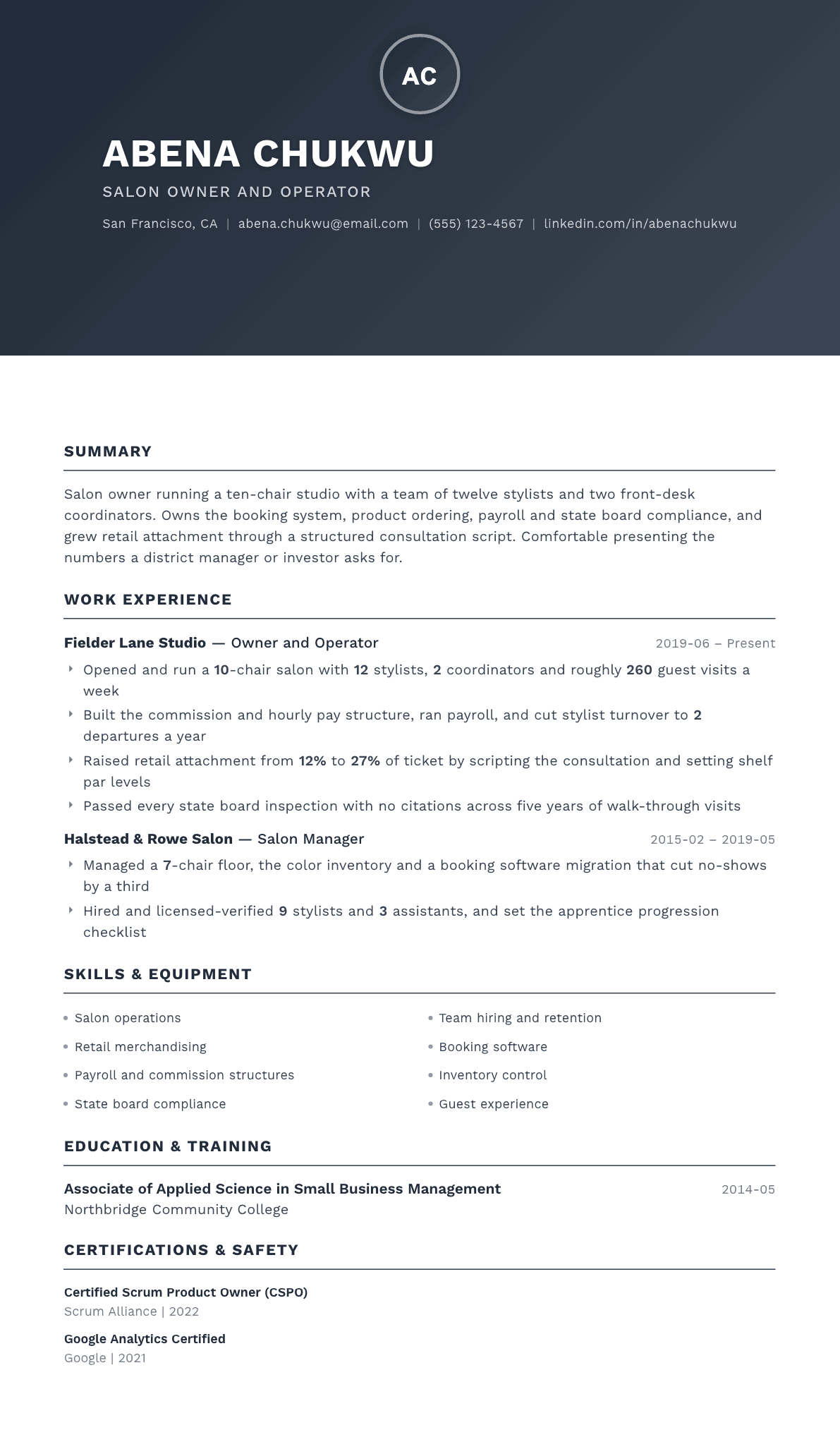
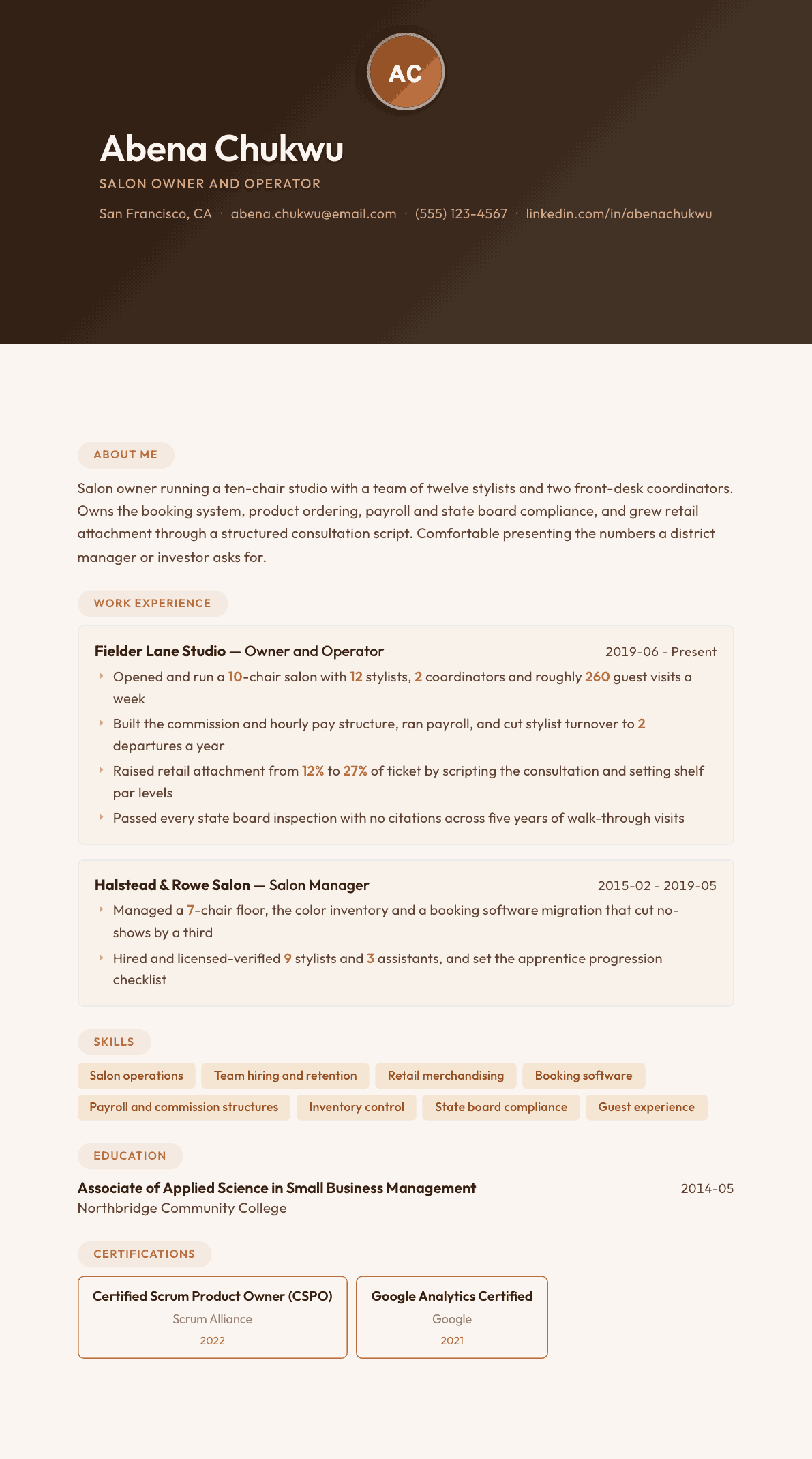
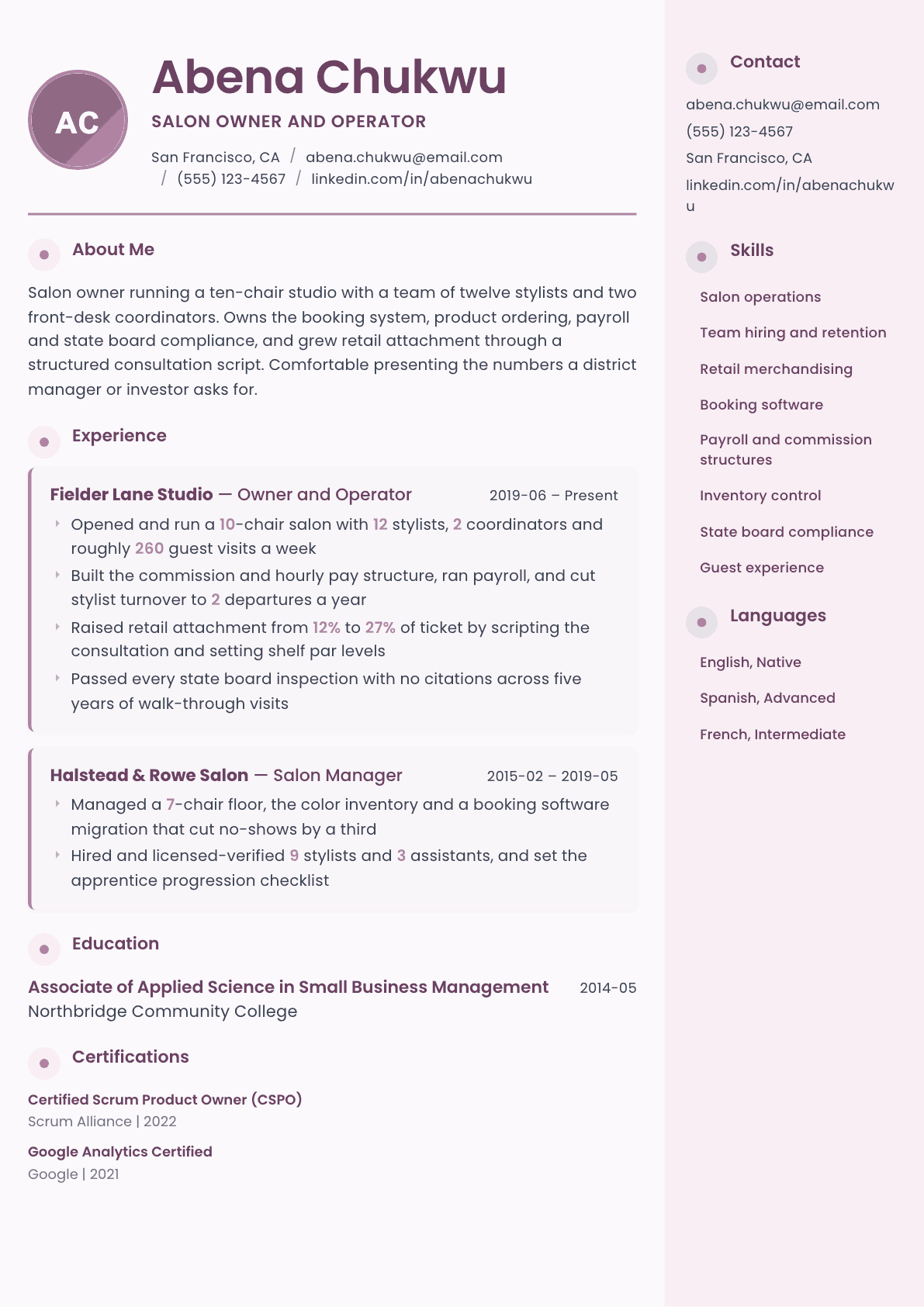
Example Salon Owner summary
Salon owner with six years running a ten-chair studio, twelve stylists and two coordinators, and four years managing a salon floor before that. Owns hiring, commission plan design, retail merchandising and state board compliance, with retail attachment more than doubled and stylist turnover held to two departures a year. Seeking a multi-location operations role.
Skills to list on a Salon Owner resume
- Salon operations
- Profit and loss ownership
- Staff hiring
- Commission plan design
- Retail attachment
- Inventory and par levels
- Booking systems
- Point of sale
- State board compliance
- Marketing and local promotion
- Guest recovery
- Apprentice development
- Vendor negotiation
- Scheduling and floor coverage
What actually gets this resume read
- Treat ownership as an operating job: chairs, headcount, weekly guest visits, retail attachment and turnover all belong on the page.
- Say who reported to you and how you paid them, because commission structure design is a real management skill.
- Show compliance work explicitly: state board inspections, license verification for every stylist, sanitation logs and product safety data sheets.
- If you are applying for a salaried role, translate ownership language into the words the posting uses, such as multi-unit or general manager.
- Name the booking and point-of-sale platform you ran, since new employers screen for the exact system in their salons.
- Keep one line of service work if you still take clients, so the reader knows you can cover a chair during a staffing gap.
How to write a salon owner resume
A salon owner writes a resume for one of two reasons: the business is being sold or closed and you are going back on payroll, or you want a bigger operating seat, a multi-location manager job, a district role with a chain, a field role with a distributor. Both readers have the same worry, which is that an owner will not take direction. The resume answers that worry by looking like an operating record instead of a story about a dream.
The second problem is that ownership hides the work. Anyone can write owner on a page. Nobody can tell from that word whether you ran three chairs from your kitchen table or a ten-chair studio with payroll, a booking platform, an inventory system and a state board inspection every year.
This guide shows how to size the business on the page, how to turn ownership duties into the vocabulary an employer already uses, and what to do with the sections an owner resume usually forgets: compliance, staff development and the numbers a district manager will ask about in the first interview.
Format: an operating resume, not a founder story
Reverse-chronological, one page for a single business, two once you have a management history before the salon. Use the job title the market recognizes. Owner and Operator reads better than Founder for an operations application, because operator is the half of the job the employer is buying.
Directly under the title, give the business a one-line profile. Chairs, headcount, service mix, weekly guest visits and years open. A reader who cannot size your salon in the first two seconds will assume it was small.
- Business profile line: chair count, staff headcount, weekly guest visits, service mix and whether stylists were employees or booth renters.
- Section order that works for owners: summary, business profile, operating experience, prior salon roles, education, licenses, skills.
- Keep the state cosmetology license on the page even in an operations application, since many jurisdictions tie salon establishment permits to it.
Turn ownership into the duties a posting names
Take the posting apart and match it. Hiring, scheduling and coverage. Payroll and pay plan design. Inventory and vendor ordering. Merchandising and retail attachment. Guest recovery and reviews. Marketing spend and local promotion. Facility and equipment upkeep. Every one of those is something you already do, but if you write it as running the salon, the reader has to do the translation and probably will not.
Pay plan design deserves its own bullet. Choosing between commission tiers, hourly plus service bonus and booth rental, then modeling what it does to take-home pay and to the schedule, is exactly the work a multi-unit manager does. So is what happened afterward: whether stylists stayed, whether the floor stayed covered on weekends.
The numbers to use and the ones to leave out
Use operating ratios rather than revenue. Retail attachment as a share of ticket, prebook rate, chair utilization, average ticket movement, stylist turnover in departures per year, guest visits per week. Those travel across salons and are the metrics a district manager already tracks. Raw revenue from a private business is unverifiable and invites a conversation you do not want.
Anchor each number to what you changed. A retail attachment figure means nothing on its own; it means something when the reader can see the consultation script and the shelf par levels that moved it. The same is true of turnover, which is a hiring and pay story, not a personality one.
- Chair utilization and prebook rate say more about your operating grip than any revenue claim.
- Report stylist turnover as departures per year against headcount, so the reader can compare it to their own floor.
- Tie every ratio to the mechanism: script, par level, schedule change, pay plan or training block.
Compliance and staff development, the two owner sections people skip
Compliance is a differentiator because employed managers are judged on it constantly. Write the concrete version: license verification for every stylist before the first shift, sanitation and disinfection logs, safety data sheets for chemical products, state board walk-through inspections and what the results were, workers compensation and the employment paperwork that comes with a real payroll.
Staff development is the other half. An apprentice progression checklist, a set of technical checkoffs before someone takes color clients, a monthly education night, a mentor pairing for new hires. A salon owner who built a bench is applying for a leadership job with proof, which is rare in this pile.
Keywords for the roles owners actually apply to
Salon manager, general manager, district or area manager, education manager, field sales for a distributor, and operations lead. Read three postings for the title you want and lift the recurring phrases: staffing and scheduling, guest experience, retail sales, inventory control, profit and loss responsibility, team development, brand standards, point of sale.
Name your systems, because employers screen for them. The booking and point-of-sale platform, the payroll provider, the inventory tool and the review platform you managed. A manager who has already run the software the company uses starts producing weeks earlier and everyone in hiring knows it.
Salon Owner resume summary examples
First two years of ownership
Licensed cosmetologist who opened a four-chair salon and grew it to three stylists and one coordinator in two years. Runs booking, ordering, payroll and the disinfection log personally while keeping a part-time chair. Seeking a salon manager seat with a larger team and a structured training track.
Six years, ten chairs
Owner and operator of a 10-chair salon with 12 stylists and roughly 260 guest visits a week. Designed the commission plan, raised retail attachment from 12% to 27% of ticket and held turnover to two departures a year. Looking for a multi-location operations role.
Multi-location owner
Owner of three salons with a combined team of 34, a shared inventory system and a central booking desk. Built the apprentice track that supplies every location, negotiated distributor terms across all sites and passed every state board inspection without citation. Targeting a regional operations director position.
Work experience bullets: before and after
Before: Owned and operated a successful hair salon.
After: Opened and ran a 10-chair salon with 12 stylists, 2 coordinators and roughly 260 guest visits a week, owning booking, payroll, ordering and facility upkeep.
Successful is a claim; chairs, headcount and weekly visits let the reader size the business in one line.
Before: Increased retail sales at the salon.
After: Raised retail attachment from 12% to 27% of ticket by scripting the closing consultation, setting shelf par levels and reviewing each stylist attachment rate in a monthly one-to-one.
The rate and the three mechanisms behind it turn a sales claim into a repeatable method an employer can buy.
Before: Hired and managed staff.
After: Hired 9 stylists and 3 assistants, verified every license before the first shift, and built an apprentice checklist that gates color clients behind six technical checkoffs.
It shows the compliance step and the development structure, which is what a manager is hired to run.
Before: Handled scheduling and payroll.
After: Designed the commission and hourly pay plan, ran a biweekly payroll for 14 people, and built a weekend coverage rota that cut unfilled evening chair hours to under four a week.
Pay plan design plus a coverage outcome reads as operations work rather than administrative upkeep.
Before: Kept the salon clean and compliant.
After: Maintained disinfection logs and chemical safety data sheets across every station and passed five consecutive state board walk-through inspections with no citations.
Compliance becomes credible when it names the documents and the inspection record behind it.
Hard skills
- Salon operations
- Profit and loss ownership
- Commission plan design
- Payroll administration
- Booking and point of sale systems
- Inventory par levels
- Retail merchandising
- Vendor and distributor negotiation
- State board compliance
- Disinfection and sanitation logs
- Staff scheduling and coverage
- Apprentice program design
- Local marketing
- Guest recovery and reviews
Soft skills
- Team leadership
- Difficult conversations
- Delegation
- Financial discipline
- Guest empathy
- Decision making under pressure
Certifications worth listing
- Barbicide Certification (King Research)
- ServSafe Food Handler (National Restaurant Association)
- Certified Bookkeeper (American Institute of Professional Bookkeepers)
Mistakes that cost salon owner candidates the interview
- Writing owner with no business profile, so a reader cannot tell a home studio from a twelve-stylist floor.
- Leading with revenue figures from a private business that nobody can verify and that distract from the operating detail.
- Describing the salon as your passion rather than as a business with a headcount, a schedule and a set of controls.
- Dropping the compliance work, which is the part of the job an employed manager is audited on every quarter.
- Leaving out the booking and point-of-sale platform, when many employers filter on that exact system name.
- Treating the years of ownership as one undifferentiated block instead of showing what changed as the business grew.
Salon Owner resume questions
Will employers think a salon owner cannot work for someone else?
Some will, so answer it on the page. Show that you followed rules you did not write, such as state board standards and distributor terms, and say plainly in the summary what kind of role you want next and why the scope appeals to you.
Should I include revenue on a salon owner resume?
Usually not. Operating ratios like retail attachment, chair utilization, prebook rate and turnover are comparable across salons and easier to defend. Keep revenue for conversations with a buyer, a lender or a franchise group that asks for it directly.
How do I list the salon if I closed it?
List it with real dates and a neutral one-line reason such as a lease ending or a relocation. Closing a business is common and hiding the end date reads worse than stating it. Keep the accomplishments in place, since the work still happened.
What job titles should a salon owner target?
Salon manager, general manager, area or district manager, education manager and distributor field roles are the usual paths. Read three live postings for each, then mirror the duties you already perform using their exact vocabulary rather than ownership language.
Do I still need my cosmetology license on the resume?
Yes. Many states tie the salon establishment permit and supervision rules to a licensed individual, and a manager who can legally cover a chair during a staffing gap is more useful. List the state and the current status near the top.
Related resume examples
- Spa Manager Resume example
- Hairstylist Resume example
- Salon Manager Resume example
- Beauty Consultant Resume example
- Spa Receptionist Resume example
- Salon Receptionist Resume example