Hairstylist Resume Examples: free ATS score and gap list
Hair Stylist Resume Ideas and a Full Hairstylist Sample
By Mustafa Tarabya, founder of CVBooster · Published · Updated
Hair stylist resume ideas and examples: license and portfolio placement, services and client book bullets, and a full sample hairstylist resume to copy.
Sample resumes for a hairstylist
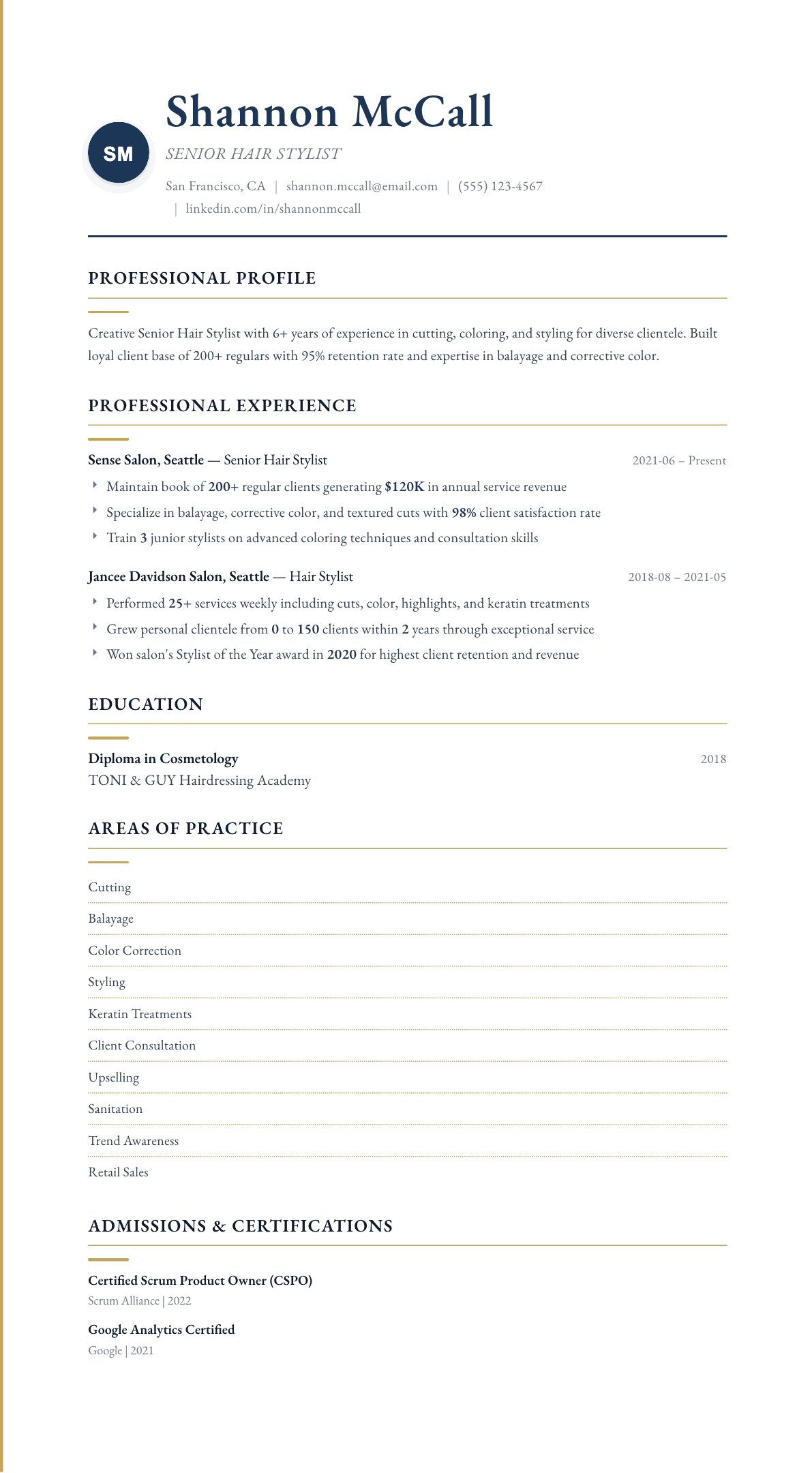
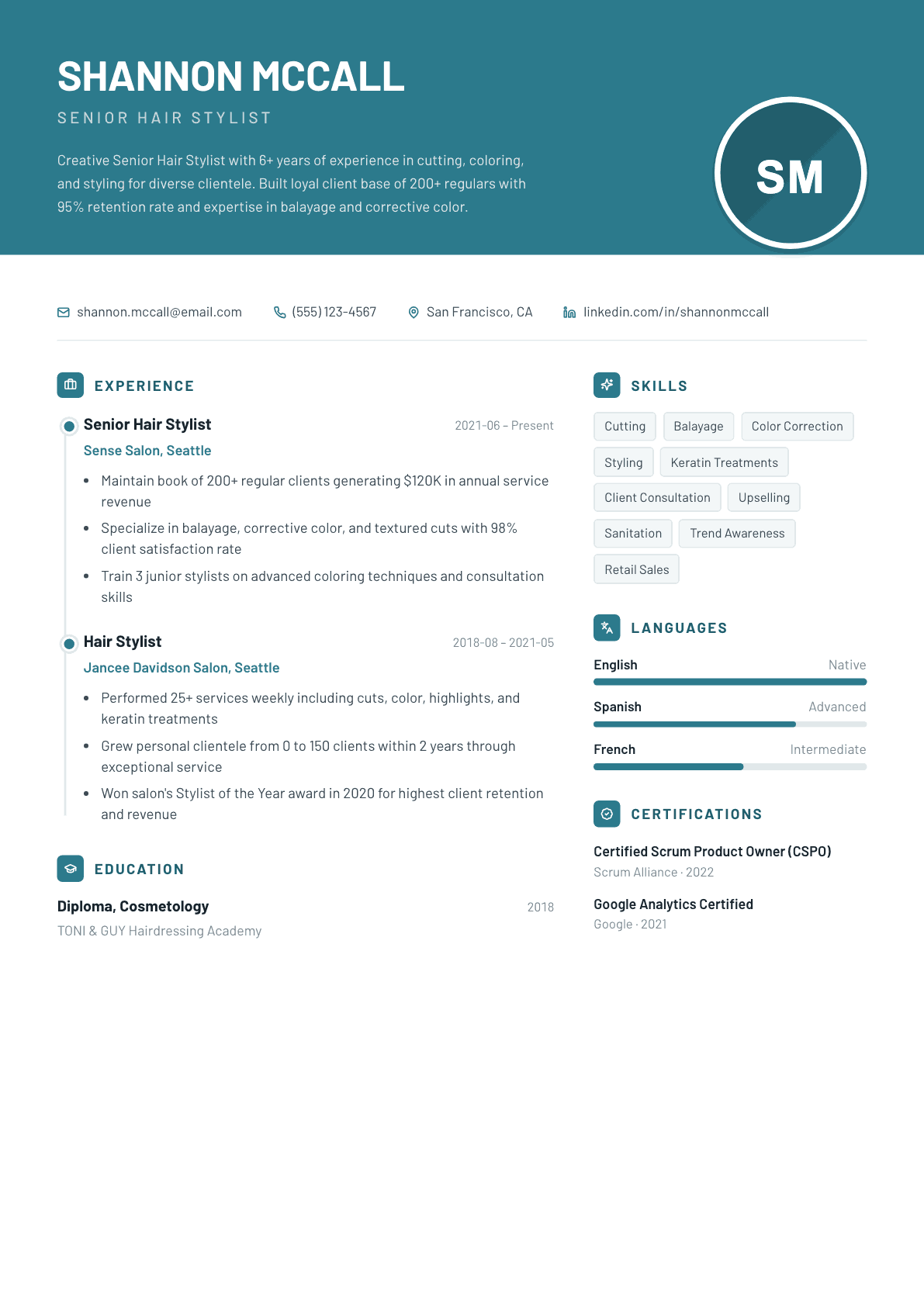
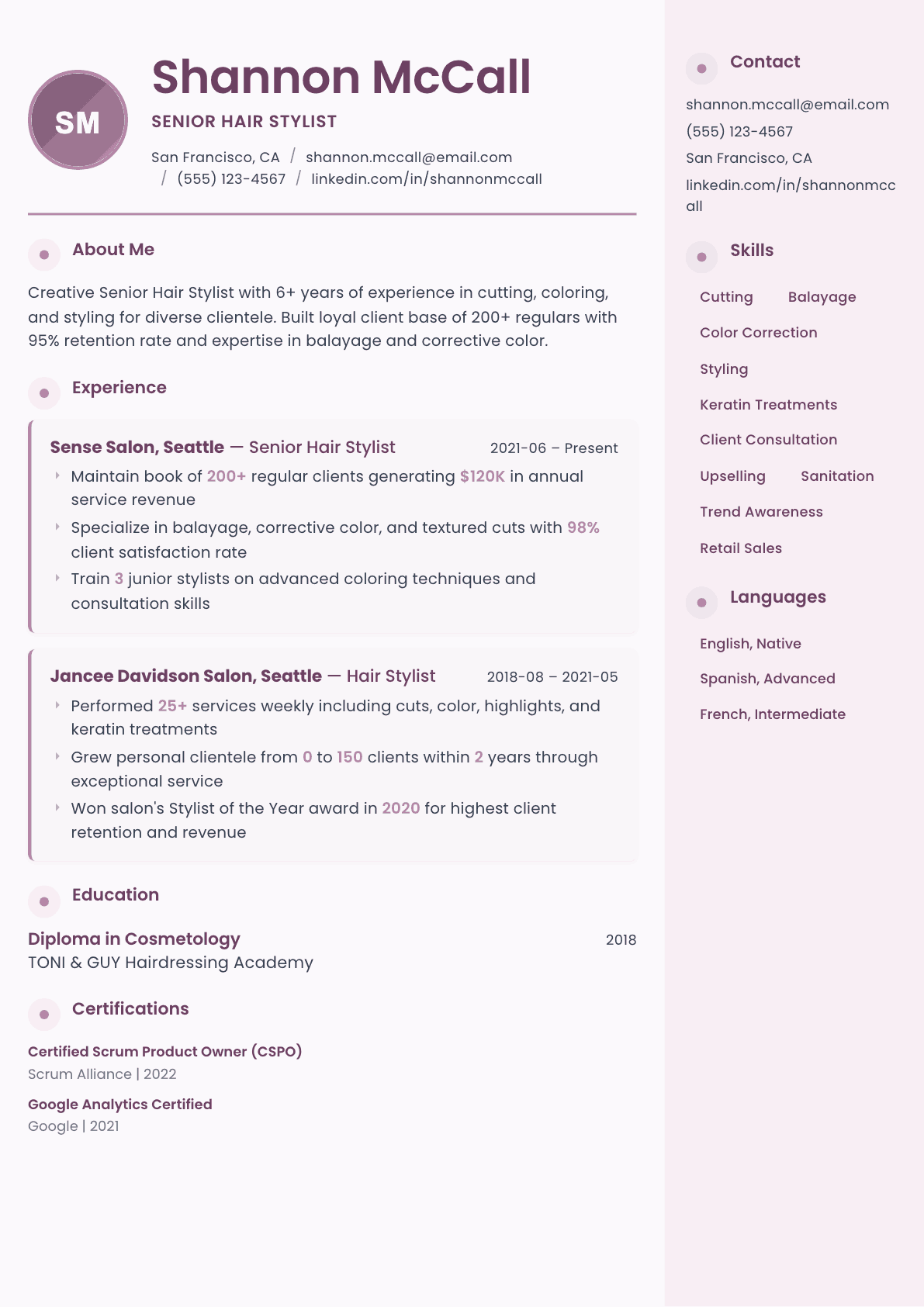
The same hairstylist content laid out in three CVBooster templates, so you can see what the finished document looks like before you write a word.
Example Hairstylist summary
Senior stylist, 6 years, a book of 200 regular clients worth $120K a year in service revenue at 95% retention. Specializes in balayage, corrective color and textured cuts, and trains junior stylists on consultation and color formulation.
Skills to list on a Hairstylist resume
- Cutting
- Balayage
- Color Correction
- Styling
- Keratin Treatments
- Client Consultation
- Upselling
- Sanitation
- Trend Awareness
- Retail Sales
What actually gets this resume read
- Highlight your cosmetology license and any advanced certifications.
- Quantify: client count, retention rate, revenue generated.
- Include specializations (balayage, extensions, corrective color).
- Show continuing education and brand-specific training.
- Mention retail sales performance if applicable.
How to write a hairstylist resume
A hair stylist resume is read by a salon owner or a manager standing at the front desk, usually in the gap between two clients. Three things decide whether you get a working interview: your cosmetology license, whether you can keep a chair full, and what you do behind the chair that the current team cannot do. Every resume idea on this page serves one of those three.
That means the resume is half credential and half business case. A salon on commission is buying service revenue and retail; a booth rental house is renting you space and wants proof you already have a book. The same resume rarely wins both, so decide which one you are applying to before you write the summary.
This guide covers the order a salon reads a hairstylist resume in, a sample hairstylist resume from header to skills, how to put a color line and a specialty into the first two lines, what numbers actually belong in your bullets, and the questions stylists ask when they move salons or come back to the chair after a break.
Format: one page, license in the header, portfolio link right under it
One page, always. Nobody in a salon reads a second page. Put your name, city, phone, email, your cosmetology license number and state, and a link to the account where your work lives. For a stylist the photo grid is the real portfolio, so the link is not decoration, it is the second half of the application.
Reverse chronological order, with the salon name and city on the first line of each job. If you have worked as an assistant, list it as an assistant and say whose column you assisted on, because a manager reads that as trained rather than as junior.
- Header: name, cosmetology license and state, city, phone, email, portfolio link.
- Section order: summary, experience behind the chair, license and education, advanced training, skills.
- Booth renters should say booth rental in the job line so nobody misreads the employment history.
Summary: specialty, years behind the chair, and the color line you formulate in
Two or three lines. Name the specialty you want to be hired for, the number of years you have actually been behind the chair rather than years since graduation, the color line you formulate in, and the size of the book you can bring or have built. A stylist who says creative and passionate has told the owner nothing that separates her from the last six applicants.
The specialty should match what the salon sells. A salon whose photos are all lived-in blonde wants to read balayage, teasylights and corrective color. A salon known for precision bobs wants to read dry cutting and razor work. Rewrite this block for each salon; it takes two minutes and it is the only part most owners read closely.
Experience: the salon, the chair, the services and the real numbers
Give each salon a context line before the bullets: the type of house, the chair count and the pricing tier. Something like high volume suburban salon, twelve chairs, commission with a retail bonus tells an owner more about your working speed than any adjective can.
Then three or four bullets. The numbers a salon manager checks are your service count per week, your average ticket, your rebooking or prebook rate, your new client retention and your retail attachment. Those are the numbers on the salon software report, so they are the numbers that are credible when you claim them.
Include the work that is not on the price list too: training assistants, running a class on a new toner, managing color inventory, covering the front desk, building the salon photo feed. Salons promote from the people who do those things, and owners know it.
- Weekly service count and the mix, for example twenty two guests a week with roughly half color services.
- Rebooking or prebook rate, and new client retention if your software tracked it.
- Retail per guest or retail as a share of your service revenue.
- Specialty services you own: extensions method, smoothing system, curly cutting method, bridal work.
License, cosmetology school and the advanced training that matters
The license goes in its own short block: license type, state, and the fact that it is current. If you hold licenses in two states, list both, because a stylist who can start without a reciprocity wait is worth more on the schedule.
Then advanced education, and be specific about the brand and the class. Manufacturer education is how salons judge whether your formulation habits will match theirs, so a line naming the color line and the level of certification you completed carries real weight. List the classes you took from named educators as well; in this trade the educator name is the credential.
Skills: services first, then the systems the salon runs on
Keep the skills block to services and tools, not personality. A salon posting is written from the service menu, so mirror that menu: cutting methods, color techniques, chemical services, texture work, extensions, blowouts and styling, plus the booking software you have used and whether you can take payment, manage a color bar and count inventory.
Two practical entries most stylists forget: sanitation and state board compliance, which an owner needs to trust before you touch a client, and photography, because a stylist who shoots and posts her own finished work is doing marketing the salon would otherwise pay for.
Sample hairstylist resume, top to bottom, ready to build in Word
Here is the skeleton a salon owner expects, filled in for a hairstylist three years behind the chair. Use it as a resume for hairstylist example to check your order, then replace every line with your own facts.
Keep it to one page. The portfolio link carries the visual proof, so the resume itself can stay plain, quick to read and easy to print at the front desk.
If you came looking for a hair stylist resume template in Word, this skeleton is the template. Open a blank Word document, type the five blocks below in order, use one font at a readable size, and make each block label a real Word heading. Leave out text boxes, tables, columns and decorative headers, because salon groups and hotel spas often run applications through a hiring system that scrambles them. Save it as a Word file for applications that ask for one, and as a PDF for everything else.
- Header: Jasmine Ortiz, Licensed Cosmetologist, state license number, phone, email and the portfolio link.
- Summary: Hairstylist with three years behind the chair at a commission salon, specializing in lived-in blondes and corrective color, formulating in Redken Shades EQ. Rebooks most color clients before they leave the chair.
- Experience: salon name, city and dates, then four bullets covering the services you are booked for, the book you built, retail and rebooking, and one thing you teach or own in the salon.
- Education and license: cosmetology school, hours completed, state license, and the advanced classes that changed what you can charge for.
- Skills: color correction, balayage, extensions, precision cutting, blowouts, consultations and the booking software the salon runs on.
Hairstylist resume summary examples
Newly licensed
Licensed cosmetologist and recent graduate with 1,200 training hours in cutting, color and chemical texture, plus a year assisting on a senior colorist's column. Comfortable with blow-dry finishing, foil placement and shampoo-bowl service. Looking for an assistant or associate track in a color-focused salon.
Three years behind the chair
Hair stylist with 3 years behind the chair in a 10-chair commission salon, averaging 24 guests a week with a 72% prebook rate. Specializes in balayage, lived-in blonde and corrective color, formulating in Redken. Grew a personal book from 0 to 180 regular clients.
Master stylist and salon educator
Master stylist with 9 years behind the chair, a fully booked column of 240 regulars and an 85% retention rate. Runs the salon's color education: trains new stylists on formulation and toner correction, manages the color bar, and leads the in-salon extension certification.
Work experience bullets: before and after
Before: Provided haircuts, coloring and styling services to clients.
After: Delivered 24 services a week across cut, single process, balayage and gloss, holding one of the top three average tickets on a 12-stylist commission floor.
Volume, service mix and ticket size describe your column; the weak version describes the job title.
Before: Built a strong client base with good retention.
After: Grew a personal book from 0 to 180 regulars in 3 years and held a 72% prebook rate at the chair.
A book size and a prebook number are figures a salon can verify against its own reports.
Before: Skilled at color correction.
After: Took on the salon's corrective color referrals, including box-dye removal and banded lightener corrections, using bond builder in every lift over two levels.
Naming the correction type and the protocol shows technical judgment instead of a claim.
Before: Sold retail products to clients.
After: Averaged 21% retail attachment by prescribing home care during the consultation and writing the routine on the service card.
The method behind the number is what a manager repeats to the rest of the floor.
Before: Helped train new stylists.
After: Ran a weekly training night for 4 associates on foil placement, formulation and consultation, moving 3 of them onto the floor within 6 months.
The cadence, the topics and the outcome turn mentoring into a measurable contribution.
Hard skills
- Precision cutting
- Razor and dry cutting
- Balayage and freehand lightening
- Foil and teasylight placement
- Color formulation and correction
- Toning and glossing
- Bond builder treatments
- Keratin and smoothing systems
- Hair extensions
- Curly and textured cutting
- Blow-dry and thermal styling
- Bridal and updo work
- Salon booking software
- State board sanitation
Soft skills
- Consultation questioning
- Managing client expectations
- Time management between chairs
- Rebooking conversation
- Retail prescribing
- Coaching assistants
Certifications worth listing
- Cosmetology License (State Board of Cosmetology)
- Barber License (State Board of Barbering and Cosmetology)
- Cosmetology Instructor License (State Board of Cosmetology)
Mistakes that cost hairstylist candidates the interview
- Leaving the license number and state off the resume, which forces the manager to ask before they can even book a working interview.
- Listing every service on the menu instead of the three you want to be booked for, so the salon cannot tell what you are actually good at.
- Writing a summary about passion for beauty rather than the specialty, the color line and the size of your book.
- Applying to a booth rental salon with a resume that never mentions an existing clientele, when the clientele is the whole point of the deal.
- Hiding assistant years or a break from the chair, when both read better named than they do as an unexplained gap.
- Sending a resume with no portfolio link, which asks a visual employer to hire you without seeing your work.
- Claiming numbers that the salon software would contradict, since owners run the same reports and will check yours in the first review.
Hairstylist resume questions
Do I put my client book size on a hair stylist resume?
Yes, if you built it and can reasonably bring part of it. Give the number of regulars and the rebooking rate rather than a vague claim. Do not promise a transfer you cannot deliver, because non-solicitation terms in your old contract may limit who you can contact.
How do I write a resume when I rent a booth instead of being employed?
List yourself as an independent stylist at the salon name, with the dates, and treat it like a small business. Cover your service volume, average ticket, retention, retail and how you handled your own booking, supplies and marketing. Owners read that as ownership, not as unemployment.
What goes on a hairstylist resume if I am newly licensed with no clients yet?
Lead with training hours, the services you completed on the school floor, and any assisting you did. Then show the transferable parts: consultation, timing, sanitation and retail. Apply to salons with an assistant or associate program, and say in the summary that this is the track you want.
Is a Word template a good choice for a hair stylist resume?
Yes, if the template is plain: one column, real headings and no photo of you. Many downloadable Word templates for stylists add graphics, icons and text boxes that print well but scramble in a hiring system. Build the sample on this page in a blank document instead, and link to your work rather than pasting it in.
How do I explain a gap in time behind the chair?
Name it in one line and say what kept your hands in the trade: freelance bridal work, family caregiving, education classes, or a stint at a beauty counter. Salons hire stylists back from breaks all the time. What they will not do is guess at an unexplained two-year hole.
Related resume examples
- Nail Technician Resume example
- Aesthetician Resume example
- Spa Manager Resume example
- Cosmetologist Resume example
- Hairdresser Resume example
- Barber Resume example