Buyer Resume Examples: what a hiring manager reads first
Write a Buyer Resume That Shows Real Buying Judgment
By Mustafa Tarabya, founder of CVBooster · Published · Updated
Buyer resume examples with sourcing, order and negotiation bullets, ATS keywords, and a guide to writing each section for retail or production buying.
Sample resumes for a buyer
The same buyer content laid out in three CVBooster templates, so you can see what the finished document looks like before you write a word.
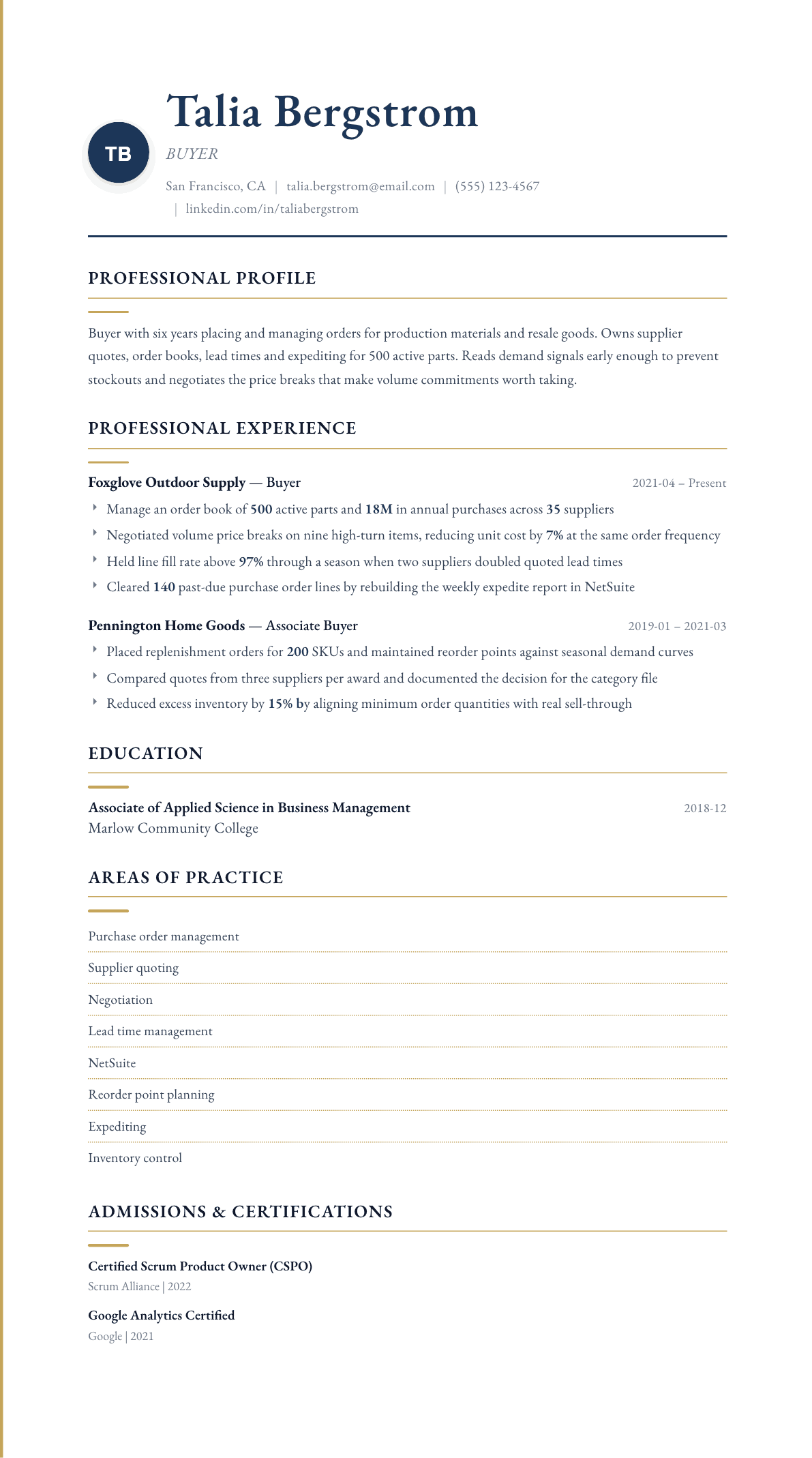
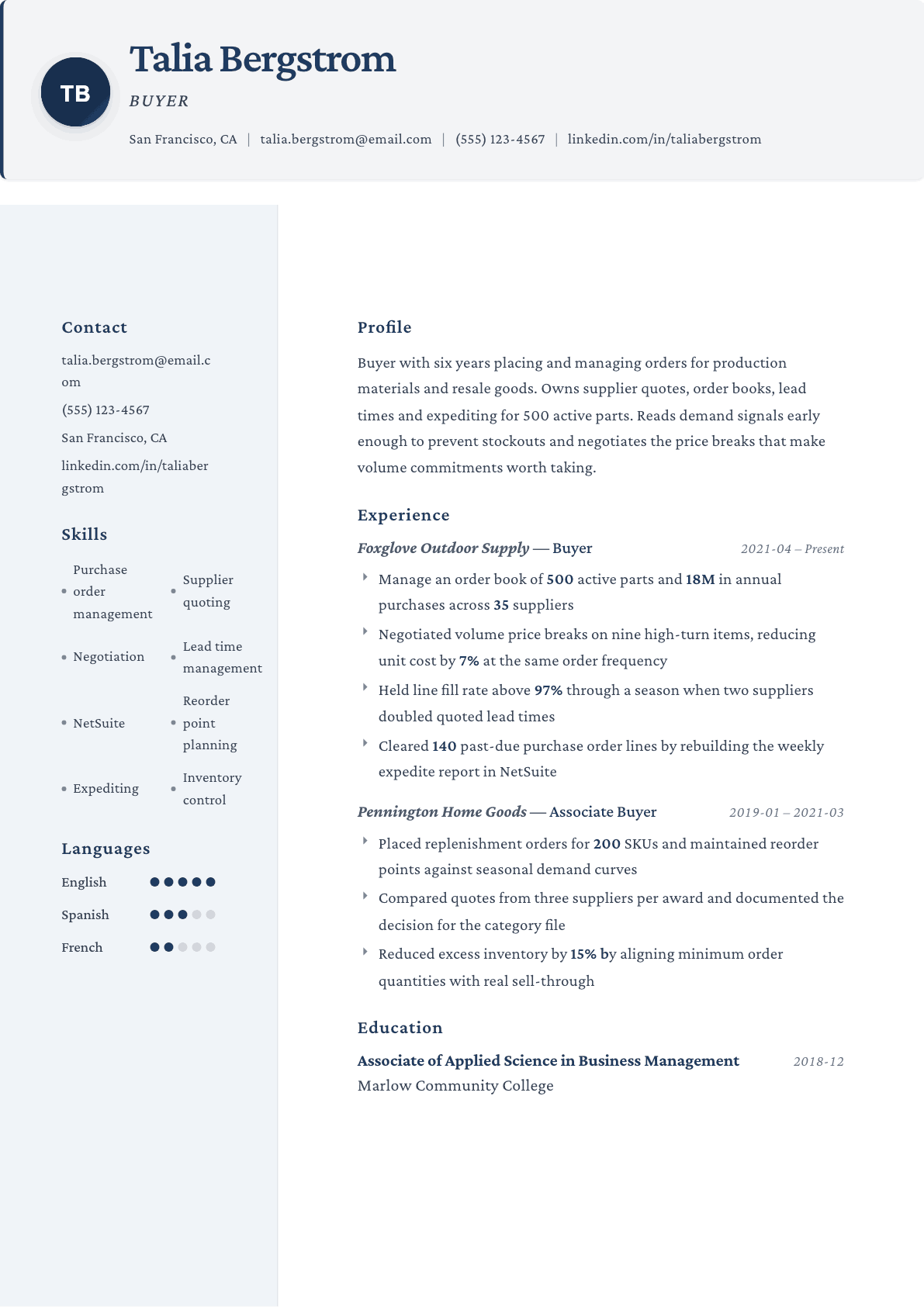
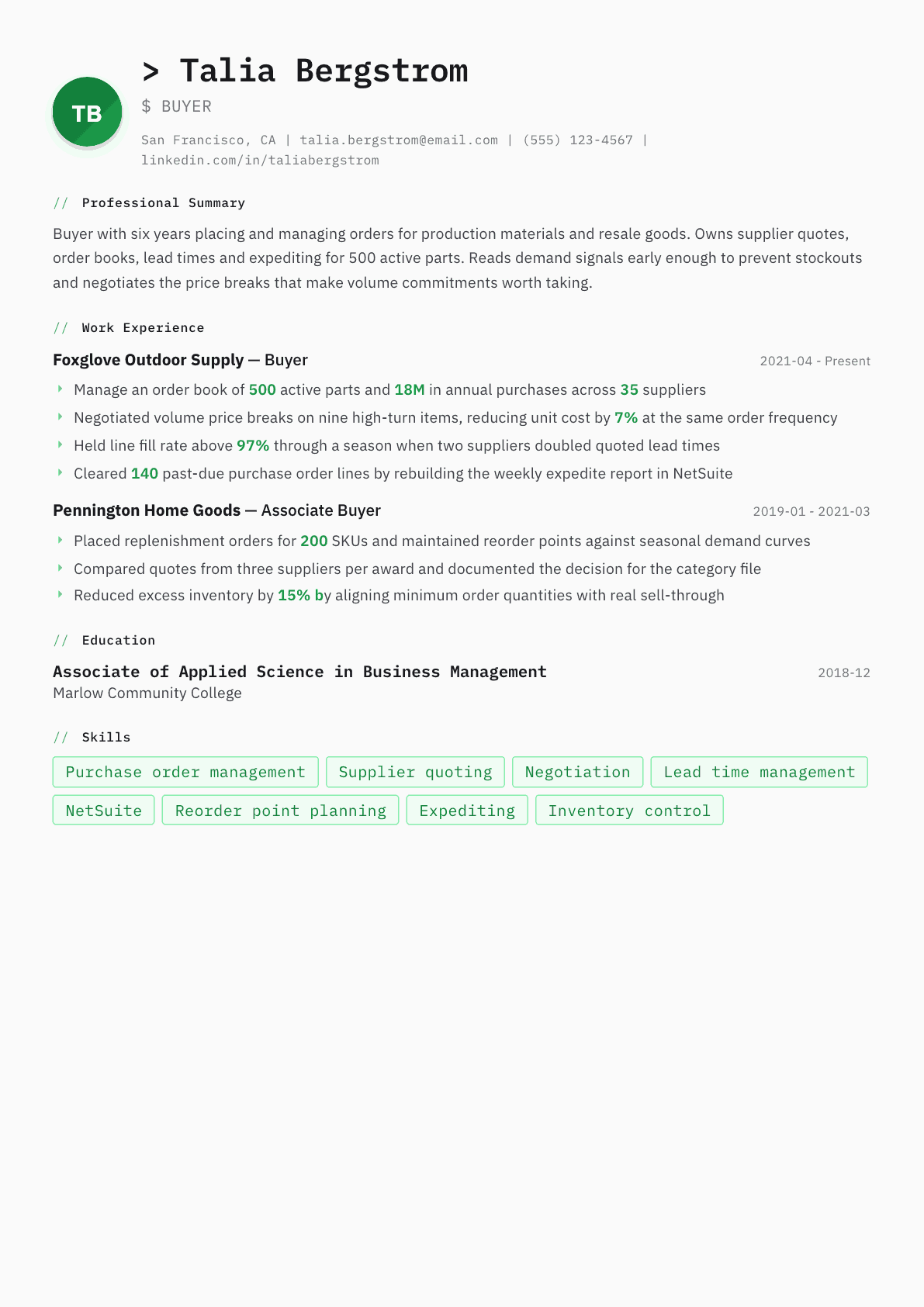
Example Buyer summary
Buyer with six years managing an order book of 500 active parts and 18M in annual purchases across 35 suppliers. Negotiated volume price breaks that cut unit cost by 7%, held line fill rate above 97% through a lead time crisis, and cleared 140 past-due order lines by rebuilding the weekly expedite report. Seeking a senior buyer role with category ownership.
Skills to list on a Buyer resume
- Purchase order management
- Supplier negotiation
- Request for quotation
- Lead time management
- Expediting
- Reorder point planning
- Inventory control
- Cost reduction
- NetSuite
- SAP
- Supplier evaluation
- Demand forecasting
- Fill rate management
- Vendor communication
What actually gets this resume read
- Say what you buy in the first line: production material, resale merchandise, MRO or services all read differently.
- Give the size of your order book in parts or SKUs, plus annual purchase value and supplier count.
- Show fill rate, past-due lines or stockouts prevented, because a buyer is measured on availability before price.
- Describe one negotiation with the lever you used: volume commitment, longer term, payment terms or freight.
- Name the ERP or planning tool where you place and expedite orders, and any reorder point logic you maintained.
- Keep expediting and supply recovery on the page, since interviewers ask how you handled a late critical order.
How to write a buyer resume
Buyer is one of the most overloaded titles in business. In a factory it means placing and expediting material against a production plan. In retail it means choosing what goes on the shelf. In distribution it means managing an order book against sell through. The first job of your resume is to make clear which kind of buyer you are, in the summary and in the scope line under every role.
After that, a hiring manager is checking two things: whether product arrives when it should, and whether you got a defensible price. Availability comes first. A buyer who saves a few points on unit cost but causes a stockout is a problem, and experienced managers screen for that balance in the wording of your bullets.
This guide breaks the page down section by section, shows what an order book bullet looks like when it carries real detail, gives three summaries from associate through senior buyer, and answers the questions buyers ask when they want to move up into category or purchasing management.
Format: say what you buy in the first six words
Reverse chronological, single column, one page for most buyers. Under each title, put the order book size in parts or SKUs, the annual purchase value, the number of suppliers and the type of goods. That is the whole screening question answered before the bullets start.
Avoid a functional layout. Buying is a dated craft in the literal sense: managers want to see continuity of order responsibility and will read a hidden timeline as a gap you are covering.
- Scope line: parts or SKUs managed, annual purchase value, supplier count, goods type.
- Section order: summary, key skills, experience, systems, education, certifications.
- Name the industry, because a components buyer and a merchandise buyer are screened by different people.
Summary: order book, availability, price
Three lines. What you buy and for whom, how big the book is, and two results: one about availability, such as fill rate or past due lines cleared, and one about cost, such as a price break negotiated or freight charges reduced.
If you are early in your career, use the summary to say what you own rather than what you assist with. Placing orders, maintaining reorder points and running the expedite report are real ownership and read better than a paragraph about supporting the purchasing team.
Experience: the four things a buyer is judged on
Availability. Fill rate, line item service level, stockouts avoided, past due purchase order lines cleared. Say what the measure was and what you moved it to. This is the number a plant manager or merchandise director cares about most.
Price. Quotes gathered, awards made, volume price breaks, freight terms, payment terms. Name the lever you used, because a buyer who won a price break by committing volume is doing something different from one who simply asked.
Inventory. Reorder points, minimum order quantities, safety stock, excess and obsolete stock reduced. Buyers create inventory with every order, and showing that you manage the consequence marks you as ready for more responsibility.
Supplier work. Quoting, qualification, corrective action on quality problems, expediting, and how you handled a supplier that consistently missed dates. Add the story of one late critical order you rescued and how.
Systems: where orders live and how they are triggered
Name the enterprise or planning system, and describe what you maintain in it. A buyer who sets reorder points, lead times and order multiples is managing the system, while a buyer who only converts requisitions is being managed by it. That difference decides promotions.
If you built your own reporting, say so. The weekly past due report, the open order book review and the supplier lead time tracker are the tools that separate an organized buyer from a reactive one.
- Enterprise and planning: SAP, Oracle, NetSuite, Epicor, Infor, Microsoft Dynamics.
- Reporting: Excel models, Power BI dashboards, expedite and past due reports you maintain.
- Documents: requests for quotation, purchase orders, order acknowledgments, supplier price files.
Keywords that match a buyer posting
Common terms are purchase order, request for quotation, supplier negotiation, lead time, expediting, fill rate, reorder point, safety stock, minimum order quantity, excess and obsolete inventory, and supplier scorecard. Retail postings swap in assortment, sell through, markdown and open to buy, so match the vocabulary of the sector you are applying to.
Use the words where they do work. Writing open to buy inside a bullet about a seasonal plan proves the skill; listing it alone proves only that you know the phrase exists.
Buyer resume summary examples
Associate buyer
Associate Buyer placing replenishment orders for 200 SKUs and maintaining reorder points against seasonal demand curves. Compares three supplier quotes per award and documents each decision for the category file. Reduced excess inventory 15% by aligning minimum order quantities with real sell through.
Buyer with a full book
Buyer managing an order book of 500 active parts and 18M in annual purchases across 35 suppliers. Held line fill rate above 97% through a season when two suppliers doubled quoted lead times, negotiated volume price breaks worth 7% on nine high turn items, and cleared 140 past due order lines.
Senior buyer
Senior Buyer owning three categories and 40M in annual spend, mentoring two associate buyers. Qualified alternate sources on the six highest risk parts, converted four suppliers to vendor managed inventory, and rebuilt the planning parameters that had been generating a third of all expedite requests.
Work experience bullets: before and after
Before: Placed purchase orders with suppliers.
After: Managed an order book of 500 active parts and 18M in annual purchases across 35 suppliers, releasing orders against a rolling twelve week plan.
Book size, spend, supplier count and the planning horizon show the scale of what you actually handled.
Before: Negotiated better prices with vendors.
After: Negotiated volume price breaks on nine high turn items by committing to quarterly order quantities, cutting unit cost 7% without increasing inventory on hand.
The lever used and the protected inventory position show commercial judgment, not just a lower number.
Before: Made sure products were available.
After: Held line fill rate above 97% through a season when two key suppliers doubled quoted lead times, by pulling orders forward and splitting volume across a qualified alternate.
The measure and the tactics prove availability was managed rather than lucky.
Before: Followed up on late orders.
After: Rebuilt the weekly expedite report in the enterprise system and cleared 140 past due purchase order lines within two months, then held past due under twenty lines.
A follow up task becomes a process improvement once the tool, the backlog and the sustained level appear.
Before: Helped reduce excess stock.
After: Reduced excess and obsolete inventory 15% by matching minimum order quantities to actual sell through and returning three slow moving lines under supplier stock rotation terms.
Two concrete techniques and a contractual mechanism replace a general claim about stock levels.
Hard skills
- Purchase order management
- Request for quotation and quote comparison
- Supplier negotiation
- Lead time management and expediting
- Reorder points and safety stock
- Fill rate and service level tracking
- Excess and obsolete inventory reduction
- Supplier qualification
- Enterprise system order processing
- Demand and replenishment forecasting
- Freight and incoterms basics
- Price file maintenance
Soft skills
- Persistence in follow up
- Prioritization under shortage pressure
- Clear supplier communication
- Accuracy and record discipline
- Negotiation
- Collaboration with planning and production
Certifications worth listing
- Certified in Planning and Inventory Management (CPIM) (ASCM)
- Certified Supply Chain Professional (CSCP) (ASCM)
- Certified Professional in Supply Management (CPSM) (Institute for Supply Management)
Mistakes that cost buyer candidates the interview
- Not saying what kind of buying you do, leaving a manufacturing recruiter to guess whether you bought merchandise.
- Listing order processing duties with no volume attached, which makes the workload impossible to judge.
- Talking only about savings while never naming a service or availability measure.
- Ignoring inventory consequences, which suggests you place orders without owning what they create.
- Leaving out the enterprise system, one of the first terms a recruiter filters on for this role.
- Describing expediting as constant firefighting with no mention of the root causes you removed.
Buyer resume questions
What is the most important number on a buyer resume?
The size of the order book, expressed in parts or SKUs and annual purchase value. Everything else, including savings and fill rate, is interpreted against that scale, so put it under every job title rather than in the summary alone.
How do I write a buyer resume with no formal purchasing title?
Pull out every ordering decision you made: quotes gathered, suppliers chosen, orders placed, stock levels set, late deliveries chased. Warehouse, production planning and store roles often contain real buying work that simply was not named that way.
Should a retail buyer and a manufacturing buyer use the same resume?
No. The mechanics differ enough that the vocabulary must change. Retail leans on assortment, open to buy, sell through and markdown. Manufacturing leans on material planning, lead times, part numbers and line stoppages. Keep two versions.
How do I get promoted from buyer to senior buyer or purchasing manager?
Show ownership beyond the transaction: supplier qualification, alternate sourcing, planning parameter changes, and mentoring. Managers promote buyers who remove the causes of expediting rather than the ones who are best at expediting.
Do buyers need a degree to be competitive?
Many postings ask for one, but strong order book experience and an inventory planning credential frequently substitute. If you do not hold a degree, put the credential and your operating numbers high on the page so the screen finds them first.
Related resume examples
- Retail Buyer Resume example
- Supply Chain Analyst Resume example
- Purchasing Clerk Resume example
- Category Manager Resume example
- Purchasing Manager Resume example
- Operations Coordinator Resume example