Supply Chain Analyst Resume Examples: what gets the call
Optimize Your Career with a Supply Chain Analyst Resume
By Mustafa Tarabya, founder of CVBooster · Published · Updated
Create a supply chain analyst resume that highlights your data-driven forecasting, inventory optimization, and cost reduction expertise.
Sample resumes for a supply chain analyst
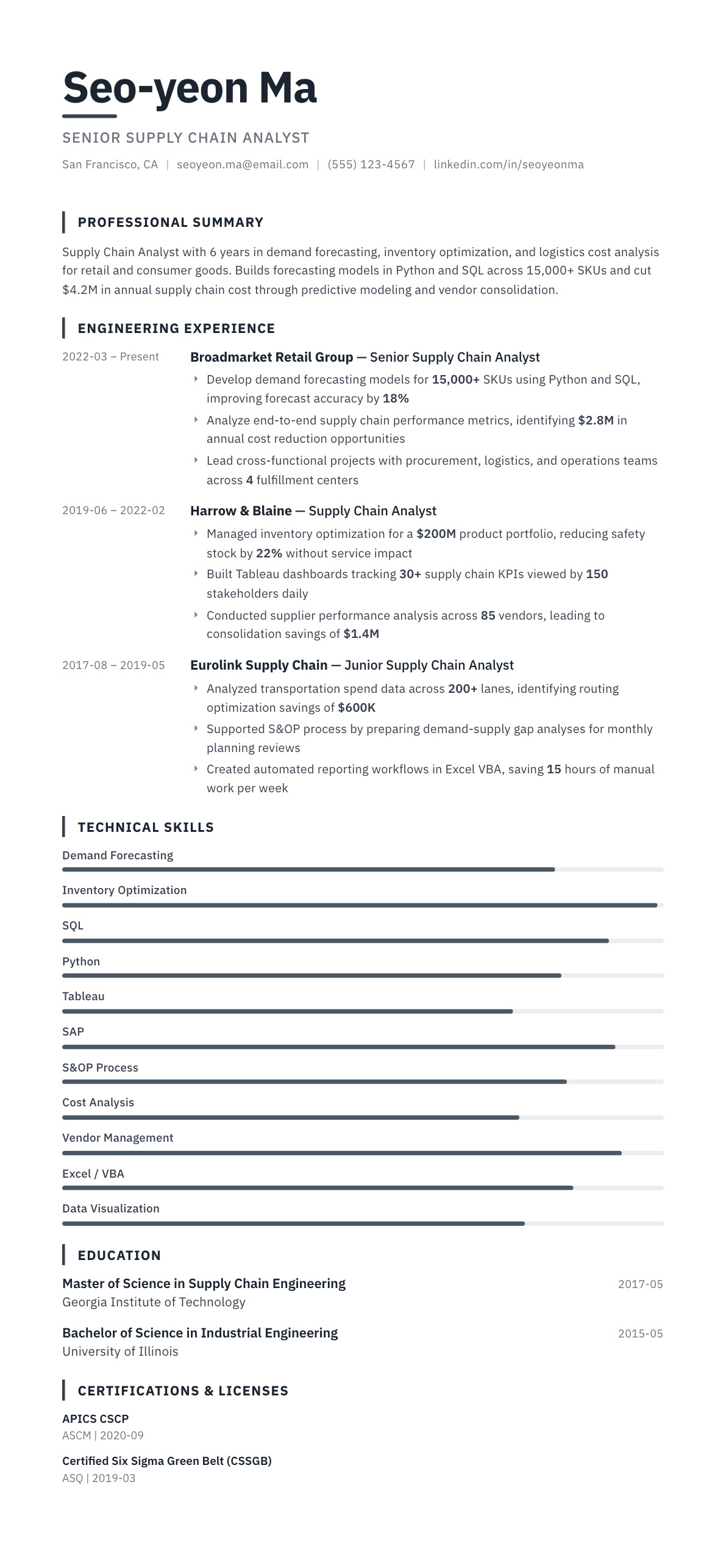
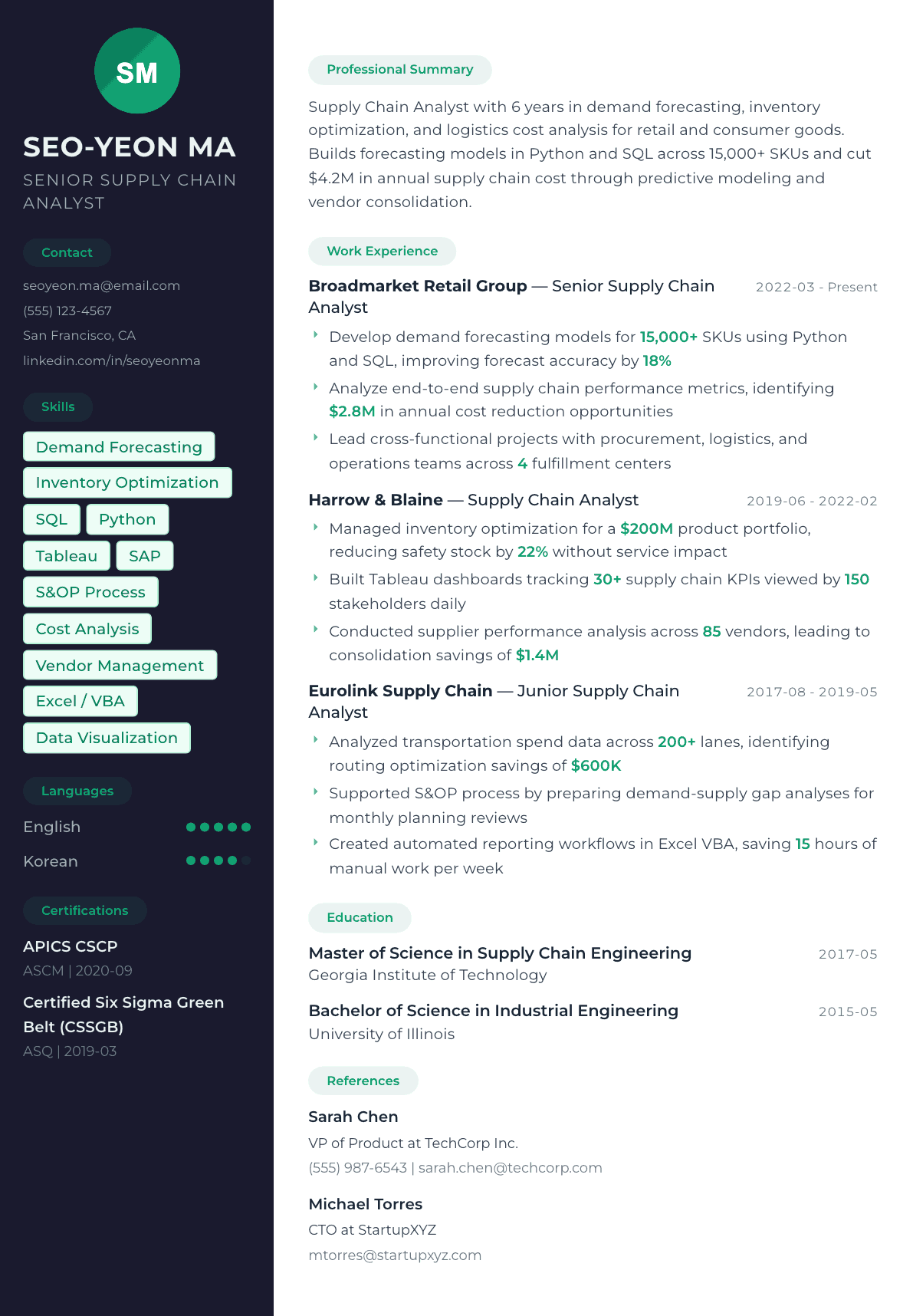
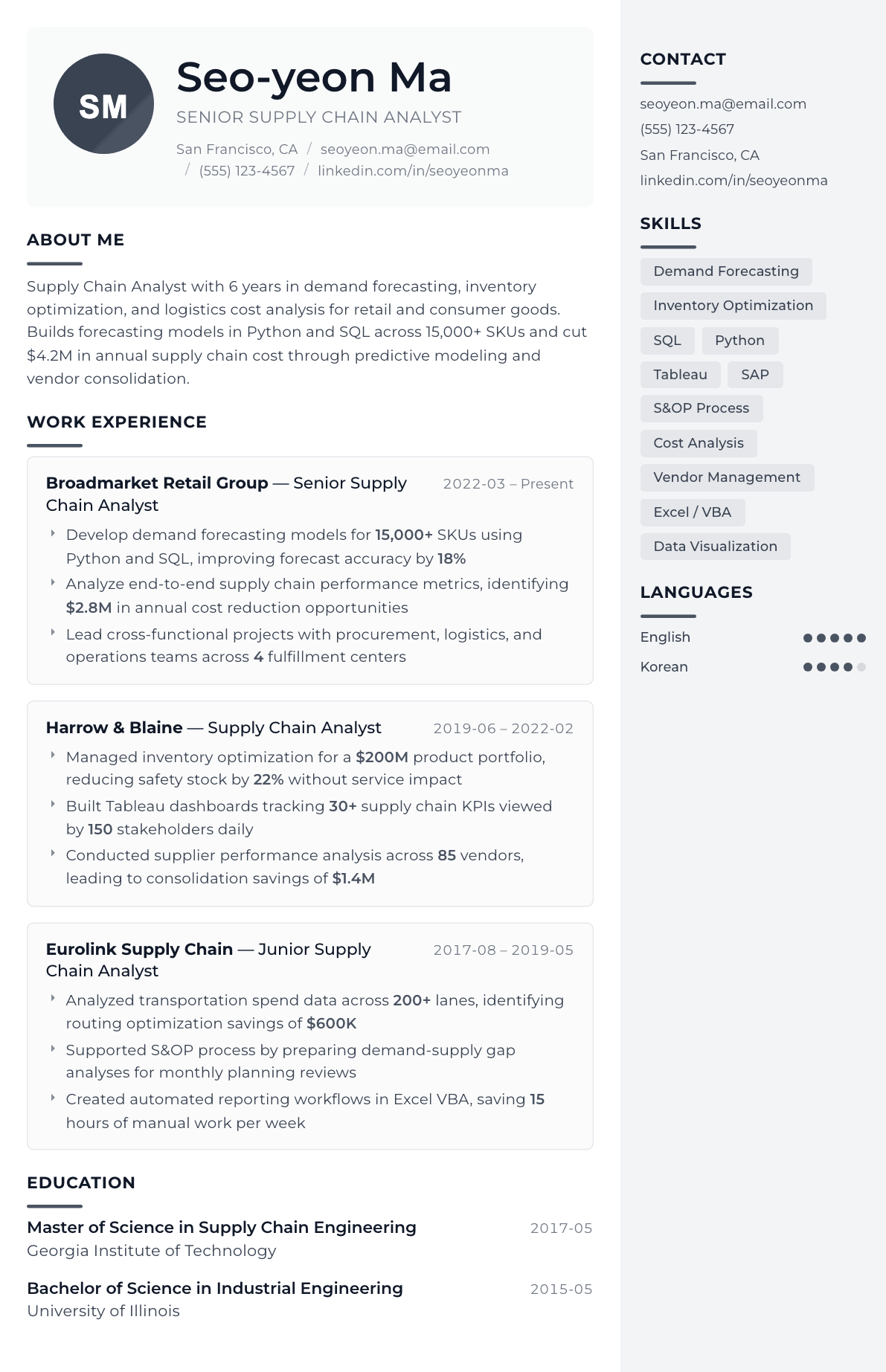
The same supply chain analyst content laid out in three CVBooster templates, so you can see what the finished document looks like before you write a word.
Example Supply Chain Analyst summary
Supply Chain Analyst, 6 years in demand planning and inventory optimization across 4 fulfillment centers and an 85-vendor base. Lifted forecast accuracy 18% and removed $4.2M in annual cost using Python, SQL, and Tableau. Seeking a senior analyst role in a global supply chain team.
Skills to list on a Supply Chain Analyst resume
- Demand Forecasting
- Inventory Optimization
- Supply Chain Analytics
- SQL / Python
- Tableau / Power BI
- SAP / Oracle SCM
- S&OP Process
- Cost-to-Serve Analysis
- Vendor Performance
- Transportation Analytics
- Lean Six Sigma
- Data Modeling
- Excel / VBA
- KPI Dashboards
What actually gets this resume read
- Quantify cost savings and efficiency improvements with specific dollar amounts and percentages.
- List analytical tools and programming languages: SQL, Python, R, Tableau, Power BI, SAP, Oracle.
- Highlight APICS certifications (CSCP, CPIM) as these are the gold standard in supply chain.
- Show experience with S&OP, demand planning, and inventory management processes.
- Include the scale of operations: number of SKUs, vendors, fulfillment centers, or lanes managed.
- Demonstrate cross-functional collaboration with procurement, logistics, and operations teams.
How to write a supply chain analyst resume
A supply chain analyst resume has to answer a question that most candidates never address: what decision changed because of your analysis. Planning managers see plenty of resumes full of dashboards and models, and very few that show a forecast being adopted, a safety stock policy being reset, or a sourcing lane being switched because the analyst made the case with data.
The second thing a hiring manager checks is whether you know the operating rhythm of a supply chain, not just the tooling. Sales and operations planning cycles, demand review, supply review, the monthly consensus meeting, the inventory targets that come out of it. An analyst who has only ever pulled data on request reads very differently from one who has sat in those meetings and defended a number.
This guide covers how to structure the document, how to write bullets that connect analysis to a business outcome, what scale figures to include, sample summaries from a first analyst seat to a senior planning analyst, and the questions analysts ask when they move between demand, inventory and network work.
Format: one page, technical stack visible early
Reverse-chronological, one page until you have roughly eight years. Put a compact technical line under the summary listing query language, visualization tool, planning system and modeling environment, because most screens for this role start by filtering on the stack.
Resist the dashboard aesthetic. Skills rated as filled circles or bar charts tell a reader nothing verifiable, take space that should hold a result, and confuse the applicant tracking system that has to read the underlying text.
- Header: name, city and state, phone, email, and the domain you analyze (demand, inventory, transportation, procurement, network).
- Order: summary, technical stack, experience, projects if early career, education, certifications.
- A short projects section is worth including for the first two years only, and it should show data and a conclusion, not a course assignment.
Summary: domain, scale, tools, and one decision you changed
Name the domain first. Demand planning, inventory optimization, transportation analytics, supplier performance and network design are separate jobs that share a title, and the reader is trying to sort you into one of them.
Then the scale of what you analyzed: number of items or item families, distribution centers, suppliers or lanes. Follow with the stack, and close with one concrete outcome, ideally an inventory or service change that came from your work. Scale plus outcome beats a list of adjectives every time.
Experience: analysis, recommendation, decision, result
Write each significant bullet in four beats compressed into one sentence: what you analyzed, what you recommended, who decided, and what moved. "Analyzed 18 months of order history across 900 items, recommended a reorder point change on the slow moving tier, and the planning manager adopted it" is a complete story in one line.
Give the planning rhythm you worked inside. Whether you produced the statistical baseline forecast, ran demand review with commercial teams, published the constrained supply plan, or maintained the inventory policy parameters in the planning system. Managers hire against a specific seat in that cycle.
Be precise about the data. Where the numbers came from, how many periods of history, what you did about outliers and promotions, and how you measured accuracy. Forecast accuracy stated without saying whether it is mean absolute percentage error at item level or aggregated at family level is a number an interviewer will pick apart.
Technical stack: name the version of the work, not the tool alone
Listing SQL, Python and a visualization tool is table stakes. What separates a candidate is saying what you built with them: a query set against an enterprise data warehouse feeding a weekly inventory health view, a Python routine that segments items by volume and variability, a model that tests service level against holding cost.
Name the planning and enterprise systems too, because they carry the master data and the parameters: SAP Integrated Business Planning, Oracle, Blue Yonder, Kinaxis, o9 or an internal planning tool. Analysts who understand where lead times, lot sizes and safety stock actually live in the system are far more useful than analysts who only see extracts.
The vocabulary planning postings use
These postings repeat a defined set of terms: demand forecasting, sales and operations planning, safety stock, reorder point, service level, fill rate, days of supply, inventory turns, cost to serve, supplier on-time in full, lead time variability, capacity constraints and scenario analysis. Use the ones that describe your work and attach a number to at least three of them inside experience bullets.
Supply Chain Analyst resume summary examples
First analyst role
Supply chain analyst with 18 months supporting demand planning for 900 items across two distribution centers. Builds the weekly statistical baseline, tracks forecast accuracy at family level, and rebuilt the inventory health report in SQL and Power BI to run without manual updates.
Four years in
Supply chain analyst with four years across demand and inventory for 4,000 items and 60 suppliers. Resegmented the portfolio by volume and variability, reset safety stock policy on the slow moving tier, and lifted fill rate to 97% while holding days of supply flat.
Senior planning analyst
Senior supply chain analyst with eight years owning the analytics behind a monthly sales and operations planning cycle for three business units. Runs scenario models on capacity and sourcing, leads the demand review with commercial teams, and holds the CSCP designation.
Work experience bullets: before and after
Before: Analyzed inventory data and made recommendations.
After: Segmented 4,000 items by volume and demand variability, then recommended a differentiated safety stock policy that the planning manager applied to the slowest moving tier first.
The method, the item count and the adoption step show analysis that landed rather than analysis that was filed.
Before: Built dashboards in Power BI for the supply chain team.
After: Built an inventory health view in Power BI over a SQL extract of on-hand, open orders and forecast, replacing a spreadsheet that took two days a week to maintain.
Naming the data behind the view and the work it removed makes the dashboard a business result.
Before: Improved forecast accuracy.
After: Cleaned promotional history out of the baseline and moved 300 seasonal items to a different statistical model, cutting mean absolute percentage error at family level by 6 points.
The specific technique and the stated accuracy measure survive the interview question that the weak version invites.
Before: Worked on the S&OP process with other departments.
After: Prepared the demand review pack each month for three business units, reconciled the commercial plan against the statistical baseline, and documented the gaps the executive meeting had to resolve.
Showing the specific deliverable and where it was consumed proves you sat inside the cycle, not beside it.
Before: Helped reduce transportation costs.
After: Modeled cost to serve across 40 lanes using freight invoice and order data, identified 8 lanes better served from a second distribution center, and supported the network change with a scenario comparison.
A named analysis over a stated dataset with a countable recommendation reads as real network work.
Hard skills
- Demand forecasting and statistical models
- Inventory optimization and safety stock policy
- Sales and operations planning support
- SQL and data warehouse querying
- Python or R for analysis
- Power BI and Tableau
- Advanced Excel modeling
- SAP and Oracle supply chain modules
- Cost to serve analysis
- Supplier performance measurement
- Scenario and what-if modeling
- Network and distribution analysis
Soft skills
- Explaining a model to non-analysts
- Defending a number in a planning meeting
- Cross functional facilitation
- Skepticism about source data
- Prioritizing analysis requests
- Written recommendation writing
Certifications worth listing
- Certified Supply Chain Professional (CSCP) (Association for Supply Chain Management)
- Certified in Planning and Inventory Management (CPIM) (Association for Supply Chain Management)
- Certified in Logistics, Transportation and Distribution (CLTD) (Association for Supply Chain Management)
- Certified Six Sigma Green Belt (CSSGB) (American Society for Quality)
- Power BI Data Analyst Associate (Microsoft)
Mistakes that cost supply chain analyst candidates the interview
- Listing tools without saying what you built with them, which makes every analyst resume look identical.
- Reporting forecast accuracy without naming the measure or the aggregation level, which invites an interview question you will lose.
- Leaving out the scale of the data: item counts, suppliers, sites and lanes are how a manager sizes your experience.
- Stopping the story at the recommendation instead of saying who acted on it and what changed.
- Filling the page with course projects after you already have paid analyst experience.
- Using the same resume for a demand planning role and a transportation analytics role when the two teams look for different domains.
Supply Chain Analyst resume questions
How technical should a supply chain analyst resume be?
Technical enough to pass a stack filter and no further. Name the query language, the visualization tool and the planning system, then spend the remaining space on the business decisions your analysis supported, which is what the hiring manager is actually buying.
What if I do not have Python experience?
Say so by omission rather than by overclaiming, and lead with advanced spreadsheet modeling plus SQL, which covers most of the work in this role. Many planning teams care far more about inventory logic and forecasting judgment than about a programming language.
Should I list the number of SKUs I managed?
Yes. Item count, along with sites, suppliers and lanes, is the fastest way for a manager to size your experience. An analyst working across thousands of items faces segmentation and automation problems that a small portfolio never creates.
Is CPIM or CSCP better for this resume?
CPIM fits analysts working close to planning, inventory and manufacturing execution, while CSCP suits a broader end to end scope including sourcing and distribution. Choose the one matching the roles you want, and list it near the top if your experience is short.
How do I show impact when my analysis was only advisory?
Name the decision forum and the outcome anyway. Saying a policy recommendation went to the planning manager and was applied to a specific item tier is honest, verifiable and far stronger than claiming an improvement you did not implement yourself.
Related resume examples
- Logistics Coordinator Resume example
- Fleet Manager Resume example
- Freight Broker Resume example
- Procurement Analyst Resume example
- Logistics Analyst Resume example
- Supply Chain Specialist Resume example