Category Manager Resume Examples: the lines they read
Craft a Category Manager Resume Built on Margin and Assortment
By Mustafa Tarabya, founder of CVBooster · Published · Updated
Category manager resume examples with assortment, pricing and sourcing bullets, plus ATS keywords and a full writing guide for the role.
Sample resumes for a category manager
The same category manager content laid out in three CVBooster templates, so you can see what the finished document looks like before you write a word.
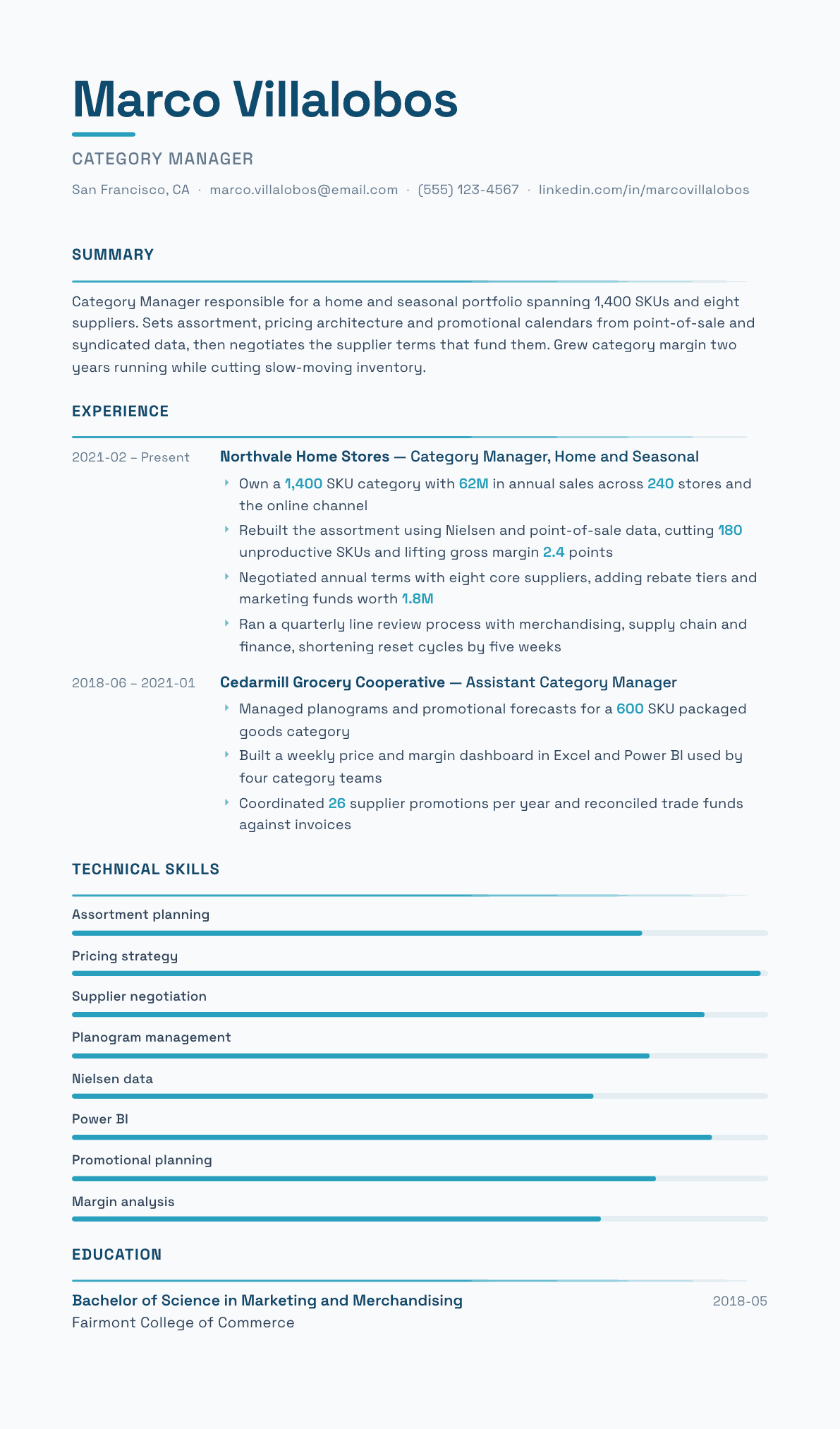
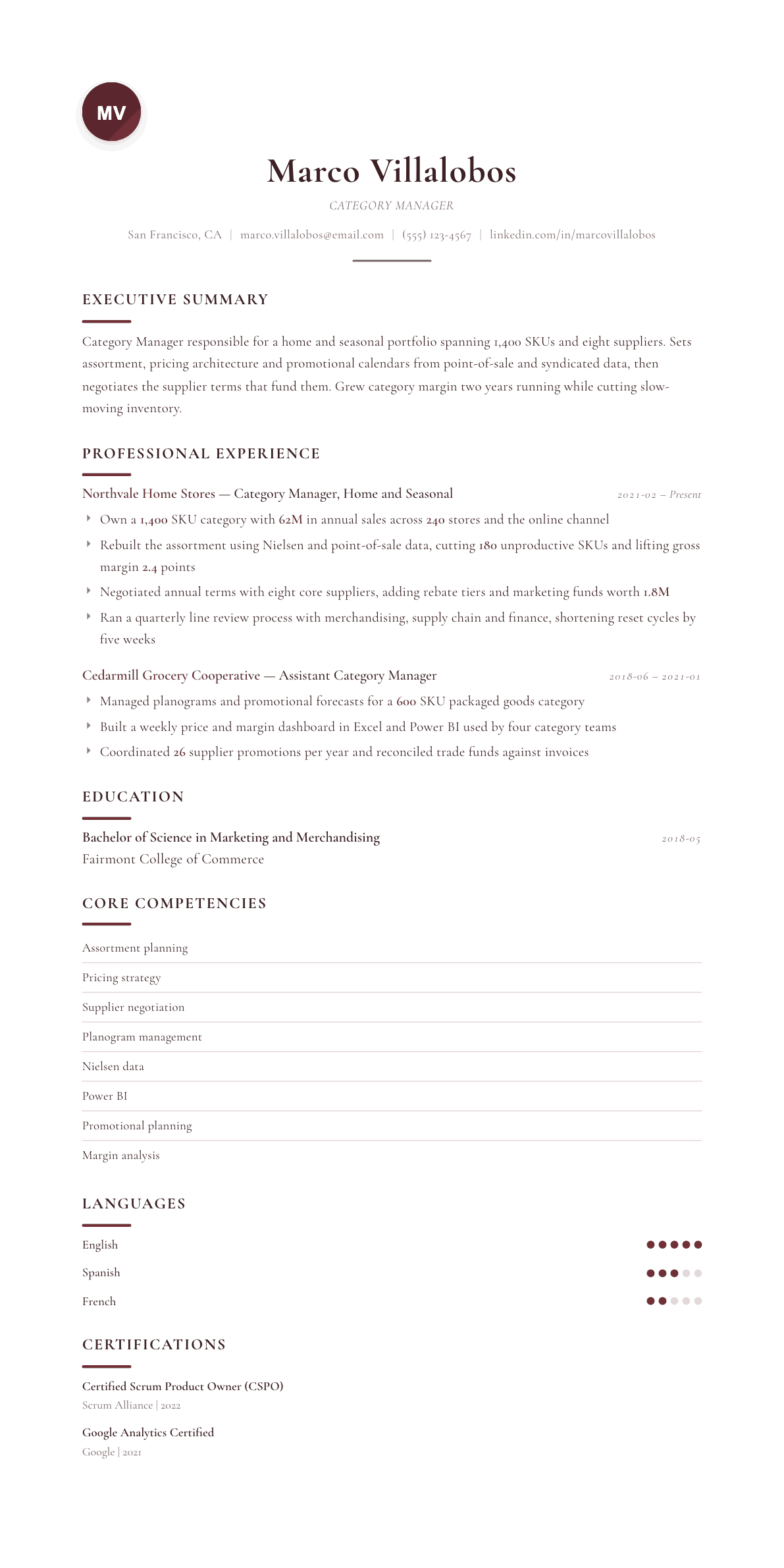
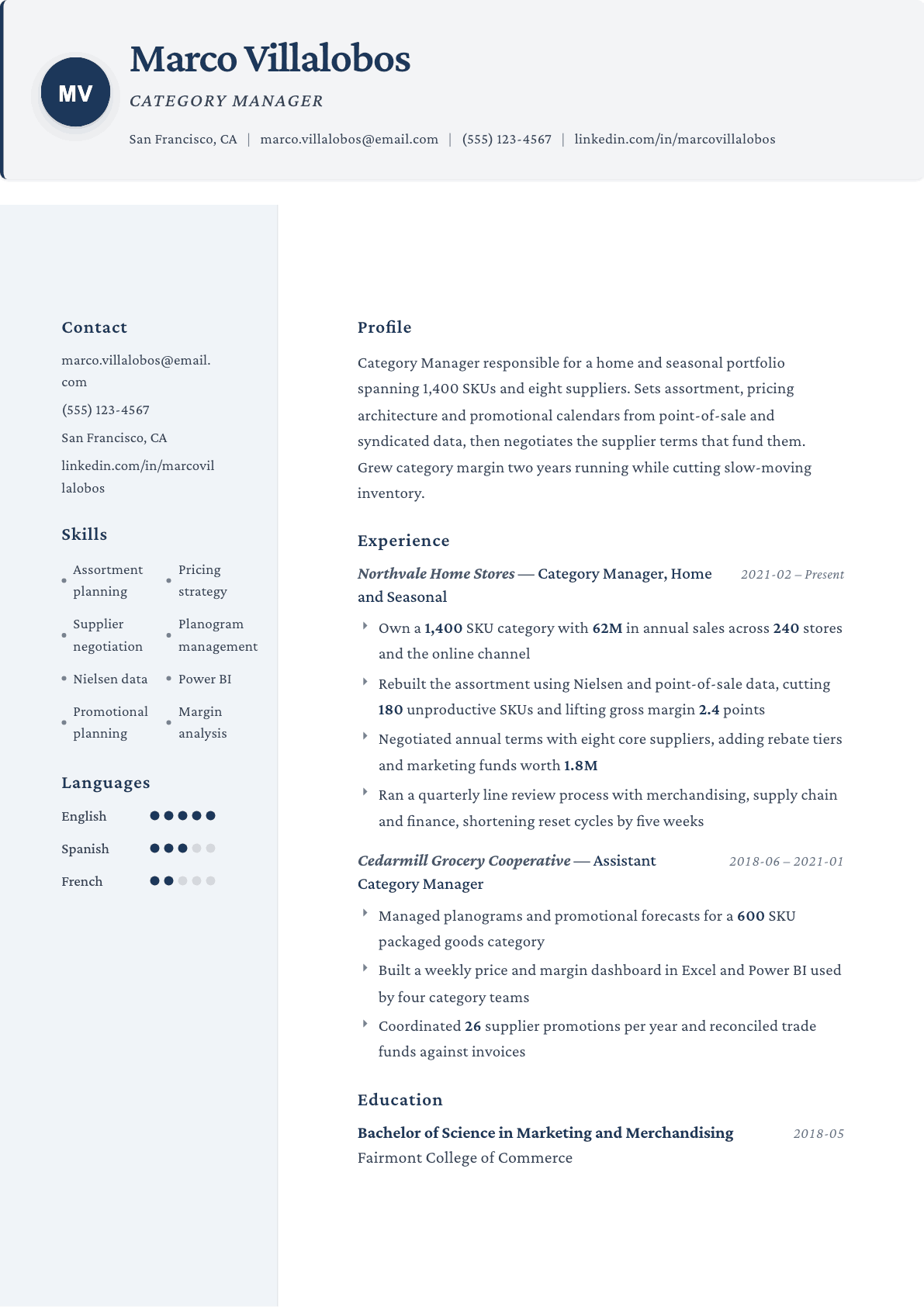
Example Category Manager summary
Category Manager for a 1,400 SKU home and seasonal portfolio worth 62M across 240 stores and online. Sets assortment, pricing and promotional calendars from point-of-sale and syndicated data, and negotiates annual supplier terms including rebate tiers and marketing funds. Removed 180 unproductive SKUs and added 2.4 margin points in one reset. Looking to lead a multi-category team.
Skills to list on a Category Manager resume
- Category management
- Assortment planning
- Pricing architecture
- Promotional planning
- Supplier negotiation
- Trade funds management
- Planogram and space planning
- Point-of-sale analysis
- Nielsen and syndicated data
- Power BI
- Inventory turns
- Margin analysis
- Private label development
- Line reviews
- Forecasting
What actually gets this resume read
- Head every role with category size: SKU count, annual sales, store count and the channels you covered.
- Show the four levers a category manager owns: assortment, price, promotion and supplier terms, with a result on each.
- Name the data you worked from, such as point-of-sale, Nielsen, Circana or loyalty data, and the tool you analyzed it in.
- Quantify margin in points and inventory in turns, because merchandising leaders read those two numbers first.
- Describe one line review or category reset end to end, including who you aligned across merchandising and supply chain.
- Keep private label, national brand and online assortment work visible if the posting names any of them.
How to write a category manager resume
Category management is a profit and loss job wearing a merchandising title. The person screening your resume, usually a divisional merchandise manager or a head of category, wants to know the size of the book you carried and what you did to the four levers you control: assortment, price, promotion and supplier terms. Everything else on the page is context.
The most common failure is a resume that reads like a supplier account plan. Long descriptions of vendor meetings and range reviews, no SKU count, no sales value, no margin movement. A category manager who cannot state the size of the category they owned looks like an assistant who sat in the meetings.
This guide sets out how to structure the page for a category hiring panel, what each of the four levers looks like as a bullet, three summaries pitched at different levels of ownership, and the questions candidates ask when they move between retail, grocery, distribution and business to business categories.
Format: category scope line under every title
Reverse chronological, single column, and directly under each job title a scope line giving SKU count, annual sales, store or account count, and the channels included. That single line does the work of a paragraph and lets the reader compare you against the last four candidates instantly.
Keep the page to one for the first eight years and two after that. Category managers accumulate long supplier lists and range review histories, and those belong in the interview, not the resume.
- Scope line: SKU count, annual category sales, number of stores or accounts, channels covered.
- Section order: summary, category scope highlights, experience, systems and data, education.
- Include the category names in plain language, since recruiters search on product terms.
Summary: the book you carried and the margin you moved
Three to four lines. The categories, the size, the channel mix, and one number that proves commercial impact. Margin points added, sales growth against the market, inventory turns improved, or private label penetration built.
If you are moving between sectors, name the transferable mechanics rather than the products. Assortment rationalization, price architecture, promotional funding and supplier term negotiation work the same in industrial distribution as they do in grocery, and saying so preempts the objection.
Experience: one bullet for each lever, then the process work
Assortment. Say what you added, what you cut, and what happened to sales and margin afterward. Removing unproductive SKUs is one of the most quantifiable things a category manager does and it is chronically underwritten.
Price and promotion. Show the architecture, not the individual deals: opening price points, good better best tiers, promotional depth and frequency, and how you funded them. If you shifted funding from blanket discounts to targeted events, say what the change did to gross margin.
Supplier terms. Annual negotiations, rebate tiers, marketing funds, payment terms and new product commitments. Quantify the value and be clear whether it landed in cost of goods or in a marketing budget.
Then the process work that makes a category manager promotable: line reviews, resets, forecast accuracy, and cross-functional alignment with supply chain, finance and store operations. Name the cadence and what you shortened or fixed.
Data and systems: what you analyzed and where
Category hiring managers care which data you can actually work with. Point of sale, syndicated market data, loyalty data and supplier shipment data each support different arguments, and knowing which one answers which question is a real skill.
List the analysis and planning tools next to the data. Space planning software, replenishment or forecasting systems, and whatever you built dashboards in. A category manager who is fluent in a pivot table and a space planning tool is more useful than one who only reads prepared reports.
- Data: point of sale, syndicated market data, loyalty, supplier shipments, competitive price checks.
- Space and assortment: JDA or Blue Yonder space planning, Relex, spreadsheets built for range decisions.
- Analysis: Excel modeling, Power BI, Tableau, SQL where you pulled the data yourself.
Keywords that get a category resume through the filter
Recurring terms across category postings include assortment planning, range review, planogram, price architecture, promotional planning, trade funds, gross margin, inventory turns, forecast accuracy, private label and supplier negotiation. Match the posting wording for the product vocabulary too, because a grocery retailer searches for center store and a distributor searches for line card.
Use each phrase once where it describes something you actually did. A resume that names range review three times but never says what happened at one reads as padding.
Category Manager resume summary examples
Assistant category manager
Assistant Category Manager supporting a 600 SKU packaged goods portfolio across 180 stores. Maintains planograms, builds promotional forecasts, and reconciles trade funds against supplier invoices. Built the weekly price and margin dashboard used by four category teams. Ready to own a category and its supplier negotiations.
Category owner
Category Manager owning a 1,400 SKU home and seasonal portfolio worth 62M across 240 stores and online. Cut 180 unproductive SKUs and added 2.4 gross margin points in one reset, and negotiated annual supplier terms adding rebate tiers and marketing funds. Runs quarterly line reviews with supply chain and finance.
Senior or divisional category manager
Senior Category Manager leading three category managers across a 300M division. Set the price architecture and private label strategy for the group, lifting own brand penetration from 14% to 23% in two years, and rebuilt the annual supplier negotiation calendar that now funds the promotional plan.
Work experience bullets: before and after
Before: Managed assortment for the home category.
After: Owned a 1,400 SKU home category worth 62M, rationalizing 180 unproductive items and reinvesting the space into nine higher margin lines that added 2.4 margin points.
Scope, action and margin outcome turn a job description line into a commercial result.
Before: Negotiated with vendors annually.
After: Led annual term negotiations with eight core suppliers, introducing volume rebate tiers and committed marketing funds worth 1.8M against the category plan.
Naming the levers and the value shows the reader exactly what kind of negotiator you are.
Before: Worked on pricing for the category.
After: Rebuilt price architecture into opening, mid and premium tiers across four subcategories, closing a gap to the market leader on entry price while protecting blended margin.
Pricing becomes credible when the structure and the trade-off are visible rather than implied.
Before: Used sales data to make decisions.
After: Combined point of sale and syndicated market data in Power BI to find eleven items losing share to a competitor line, then replaced them ahead of the spring reset.
It names the data sources, the tool, the finding and the action, which is what analytical ability looks like.
Before: Ran promotions with suppliers.
After: Planned 26 supplier funded promotions a year and moved a third of the budget from blanket discounts into targeted events, improving promotional gross margin without losing unit volume.
The shift in approach and the protected volume tell the reader you understand promotional economics.
Hard skills
- Assortment planning
- Range review and resets
- Price architecture
- Promotional planning
- Trade funds management
- Supplier term negotiation
- Planogram and space planning
- Point of sale analysis
- Syndicated market data
- Gross margin management
- Inventory turns and forecasting
- Private label development
Soft skills
- Commercial judgment
- Cross-functional alignment
- Negotiation
- Presenting to senior merchants
- Prioritization across a wide book
- Supplier diplomacy
Certifications worth listing
- Certified Professional in Supply Management (CPSM) (Institute for Supply Management)
- Certified Supply Chain Professional (CSCP) (ASCM)
- Certified Professional Category Analyst (CPCA) (Category Management Association)
Mistakes that cost category manager candidates the interview
- Omitting the size of the category, which leaves the reader unable to place your level at all.
- Writing about supplier meetings and range reviews without saying what the outcome of one was.
- Reporting sales growth with no margin figure, when margin is what the hiring merchant is accountable for.
- Ignoring the inventory side, so the resume reads as a buyer who never carried a working capital target.
- Using internal category names and codes that mean nothing outside your former employer.
- Burying private label, online assortment or new product launches when the posting explicitly asks for them.
Category Manager resume questions
How is a category manager resume different from a buyer resume?
A buyer resume is judged on orders, cost and availability. A category manager resume is judged on the profit and loss of a range: what you stocked, at what price, promoted how, on what supplier terms. Write to the strategy, not the order book.
What numbers matter most on a category management resume?
Category sales value, SKU count, gross margin in points, inventory turns or weeks of cover, and the value of supplier terms you negotiated. Those five let a hiring merchant size your experience in seconds without asking a single question.
Can I move into category management from sales at a supplier?
Yes, and it is a common path. Lead with the retailer facing work you did: joint business planning, range presentations, promotional proposals and the market data you built them from. Then show you can take the retailer side of that same table.
Should I name the brands and suppliers I worked with?
Name the categories always and the suppliers selectively. Two or three recognizable partners give the resume texture. A full supplier roster reads as a contact list rather than evidence that you made commercial decisions.
How do I show category management skills without a category title?
Group the work by lever instead of by job. If you set assortment for a region, priced a product line, or negotiated annual terms while holding a merchandising or planning title, those bullets do the same job as a title would.
Related resume examples
- Retail Buyer Resume example
- Brand Manager Resume example
- Buyer Resume example
- Purchasing Manager Resume example
- Business Consultant Resume example
- Vendor Manager Resume example