Retail Buyer Resume Examples: free ATS score and gap list
Create a Retail Buyer Resume That Gets Noticed
By Mustafa Tarabya, founder of CVBooster · Published · Updated
Build an ATS-optimized retail buyer resume with proven templates and tips to showcase your merchandising expertise.
Sample resumes for a retail buyer
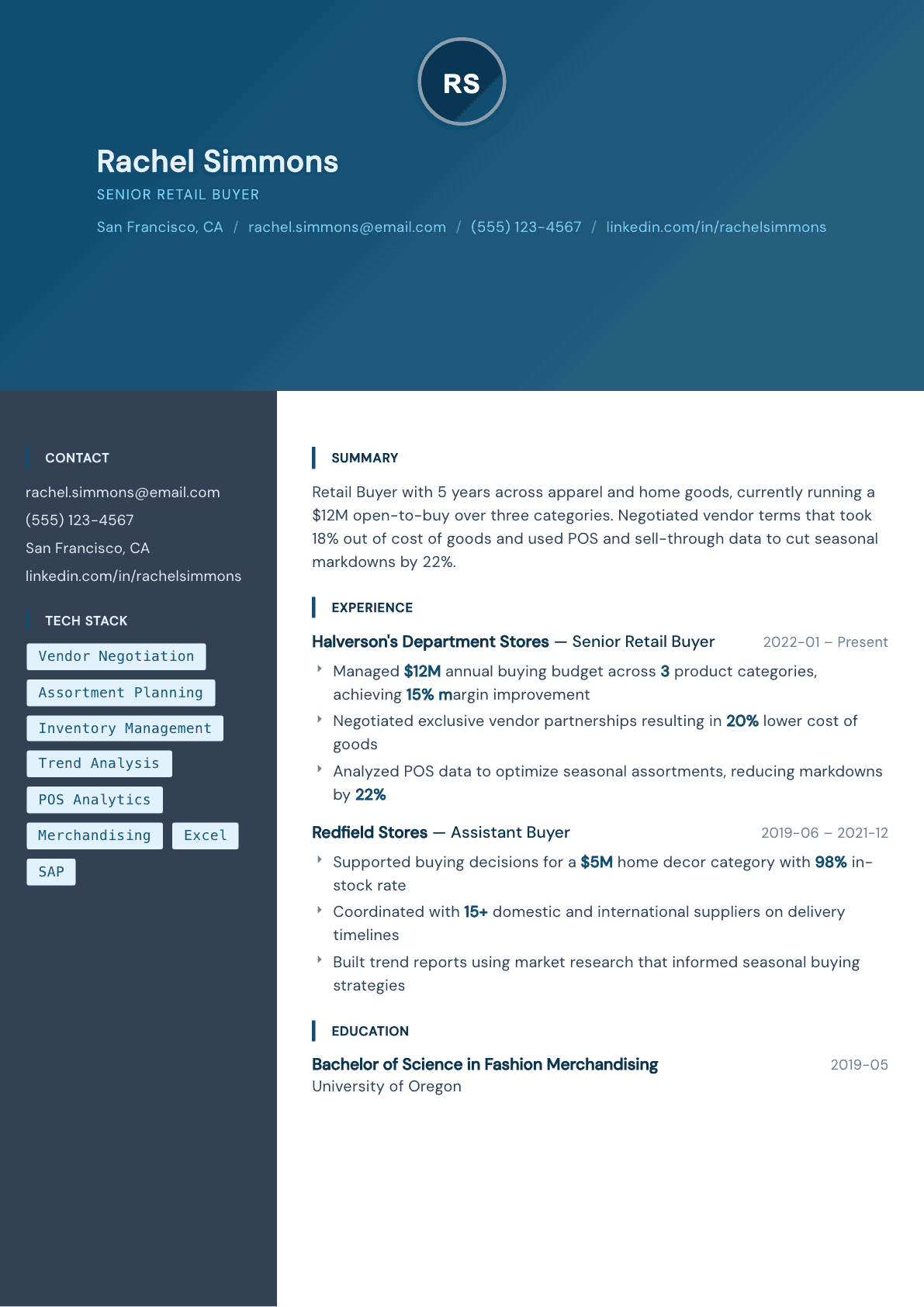
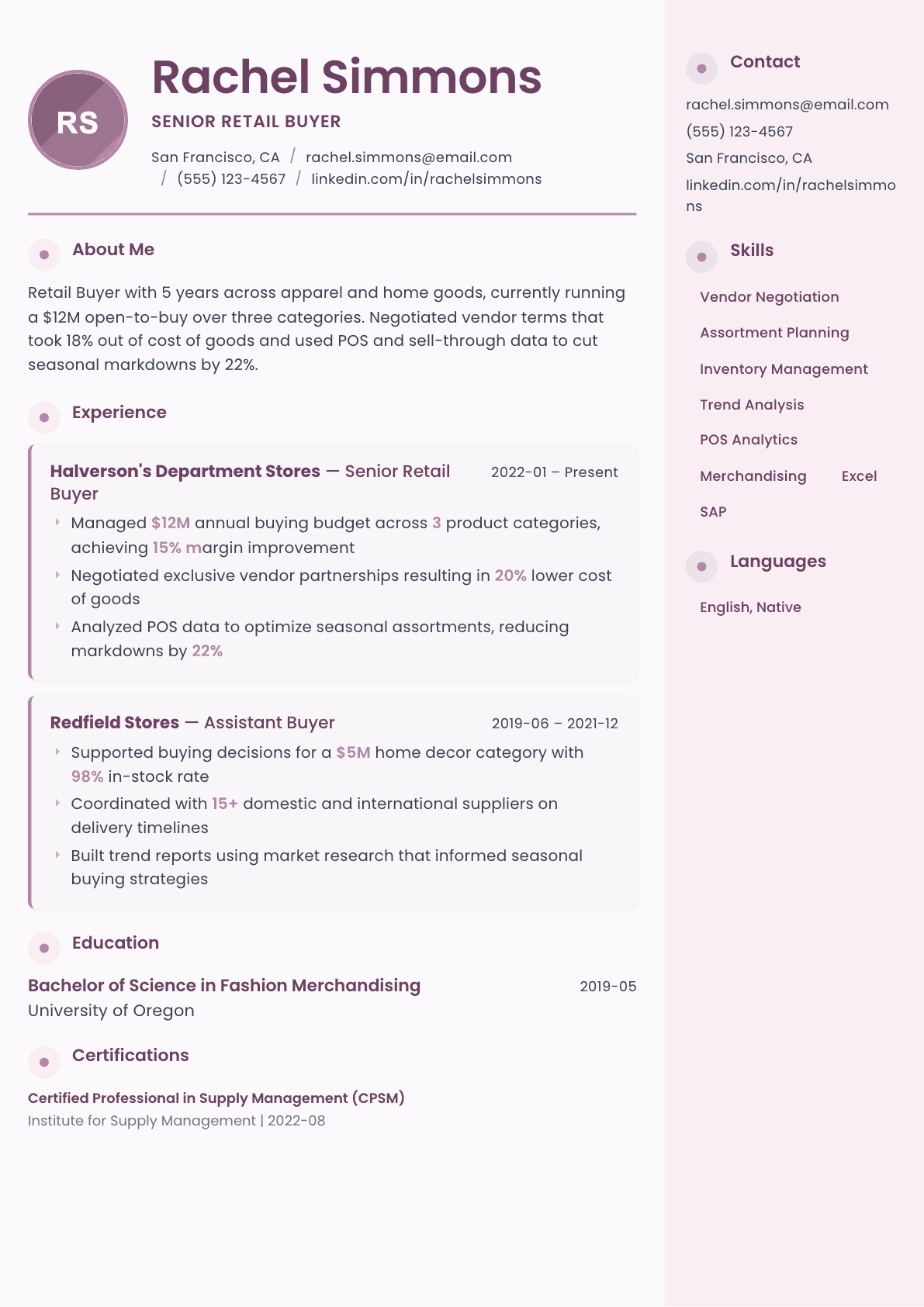
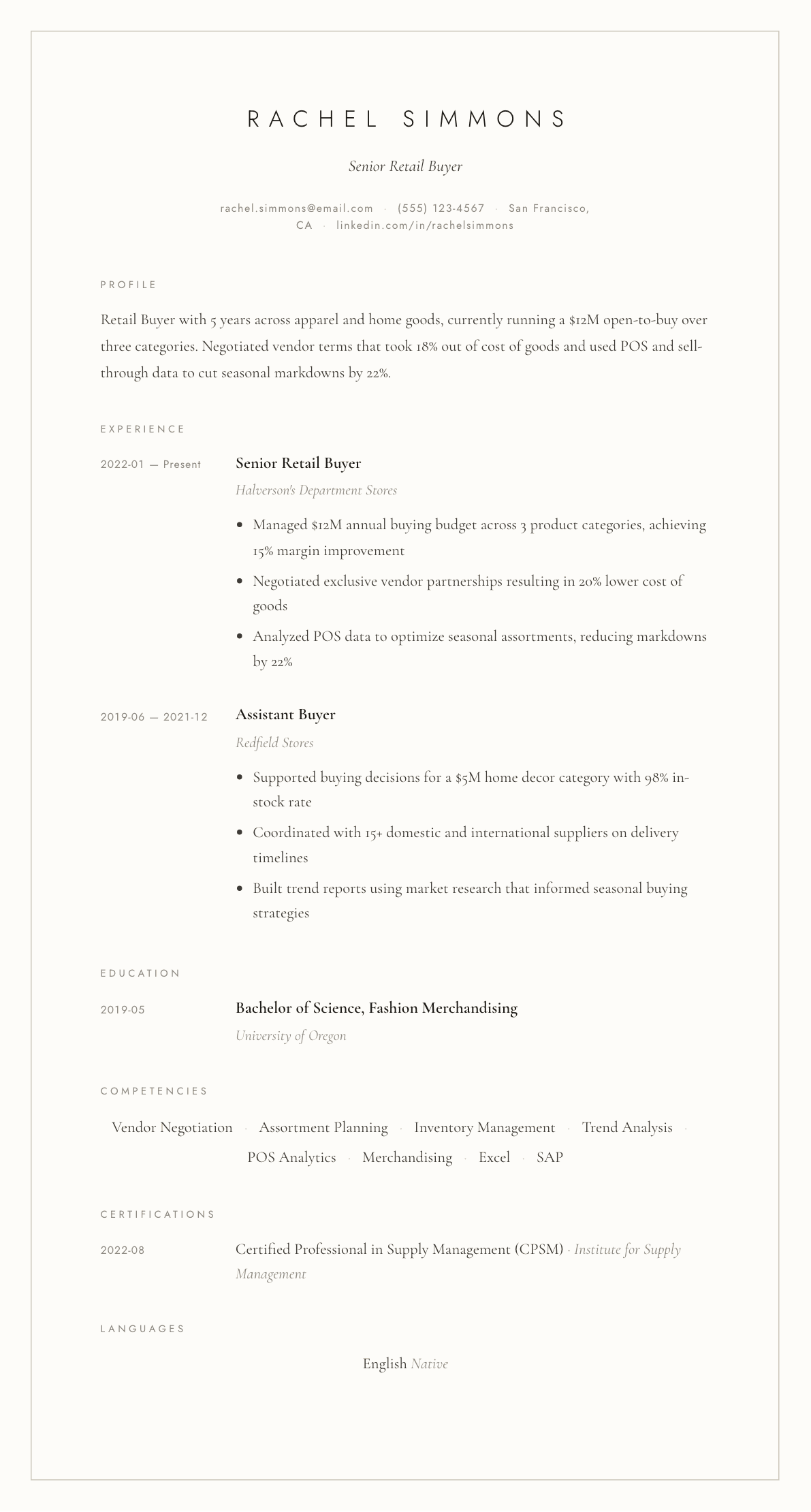
The same retail buyer content laid out in three CVBooster templates, so you can see what the finished document looks like before you write a word.
Example Retail Buyer summary
Strategic Retail Buyer with 5 years of experience managing multi-million-dollar budgets across apparel and home categories. Skilled at negotiating vendor contracts, optimizing assortments, and driving margin growth through data-backed buying decisions.
Skills to list on a Retail Buyer resume
- Vendor Negotiation
- Assortment Planning
- Inventory Management
- Trend Forecasting
- Margin Optimization
- POS Data Analysis
- Supply Chain Coordination
- Merchandising Strategy
- SAP / Oracle
- Contract Management
What actually gets this resume read
- Open with the open-to-buy you controlled, the categories it covered and the number of doors or the online volume it fed.
- Report the merchandising numbers a buying director asks for: initial markup, maintained margin, sell-through at week eight, markdown rate and in-stock percentage.
- Describe the vendor work in detail: how many suppliers you carry, domestic against import lead times, payment terms won, and any exclusive or private label programs you built.
- Say how you decide what to buy, from POS and sell-through reporting to store visits, trend services and competitive shopping.
- Name your categories precisely, since apparel, home, hardlines and food buying are separate hiring pools.
How to write a retail buyer resume
A retail buyer resume is judged on the size and shape of the book you owned. The divisional merchandise manager reading it wants the category, the annual purchase budget or retail sales the category produced, the number of stock keeping units and vendors, the channels the assortment served, and whether you set the strategy or executed someone else's open to buy.
Then come the numbers that decide whether a buyer is any good: initial markup and maintained margin, sell through at full price, markdown rate, weeks of supply and in-stock position on core items, and vendor terms improvement. Those are the levers a buyer actually pulls. A resume full of vendor relationship language with no margin or sell through figure reads like an assistant buyer resume with a promoted title.
This guide covers the category scope block, how to write vendor negotiation credibly, summaries for an assistant buyer, a buyer and a senior or divisional buyer, before and after bullets, and the questions people ask when moving between hardline, softline and grocery categories.
Format: the category block does the heavy lifting
Reverse chronological, one page under seven years, single column so the applicant systems used by large retailers parse it correctly. Under each buying title write a category block before the bullets: the categories owned, annual purchase budget or category retail volume, item count, vendor count, the number of doors or the channel mix, and who reported to you.
Say whether the business was branded resale, private label development, or both, because they are different jobs. Private label work means specification writing, factory selection, sampling, quality testing and a much longer lead time. Branded buying means assortment selection, vendor terms and allowance negotiation, and fighting for allocation on constrained goods.
- Header: name, city and state, phone, email, and travel availability if market weeks or factory visits were part of the role.
- Section order: summary, category scope, experience, systems and analytics, education, professional development.
- For every role, state whether you owned the open to buy or executed against a plan someone else set.
Margin, sell through and the open to buy
Lead each job with the financial result. Initial markup and maintained margin against plan, sell through at full price by the end of the season, markdown as a share of sales, gross margin return on inventory investment, and turn. A buyer who can quote maintained margin and markdown together is describing the whole decision, since a strong initial markup destroyed by end of season markdowns is not a win.
Open to buy management deserves its own bullet. Say how you managed receipt flow against sales, what you did when the category ran ahead or behind plan, how you handled a canceled order or a late delivery, and whether you carried the reforecast. That is the discipline that separates a buyer from an order writer.
In-stock and availability are the other half. Weeks of supply on core items, fill rate from suppliers, out of stock rate on the top sellers, and how you protected availability during a demand spike. In grocery and consumables that number outranks margin, so lead with it if the posting is in that world.
Vendor negotiation written so a merchant believes it
Negotiation bullets fail when they say negotiated better terms. Name the levers you actually moved: cost of goods, payment terms, freight allowance and who pays inbound, defective and return allowances, markdown support, advertising and promotional funds, minimum order quantities, exclusivity on a style or pack, and rebate structures tied to volume.
Then say what it bought. A payment term extension improves working capital. A markdown allowance protects maintained margin at the end of the season. Exclusivity protects price. Writing the lever and the effect shows commercial reasoning rather than an assertion of toughness.
Add the sourcing work if you have it: new vendor qualification, factory audits, sample review and approval, cost engineering with a supplier to hit a retail price point, and compliance on testing and labeling. Buyers who can bring a private label item from concept to floor are hired above buyers who cannot.
Analytics, planning partnership and systems
Buying is an analytical job and hiring managers test for it. Name the analysis you run: item and class level sell through, size and color curve analysis, price point architecture and good better best structure, competitive shopping and price comparison, and post-season hindsight that changes next year's plan. Show you can build the case in a spreadsheet rather than only read the report someone sends you.
Name the systems by product: the enterprise planning or merchandise financial planning tool, the assortment planning system, the enterprise resource planning platform such as SAP or Oracle Retail, the reporting layer, and the vendor portal or electronic data interchange setup you worked through. Add the planning partnership explicitly, since buyer and planner is a paired role and hiring managers want to know how you split the work.
Keywords the screener is scanning for
Merchandising postings repeat a fixed vocabulary: assortment planning, open to buy, initial markup, maintained margin, sell through, markdown management, gross margin return on investment, weeks of supply, vendor negotiation, private label development, line review and hindsight. Use the ones that describe your real work in both the summary and a bullet.
Sector language differs sharply. Apparel wants size curves, color stories, market weeks and seasonal flow. Grocery wants category management, promotional planning, trade funds and pack size. Hardlines want product specification, warranty and returns handling. Home wants sample approvals and freight cost per item. Mirror the vocabulary of the posting you are answering.
Retail Buyer resume summary examples
Assistant buyer
Assistant Buyer supporting a home decor category of roughly 600 items across 140 doors, handling purchase orders, sample tracking, vendor follow-up and weekly sell through reporting. Built the seasonal hindsight deck and maintained a 98% in-stock position on the top 50 items.
Buyer, five years in
Retail Buyer owning three apparel categories with a purchase budget in the eight figure range across 220 doors and online. Manages the open to buy, negotiates cost and markdown support with 26 vendors, and improved maintained margin by 3 points while cutting markdown rate.
Senior buyer
Senior Buyer leading a hardlines division with two buyers and an assistant, responsible for branded assortment and private label development from specification through factory approval. Runs line reviews, competitive price architecture and vendor terms strategy across a supplier base of 40.
Work experience bullets: before and after
Before: Managed vendor relationships and negotiated contracts.
After: Negotiated cost, payment terms, freight allowance and markdown support with 26 vendors, extending standard terms and adding an end of season allowance that protected maintained margin on slow classes.
Naming the specific levers and what each one protected shows commercial reasoning rather than a claim of toughness.
Before: Selected products for the seasonal assortment.
After: Built a seasonal assortment of 340 items across a good better best price architecture, using prior season sell through by color and size to cut the tail by a fifth without losing sales coverage.
The structure, the data source and the item reduction turn taste into a repeatable merchandising method.
Before: Improved margins for my category.
After: Lifted maintained margin by 3 points year over year while holding markdown rate at 14%, by raising initial markup on opening price points and moving two slow classes to a smaller buy with faster reorders.
Quoting maintained margin and markdown together proves the gain survived the end of the season.
Before: Kept products in stock and worked with suppliers on delivery.
After: Held 98% in-stock on the top 50 items by resetting weeks of supply targets, adding a second inbound freight consolidation point, and escalating fill rate misses against a supplier scorecard.
The availability metric plus the supply chain mechanics shows control of flow, not just an order calendar.
Before: Worked on private label products.
After: Developed 22 private label items from specification through sampling, factory audit and safety testing, hitting the target retail price by cost engineering the packaging and pack size with the supplier.
The full development path and the cost engineering detail prove you can create product rather than only buy it.
Hard skills
- Assortment planning
- Open to buy management
- Initial markup and maintained margin analysis
- Sell through and markdown management
- Vendor negotiation and terms structuring
- Private label development
- Line review preparation
- Competitive price architecture
- Weeks of supply and inventory turn
- Supplier scorecards and fill rate
- Merchandise financial planning systems
- SAP and Oracle Retail
- Advanced Excel modeling
- Post-season hindsight analysis
Soft skills
- Commercial judgment
- Negotiation under time pressure
- Partnership with planning
- Decisiveness on incomplete data
- Vendor relationship management
- Presenting to merchandising leadership
Certifications worth listing
- Certified Professional in Supply Management (CPSM) (Institute for Supply Management)
- Certified Supply Chain Professional (CSCP) (Association for Supply Chain Management)
- Certified in Planning and Inventory Management (CPIM) (Association for Supply Chain Management)
- Certified Professional Purchasing Manager (CPPM) (American Purchasing Society)
Mistakes that cost retail buyer candidates the interview
- Describing vendor relationships without a single margin, sell through or terms outcome attached to them.
- Leaving out the purchase budget, item count and door count, so the reader cannot size the book you carried.
- Quoting initial markup alone, which hides whether end of season markdowns gave the gain back.
- Failing to say whether you owned the open to buy or executed a plan someone else built.
- Ignoring availability metrics in categories such as grocery and consumables where in-stock outranks margin.
- Presenting branded resale experience as if it were private label development, which involves specification, sampling and testing.
- Skipping the systems by name when merchandising recruiters filter on the planning and enterprise platforms.
Retail Buyer resume questions
What numbers should a retail buyer resume include?
Purchase budget or category volume, item and vendor counts, initial markup, maintained margin, full price sell through, markdown rate, weeks of supply and in-stock on core items. Choose the ones your category was judged on and show the change you produced.
How do I move from assistant buyer to buyer?
Show the buyer-level work you already carry: managing part of the open to buy, running vendor calls alone, building the hindsight that shaped the next plan, and owning a subcategory end to end. Then name the promotion target directly in your summary.
Can I move between categories as a buyer?
Yes, and hiring managers do it regularly, but you have to name the transferable machinery: open to buy discipline, margin management, vendor negotiation and hindsight. Then acknowledge the category learning curve rather than pretending the product knowledge transfers.
How do I write about a category that shrank?
Write it honestly with the context. A declining category managed to plan, with markdown controlled and inventory exited cleanly, is a real accomplishment. State the market condition, then the margin, markdown and inventory outcomes you actually delivered inside it.
Does e-commerce buying belong on the same resume as store buying?
Yes, and say which channel each result came from. Online assortments run deeper, reorder faster and expose the whole tail, so a buyer who has managed both channels and can talk about the differences in depth and flow is more valuable than one who has not.