Change Management Consultant Resume Examples: free score
Create a Change Management Consultant Resume That Drives Adoption
By Mustafa Tarabya, founder of CVBooster · Published · Updated
Build a change management consultant resume that demonstrates stakeholder alignment, adoption strategies, and organizational transformation with measurable outcomes.
Sample resumes for a change management consultant
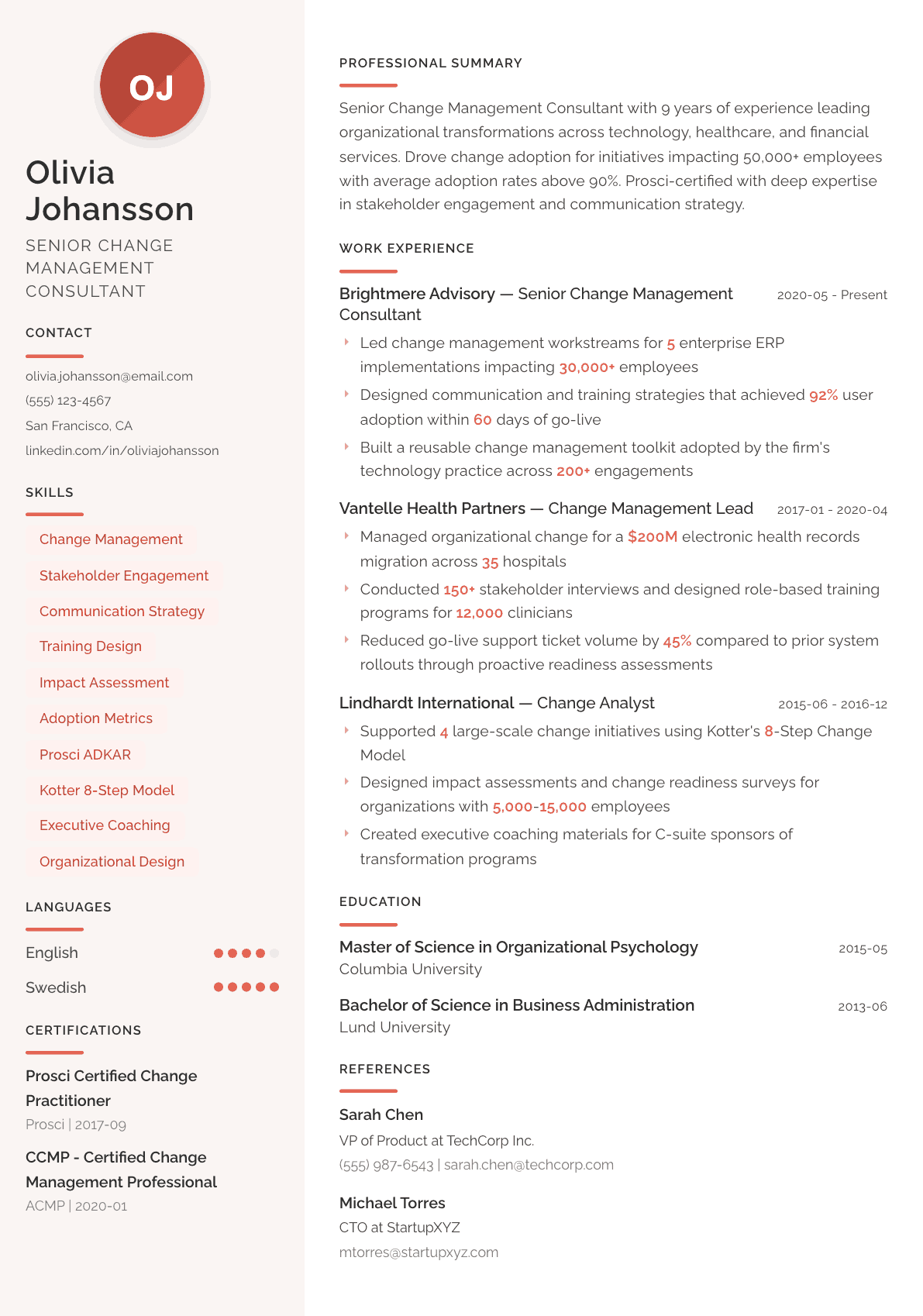
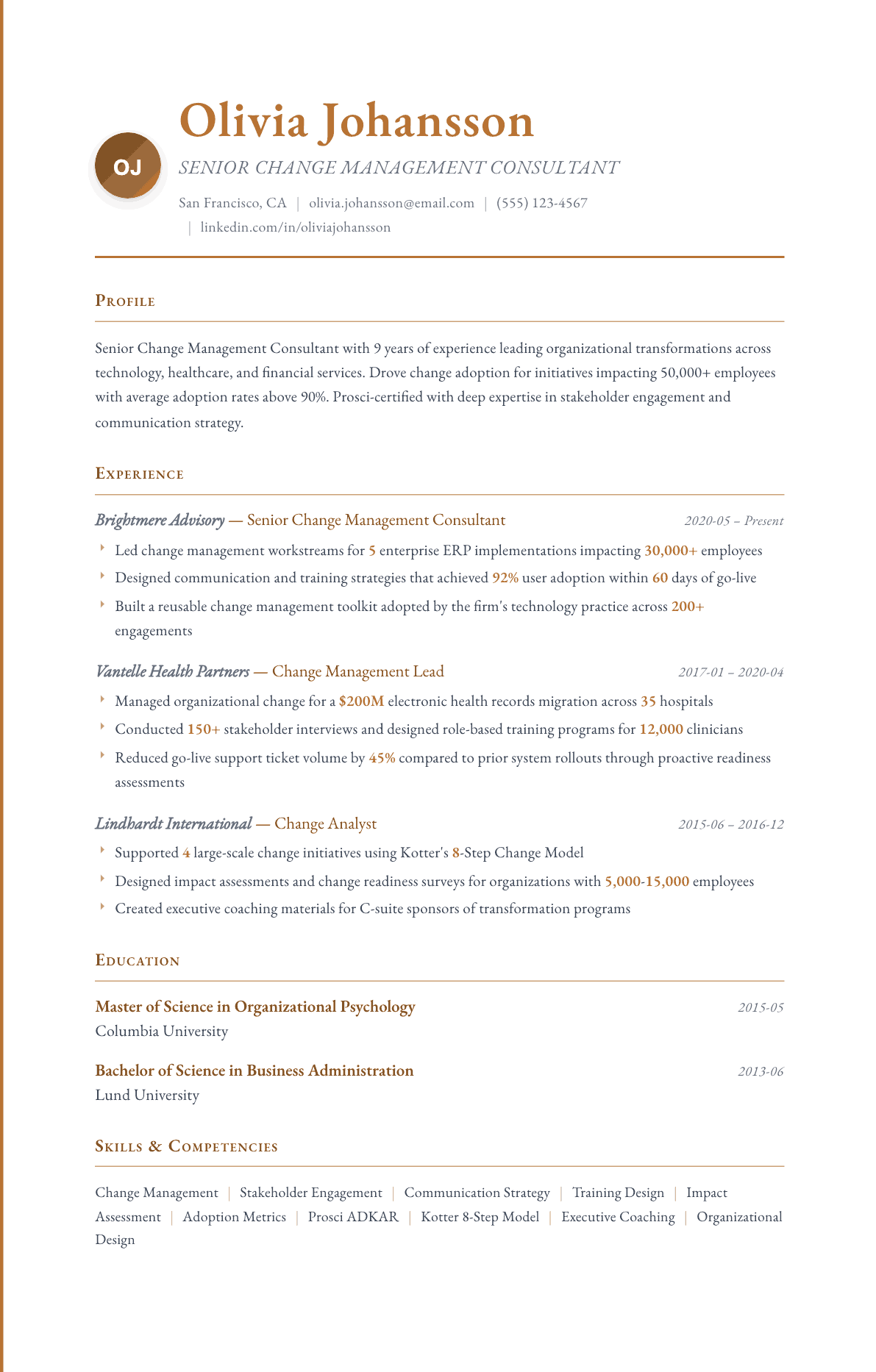
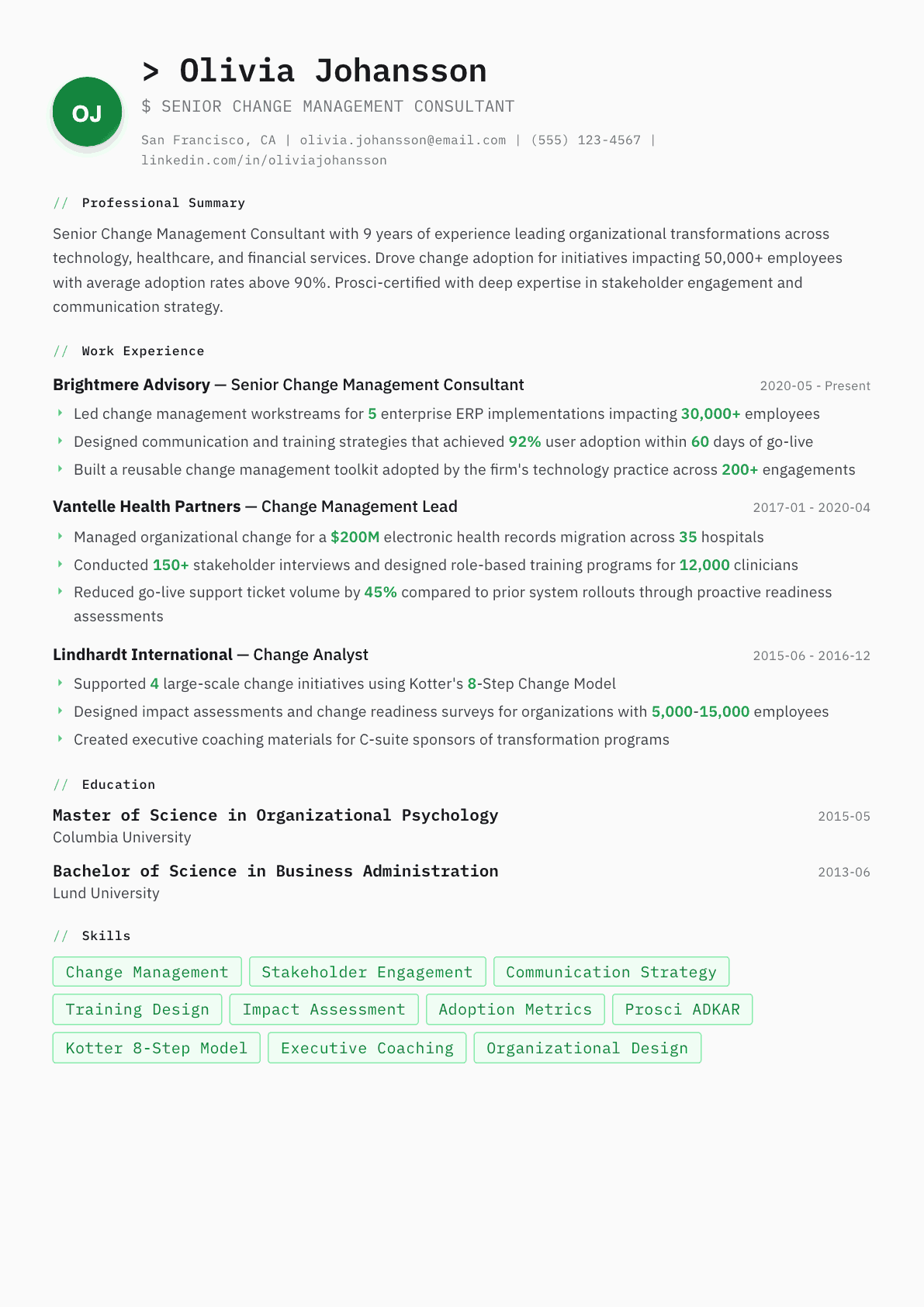
The same change management consultant content laid out in three CVBooster templates, so you can see what the finished document looks like before you write a word.
Example Change Management Consultant summary
Senior Change Management Consultant with 9 years of experience driving organizational transformation across technology and healthcare. Achieved 90%+ adoption rates for initiatives impacting 50,000+ employees. Prosci and CCMP certified with expertise in communication strategy, training design, and stakeholder engagement. Seeking a Director of Change Management role to lead enterprise-wide transformation.
Skills to list on a Change Management Consultant resume
- Change Management
- Stakeholder Engagement
- Communication Strategy
- Training Design & Delivery
- Impact Assessment
- Adoption Measurement
- Prosci ADKAR
- Kotter 8-Step Model
- Executive Coaching
- Organizational Design
- Readiness Assessment
- Resistance Management
- Workshop Facilitation
What actually gets this resume read
- Quantify adoption rates, training completion, and support ticket reductions to show impact.
- Name the change management methodologies you use: Prosci ADKAR, Kotter, Bridges, APMG.
- Show the scale of transformations: number of employees impacted, locations, and budget.
- Highlight communication strategy design and stakeholder engagement as core competencies.
- Include experience with specific transformation types: ERP, M&A integration, restructuring.
- Certifications like Prosci, CCMP, or APMG Change Management are highly valued.
How to write a change management consultant resume
Change management is the discipline most likely to be described in language nobody can verify. Partners and program directors who hire consultants for this work have read hundreds of resumes about driving cultural transformation and empowering stakeholders, and they have learned to skip past them to find four facts: what was changing, how many people it hit, what you personally produced, and how adoption was measured after go-live.
The role also has a specific place in a program. You are usually one workstream lead alongside technology, process and data, reporting into a program director, with a sponsor somewhere above who needs coaching. Showing that you understand that structure, and that you delivered inside it rather than beside it, is what separates a practitioner from someone who ran a communications plan.
This guide covers how to describe an engagement so a reader can size it, which change artifacts to name, how to write about adoption honestly when the number was not flattering, and the questions consultants ask when they move between industries or from an internal change team into consulting.
Format: engagement-led, two pages, methodology stated once
Consulting resumes are read engagement by engagement, so structure the page that way. Under each firm, list the engagements with the client described by sector and scale, the program, your role in it, and the duration. Two pages is normal once you have several major programs behind you.
State your methodology in the skills or summary block once, not in every bullet. A reader wants to know which structured approach you work in, then wants to see what you did with it. Repeating the framework name in eight bullets makes the page look like a training certificate rather than a delivery record.
- Header: name, city, phone, email, certification after your name if you hold a change credential.
- Sections: summary, certifications, engagement experience, artifacts and methods, education.
- Describe clients as sector and size where naming them is restricted by the engagement agreement.
Summary: the kind of change, the population, the sponsor level
Three lines. Name the change types you have delivered, the size of population affected, the industries, and the level of sponsor you have coached. There is a real difference between guiding a director through a departmental process change and preparing an executive committee to front a restructuring, and the second is far harder to hire.
Also name the change context. A system implementation, an operating model redesign, an outsourcing transition, a merger integration and a regulatory-driven process change all demand different work, and consultants are usually hired for the one that matches the program in front of them.
Experience: impact assessment, network, communications, training, adoption
Take each engagement through the same spine so a reader can compare them. Start with the change impact assessment: how many roles and processes changed, and how you established it, whether through workshops, process comparison or shadowing. Then the stakeholder analysis and the sponsor coaching you delivered, including the cadence you held with the sponsor.
Then the machinery: the change network of local champions you built and how you kept it active, the communications plan and the channels that actually reached frontline staff, the training needs analysis, and the role-based curriculum and materials you produced. Give volumes, because volumes are what make this work sound like delivery: number of impacted roles, champions recruited, sessions run, learners trained.
Finish with readiness and adoption. Name the readiness assessments you ran before go-live, the criteria used to declare readiness, and the post go-live measures: system usage, process compliance, support ticket volume, time to proficiency, and the hypercare period you supported. If adoption was slow and you fixed it, that story is stronger than a clean number.
- Program scale: budget band, duration, employees impacted, sites, countries and languages.
- Change impact assessment: roles and processes changed, and how the assessment was produced.
- Sponsor coaching and stakeholder engagement, with the level of the people you worked with.
- Change network size, communications reach and training delivered.
- Readiness criteria and post go-live adoption measures, including hypercare.
Artifacts and methods: what a program director can pick up and use
Name the deliverables you have personally authored: change impact assessment, stakeholder map and engagement plan, communications plan and message house, change network charter, training needs analysis, role-based curriculum, readiness assessment, adoption dashboard, and the sustainment or benefit tracking plan after go-live.
Then the methods and platforms: the structured change methodology you are certified in, survey and pulse tools, learning management systems, the collaboration platform your change network ran on, and how you reported adoption to the steering committee. In consulting, being able to hand over a reusable asset is valued as highly as the engagement itself, so say when a toolkit you built was reused.
Credentials, commercial contribution and the vocabulary of the posting
The two credentials that get filtered on are the main practitioner certification in structured change management and the professional certification offered by the change management association. Organizational psychology, human resources or occupational psychology backgrounds are common and worth naming. If you are internal rather than a consultancy hire, say which transformation office you sat in.
Consulting firms also read for commercial contribution. Proposals you helped write, work you sold or extended, utilization you held, and juniors you managed on an engagement. Include one or two of those, because the difference between a delivery consultant and a manager is who brings the next engagement in.
Change Management Consultant resume summary examples
Change analyst
Change analyst with 2 years supporting enterprise system rollouts, running impact assessments across 40 affected roles and coordinating a champion network of 25 across 6 sites. Builds communications and training materials, and reports adoption to the program office each week during hypercare.
Change management consultant
Change management consultant with 6 years on system and operating model programs in health care and utilities, certified in a structured change methodology. Led the change workstream for a rollout affecting 9,000 staff across 3 countries, reaching 91% system usage within 60 days of go-live.
Engagement lead
Senior change consultant leading change workstreams on programs above 4 years in duration, coaching executive sponsors and managing teams of 5 consultants. Built a reusable change toolkit adopted across a practice, and has taken 4 large deployments from impact assessment through sustainment.
Work experience bullets: before and after
Before: Led change management for a large system implementation.
After: Led the change workstream for a finance system replacement affecting 9,000 employees across 3 countries, reporting into the program director alongside the technology and process leads.
Population, geography and reporting line let a program director size the engagement instead of guessing at it.
Before: Created communication plans to support the change.
After: Built a communications plan across 6 channels including line manager briefing packs, and reached 94% of frontline staff who had no regular email access through shift huddles and printed guides.
Channels chosen for a hard-to-reach audience prove the plan was designed for the population, not for the intranet.
Before: Conducted training for end users.
After: Ran a training needs analysis across 40 impacted roles, built 9 role-based curricula, and trained 2,400 users through a mix of classroom, floor walking and short reference guides.
Needs analysis, role coverage and delivery mix show a training program rather than a set of slides.
Before: Achieved high user adoption after go-live.
After: Tracked adoption weekly through system usage and support ticket volume, and lifted active usage from 58% at week 2 to 91% by week 8 by retraining 4 sites that had missed the pilot.
Showing the low starting point and the corrective action is more credible than a single flattering figure.
Before: Worked with senior leaders to support the change.
After: Coached 7 executive sponsors through a fortnightly cadence, preparing them for town halls and difficult questions on role changes ahead of each deployment wave.
Sponsor level, cadence and the actual subject of the coaching turn a vague relationship into a described practice.
Hard skills
- Change impact assessment
- Stakeholder analysis and engagement planning
- Sponsor coaching
- Communications planning
- Training needs analysis
- Role-based curriculum design
- Change network and champion programs
- Readiness assessment
- Adoption measurement and reporting
- Hypercare and sustainment planning
- Benefit tracking
- Operating model and role mapping
- Survey and pulse tooling
Soft skills
- Facilitating resistant groups
- Influencing without authority
- Executive communication
- Listening for the real objection
- Working alongside technology teams
- Holding a line on readiness criteria
Certifications worth listing
- Prosci Change Management Certification (Prosci)
- Certified Change Management Professional (CCMP) (Association of Change Management Professionals)
- APMG Change Management Practitioner (APMG International)
- Project Management Professional (PMP) (Project Management Institute)
Mistakes that cost change management consultant candidates the interview
- Writing about culture and mindset with no population size, no artifacts and no adoption measure attached.
- Repeating the methodology name in every bullet instead of showing what you produced with it.
- Claiming the program benefit as your own result, when the reader knows the change workstream is one of several.
- Skipping the impact assessment, which is the deliverable that proves you did the analysis rather than only the communications.
- Giving a single adoption number with no baseline, timescale or definition, which invites an interviewer to unpick it.
- Leaving out the sponsor level you worked with, when that is the clearest signal of the seniority you can operate at.
- Ignoring commercial contribution on a consulting resume, where proposals and extensions matter as much as delivery.
Change Management Consultant resume questions
How do I measure change management success on a resume?
Use measures that existed in the program: system usage, process compliance, time to proficiency, support ticket volume during hypercare, training completion, readiness assessment scores and retention through the transition. State the baseline and the period so the number can be interpreted.
Which change management certification should I list?
List the structured practitioner certification you actually completed and the professional certification from the change management association if you hold it. Both are recognized in procurement documents and program staffing, so put them near the top rather than at the end of the page.
Can I name the clients I worked with?
Only if your engagement terms allow it, and many do not. Describe the client by sector, size and geography instead, such as a regional health system with 9 hospitals. That gives a reader the context they need to judge the complexity without breaching confidentiality.
How do I move from an internal change role into consulting?
Restructure the page into engagements rather than one long job, name the methodology and artifacts explicitly, and add anything commercial you touched such as scoping work, business cases or briefing external suppliers. Deep industry knowledge from an internal role is an asset consultancies buy.
What do I write when the change failed or was canceled?
Describe what you delivered, what the readiness assessments told you, and what you recommended. A consultant who called a program not ready and can explain the evidence reads as a professional. Silence about a canceled program is more damaging than a clear account of it.
Related resume examples
- Management Consultant Resume example
- Program Director Resume example
- Performance Manager Resume example
- Organizational Development Manager Resume example
- Business Consultant Resume example
- Vice President Resume example