Organizational Development Manager Resume Examples
Build an Organizational Development Manager Resume With Proof
By Mustafa Tarabya, founder of CVBooster · Published · Updated
An organizational development manager resume that shows design work, change adoption and measured outcomes, with a sample resume and a writing guide.
Sample resumes for a organizational development manager
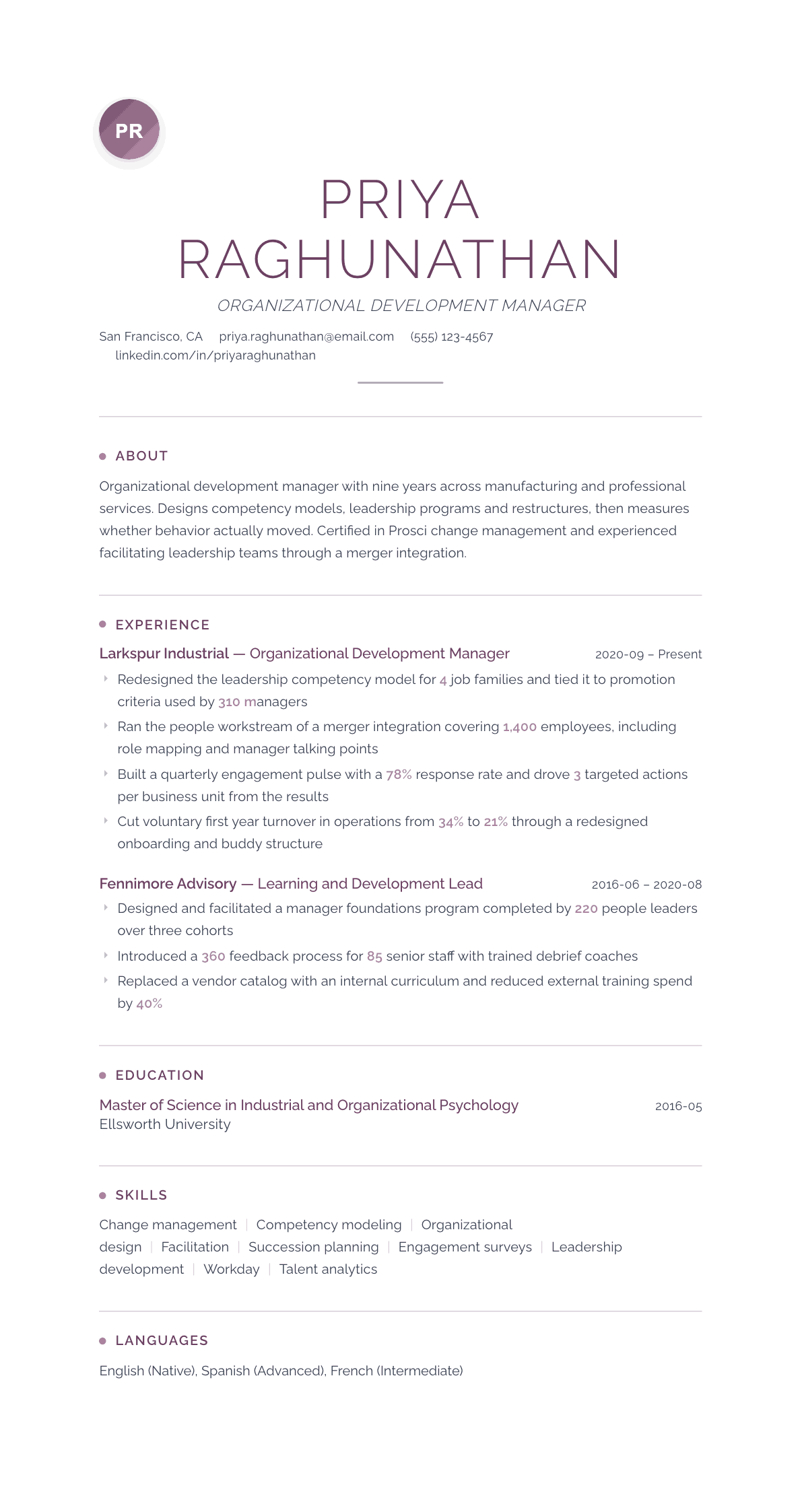
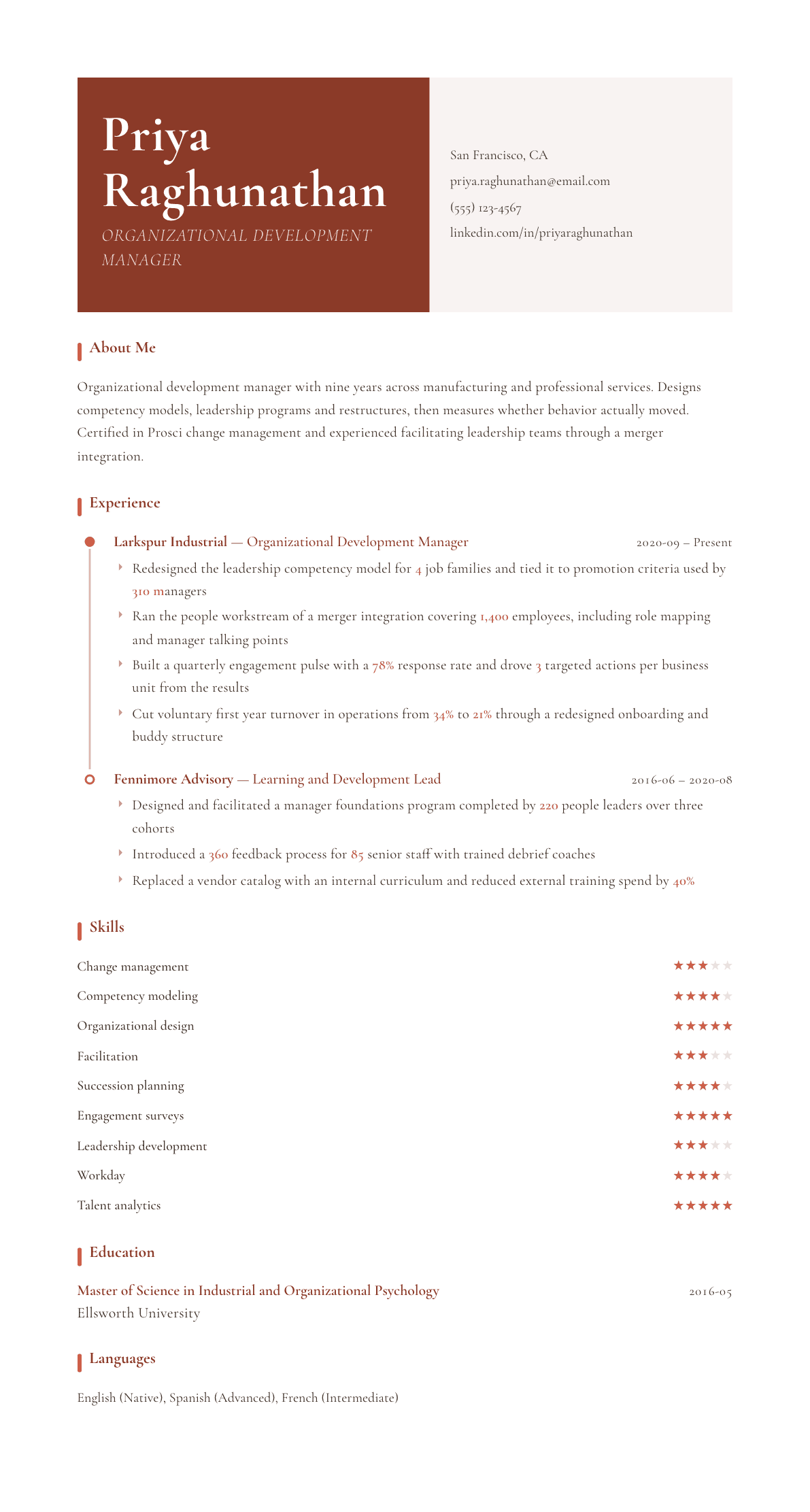
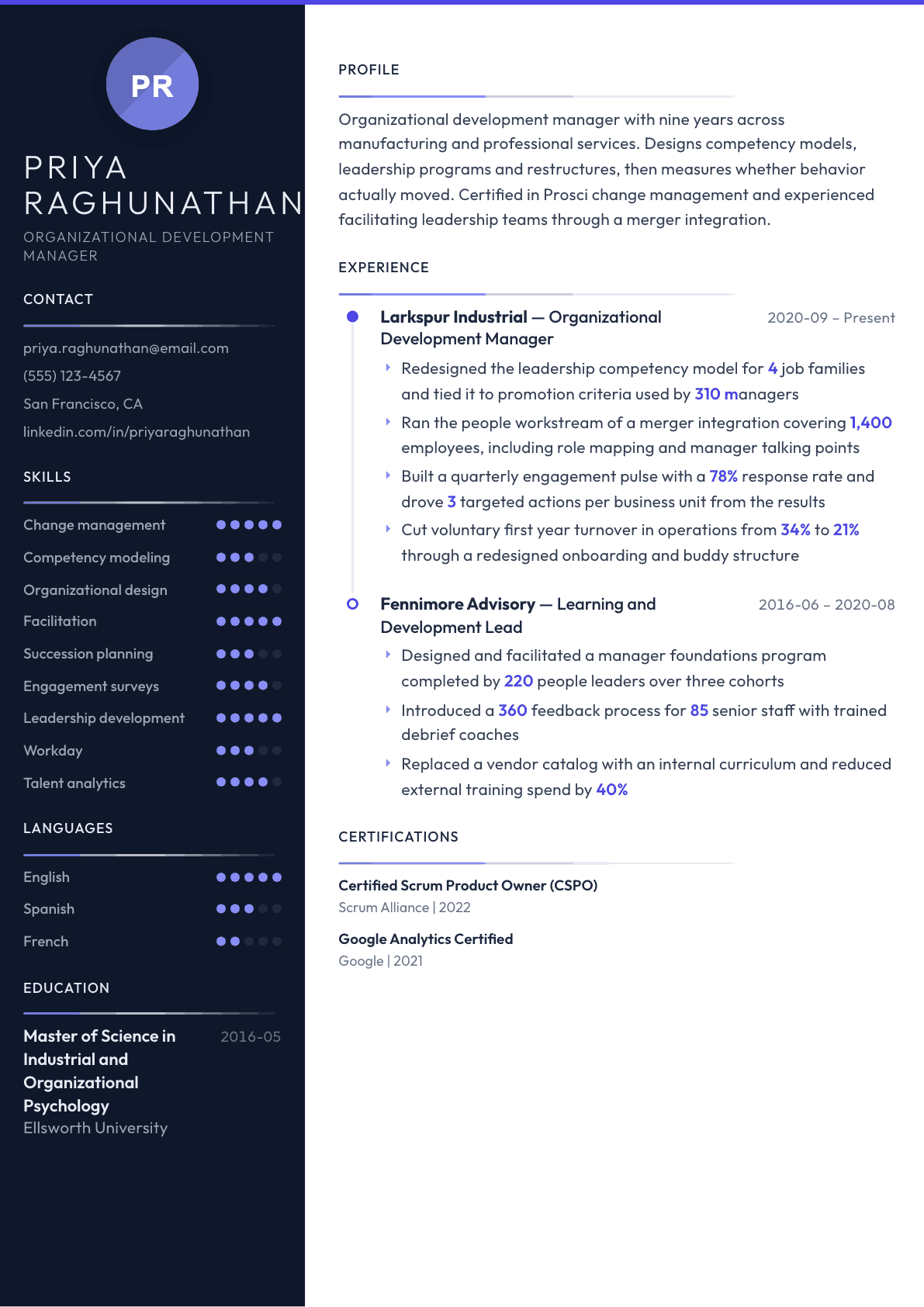
The same organizational development manager content laid out in three CVBooster templates, so you can see what the finished document looks like before you write a word.
Example Organizational Development Manager summary
Organizational development manager with nine years designing competency models, leadership programs and restructures across manufacturing and professional services. Led the people workstream of a merger integration covering fourteen hundred employees, rebuilt onboarding to cut first year turnover, and measures every program against a number agreed with the business before the design work starts.
Skills to list on a Organizational Development Manager resume
- Organizational design
- Change management
- Competency modeling
- Leadership development
- Succession planning
- Engagement survey design
- Facilitation
- Performance management design
- Talent analytics
- Merger integration
- Job architecture
- Coaching
- Workday
- Program evaluation
What actually gets this resume read
- Anchor each project in a business problem, not a program name, so the reader sees why the work existed at all.
- State the population you touched: how many managers, how many employees, how many locations or job families.
- Show the measurement you used, whether that is turnover, promotion readiness, survey movement or time to productivity.
- Name the change methodology you were trained in and where you applied it, because postings often ask for a specific one.
- Separate design work from facilitation work, since hiring managers look for one or the other depending on the team.
- Include the human resources systems you pulled data from, as talent analytics is now part of the job description.
How to write a organizational development manager resume
The hardest thing about an organizational development manager resume is that the work sounds abstract on paper. Competency frameworks, culture initiatives, leadership journeys and capability building all read as activity rather than result, and a chief human resources officer reading fifty applications is looking for the one candidate who tied that work to a number the business already cared about.
The people who get interviewed write in a specific pattern. Business problem, population, intervention, measurement. A design without a problem behind it reads as a hobby, and a program without a population attached leaves the reader unable to judge whether you have operated at their scale.
This guide covers how to structure the page, how to turn design and facilitation work into evidence, three example summaries across career stages, before and after bullets taken from the phrasing that shows up in almost every organizational development resume, and the questions candidates ask when moving from learning delivery into design.
Format: reverse chronological with a projects layer
Two pages, reverse chronological, single column. Resist the portfolio style layout with graphics of frameworks, because the file passes through screening software and because a hiring executive wants prose she can skim, not a poster.
Inside each role, group your bullets into the two or three programs that mattered rather than listing every workshop. A reader remembers three programs with outcomes. She does not remember eleven activities.
- Header: name, city and state, phone, email, and a credential such as a coaching or change certification.
- Sections: summary, core capability areas, professional experience, certifications, education.
- Under each program: the business problem, the population, the design, and the measure.
Summary: the systems you build, not the values you hold
Name the size of organization you have worked in, the disciplines you cover, and the change methodology you were trained in. An organizational development manager who has run design work in a unionized manufacturing setting is a different hire from one who has done it in a professional services firm, and the summary should make that obvious.
Say what you are accountable for rather than what you believe in. Job architecture, succession, engagement measurement, leadership curriculum, restructure support: those are the accountabilities that appear in postings, and a summary listing them reads as someone who has done the job.
Experience: population, intervention, measure
Every significant bullet should carry the population you affected. Three hundred managers, four job families, fourteen hundred employees through an integration, eleven sites. Without the population, a competency model built for a team of twelve reads identically to one built for a company of thousands.
Then the measurement. Organizational development work is measurable more often than practitioners admit: first year turnover, internal promotion rate, time to productivity for new hires, movement on specific survey items, the proportion of key roles with a ready successor, the completion and application rate of a program. Choose the measure that the business already tracked, because a measure you invented for the project reads as marking your own work.
Restructures and integrations deserve their own bullets. Role mapping, selection processes, manager briefing packs and consultation support are hard, visible work, and a candidate who has done them will always be preferred for a role where change is on the agenda.
Facilitation and coaching: show the room
If facilitation is part of the job you want, prove you can hold a difficult room. Say what kind of session, at what level, and with what stakes: an executive team offsite where the operating model was decided, a merger integration workshop, a debrief of a survey result the leadership team did not like.
For coaching, give the number of leaders, the level, the length of the engagements and whether you used a specific instrument. Naming a psychometric you are genuinely accredited in is useful, and claiming one you are not is a fast way to lose a reference check.
Skills, systems and keywords
Screening software looks for organizational design, change management, competency modeling, succession planning, performance management, talent review, engagement survey, job architecture, learning strategy and leadership development. Use the posting wording once inside a bullet where it is demonstrated.
Add the systems, because talent analytics is now part of the role. The human capital platform you pulled data from, the survey tool you administered, the learning system you built curricula in, and the level of spreadsheet or analysis work you do yourself all belong in a short technical line.
Organizational Development Manager resume summary examples
Moving from learning delivery
Learning and development specialist with 4 years designing and facilitating manager training, most recently a foundations program completed by 220 people leaders. Trained in instructional design and moving into organizational development, with early experience in competency mapping and running a 360 feedback process for 85 senior staff.
Owning the practice at one company
Organizational development manager with 9 years across manufacturing and professional services. Redesigned a leadership competency model used by 310 managers, ran the people workstream of an integration covering 1,400 employees, and cut first year operations turnover from 34% to 21% through a rebuilt onboarding structure.
Leading the function
Head of organizational development with 15 years building talent systems for multi site employers, currently leading a team of 5 across design, learning and analytics. Owns job architecture, succession and the engagement measurement cycle, and has guided two executive teams through operating model changes.
Work experience bullets: before and after
Before: Developed a leadership development program for managers.
After: Designed a manager foundations program for 220 people leaders across three cohorts, with practice labs, a manager toolkit and a 90 day application check completed by 84% of participants.
Population, structure and a follow through measure show a program that changed behavior rather than one that filled a calendar.
Before: Supported the organization through a merger.
After: Ran the people workstream of a merger integration covering 1,400 employees, delivering role mapping for 4 job families, manager briefing packs and a consultation timeline agreed with legal.
Naming the deliverables and the population converts a vague supporting role into visible ownership of the hardest part of a merger.
Before: Improved employee engagement across the company.
After: Rebuilt the engagement pulse to a quarterly cycle with a 78% response rate, and required each business unit to pick 3 targeted actions, tracked by the leadership team at every quarterly review.
The cadence, the response rate and the accountability mechanism explain how engagement moved instead of asserting that it did.
Before: Created a competency framework for the business.
After: Redesigned the leadership competency model for 4 job families and tied it directly to promotion criteria, so that 310 managers were assessed against the same behaviors at the annual talent review.
A framework only matters when it is connected to a decision, and this version names the decision it now drives.
Before: Reduced turnover through better onboarding.
After: Cut voluntary first year turnover in operations from 34% to 21% by redesigning onboarding into a 90 day structure with assigned buddies, weekly check-ins and a supervisor scorecard.
The before and after figures plus the mechanism let a reader judge both the size of the win and how it was achieved.
Hard skills
- Organizational design
- Change management
- Competency modeling
- Job architecture
- Succession planning
- Leadership development design
- Engagement survey design and analysis
- Performance management systems
- Talent review facilitation
- Program evaluation
- Talent analytics
- Merger and restructure support
Soft skills
- Executive facilitation
- Coaching
- Stakeholder influence
- Difficult conversations
- Consulting mindset
- Written clarity
Certifications worth listing
- Prosci Change Management Certification (Prosci)
- Senior Certified Professional (SHRM-SCP) (Society for Human Resource Management)
- Senior Professional in Human Resources (SPHR) (HR Certification Institute)
- Associate Certified Coach (ACC) (International Coaching Federation)
- Hogan Assessment Certification (Hogan Assessments)
Mistakes that cost organizational development manager candidates the interview
- Writing about frameworks and philosophies without naming the business problem that paid for the work.
- Leaving out the population, so a reader cannot tell whether you designed for a department or an enterprise.
- Claiming culture change with no measure attached, which is the single least credible line in this field.
- Listing every workshop facilitated instead of the two or three programs that changed how the company operates.
- Overstating accreditation on psychometric instruments, which fails at the first reference or technical conversation.
- Using human resources generalist language for a role that is specifically about design, measurement and change.
Organizational Development Manager resume questions
How is an organizational development resume different from a generalist HR resume?
A generalist resume covers employee relations, hiring and policy across a client group. An organizational development resume is built around design and measurement: structures, competencies, succession, leadership capability and change, each attached to a population and a business outcome.
What metrics can I actually use for this work?
Use measures the business already tracked before your project: first year turnover, internal promotion rate, time to productivity, succession coverage for key roles, movement on named survey items, and program completion with application follow up at a set interval.
Should I list the change methodology I trained in?
Yes, name it and say where you applied it, because many postings list a specific methodology as a requirement. Certification alone is weak evidence, so pair it with one project where the approach shaped how you ran the change.
How do I move from learning and development into organizational development?
Lead with any work that touched structure, capability frameworks or measurement rather than course delivery. Show a needs analysis you ran, a competency map you built, or an evaluation that changed a business decision, and describe delivery work in design language.
Do I need a psychology or organizational behavior degree?
It helps and many postings prefer it, but experience running real change at scale competes well. If you hold the degree, put it on the page early. If you do not, lead with restructure, succession and measurement work that proves the same capability.
Related resume examples
- HR Consultant Resume example
- Change Management Consultant Resume example
- Performance Manager Resume example
- Executive Director Resume example
- Vice President Resume example
- COO Resume example