Vice President Resume Examples: the lines they read
Build a Vice President Resume That Shows Scope, Not Titles
By Mustafa Tarabya, founder of CVBooster · Published · Updated
A vice president resume guide with a sample profile, guidance on proving scope and budget, keyword lists, and how to structure a two page executive resume.
Sample resumes for a vice president
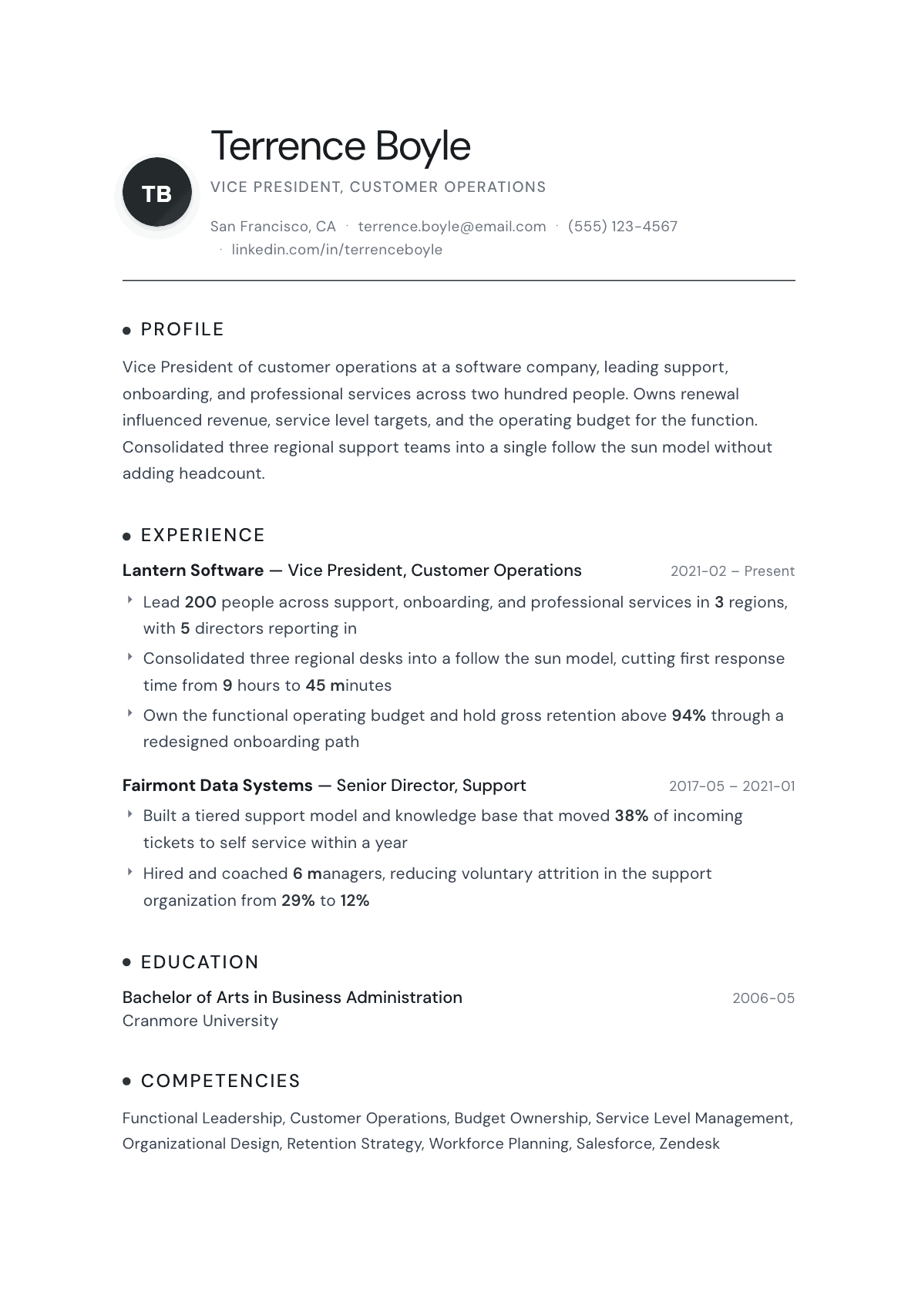
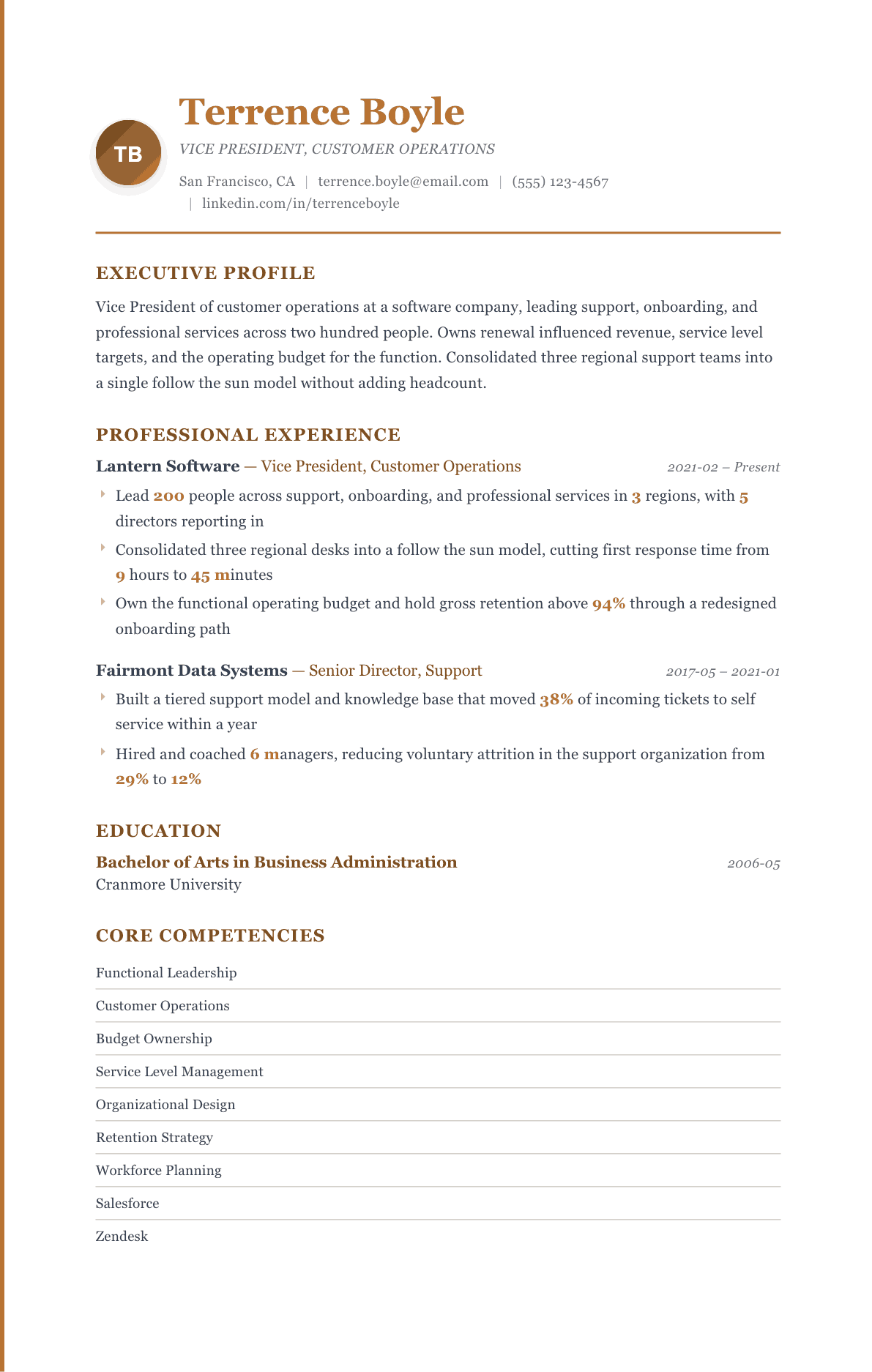
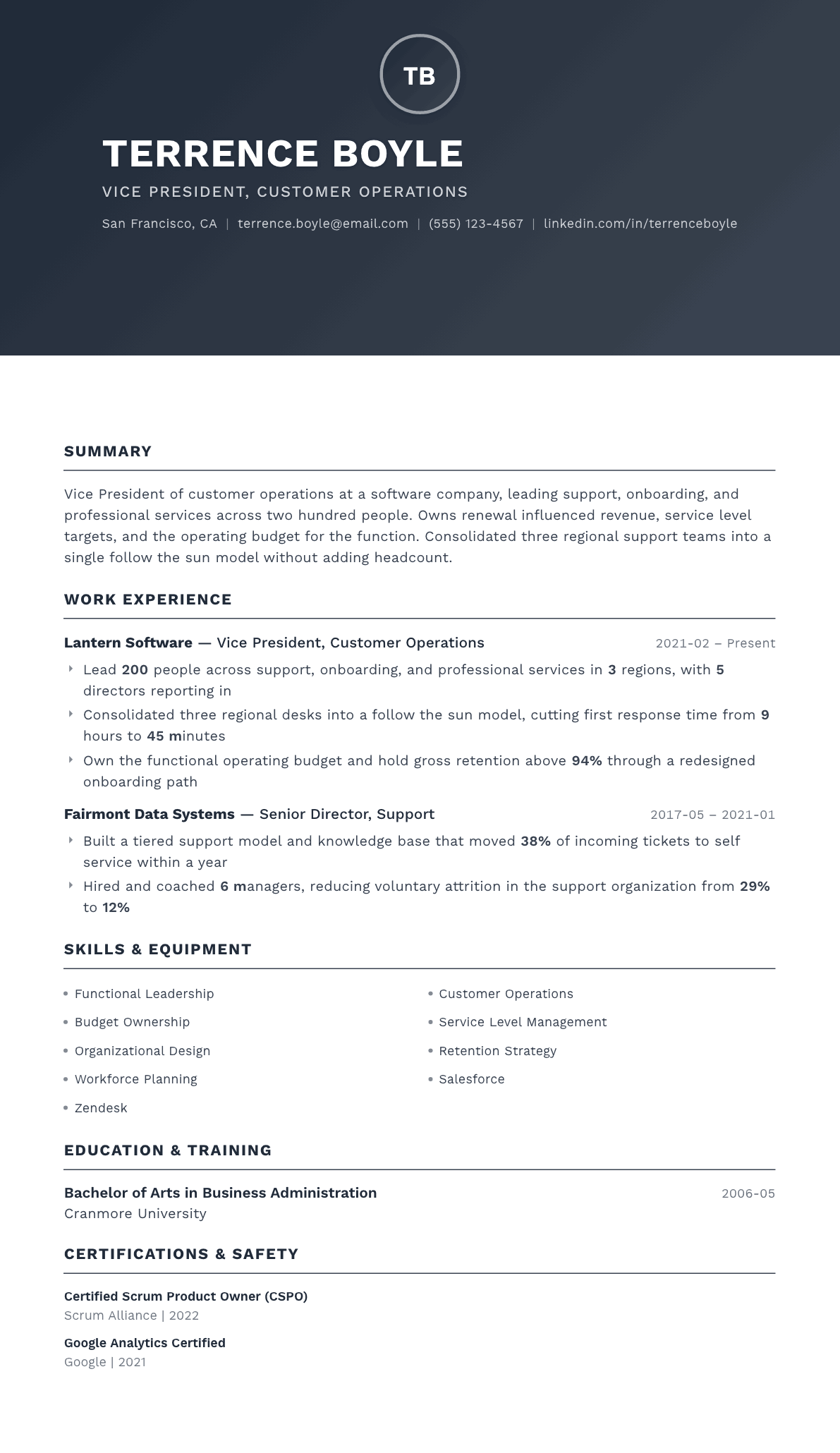
The same vice president content laid out in three CVBooster templates, so you can see what the finished document looks like before you write a word.
Example Vice President summary
Vice President with twelve years in customer operations for software companies, currently leading support, onboarding, and professional services across two hundred people in three regions. Owns the functional budget and gross retention, and rebuilt three separate regional desks into one follow the sun model without adding headcount. Known for developing managers into directors and reporting cleanly to an executive team.
Skills to list on a Vice President resume
- Functional Leadership
- Organizational Design
- Budget Ownership
- Operating Model Design
- Service Level Management
- Retention Strategy
- Workforce Planning
- Executive Stakeholder Management
- Performance Management
- Cross Functional Program Delivery
- Vendor Management
- Talent Development
- Change Leadership
- Business Reporting
What actually gets this resume read
- Define the function you lead in the opening line, because vice president covers wildly different scope from one company to the next.
- Quantify scope with headcount, budget, the number of directors reporting in, and the geographies your function covers.
- Separate results you owned outright from results you influenced, since senior interviewers test that distinction directly.
- Show at least one reorganization or consolidation you led, with what it cost or saved on an annual run rate basis.
- Name the peers you partnered with, such as the chief revenue officer or the finance leader, to signal your working altitude.
- Hold bullets to decisions and results, then move tools and platforms into a compact skills block near the end of page two.
How to write a vice president resume
Vice President is a title with no fixed meaning. At a large bank it can sit two levels above an analyst. At a software company it means running a whole function with directors reporting in. At a small business it can be the second most senior person in the building. Because of that spread, a screener reads a vice president resume looking for scope first and achievements second, and a document that leads with achievements gets misfiled.
The reader is usually an internal executive recruiter or the hiring executive herself. She is comparing four candidates whose titles all match and whose responsibilities do not. What decides the shortlist is a clear picture of what you owned: headcount, budget, the layer of leaders reporting to you, and the results that sat with you rather than with a peer.
This guide covers how to establish scope quickly, how to write about a function rather than a set of projects, three summaries across different scales, before and after bullets that make ownership unambiguous, and the questions people ask when moving from director to vice president.
Format: two pages, function and scope in the first line
Two pages, single column, conservative type. The first line of the profile should name the function you lead and its size. Vice President of Customer Operations leading two hundred people across support, onboarding, and professional services tells a reader more in one sentence than a page of accomplishments.
Add the reporting structure. Whether five directors report to you or twelve individual contributors do is the difference between an executive role and a large management role, and every senior interviewer will ask within the first ten minutes.
- Header: name, city, phone, email, and a professional profile link.
- Order: profile, selected results, experience, skills, education.
- Include the company size and stage in each role, since the same title scales very differently.
Own it or influence it, and say which
Senior interviewers test ownership relentlessly, because at this level almost every result has several contributors. Write bullets that make your part explicit. Owning gross retention is different from influencing it. Owning the operating budget is different from managing to one someone else set.
Where a result was shared, name the partner and your specific contribution. That reads as honest and collaborative, and it survives a reference call. Claiming a whole cross functional outcome as personal work does not, and it is the fastest way to lose a late stage process.
Show a structural change, not only performance improvement
A vice president is hired to change how a function works, not to run it slightly better. Reorganizations, operating model changes, consolidations, and new team designs are the evidence. Pick at least one, and describe the before state, the new structure, and what it cost or saved on an annual run rate basis.
Include what the change was hard about. Merging three regional teams into a single follow the sun model means renegotiating coverage hours, handover quality, and career paths, and a reader who has done it recognizes immediately whether you actually have.
The people layer: directors and managers you built
The distinguishing skill at this level is developing leaders. Show who you hired, who you promoted, and what happened to attrition and internal mobility in your function. A vice president who has moved managers into director roles has proved the thing an executive team most needs from the seat.
Performance management belongs here too. Restructuring underperforming teams, exiting a leader, and rebuilding a function are difficult and common, and a candid line about one of them is more persuasive than a page of growth.
Executive fluency: budget, reporting, and peers
Name the executive forums you presented in and the peers you worked alongside, such as the revenue leader, the product leader, or the finance leader. It signals the altitude you have operated at and the kind of conversations you are used to holding.
Then show the operating rhythm you ran: how you planned headcount, how you forecast the budget, what your function reported monthly, and how you handled a mid year target change. Executives hire for reliability at this level, and the rhythm is where reliability lives.
Vice President resume summary examples
Moving up from senior director
Senior Director stepping into a vice president role after leading a support organization of 70 through a tiered service redesign. Moved 38% of tickets to self service, hired and coached six managers, and cut voluntary attrition in the function from 29% to 12% over two years.
Leading a full function
Vice President of Customer Operations leading 200 people across support, onboarding, and professional services in three regions, with five directors reporting in. Owns the functional operating budget and gross retention, currently held above 94% following an onboarding redesign.
Multi function executive
Vice President with twelve years leading customer facing functions in software companies, currently accountable for support, services, and renewals across three regions. Consolidated three regional desks into one follow the sun model without adding headcount and has developed four managers into director roles.
Work experience bullets: before and after
Before: Led a large customer operations organization.
After: Lead 200 people across support, onboarding, and professional services in 3 regions, with 5 directors reporting in and full accountability for the functional operating budget.
Headcount, functions, geography, direct reports, and budget answer the scope question a reader asks first.
Before: Restructured the support organization to be more efficient.
After: Consolidated three regional support desks into a follow the sun model with shared handover standards, cutting first response time from 9 hours to 45 minutes with no increase in headcount.
Naming the new structure and holding headcount flat shows a design change rather than added capacity.
Before: Improved customer retention through better onboarding.
After: Redesigned the onboarding path around a 30 day activation milestone with the product team, holding gross retention above 94% through two renewal cycles.
A named mechanism, a partner, and two cycles of evidence make the retention claim testable.
Before: Developed the management team within my function.
After: Hired and coached 6 managers, promoted two into director roles, and reduced voluntary attrition in the support organization from 29% to 12% over two years.
Promotions plus an attrition figure prove leadership development instead of asserting it.
Before: Managed the department budget and reported to executives.
After: Own the functional operating budget, run quarterly headcount planning with finance, and present service performance and retention risk monthly to the executive team.
The operating rhythm shows how you work at executive level, which is what the hiring executive is buying.
Hard skills
- Functional leadership and operating model design
- Operating budget ownership
- Headcount and workforce planning
- Service level and performance management
- Retention and renewal strategy
- Organizational restructuring
- Cross functional program delivery
- Vendor and outsourcing management
- Business reporting and forecasting
- Process design and standardization
- Talent development frameworks
- Executive stakeholder management
Soft skills
- Coaching managers into directors
- Influencing executive peers
- Difficult performance conversations
- Communicating change to a whole function
- Prioritizing against a fixed budget
- Judgment on when to escalate
Certifications worth listing
- Project Management Professional (PMP) (Project Management Institute)
- Certified Customer Experience Professional (CCXP) (Customer Experience Professionals Association)
- ITIL 4 Managing Professional (PeopleCert)
Mistakes that cost vice president candidates the interview
- Leading with achievements before scope, which leaves a reader unable to compare you against candidates with the same title.
- Omitting how many leaders report to you, when that single fact separates an executive role from a large management one.
- Claiming cross functional outcomes outright, which unravels the moment a reference is asked who owned the number.
- Listing projects instead of a function, which reads as a program manager rather than someone accountable for a team.
- Skipping any structural change, so the resume shows a function maintained rather than a function redesigned.
- Filling page two with tools and platforms when the hiring executive is assessing budget, people, and judgment.
Vice President resume questions
How do I make my vice president title comparable across industries?
Translate it into scope. Give headcount, budget accountability, the number of leaders reporting to you, and the functions covered. A reader in another industry cannot interpret the title itself, but those four numbers mean the same thing everywhere.
What is the real difference between a director and a vice president resume?
A director resume shows a team delivering well against a plan. A vice president resume shows a function redesigned, a budget owned, and leaders developed. If your history is mostly the first, look for the structural changes you led and move them to the top.
Should I include the size of the company as well as my team?
Yes, because a function of two hundred inside a company of eight hundred is a very different role from the same function inside a company of twenty thousand. One short line naming company size and stage gives every other number its meaning.
How do I handle a title that was inflated relative to the work?
Describe the actual scope honestly and let the title stand as it was granted. Experienced screeners know that titles vary and they are assessing what you ran, so an accurate scope line protects you from an awkward conversation in the second interview.
Is a two page resume acceptable at vice president level?
Two pages is the norm and one page is often too compressed to show scope, structure, and results. Keep page one for the profile, selected results, and your current role, and use page two for earlier positions in progressively shorter form.
Related resume examples
- Executive Resume example
- VP Operations Resume example
- Managing Director Resume example
- Director of Operations Resume example
- Team Leader Resume example
- HR Consultant Resume example