Performance Manager Resume Examples: what gets the call
Build a Performance Manager Resume That Measures Up
By Mustafa Tarabya, founder of CVBooster · Published · Updated
Create a performance manager resume showcasing KPI frameworks, employee development programs, and organizational performance optimization with data-driven results.
Sample resumes for a performance manager
The same performance manager content laid out in three CVBooster templates, so you can see what the finished document looks like before you write a word.
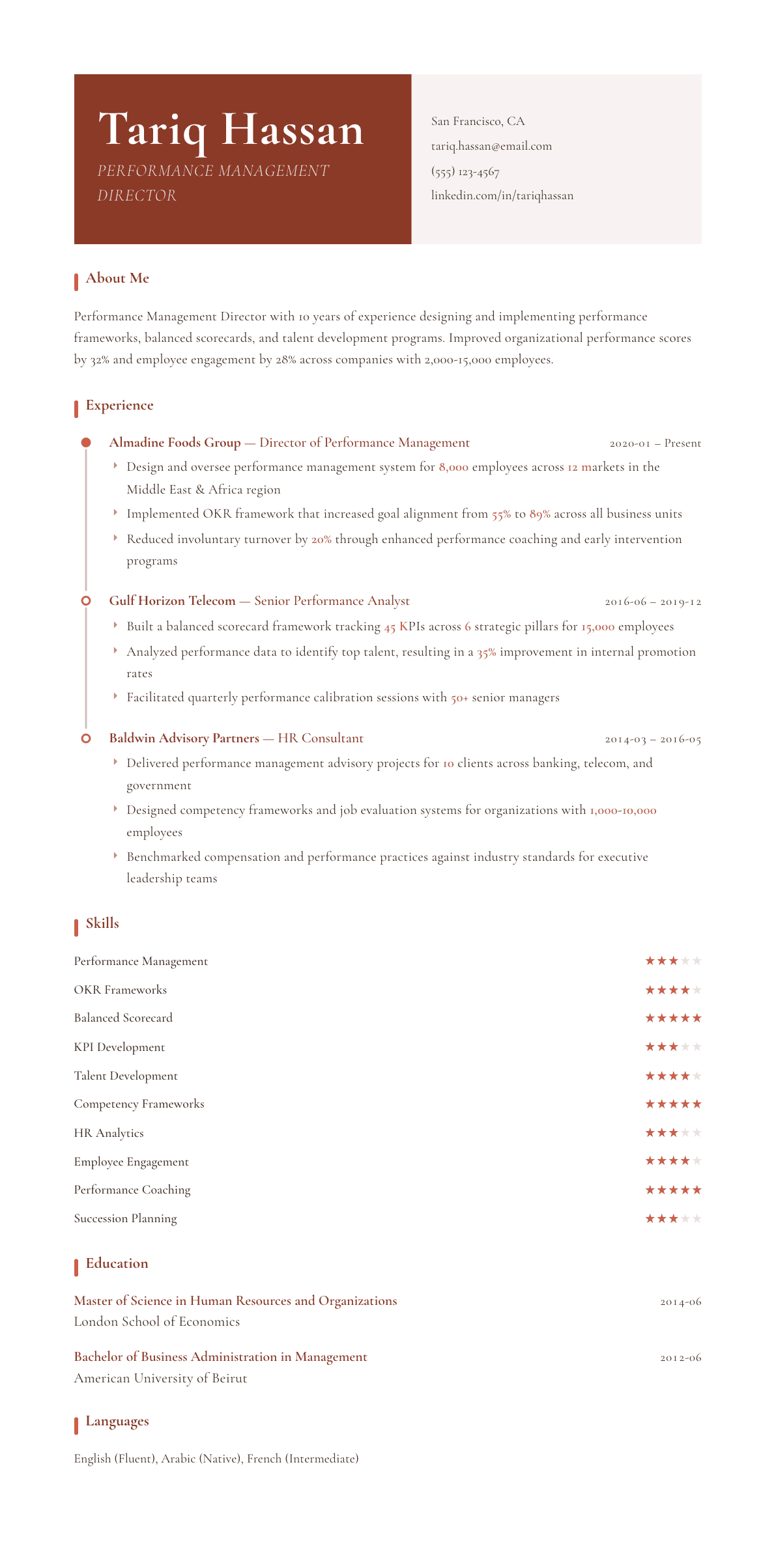
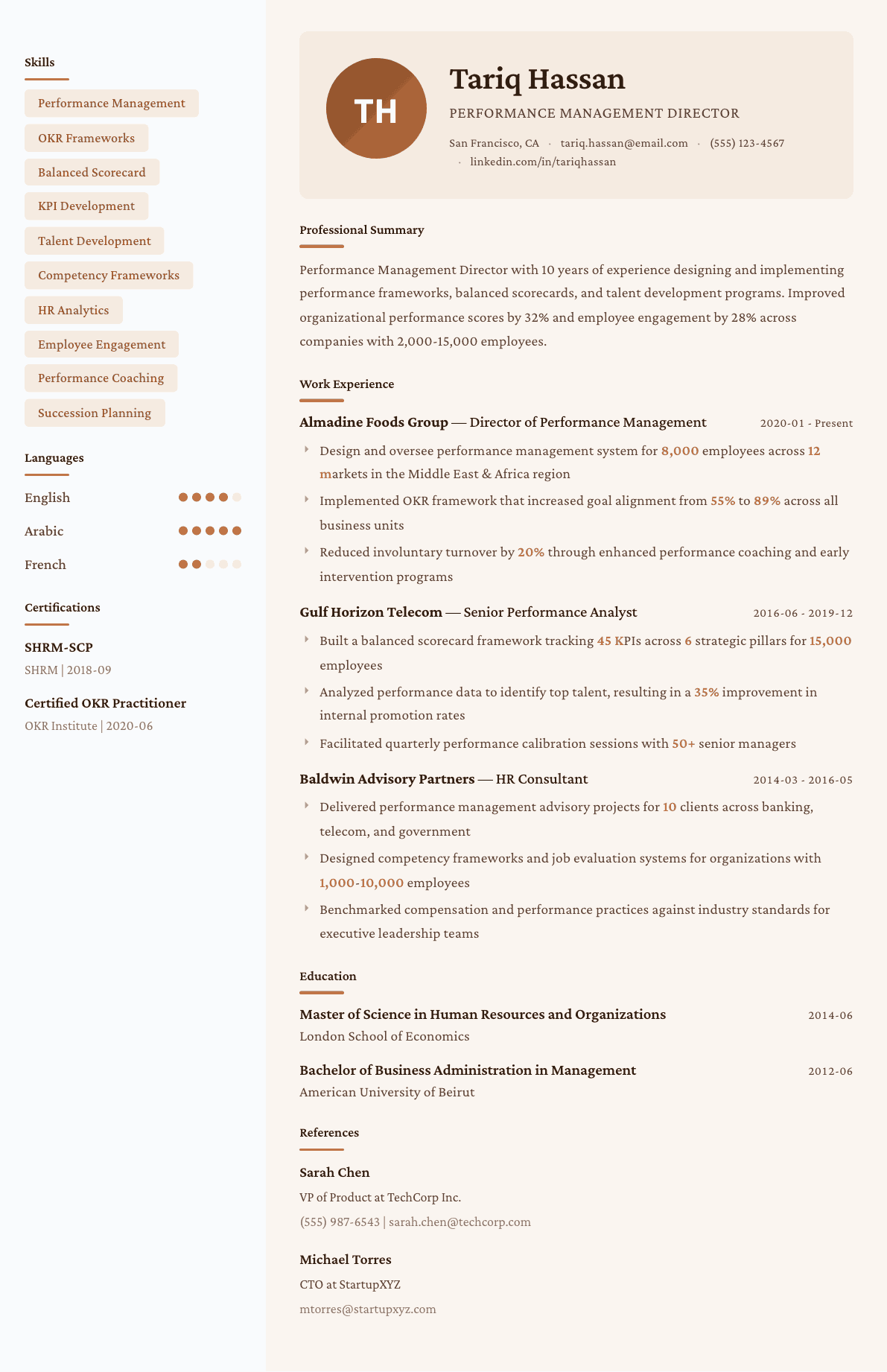
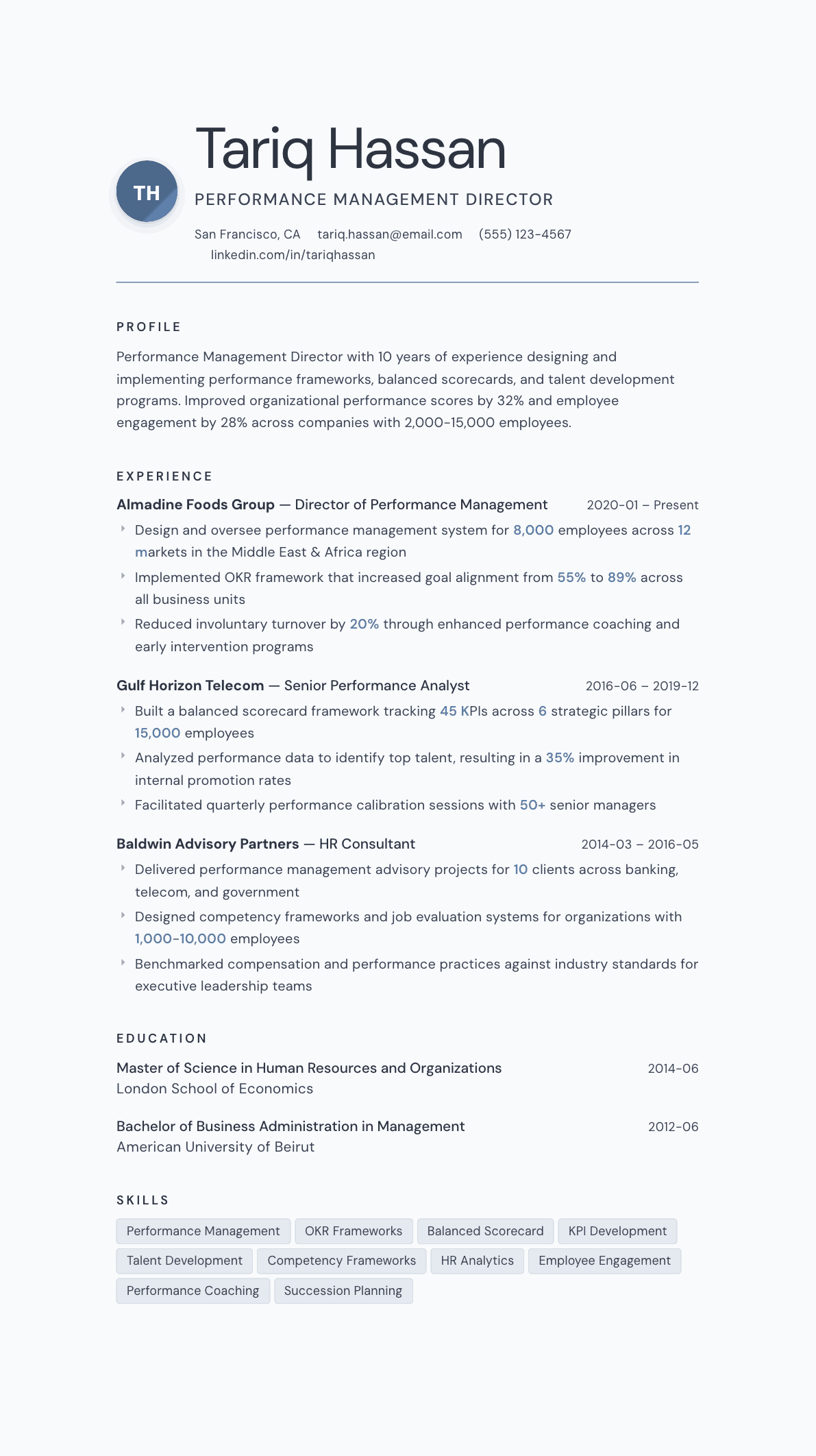
Example Performance Manager summary
Performance Management Director with 10 years of experience designing enterprise performance frameworks and talent development programs. Improved organizational performance scores by 32% and engagement by 28% across multi-market operations. SHRM-SCP certified with expertise in OKR, balanced scorecard, and HR analytics. Seeking a VP Talent & Performance role to drive people strategy at a global organization.
Skills to list on a Performance Manager resume
- Performance Management
- OKR / MBO Frameworks
- Balanced Scorecard
- KPI Development
- Talent Development
- Competency Frameworks
- HR Analytics
- Employee Engagement
- Performance Coaching
- Succession Planning
- Calibration Sessions
- 360 Feedback
- Workforce Planning
What actually gets this resume read
- Quantify improvements in performance scores, engagement, retention, and promotion rates.
- Highlight specific frameworks you have designed: OKR, balanced scorecard, MBO, competency models.
- Show the employee population and geographic scope of programs you managed.
- Include HR analytics and data-driven decision-making capabilities.
- Demonstrate experience with performance calibration, 360 feedback, and succession planning.
- Certifications like SHRM-SCP, CIPD, or specialized OKR training add credibility.
How to write a performance manager resume
A performance manager owns the machinery that tells an organization how its people and its goals are doing: the goal setting cycle, the review calendar, the calibration sessions, the competency model and the data that comes out the other end. The people hiring for it are usually a chief people officer or a head of talent who has inherited a review process nobody trusts, and they are reading your resume to see whether you have rebuilt one before.
The trap is writing the resume as a list of processes you administered. Ran the annual review cycle is true of every performance manager and answers none of the questions the hiring leader has: how many employees, across how many countries, on what system, with what completion rate, and what changed about the quality of the conversations after you touched it.
This guide covers the population and system detail that has to sit at the top, how to write about frameworks you designed rather than inherited, summaries for a performance analyst, an established program owner and a head of performance, and the questions people ask when moving between human resources generalist work and a specialist performance role.
Format: population, geography and system, before anything else
Use reverse chronological order over one page early in your career and two once you have run enterprise programs. Under each role, state the employee population you served, the number of countries or legal entities, the business units, and the human capital system the cycle ran in. Those four facts are what separate a performance manager for a single site from one who has run calibration across a matrixed global organization, and no bullet later on will make up for leaving them out.
Name the system precisely. Workday, SuccessFactors, Oracle Human Capital Management, Cornerstone, Lattice and Culture Amp behave differently, and a company mid migration will filter for someone who has configured the one they are moving to. If you have run a cycle through a migration, that is a headline, not a footnote.
- Population line: headcount served, countries, business units, employee groups covered.
- System line: the human capital platform, the engagement survey tool, and your reporting layer.
- Program line: the goal framework in use, the review cadence, and whether ratings are forced or open.
- Bullets: what you designed, what you changed and what the measured outcome was.
Designed, redesigned or administered: say which
A hiring leader distinguishes sharply between running an existing cycle and building one. If you designed the competency framework, say how many levels and job families it covered and how you validated it with the business. If you replaced ratings with a different model, say what the old model was, why leadership wanted it changed, and how managers reacted in the first cycle after the change.
Where you administered rather than designed, write it honestly and make the operational rigor the story instead: completion rates, the manager chase cadence, the quality checks you ran on written feedback, the exceptions you handled for employees on leave or mid transfer. Clean operations at scale is a real skill and it reads better than an inflated design claim that collapses in the interview.
Calibration, ratings distribution and the hard conversations
Calibration is where performance management either earns credibility or loses it, so give it its own bullets. Describe how many sessions you facilitated, at what level of leadership, how you prepared the packs, and what you did when a leader arrived determined to protect a rating. A candidate who has held a room of directors to a consistent standard has done the part of this job that cannot be taught from a manual.
Be careful with distribution language. Say what the organization actually operated: guided distribution, forced ranking, an open rating scale, or a two axis performance and potential grid. Then connect it to the downstream decisions it fed, whether that is compensation review, promotion nomination, succession slating or performance improvement plans.
Analytics: the difference between reporting and insight
Every performance manager produces a completion dashboard. The ones who get hired into senior roles have connected performance data to something the business cares about: attrition among high rated employees, promotion velocity by job family, rating patterns that differ across manager populations, or the relationship between goal quality and quarterly results.
Name the analysis and the action it produced. A finding that first year manager reviews were consistently late until the reminder cadence changed is a small story told well. A finding presented to an executive committee that changed the promotion nomination process is a large one. Both beat a bullet that says you produced reports.
Keywords and how to mirror the posting
Performance roles are advertised with a recognizable vocabulary: performance management cycle, goal setting, objectives and key results, competency framework, calibration, talent review, nine box, succession planning, engagement survey, manager enablement, and human resources analytics. Use the ones you have genuinely run, once each, where they are attached to work.
Read the posting for whether the organization sits in a compliance heavy environment. Public sector, financial services and regulated industries expect documented processes, audit trails and defensible ratings, and a resume that mentions the documentation standard you maintained will land differently there than at a fast growing technology company that wants ratings removed.
Performance Manager resume summary examples
Performance and talent analyst
Talent analyst with two years supporting the annual performance cycle for a 1,400 employee organization in Workday. Built the completion tracker that lifted on time manager submissions from 61% to 94%, and prepared calibration packs for nine business unit sessions.
Performance program manager
Performance manager owning the goal setting and review cycle for 6,000 employees across eleven countries in SuccessFactors. Redesigned the competency framework into five levels across seven job families, and trained 240 managers on writing evidence based feedback ahead of the first cycle under the new model.
Head of performance and talent
Head of performance with twelve years building enterprise performance and succession systems. Replaced a forced distribution model with a two axis talent review for a group of twenty thousand employees, ran quarterly calibration with the executive committee, and cut regretted attrition among top rated employees by 18%.
Work experience bullets: before and after
Before: Managed the annual performance review process.
After: Ran the annual review cycle for 6,000 employees across eleven countries in SuccessFactors, coordinating four regional launch dates around local holidays and closing the cycle with 97% manager completion.
Population, system, the operational complication and the completion figure show scale instead of a job title.
Before: Developed a competency framework for the company.
After: Designed a five level competency framework across seven job families, validated it in eighteen interviews with function leads, and mapped every existing job profile onto it before the first review cycle used it.
The validation step and the mapping work prove the framework was adopted rather than published and ignored.
Before: Facilitated calibration sessions with leadership.
After: Facilitated 14 calibration sessions with director and vice president panels, prepared the evidence packs, and challenged rating decisions that were unsupported by documented feedback, narrowing the spread between the two widest business units.
Facilitation only counts when the reader sees you changed an outcome in the room.
Before: Produced reports on performance data.
After: Analyzed three cycles of rating and exit data to show that high rated employees in one function were leaving within four months of the review, and presented the pattern to the executive team, who funded a retention plan for that group.
The analysis is tied to a finding, an audience and a decision, which is what separates insight from reporting.
Before: Trained managers on giving feedback.
After: Built and delivered a two hour manager workshop on evidence based feedback to 240 people leaders in six cohorts, then audited a sample of written reviews and reran the session for the two functions with the weakest documentation.
The audit and the follow up show you measured whether the training worked instead of counting attendance.
Hard skills
- Performance cycle design and administration
- Objectives and key results frameworks
- Balanced scorecard design
- Competency modeling and job architecture
- Calibration facilitation
- Talent review and nine box
- Succession planning
- Workday and SuccessFactors configuration
- Engagement survey design and analysis
- People analytics and dashboarding
- Manager enablement and training design
- Performance improvement plan governance
Soft skills
- Challenging senior leaders on evidence
- Confidentiality and discretion
- Coaching managers through difficult conversations
- Translating data for non technical executives
- Stakeholder alignment across regions
Certifications worth listing
- SHRM Senior Certified Professional (SHRM-SCP) (Society for Human Resource Management)
- Senior Professional in Human Resources (SPHR) (HR Certification Institute)
- Certified Compensation Professional (CCP) (WorldatWork)
- CIPD Level 7 Advanced Diploma in Strategic People Management (Chartered Institute of Personnel and Development)
- Workday HCM Certification (Workday)
Mistakes that cost performance manager candidates the interview
- Describing the review cycle without the employee population, the countries or the system it ran in.
- Claiming you designed a framework you actually inherited and administered, which unravels in the first interview question.
- Presenting completion rates as the only outcome, when a hiring leader wants evidence the conversations improved.
- Skipping calibration entirely, even though it is the part of the role that requires the most judgment.
- Listing engagement scores without saying what you changed between the surveys.
- Using an internal acronym for a program without a short plain description of what it did.
Performance Manager resume questions
Is a performance manager a human resources role or a business operations role?
It sits inside human resources at most organizations, reporting to talent or people operations, but some companies place a performance manager in business operations to own commercial scorecards instead. Read the posting for the population it serves, and mirror that framing in your summary and title line.
How do I show impact when performance work has long feedback loops?
Use the leading indicators you can evidence: completion and timeliness, the quality of written feedback in a sampled audit, manager confidence measured before and after training, and calibration consistency across units. Then connect at least one program to a downstream people outcome such as promotion velocity or retention in a named group.
Should I list the performance systems I have used?
Yes, on their own line and by name. Organizations screen for prior experience with their platform, especially during a migration, and there is a real difference between configuring a cycle in Workday and running one on spreadsheets. Say what you configured rather than what you logged into.
What if my company removed performance ratings?
That is a strong story if you tell it fully. Describe the model that replaced ratings, how compensation and promotion decisions were then made, what managers found hardest, and what you did in the second cycle to fix it. Removing ratings well is harder than administering them.
Do I need a human resources certification for this role?
Not universally, but a recognized credential helps when you are moving from a generalist background into a specialist performance role, and it signals familiarity with employment practice. Pair it with evidence of framework design and calibration facilitation, which is what a hiring leader actually tests you on.
Related resume examples
- Change Management Consultant Resume example
- General Manager Resume example
- Chief of Staff Resume example
- HR Consultant Resume example
- Organizational Development Manager Resume example
- Regional Manager Resume example