CISO Resume Examples: what a hiring manager reads first
Build a CISO Resume That Reads Like a Board Briefing
By Mustafa Tarabya, founder of CVBooster · Published · Updated
A chief information security officer resume example with governance keywords, board reporting bullets, and a guide to writing at executive scope.
Sample resumes for a ciso
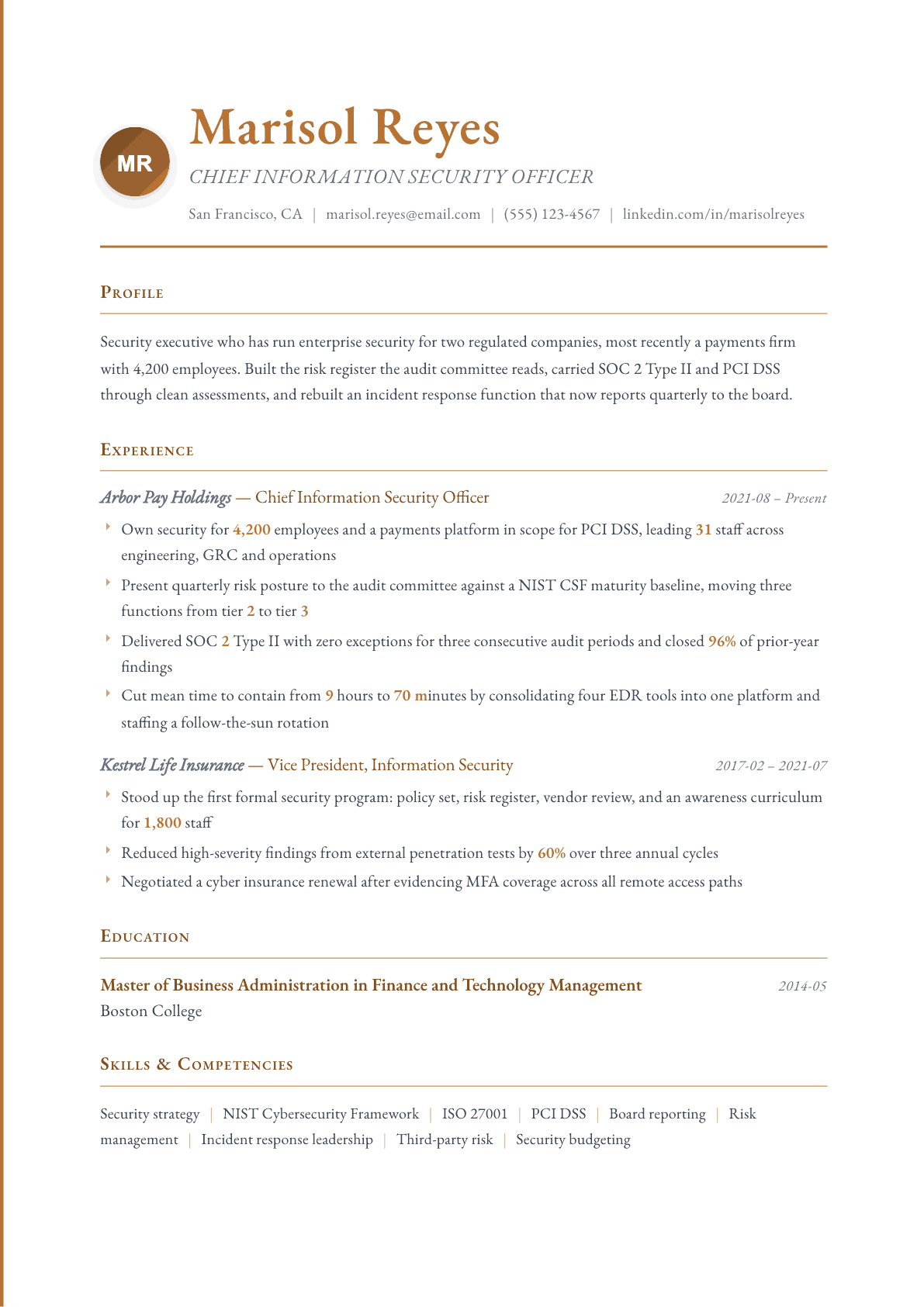
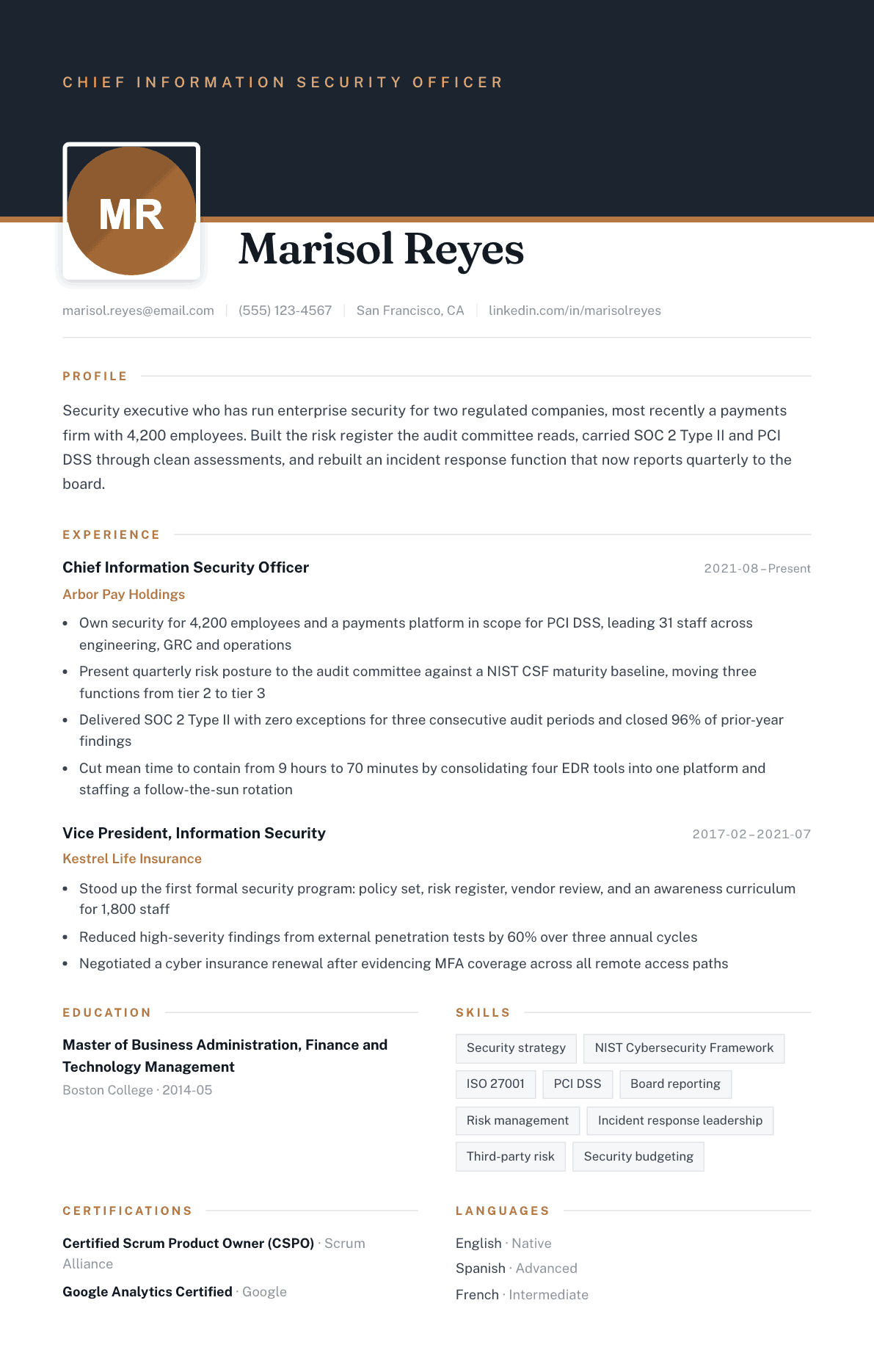
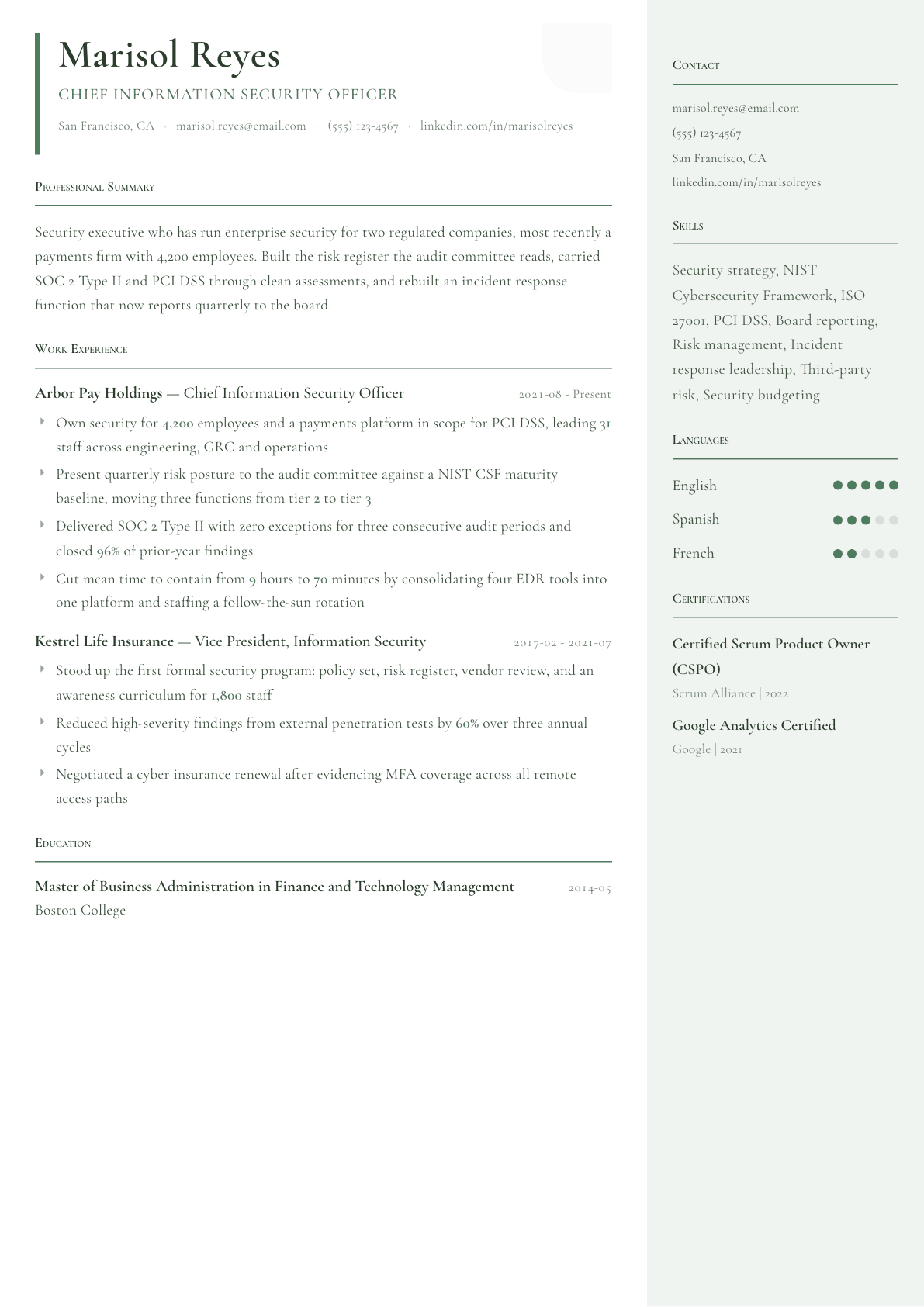
The same ciso content laid out in three CVBooster templates, so you can see what the finished document looks like before you write a word.
Example CISO summary
Chief information security officer with a decade of enterprise security leadership in payments and insurance, currently protecting 4,200 employees with a 31 person team. Rebuilt an incident response function that cut mean time to contain from nine hours to 70 minutes, carried SOC 2 Type II through three clean cycles, and reports risk posture quarterly to the audit committee against a NIST CSF baseline. Looking for a first CISO seat at a scaling healthcare technology company.
Skills to list on a CISO resume
- Security strategy
- Governance risk and compliance
- NIST Cybersecurity Framework
- ISO 27001
- PCI DSS
- SOC 2
- Board and audit committee reporting
- Incident response leadership
- Third-party risk management
- Identity and access governance
- Security architecture oversight
- Budget and vendor management
- Data privacy programs
- Security awareness programs
- Crisis communication
- Team building and hiring
What actually gets this resume read
- Open with scope: headcount you protect, the size of your security team, and the regulatory frameworks you carry.
- Write outcomes the board hears, such as clean audit opinions, insurance terms, and reductions in mean time to contain.
- Name the frameworks you have actually operated under: NIST CSF, ISO 27001, PCI DSS, HIPAA or FedRAMP.
- Show budget ownership and vendor consolidation, because a CISO is judged on spend discipline as well as defense.
- Include one paragraph or bullet on a real incident you led, with the timeline and the decisions you personally made.
- Keep the technical detail one layer higher than an engineer resume: architecture direction, not the tool syntax.
How to write a ciso resume
A CISO resume is read by people who do not run security: a chief executive, a general counsel, an audit committee chair, sometimes a private equity operating partner. They are trying to answer one question. If something bad happens on this person's watch, will the board be defended or embarrassed? Everything on the page should serve that answer.
That makes the CISO resume unlike every other security document you have written. The reader does not want packet detail or product opinions. They want scope, accountability, regulatory outcomes, spend discipline and evidence that you have stood in front of a room during a real incident and said what was true.
This guide sets out the section order an executive search reader expects, how to size your scope on paper, how to write about incidents and audits without either overclaiming or hiding, three example summaries across the path into the seat, and the questions security leaders ask when they write this document for the first time.
Format: two pages, scope first, technology last
Two pages is standard and expected at this level. Open with a four line positioning statement, then a short scope block, then experience. Certifications and education go at the end. A one page executive resume looks thin and a three page one looks like an unedited career history.
Add a scope block under the summary with the facts a search consultant needs immediately: employees protected, security headcount, direct reports, budget responsibility stated as owned rather than as a number if you prefer, the regulatory regimes in play, and the reporting line. A CISO who reports to the chief executive and one who reports to a chief information officer are different jobs, and the reader wants to know which you have held.
- Header: name, city and state, phone, email, and a board or advisory affiliation if you hold one.
- Order: positioning statement, scope block, experience, board and committee work, certifications, education.
- Keep tool names out of the top half. Name platforms only where a consolidation or a migration was the achievement.
Positioning statement: the sentence a search partner repeats
Write four lines that a recruiter could read aloud to a hiring committee. Sector, regulatory environment, size of the estate you have defended, the maturity move you led, and what you are looking for next. Vague adjectives about being a visionary security leader are removed by the reader before they reach the committee.
Be explicit about the kind of seat you want, because the market splits sharply. A first CISO building a program from nothing, a CISO inheriting a mature function under regulatory pressure, and a CISO carrying a company through an acquisition are three different hires. Say which one you are.
Experience: outcomes the audit committee heard
Every role opens with a scope line, then four to six bullets. Write outcomes that appear in board papers: clean audit opinions, findings closed, maturity movement against a named framework, cyber insurance terms improved, a material risk retired, a regulator satisfied. Avoid activity bullets such as implementing security controls, which say nothing about whether they worked.
Frame maturity movement against a framework by name and by direction. Moving three NIST Cybersecurity Framework functions from a documented baseline to a measured and managed state, with the assessment done by an outside party, is a defensible claim. Saying you improved security posture is not.
Include one incident. Give the type, the timeline in hours or days, your personal decisions, who you notified and when, and what changed structurally afterward. Boards hire security leaders who have already been in the room on the worst day, and a resume that avoids all incident history reads as a leader who has never been tested.
- Regulatory outcomes: assessment results, exam findings closed, attestation cycles delivered without exception.
- Program building: policy set, risk register, third-party review, awareness curriculum, security architecture standard.
- Commercial outcomes: vendor consolidation, insurance renewal terms, customer security reviews unblocked before a deal.
Team, budget and the operating model
Security leaders are hired on organizational design as much as on defense. Say how your function was structured: how many people, split across which towers, how much was outsourced to a managed provider, and what you insourced or divested. A leader who moved monitoring from an external provider to an internal team, or the reverse, and can explain the reasoning, is far more interesting than a headcount figure.
Talk about spend as discipline, not as a trophy. Consolidating overlapping platforms, retiring a tool nobody used, or holding flat spend while coverage grew are the lines a chief financial officer notices. Avoid precise budget figures if your employer would consider them sensitive; owning the security operating and capital plan is enough.
Governance, certifications and the words the filter wants
Give board and committee work its own short section if you have it: quarterly audit committee reporting, a risk committee seat, an advisory board role, or participation in an industry information sharing group. This is the material that separates a head of security from a CISO on paper.
Executive search filters still run on acronyms. CISSP and CISM are the two that matter most at this level, CRISC reads as risk fluency, and a governance credential alongside a business degree signals you can hold both halves of the conversation. Mirror the regulatory vocabulary the posting uses, whether that is SOC 2, ISO 27001, PCI DSS, HIPAA, GLBA, FedRAMP or DORA, and use each one only where you genuinely operated under it.
CISO resume summary examples
Moving into the first CISO seat
Head of information security for a payments company of 900 staff, currently reporting to the chief information officer with a team of eight. Built the risk register, the policy set and the third-party review process from nothing, and delivered the first SOC 2 Type II. Seeking a first CISO seat with a direct line to the executive team.
Sitting CISO, mid-market
CISO for a regulated insurer of 4,200 employees, leading 31 staff across engineering, governance and operations. Carried PCI DSS and three clean SOC 2 Type II cycles, cut mean time to contain from nine hours to 70 minutes, and reports risk posture quarterly to the audit committee against a NIST CSF baseline.
Enterprise CISO
Global CISO for a healthcare group operating in eleven countries, accountable for a security function of 140 people and a converged security and privacy program. Led the response to a supplier compromise affecting three business units, closed 96% of prior-year findings, and rebuilt the vendor risk model that now gates every clinical procurement.
Work experience bullets: before and after
Before: Responsible for the overall cybersecurity of the organization.
After: Accountable for security across 4,200 employees and a payments platform in regulatory scope, leading 31 staff and reporting quarterly to the audit committee on a measured risk posture.
Headcount, scope, team size and reporting line let a search partner place you on the market map immediately.
Before: Improved the company security posture.
After: Moved three NIST Cybersecurity Framework functions from a documented baseline to a measured state over two annual assessments, verified by an external assessor and reported to the board each cycle.
A named framework, a direction of travel and independent verification make the improvement checkable rather than asserted.
Before: Managed incident response for the company.
After: Led response to a supplier account compromise: contained within four hours, notified the general counsel and two regulators inside the required window, and replaced the vendor access model that allowed the entry path.
The timeline, the notification decisions and the structural fix show executive judgment, not just that an incident occurred.
Before: Reduced security tool costs.
After: Consolidated four endpoint and email security products into two platforms, retiring overlapping contracts and holding operating spend flat while endpoint coverage grew across two acquired businesses.
Naming the consolidation and the coverage growth reads as spend discipline rather than a blunt cut.
Before: Worked with auditors on compliance requirements.
After: Delivered SOC 2 Type II with no exceptions across three consecutive periods and closed 96% of prior-year findings ahead of the agreed remediation dates.
Audit results and remediation timeliness are the two numbers an audit committee actually tracks.
Hard skills
- Enterprise security strategy
- NIST Cybersecurity Framework
- ISO 27001 program ownership
- SOC 2 and PCI DSS attestation
- Enterprise risk register and quantification
- Third-party and supply chain risk
- Identity and access governance
- Incident response command
- Security architecture direction
- Data privacy and regulatory reporting
- Security budget and vendor portfolio management
- Business continuity and disaster recovery
- Merger and acquisition security diligence
Soft skills
- Board and audit committee communication
- Crisis leadership
- Translating risk into business language
- Executive influence without authority
- Hiring and retaining security leaders
- Negotiation with vendors and insurers
Certifications worth listing
- Certified Information Security Manager (CISM) (ISACA)
- Certified in Risk and Information Systems Control (CRISC) (ISACA)
- Certified Information Systems Auditor (CISA) (ISACA)
- Certified Information Systems Security Professional (CISSP) (ISC2)
- Certified Cloud Security Professional (CCSP) (ISC2)
- Certified Information Privacy Professional (CIPP) (International Association of Privacy Professionals)
Mistakes that cost ciso candidates the interview
- Writing an engineering resume with a bigger title, full of product names the board has never heard of.
- Omitting the reporting line, which leaves the reader unable to tell whether you have ever had executive standing.
- Avoiding all incident history, which reads as a leader who has never been tested rather than a leader with a clean record.
- Claiming maturity improvement with no framework, no baseline and no independent assessment behind it.
- Listing every framework in existence when you have only operated under two of them.
- Hiding the team structure, so the reader cannot tell whether you led 60 people or coordinated an outsourced provider.
- Naming the employer's security tooling in detail, which some boards treat as disclosure and every reader treats as noise.
CISO resume questions
How long should a CISO resume be?
Two pages. Executive readers expect room for scope, regulatory outcomes and board work, and a single page forces you to cut exactly the material that proves seniority. Three pages signals that nobody has edited the career history yet.
Should I put the security budget on my resume?
Only if your employer would not consider the figure sensitive. Ownership of the security operating and capital plan communicates the same standing, and consolidation results or flat spend against growing coverage prove discipline without publishing a confidential number.
How do I write about a breach I handled?
Give the incident class, your containment timeline, the notification decisions you personally made, and the structural change that followed. Leave out the company impact figures, the attacker attribution and anything covered by a settlement or an ongoing legal matter.
Can I move into a CISO role from a security director job?
Yes, and the resume has to close the gap deliberately. Lead with board or audit committee exposure, program ownership rather than function ownership, budget and vendor accountability, and any period where you acted as the senior security voice to the executive team.
Do CISO resumes still need certifications?
They still clear automated filters and search database queries, so keep CISM or CISSP visible at the end of the document. They will not win the seat on their own, because at this level the interview turns on scope, regulatory outcomes and how you handled the worst week of your career.
Related resume examples
- Cybersecurity Manager Resume example
- Security Engineer Resume example
- IT Director Resume example
- Security Director Resume example
- CTO Resume example
- IT Auditor Resume example