IT Director Resume Examples: free ATS score and gap list
Write an IT Director Resume That Shows Portfolio Ownership
By Mustafa Tarabya, founder of CVBooster · Published · Updated
Director resume sample: an IT director resume example with roadmap, budget and governance bullets, plus director resume examples for operations, sales and finance.
Sample resumes for a it director
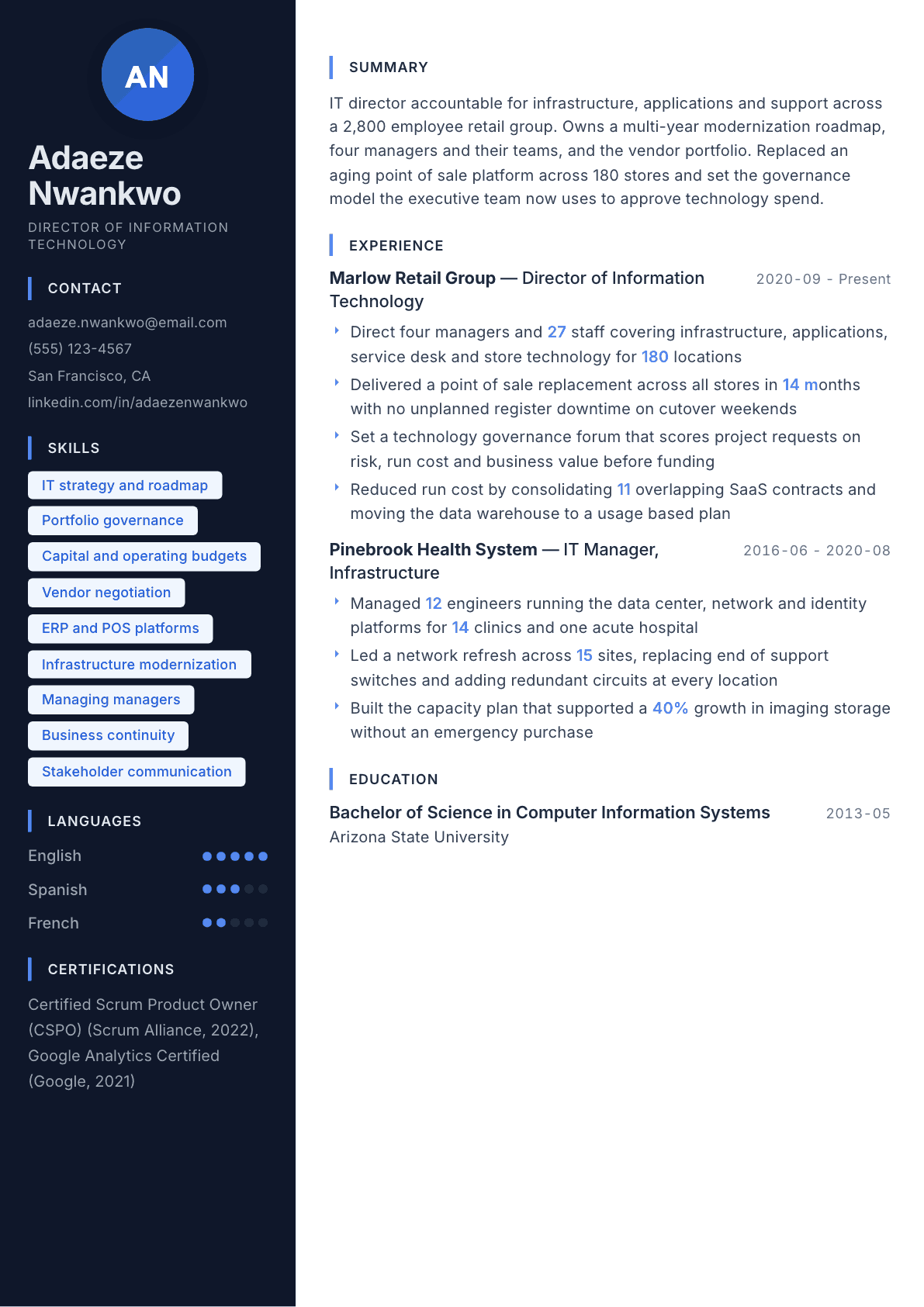
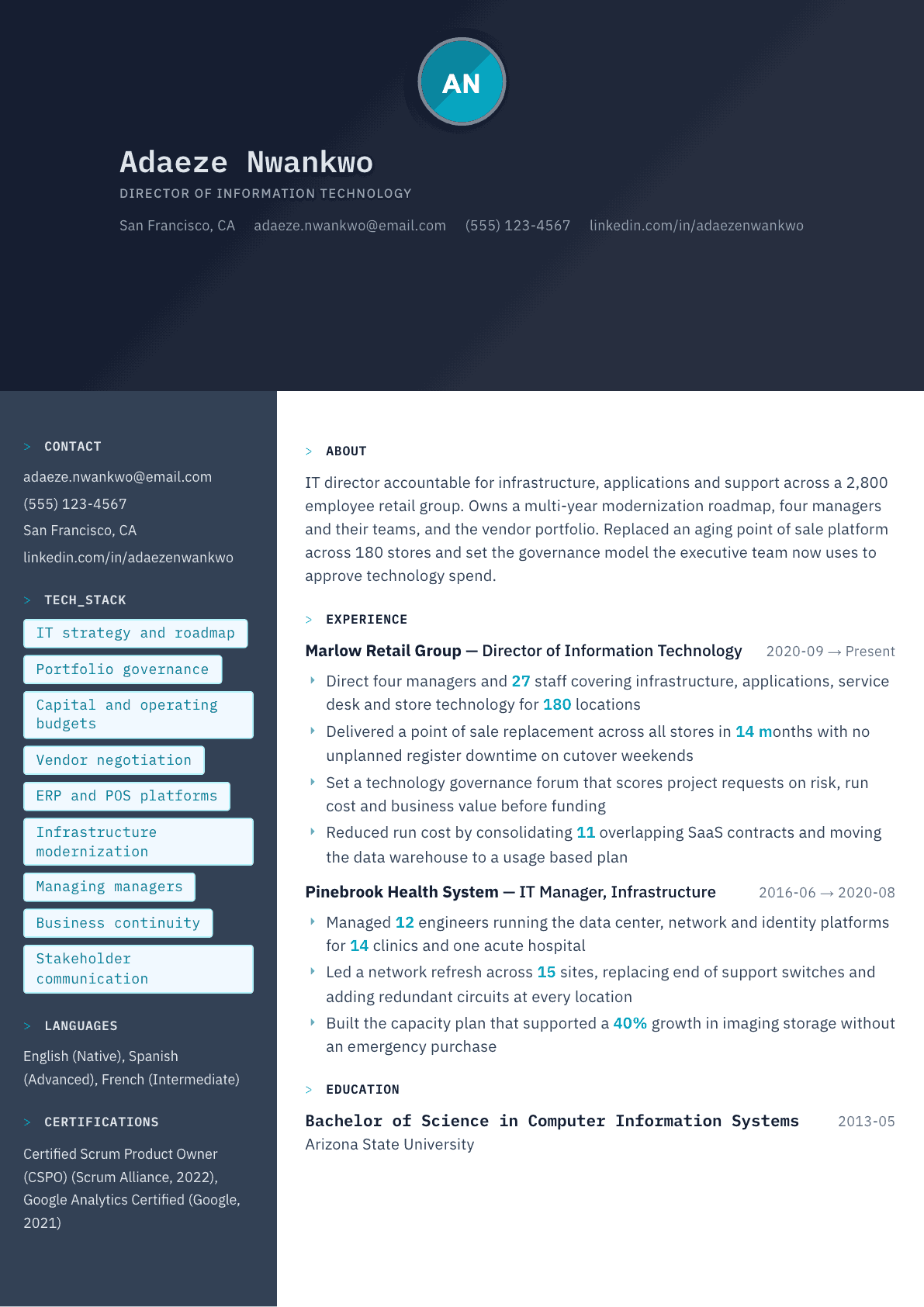
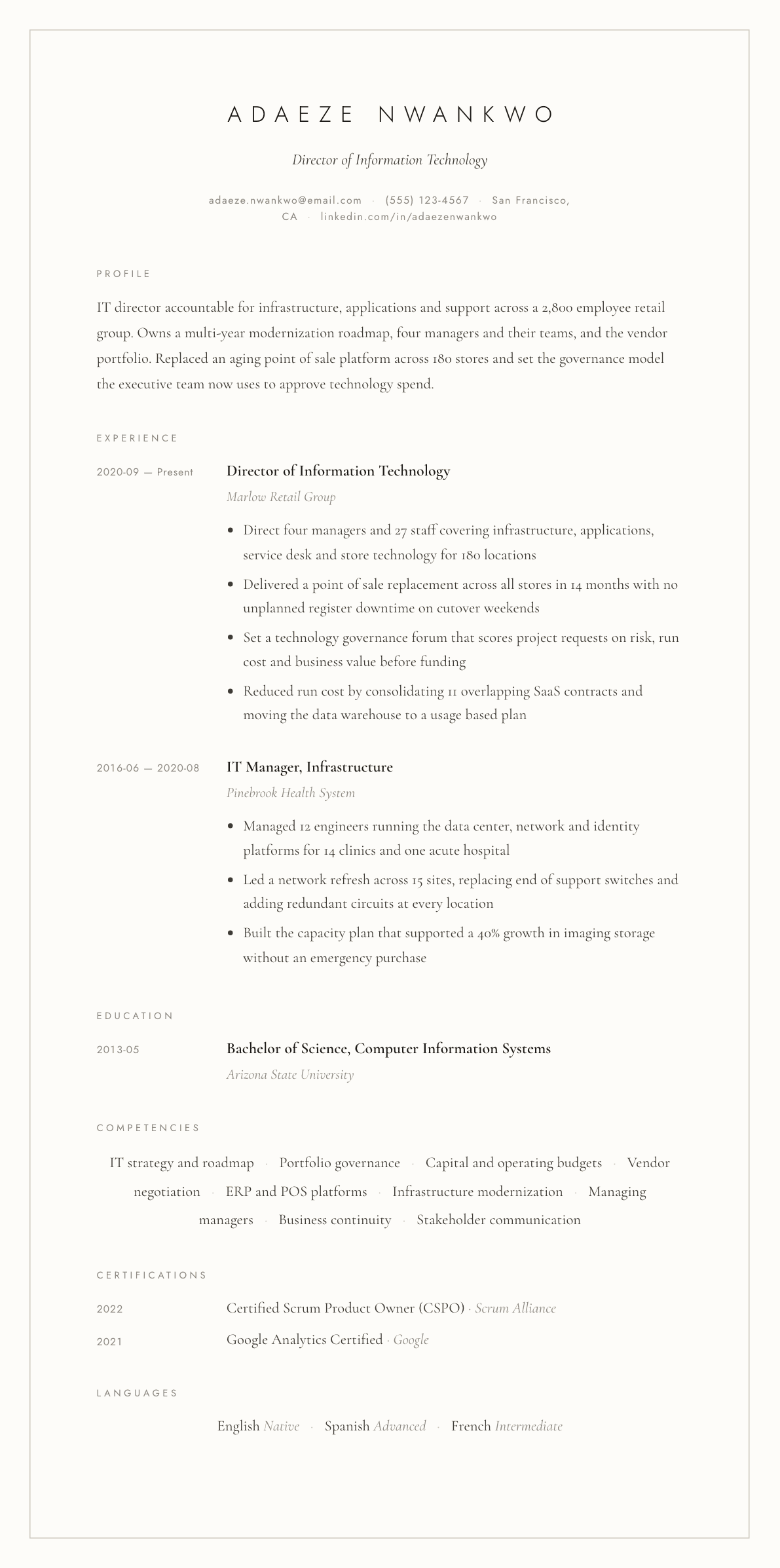
The same it director content laid out in three CVBooster templates, so you can see what the finished document looks like before you write a word.
Example IT Director summary
IT director with eleven years in infrastructure and applications leadership, now accountable for four managers, 27 staff and technology across 180 retail locations. Delivered a chainwide point of sale replacement in 14 months, cut run cost by consolidating 11 SaaS contracts, and built the governance forum the executive team uses to fund technology work. Targeting a director or vice president seat where the roadmap and the operating budget sit together.
Skills to list on a IT Director resume
- IT strategy
- Technology roadmap planning
- IT governance
- Capital and operating budget ownership
- Managing managers
- Vendor and contract negotiation
- ERP program delivery
- Infrastructure modernization
- Business continuity planning
- Cloud migration strategy
- Application portfolio management
- Service level management
- Executive stakeholder communication
- Cybersecurity oversight
- Organizational design
What actually gets this resume read
- Open with the portfolio: which functions report to you, how many managers, and the user or site count.
- Show a multi-year roadmap you owned, not a single project, and name what got funded and what got retired.
- Quantify run cost work separately from project work, since directors are measured on both lines.
- Describe your governance model in one bullet: how requests get scored, funded and reviewed.
- Name the business platforms, such as the ERP, the point of sale or the electronic health record, not only the infrastructure.
- Reserve tool names for the roles where you were hands-on and keep the director role focused on decisions and outcomes.
How to write a it director resume
The step from manager to director is the hardest jump in a technology career to put on paper, because the work stops being visible. A director does not fix the outage or run the migration. A director decides which of five requests gets funded, which platform gets retired, which manager gets the headcount, and then answers for that choice a year later when the business asks why.
Readers at this level, usually a chief information officer, a chief operating officer or a private equity operating partner, are looking for portfolio thinking. How many functions reported to you. How you allocated a fixed budget across run and change. What you killed. What you funded and what it returned. A resume full of projects delivered, with no evidence of choosing between them, reads as a large manager rather than a director.
This guide covers how to size a portfolio on paper, how to write governance and budget work without drifting into abstractions, three example summaries across the director band, before and after bullets, and the questions technology leaders ask when they write for an executive audience for the first time.
Director resume sample: the same structure in any department
A director resume sample is read for scope before anything else: the budget, the size of the team, the number of locations and the one decision that changed the business. That holds for an IT director and for a director of operations, sales or finance, so the structure below works for any director title.
IT director: Director of IT for a 1,200 employee distribution company with a multimillion dollar budget and a team of 22. Moved the business to cloud email and identity, consolidated two data centers into one and brought the service desk under a single ITIL process.
Director of operations: Director of operations for a three plant food manufacturer with 600 staff. Owns the production, maintenance and logistics budgets and led the rollout of a new planning system across all three sites.
Sales director: Sales director leading 30 account managers across four regions, responsible for a multimillion dollar revenue target and the move from spreadsheets to a CRM forecast.
Finance director: Finance director for a 300 person services company, owning the monthly close, the annual budget, the audit and the banking relationship.
In the experience section, the IT director sample reads: Director of Information Technology, Halbrook Distribution, reporting to the CFO with a multimillion dollar budget, 22 staff and five major vendor contracts. Set the three year technology roadmap with the executive team and reports progress to the board twice a year. Moved email, files and identity to the cloud for 1,200 users across 14 sites without a lost working day. Consolidated two data centers into one colocation site and retired the second lease.
Every director resume needs these five things near the top.
- The budget you own.
- Team size and number of direct reports.
- Locations, business units or countries covered.
- One strategic decision and what it changed.
- Who you report to, and whether you present to the board.
Format: two pages, portfolio block before experience
Two pages, reverse chronological, with a positioning statement and a portfolio block before the first role. Executive readers scan the top third and then decide whether to read the rest, so the scope has to live there rather than emerging on page two.
The portfolio block is four or five short lines: functions reporting to you, managers and total headcount, users and sites served, the business platforms in your estate, and the budget you own stated as run and change. That block does more work than any bullet on the page.
- Header: name, city and state, phone, email, and a board or industry group affiliation if you have one.
- Order: positioning statement, portfolio block, experience, education, certifications.
- No tool matrix, no rating bars. Platform names belong inside outcomes, not in a grid.
Positioning statement: what kind of director you are
Four lines. Sector, portfolio size, the transformation you are known for, and the seat you want next. The market splits between directors who modernize a neglected estate, directors who run a stable operation efficiently, and directors who integrate acquisitions. Each hires differently and the reader needs to place you in the first ten seconds.
Say what the business does and what the technology has to survive. Retail with seasonal peaks, healthcare with clinical uptime, logistics with warehouse cutovers that cannot slip: each of those is a credential in itself, and stating it stops the reader from assuming your experience is generic corporate infrastructure.
Experience: the roadmap you owned and the choices inside it
Open each role with the portfolio line, then five or six bullets. Lead with a multi-year outcome rather than a single project. A three-year modernization with a stated end state, the platforms retired along the way, and the run cost that fell as a result is the shape of a director bullet.
Write at least one bullet on what you did not do. Directors are judged on prioritization, so a line describing how you deferred or stopped work to protect a critical program, and what that protected, is unusually persuasive because almost nobody writes it.
Keep one bullet on delivery under pressure with real constraints: a cutover across many sites, a regulatory deadline, an acquisition integration with a date fixed by a contract. Name the constraint, the scale and the outcome. Directors are hired for calm delivery against dates that cannot move.
- Roadmap: the multi-year plan, what got funded, what got retired, and the end state you reached.
- Money: run versus change split, run cost reductions, consolidation, and the funding case you defended.
- Organization: managers developed, teams restructured, functions insourced or moved to a managed provider.
Governance: how technology work gets approved on your watch
Every credible director has a governance model, and stating yours in one bullet does more than three project descriptions. Explain how requests reach you, how they are scored, who sits in the forum, and what happens to work that fails the test. A model that scores requests on risk, run cost and business value before funding is concrete and quotable.
Add the assurance side: how you track benefits after delivery, how service levels are reviewed with the business, and how risk and audit findings are managed to closure. Executive readers have been burned by leaders who deliver projects and never check whether anything improved.
Business platforms, vendors and the keywords the search runs on
Name the business systems, not only the infrastructure. An enterprise resource planning platform, a point of sale estate, an electronic health record, a warehouse management system or a core banking platform tells a reader far more about your experience than a hypervisor version. Executive recruiters search on those platform names directly.
Postings at this level repeat a stable vocabulary: technology strategy, roadmap, governance, portfolio, run and change, service levels, business continuity, vendor management, organizational design, digital transformation. Use the phrasing the posting uses, once in the positioning statement and once inside a bullet where you can defend it.
IT Director resume summary examples
Stepping up from senior manager
Senior IT manager leading two team leads and 18 staff across infrastructure and end user services for nine sites. Delivered a network refresh with redundant circuits at every location, owns the annual capital plan, and reduced unplanned outages from 22 a year to five. Ready for a director seat with application portfolio ownership.
Director of a full IT function
IT director accountable for infrastructure, applications and support across a retail group of 2,800 employees, directing four managers and 27 staff. Delivered a point of sale replacement across 180 stores in 14 months, consolidated 11 overlapping contracts, and built the governance forum that now scores every funding request.
Director in a complex or multi-country estate
Senior IT director for a manufacturing group operating in six countries, with five managers, 90 staff and a run and change budget split. Integrated two acquisitions onto a single enterprise resource planning platform inside contractual deadlines and moved 60% of the estate off end of support hardware.
Work experience bullets: before and after
Before: Oversaw the IT department for the company.
After: Directed four managers and 27 staff across infrastructure, applications, service desk and store technology, serving 2,800 employees and 180 retail locations.
Naming the functions, the layer of managers and the physical estate places the role on the market map immediately.
Before: Led digital transformation initiatives.
After: Owned a three-year modernization roadmap that replaced the point of sale estate, moved the data warehouse to a usage based plan, and retired two legacy reporting systems and their support contracts.
A roadmap with named replacements and named retirements shows portfolio ownership instead of a transformation slogan.
Before: Managed the IT budget.
After: Held the run and change split at roughly two thirds run, funded four programs from savings created by consolidating eleven overlapping software contracts, and defended the capital request through two finance reviews.
The split, the source of funding and the approval path show how money was actually managed, not just that a budget existed.
Before: Implemented IT governance.
After: Established a monthly technology forum with the operations, finance and merchandising leads that scores every request on risk, run cost and business value, and deferred two low value programs to protect the store rollout.
Describing who sits in the forum and what got deferred turns governance from a word into a working mechanism.
Before: Responsible for business continuity planning.
After: Ran an annual continuity exercise with store operations and finance covering loss of the payment gateway, and closed the two gaps it exposed by adding an offline transaction mode and a documented manual fallback.
An exercise with named participants and the specific gaps closed proves continuity was tested rather than documented.
Hard skills
- Technology strategy and roadmap planning
- IT portfolio and demand governance
- Run and change budget ownership
- Enterprise resource planning program delivery
- Infrastructure and end of support modernization
- Cloud migration strategy
- Application portfolio rationalization
- Vendor selection and contract negotiation
- Service level and supplier performance management
- Business continuity and disaster recovery planning
- Cybersecurity oversight and audit remediation
- Merger and acquisition technology integration
- Organizational design and workforce planning
Soft skills
- Executive stakeholder management
- Prioritization under a fixed budget
- Developing managers into leaders
- Communicating trade-offs to non-technical peers
- Holding suppliers to account
- Decision making with incomplete information
Certifications worth listing
- Project Management Professional (PMP) (Project Management Institute)
- Program Management Professional (PgMP) (Project Management Institute)
- ITIL 4 Managing Professional (PeopleCert)
- Certified Information Security Manager (CISM) (ISACA)
- Certified in the Governance of Enterprise IT (CGEIT) (ISACA)
- TOGAF Enterprise Architecture Practitioner (The Open Group)
Mistakes that cost it director candidates the interview
- Presenting a list of delivered projects with no evidence that you chose between them under a fixed budget.
- Leaving out the portfolio: which functions reported to you, how many managers, how many sites and users.
- Writing only about infrastructure when the business platforms are what executive recruiters search on.
- Using transformation language with no named systems retired, replaced or consolidated behind it.
- Omitting the governance model, which is the clearest single signal of director-level thinking.
- Keeping hands-on tool detail in the current role, which pulls the reader back down to manager level.
- Claiming a cost reduction with no indication of whether service quality held or degraded alongside it.
IT Director resume questions
What is the difference between an IT manager and an IT director resume?
A manager resume proves the operation ran well. A director resume proves a portfolio was governed: which functions reported in, how a fixed budget was split between run and change, what was funded, what was retired, and who the managers under you became.
What should a director resume sample include?
A one line scope statement with budget, team size and locations, the strategic decisions you owned, and experience bullets that tie each decision to a business result. The director resume examples above show that pattern for IT, operations, sales and finance directors, and the IT entry shows it in full.
Should an IT director resume list specific technologies?
Name the business platforms and the major infrastructure decisions, because recruiters search on them. Leave configuration level detail out entirely, since it drags the document back toward a hands-on role the reader is not hiring for.
How many pages should an IT director resume be?
Two pages. That is enough for a portfolio block, three roles in depth and a short education and certification section. Anything longer usually means older roles have never been compressed into a single line each.
How do I get past a filter that wants a bachelor degree I do not have?
Put your certifications and any executive education in a visible block and let twelve or more years of portfolio ownership carry the weight. Many director postings list a degree as preferred, and a portfolio block with headcount, budget and named platforms outweighs it with a human reader.
Related resume examples
- IT Consultant Resume example
- IT Project Manager Resume example
- IT Manager Resume example
- CISO Resume example
- Chief Digital Officer Resume example
- CTO Resume example