Cybersecurity Manager Resume Examples: read this first
Build a Cybersecurity Manager Resume That Commands Attention
By Mustafa Tarabya, founder of CVBooster · Published · Updated
Create a powerful cybersecurity manager resume that highlights your threat mitigation expertise, team leadership, and compliance knowledge.
Sample resumes for a cybersecurity manager
The same cybersecurity manager content laid out in three CVBooster templates, so you can see what the finished document looks like before you write a word.
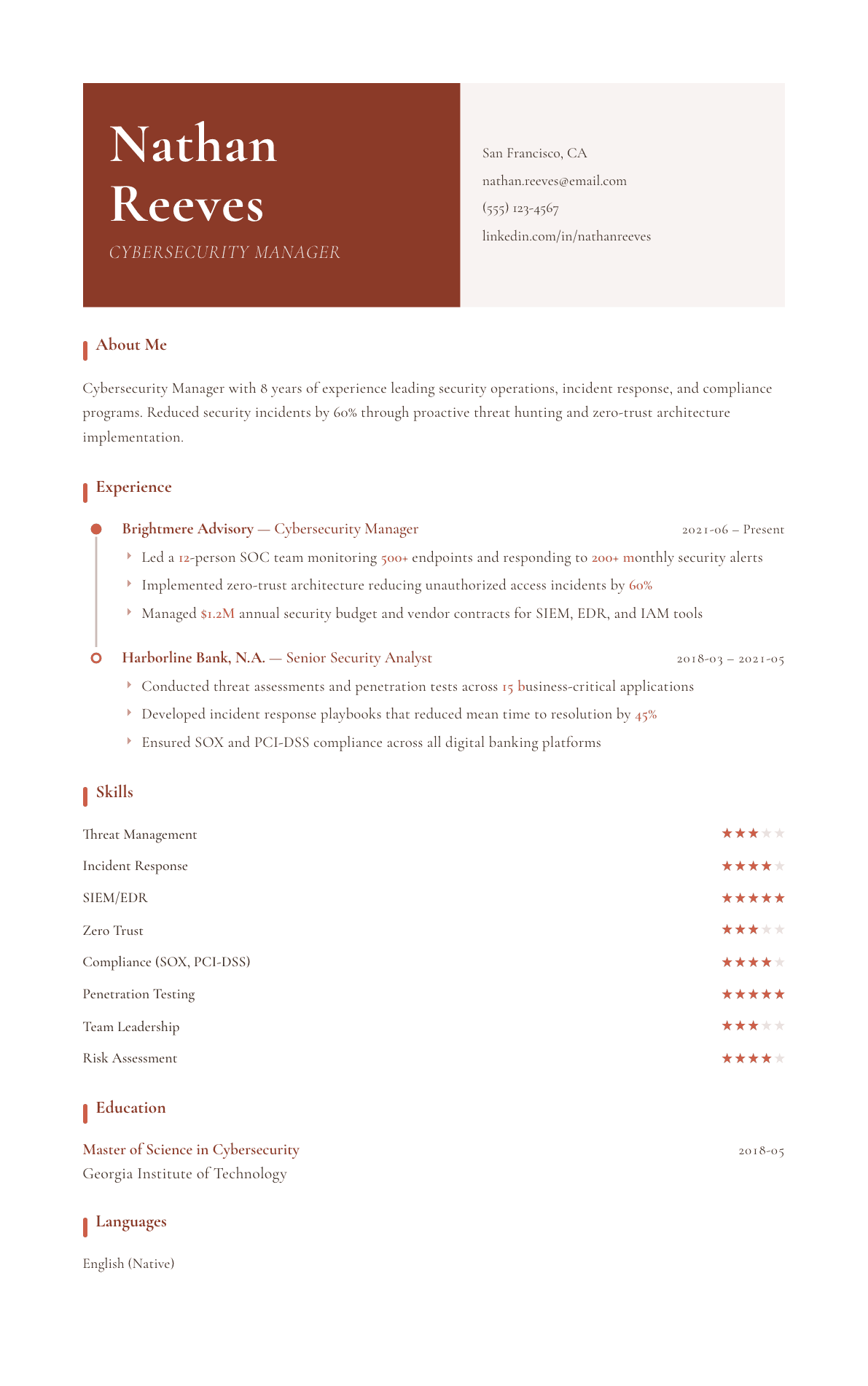
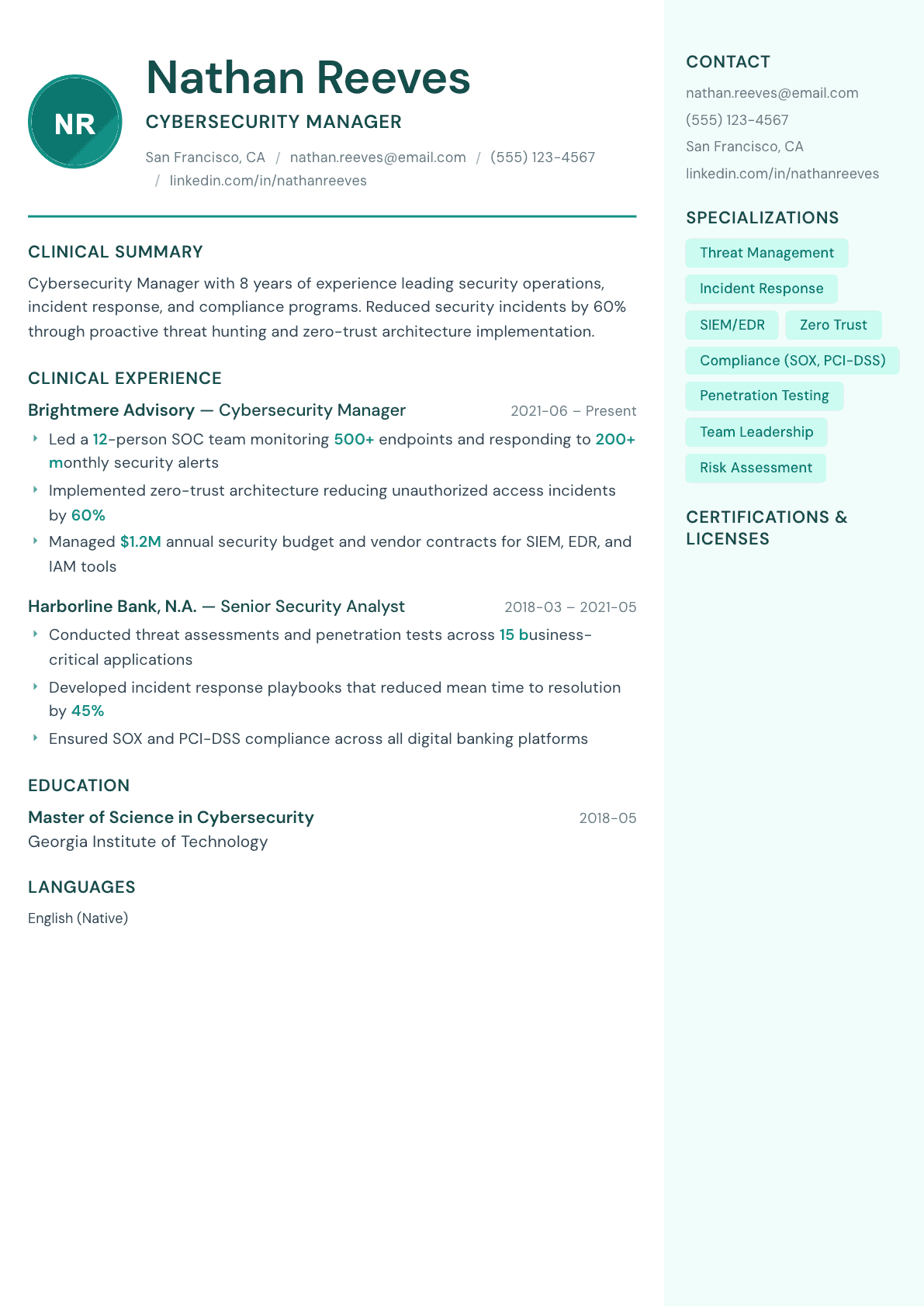
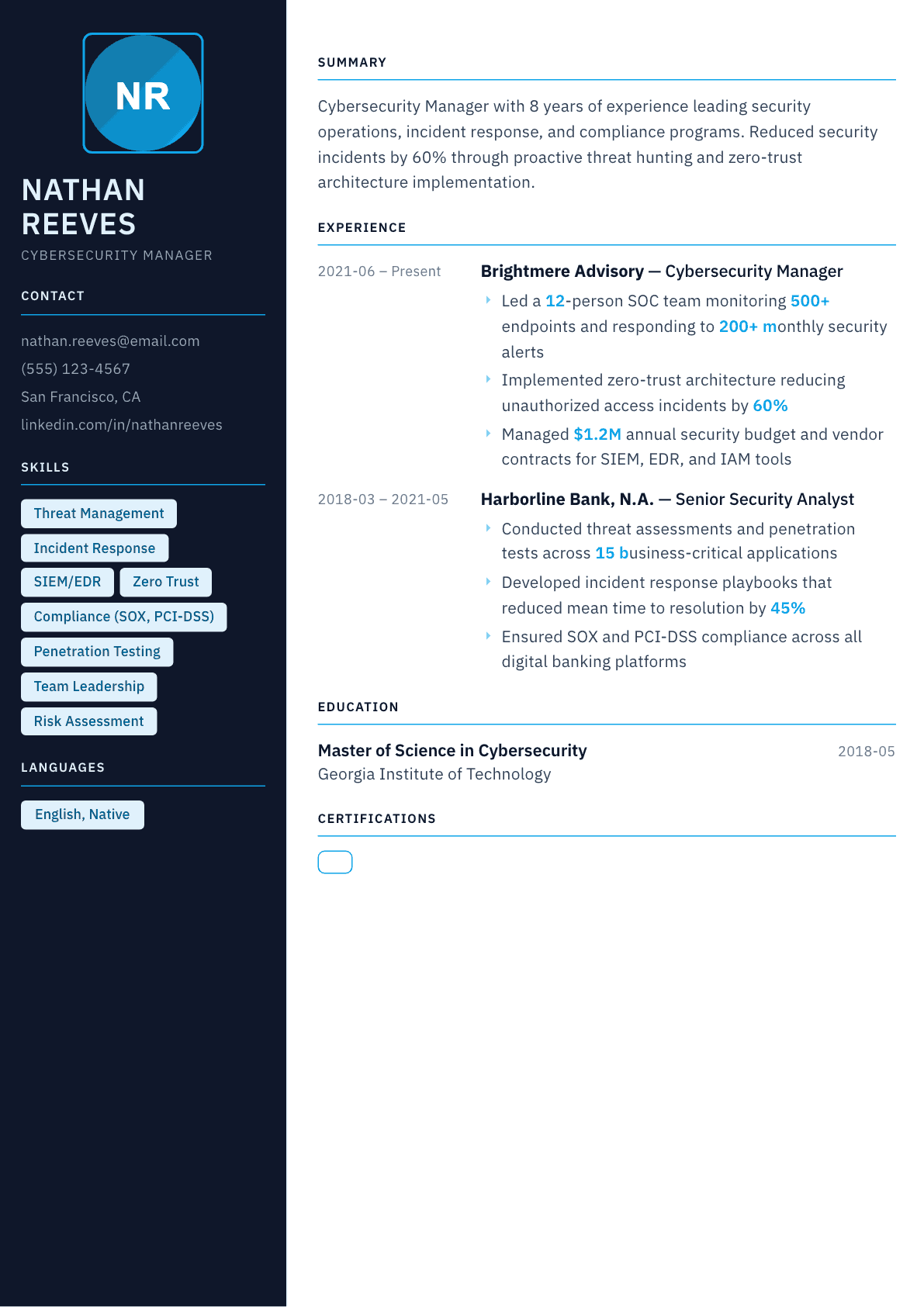
Example Cybersecurity Manager summary
CISSP-certified Cybersecurity Manager with 8 years of experience leading SOC teams and reducing security incidents by 60%. Expert in zero-trust architecture, compliance, and incident response.
Skills to list on a Cybersecurity Manager resume
- Security Operations
- Incident Response
- Threat Intelligence
- Zero-Trust Architecture
- SIEM Management
- Penetration Testing
- Compliance & Governance
- Risk Assessment
- Team Leadership
- Vulnerability Management
What actually gets this resume read
- Feature your CISSP, CISM, or CEH certifications prominently as they are industry gold standards.
- Quantify threat reduction, incident response times, and compliance audit results.
- Highlight experience with specific frameworks like NIST, ISO 27001, or CIS Controls.
- Include budget management and vendor oversight to demonstrate strategic leadership.
How to write a cybersecurity manager resume
A cybersecurity manager resume is read by a chief information security officer or a director who needs one specific gap covered: security operations, engineering, governance and risk, or application security. Those four tracks share vocabulary and almost nothing else in daily practice, so a resume that presents itself as generally strong in security tends to be passed over by every one of them.
The screener before that reader is filtering on credentials, frameworks and stack. CISSP or CISM, the control framework you have run a program against, the security information and event management platform, the endpoint detection tool, and whether you have carried an audit. Those facts belong high on the page in named form, because a keyword screen will not infer them from a description of your responsibilities.
This guide sets out the section order security leaders expect, three summaries from a first management step to a program owner, before-and-after bullets, and the questions that come up when a technical practitioner has to write a leadership resume.
Format: certifications and frameworks near the top
Two pages is normal at manager level, since this role carries both technical depth and program ownership. Reverse chronological, single column, and no skills matrix with rating bars, which parses badly and tells a security leader nothing about depth.
Place a credentials line under the header with your active certifications and any clearance by level and status. Follow it with a short frameworks and stack block: the control frameworks you have operated under and the tooling you have owned. That block is what a technical screener reads before the experience section.
- Header: name, city and state, phone, email, and the security track you lead.
- Order: summary, certifications, frameworks and tooling, experience, education.
- Say whether you managed people, and how many, on the first line of each management role.
Summary: track, team, environment, program
Four lines at most. Name your track, the size of the team you manage, the environment you defend, and the program you own. Environment means something concrete: endpoint count, cloud provider, regulated industry, and whether you run twenty-four hour coverage or business hours with an on-call rotation.
If you are moving from senior analyst or engineer into management, say it plainly and lead with the leadership surface you already covered: running the on-call rotation, owning a tool, mentoring analysts, presenting to an audit committee. Those are the responsibilities the promotion actually tests.
Experience: detection, response, and the risk you retired
For security operations work, show the shape of the queue and what you did to it: alert volume, escalation rate, false positive reduction, detection content you wrote, mean time to detect and to contain, and the tabletop or live incidents you led. Naming the detection logic you tuned is far stronger than counting alerts monitored.
For governance and risk work, show the program: the framework you assessed against, the control gaps you closed, the audits you carried and their outcome, the policies you rewrote, and the vendor risk process you ran. An audit that passed with a named framework behind it is the clearest evidence a manager can offer.
For engineering-leaning roles, show what you built or replaced: an identity and access management rollout, network segmentation, a vulnerability management program with a service-level target for remediation, a logging pipeline consolidation. Give the scale, because a control that works on one hundred endpoints is not the same control at ten thousand.
Include the human side of management. Analysts hired, on-call rotation designed, runbooks written, an analyst career ladder built, burnout and turnover addressed. Security operations centers fail on staffing more often than on tooling, and hiring leaders know it.
Frameworks, tools and compliance: use the exact names
Name the control frameworks by their real names: the NIST Cybersecurity Framework, NIST 800-53, ISO 27001, the CIS Critical Security Controls, SOC 2, PCI DSS, HIPAA and the Sarbanes-Oxley technology controls where relevant. Say what you did with each one, since assessing against a framework, operating under it and certifying to it are three different levels of involvement.
Name the tooling in categories a reader can scan: the security information and event management platform, endpoint detection and response, identity and access management, vulnerability scanning, cloud security posture management, email security, and the case management system. MITRE ATT&CK belongs here too if you map detections to it, and it is a phrase hiring managers actively look for.
Keywords a security leadership screen looks for
The phrases that recur are security operations, incident response, threat hunting, vulnerability management, risk assessment, security architecture, identity and access management, zero trust, compliance and audit, security awareness, third-party risk and budget ownership. Mirror the posting language once near the top and once inside a bullet that carries evidence. Skip the certification alphabet soup with no context: a hiring leader tests every acronym you print.
Cybersecurity Manager resume summary examples
Senior analyst stepping into management
Senior security analyst moving into management after owning the on-call rotation and detection engineering for a five-person team. Wrote 60 detection rules mapped to MITRE ATT&CK, cut false positives by 40%, and led two live incident responses end to end. CISSP and GCIA certified.
Cybersecurity manager
Cybersecurity Manager leading a twelve-person security operations team covering 500 endpoints and a cloud environment on a twenty-four hour rotation. Rebuilt incident response playbooks that cut mean time to containment by 45%, and carried PCI DSS and SOC 2 audits with no major findings.
Security program owner
Security leader owning operations, vulnerability management and governance for a regulated financial services environment. Manages three team leads, runs the annual risk assessment against the NIST Cybersecurity Framework, owns the security budget and vendor contracts, and briefs the audit committee quarterly.
Work experience bullets: before and after
Before: Managed the security operations center and responded to incidents.
After: Led a twelve-person security operations team through roughly 200 escalated alerts a month, holding mean time to containment under one hour for critical incidents.
Team size, queue volume and a response target let a security leader judge the operating tempo you are used to.
Before: Implemented zero-trust architecture across the company.
After: Delivered a phased zero trust rollout starting with identity: enforced conditional access and phishing-resistant authentication for all administrative accounts, then segmented the production network by application tier.
The sequence and the specific controls turn a fashionable phrase into an implementation somebody can evaluate.
Before: Ensured compliance with security regulations.
After: Ran the annual SOC 2 Type II audit and the PCI DSS assessment, closing eleven control gaps ahead of fieldwork and finishing both with no major findings.
Naming the frameworks, the gap count and the audit result makes compliance work verifiable instead of assumed.
Before: Reduced vulnerabilities across the environment.
After: Built a vulnerability management program with tiered remediation targets by severity, moving critical findings from an open backlog to closure within seven days at a 92% rate.
A service-level target with an achieved rate proves a working process, where reduced vulnerabilities proves nothing.
Before: Managed security tools and vendors.
After: Consolidated three overlapping endpoint agents into one detection and response platform, cutting agent conflicts on user machines and freeing budget that funded two analyst hires.
A tool decision with a stated tradeoff and a downstream outcome reads as management judgment, not procurement.
Hard skills
- Security operations management
- Incident response and forensics
- Threat hunting and detection engineering
- MITRE ATT&CK mapping
- Security information and event management
- Endpoint detection and response
- Vulnerability management
- Identity and access management
- Cloud security posture management
- Risk assessment and treatment
- NIST Cybersecurity Framework and ISO 27001
- SOC 2, PCI DSS and HIPAA compliance
- Third-party and vendor risk
- Security budget and vendor management
Soft skills
- Explaining risk to non-technical executives
- Calm command during a live incident
- Mentoring analysts and preventing burnout
- Negotiating remediation with engineering teams
- Written incident and board reporting
Certifications worth listing
- Certified Information Systems Security Professional (CISSP) (ISC2)
- Certified Information Security Manager (CISM) (ISACA)
- Certified Information Systems Auditor (CISA) (ISACA)
- GIAC Certified Incident Handler (GCIH) (GIAC)
- GIAC Security Operations Manager (GSOM) (GIAC)
- Certified Cloud Security Professional (CCSP) (ISC2)
- Offensive Security Certified Professional (OSCP) (OffSec)
Mistakes that cost cybersecurity manager candidates the interview
- Presenting as a generalist in security when the four hiring tracks are separate jobs with separate interview loops.
- Listing tool names with no evidence of what you configured, tuned or replaced with them.
- Claiming zero trust or threat hunting as a phrase without naming the controls or the hypotheses behind the work.
- Leaving out environment scale, so a reader cannot tell a fifty-person company from a global enterprise.
- Printing a long certification list including expired credentials, which an interviewer will test acronym by acronym.
- Omitting people management entirely, when hiring, on-call design and analyst retention are half of what the job is.
- Describing incidents in identifiable detail from a previous employer instead of the process and the response times.
Cybersecurity Manager resume questions
How much technical detail should a cybersecurity manager resume carry?
Enough that a technical interviewer believes you can review your team's work. Name detection logic, identity controls, segmentation approach or forensic steps you personally handled, then move up a level to describe the program, the budget and the people you managed.
Which certifications should go at the top?
The active ones the posting names, usually CISSP for technical leadership and CISM for program ownership. List them under the header with the issuing body, keep expired credentials off the page, and let audit or cloud credentials follow rather than lead.
Can I write about incidents I responded to?
Describe the class of incident, your role, the process you ran and the timeline you achieved. Do not name the employer's specific breach details, affected systems or customers. Hiring leaders read that restraint as professional judgment rather than as a thin answer.
How do I show security leadership if I have never had direct reports?
Show the leadership surfaces you have carried: owning a tool end to end, running the on-call rotation, writing runbooks the team uses, leading an incident bridge, or presenting to auditors. Those responsibilities are what a first-line manager actually does every week.
Should I include metrics on a security resume?
Yes, but only measures a peer would recognize: mean time to detect and contain, patch closure rates against a target, alert-to-escalation ratio, audit findings closed, phishing simulation failure trend. Invented reductions in risk are the fastest way to lose credibility in the interview.
Related resume examples
- Loss Prevention Manager Resume example
- Private Investigator Resume example
- Production Manager Resume example
- Cybersecurity Analyst Resume example
- Security Engineer Resume example
- Cloud Security Engineer Resume example