Security Director Resume Examples: the lines they read
Write a Security Director Resume That Reads at Board Level
By Mustafa Tarabya, founder of CVBooster · Published · Updated
Security director resume example and guide covering multi site programs, governance, executive briefings, budgets and crisis leadership.
Sample resumes for a security director
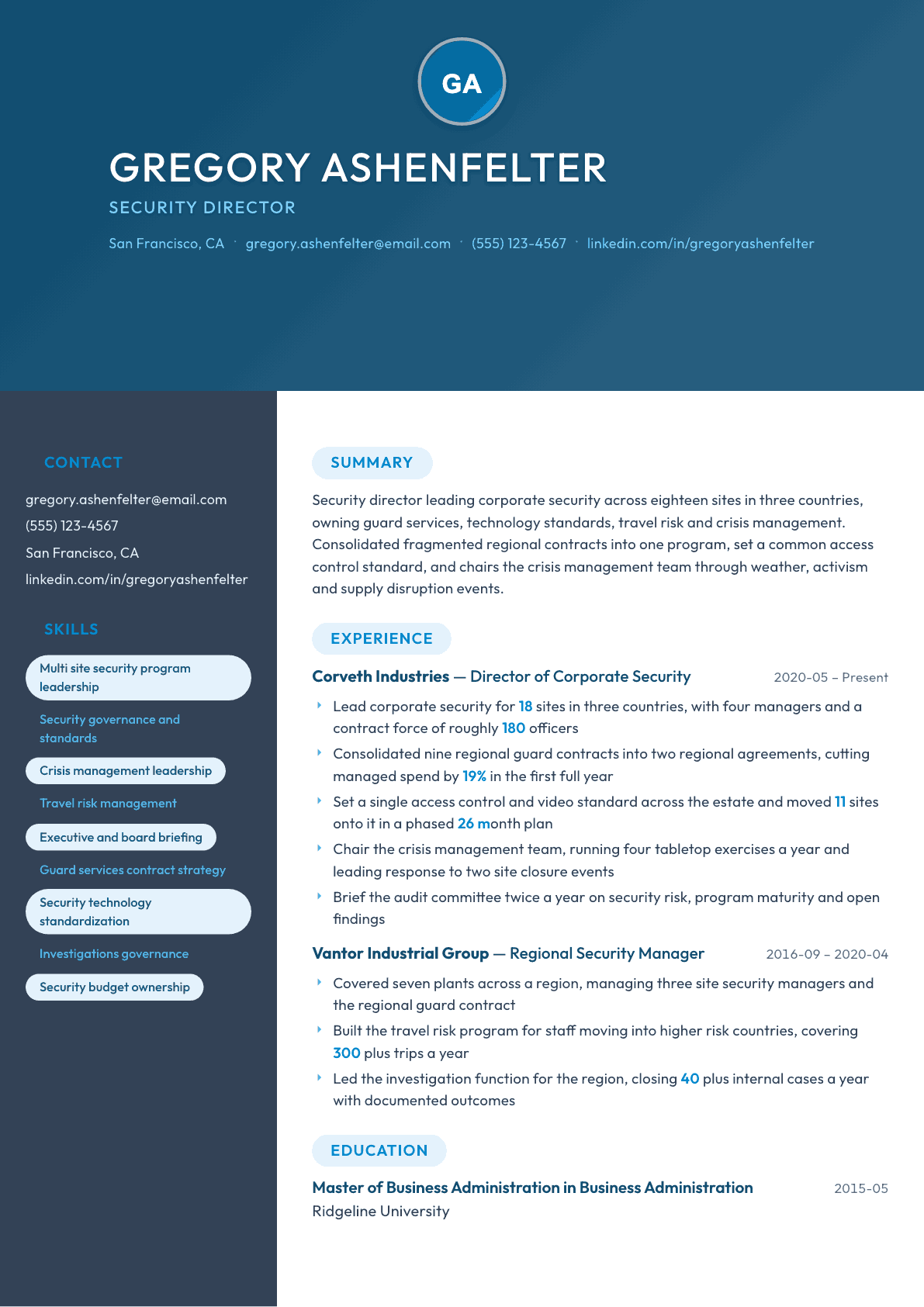
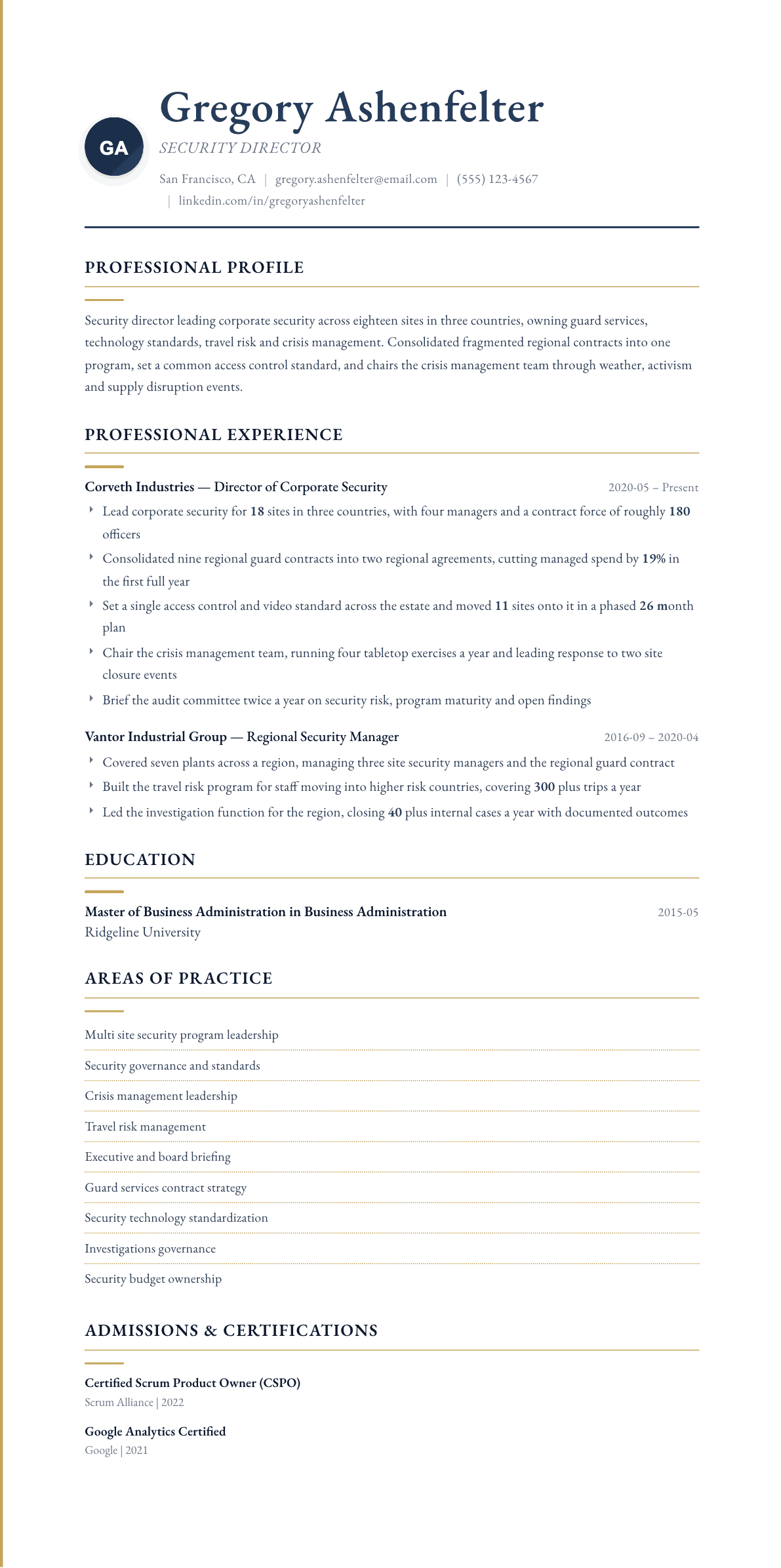
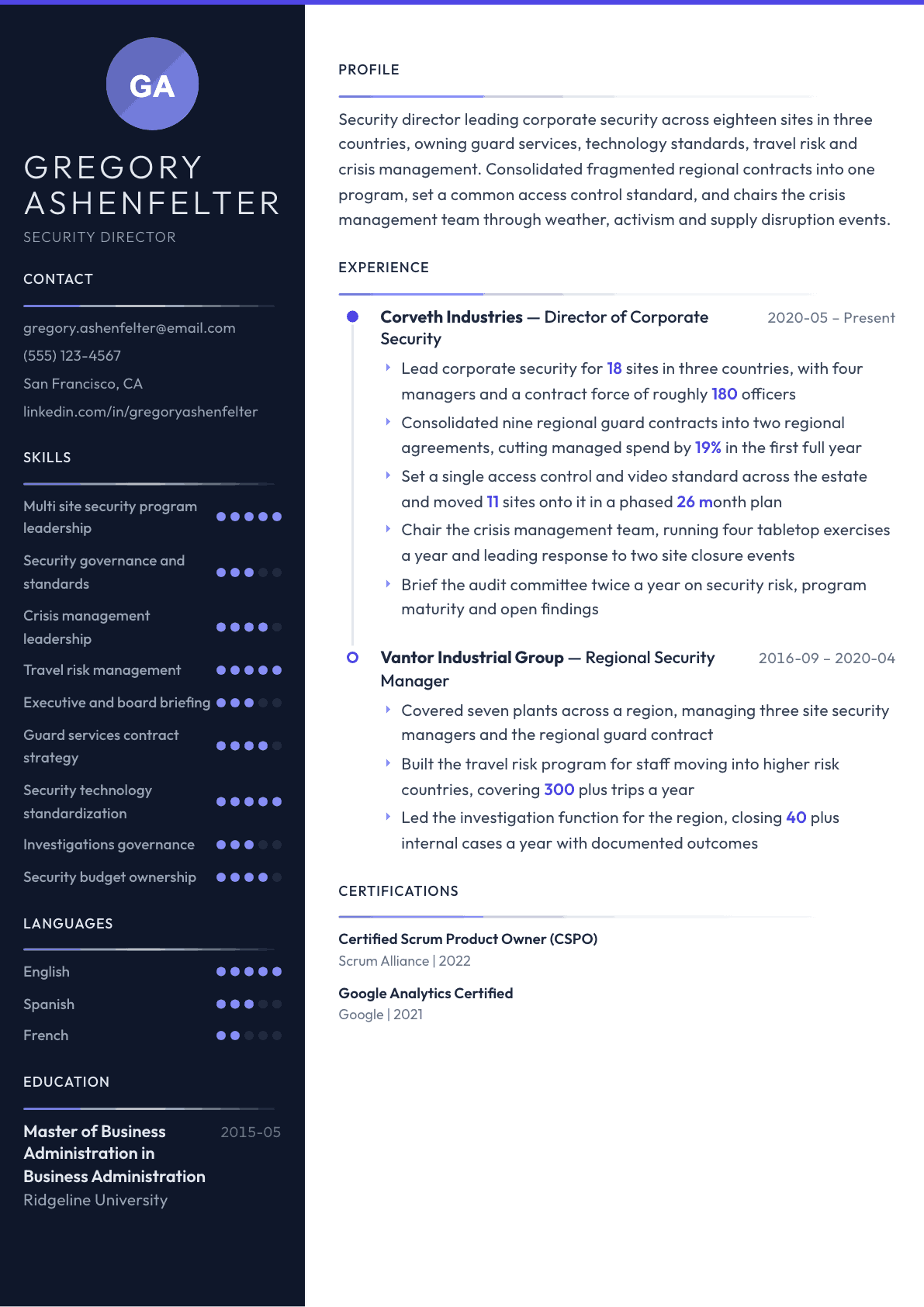
The same security director content laid out in three CVBooster templates, so you can see what the finished document looks like before you write a word.
Example Security Director summary
Security director leading corporate security across eighteen sites in three countries, with four managers and a large contract force. Consolidated nine regional guard contracts into two agreements, set one access control and video standard across the estate, chairs the crisis management team through site closure events, and briefs the audit committee on security risk and open findings twice a year.
Skills to list on a Security Director resume
- Enterprise security strategy
- Multi country program leadership
- Security governance and minimum standards
- Crisis management and business continuity
- Executive and audit committee briefing
- Global guard services sourcing
- Security technology standardization
- Travel risk and duty of care
- Investigations governance and case oversight
- Insider risk program design
- Security budget and capital planning
- Regulatory and customer audit response
- Manager development and succession
- Threat and intelligence program oversight
- Merger and site integration security
What actually gets this resume read
- Open with the estate you cover: sites, countries, headcount and the reporting line, because scope defines the level.
- Show consolidation or standardization work, since directors are hired to fix fragmented regional security programs.
- Give crisis leadership examples with the event type and your role in the room, not just membership on a team.
- Say who you brief and how often, because a director who never reaches the audit committee reads as a manager.
- Include travel risk and duty of care if you own them, since they sit with the director in most corporate structures.
- Describe your governance artifacts: standards, minimum requirements, maturity assessments and the audit responses.
- Keep technology at the standard setting level, because the platform detail belongs on a security manager resume.
How to write a security director resume
A security director is hired to fix a portfolio, not to run a site. The chief operating officer or general counsel doing the hiring usually has a specific problem: fragmented regional guard contracts, inconsistent technology across an estate, a crisis that exposed the plan, an audit finding, or a board that has started asking about physical risk. The resume that wins names that class of problem and shows it solved somewhere else.
Applications at this level fail in a predictable way. They read as very good manager resumes: platforms administered, force sizes, assessments completed, incidents handled. All of it true, none of it at the altitude of the role. A director resume has to show governance, standards, budget at portfolio level, crisis leadership and the ability to sit in front of an audit committee without a translator.
This guide covers scope, governance artifacts, crisis leadership, and how to write the executive facing part of the job so the page reads at the level the title claims, along with the questions managers ask when they make the step up.
Format: portfolio scope first, then transformation, then operations
Two pages. A director with fifteen years cannot be compressed to one without losing the scope that justifies the title, and executive readers expect the second page. What they will not forgive is two pages of operational detail with the strategic content buried on page two.
Under each role, open with the portfolio: sites, countries, protected headcount, direct reports, total force including contract officers, and the reporting line. Then lead the bullets with transformation work, because that is what a director is bought for. Steady state operations get one compressed bullet at the end.
- Portfolio line: sites, countries or regions, protected headcount, direct reports, total force, reporting line.
- Mandate line: the problem you were hired to solve, in one clause, and whether it was solved.
- Governance line: standards, minimum requirements and policies you authored or ratified.
- Executive line: the forums you brief and the cadence, including any board or audit committee exposure.
- Budget line: the categories you own at portfolio level and how the spend profile changed.
Summary: portfolio, mandate, governance, executive reach
Four lines, and they should read like a scope statement rather than a personality description. Portfolio size, what you own, what you standardized or consolidated, and who you report to. A general counsel reading that knows within seconds whether you operate at her level.
Directors who came up through law enforcement or the military often lead with that background. Put it at the end instead. It is credibility, not scope, and an executive reader wants the estate you have run before the badge you used to carry.
Experience: consolidation, standards, technology strategy
Consolidation is the most common director mandate. Regional guard contracts negotiated locally, technology bought by whoever was on site, and no way to compare one location to another. Write what you found, what you consolidated it into, over what period, and what the change bought: cost movement, coverage consistency, or the ability to report across the estate for the first time.
Standards are the durable output of a director. A minimum physical security standard, a site classification model that assigns requirements by risk tier, and a maturity assessment that scores each location against it are the artifacts that outlast any individual project. If you have written them, say what they cover and how many sites were assessed against them.
Technology strategy at this level is about a common platform and a lifecycle, not about a migration. Say what standard you set, how many sites you moved onto it, over what phased period, and what you did about the sites that could not move yet. Directors are judged on whether the estate is converging or diverging.
Investigations, insider risk and intelligence functions often report to the director. Describe the governance rather than the cases: who has authority to open, how legal and human resources are involved, how evidence is handled across jurisdictions, and how outcomes reach leadership.
Crisis leadership and executive communication
Every director claims crisis management. The credible version names the events, the role you held in the room and the decisions you owned. Chairing a crisis team through a site closure, an activist occupation, a severe weather shutdown or a supply disruption is a different claim from having a seat on the team. Say which one is yours.
Exercises matter as much as real events, because they show a program that is maintained. Give the cadence, who participates, whether executives take part, and one change the exercise produced. A tabletop that never changed a plan was theater.
The executive communication line is the last thing many otherwise strong candidates omit. Name the forum, the frequency and the content: risk posture, program maturity, open findings, incident trends. A director who briefs an audit committee twice a year is operating at a level a manager never reaches, and the page should say so plainly.
- Crisis events led, by category, with the decision you owned in each.
- Exercise program: cadence, participants, scenario types and one change produced.
- Business continuity interface: which plans you own and which you support.
- Travel risk and duty of care: trips supported, higher risk destinations, and the approval process you run.
- Executive reporting: forum, cadence and the outcomes your reporting has driven.
Skills and keywords an executive search screens on
Director searches use a distinct vocabulary: enterprise security, governance, minimum standards, program maturity, crisis management, business continuity, duty of care, insider risk, third party risk, audit response and executive reporting. Those terms are what a search consultant matches against the specification, so use them precisely rather than approximately.
One caution. Do not import cyber terminology unless you genuinely own that function. Many directors sit alongside an information security leader rather than above one, and overstating the boundary is the fastest way to fail a structured interview with the chief information security officer in the room.
Security Director resume summary examples
Manager stepping into a director seat
Regional security manager covering seven plants and three security managers, now owning the regional guard contract, the travel risk process and the investigation function. Built the first regional minimum security standard and assessed all seven sites against it in 2024. Seeking a corporate director mandate.
Corporate security director
Director of corporate security for 18 sites in three countries, with four managers and a contract force of roughly 180 officers. Consolidated nine regional guard contracts into two agreements, cut managed spend by 19%, set one access control and video standard, and chairs the crisis management team.
Global head of security
Global security leader responsible for 60 locations across four regions, with regional directors reporting in and accountability for guarding, technology, travel risk and investigations. Rebuilt the governance model around a three tier site classification, and briefs the audit committee on physical risk twice a year.
Work experience bullets: before and after
Before: Managed security across multiple company locations.
After: Led corporate security for 18 sites in three countries with four managers and a contract force of roughly 180 officers, owning guarding, technology standards, travel risk and crisis management.
Sites, countries, management layers and the four owned domains establish portfolio scope rather than site scope.
Before: Consolidated security vendors to reduce cost.
After: Consolidated nine regional guard contracts into two regional agreements over eleven months, cutting managed spend by 19% in the first full year while introducing one common service level across every site.
Contract count, timeline, cost movement and the standardization benefit show a portfolio decision with a result.
Before: Standardized security technology at our sites.
After: Set a single access control and video standard for the estate and moved 11 of 18 sites onto it in a phased 26 month plan, with a documented exception process for the sites deferred to the next capital cycle.
Adoption count, phasing and a named exception process demonstrate governance rather than a project that stalled.
Before: Was part of the crisis management team.
After: Chaired the crisis management team through two site closure events and an activist occupation, owning the decision to suspend operations and the communication sequence to regional leadership and legal counsel.
Chairing rather than attending, with the decisions owned, is the difference between crisis leadership and crisis attendance.
Before: Reported on security matters to senior leadership.
After: Briefed the audit committee twice a year on physical security risk, program maturity against the internal standard and open findings, and secured capital for perimeter work at three sites as a result.
The forum, the content and the funding outcome prove executive reach that a manager level resume cannot claim.
Hard skills
- Enterprise physical security strategy
- Multi country program leadership
- Security governance and minimum standards
- Site classification and program maturity assessment
- Crisis management and business continuity interface
- Executive and audit committee reporting
- Global guard services sourcing and consolidation
- Security technology standardization and lifecycle planning
- Travel risk management and duty of care
- Investigations governance and case oversight
- Insider risk program design
- Security budget and capital planning
- Third party and supply chain security risk
- Merger, acquisition and site integration security
Soft skills
- Framing physical risk in the language a finance leader will act on
- Holding a standard across regions that each believe they are the exception
- Deciding under incomplete information while the site is still unfolding
- Building regional leaders who do not need you in the room
- Knowing which battles to escalate to the executive committee and which to absorb
Certifications worth listing
- Certified Protection Professional (CPP) (ASIS International)
- Physical Security Professional (PSP) (ASIS International)
- Professional Certified Investigator (PCI) (ASIS International)
- Certified Business Continuity Professional (CBCP) (DRI International)
Mistakes that cost security director candidates the interview
- Presenting a strong manager resume under a director title, with platforms and force sizes but no governance or standards.
- Omitting portfolio scope, so an executive reader cannot tell whether the estate is three sites or sixty.
- Claiming crisis management without naming the events, the role held or the decisions owned.
- Leading with a law enforcement or military background instead of the commercial scope that justifies the level.
- Leaving executive reporting off the page, which makes the program look invisible above the security function.
- Overstating ownership of information security when the role sits alongside that function rather than above it.
- Filling both pages with operational detail and pushing the transformation work to the bottom where nobody reaches it.
Security Director resume questions
How do I make the jump from security manager to director?
Take ownership of something that spans sites: a standard, a regional contract, the travel risk process or the investigation governance. Then rewrite the page around portfolio scope and governance artifacts, and move site level operational content into a single compressed bullet under each role.
How long should a security director resume be?
Two pages, with the first page carrying scope, mandate and the two or three transformations that define you. Executive readers and search consultants both skim the first half page before deciding, so the strategic content cannot be held back for page two.
Should I include my law enforcement or military background?
Yes, but place it at the end as background rather than leading with it. Boards value the judgment it built, and search consultants value the corporate scope you have run since. Leading with the badge signals that the corporate half of your career is the thinner half.
What do I write if my company never had a formal governance model?
Write what you built in its absence: a minimum standard, a site tiering model, an assessment scorecard or a common reporting pack. Directors are frequently hired precisely because a portfolio has no governance, so evidence that you created it from nothing is the strongest possible signal.
How specific can I be about crisis events?
Name the event category, your role and the decisions you owned, and stop there. Site closure, activist occupation, severe weather, supply disruption and executive threat are all describable without identifying a location, a date or a person. Confidentiality discipline is itself part of what is being assessed.
Related resume examples
- Emergency Management Director Resume example
- Loss Prevention Manager Resume example
- Security Manager Resume example
- Security Consultant Resume example
- Military Officer Resume example
- Environmental Health and Safety Manager Resume example