Clinical Data Manager Resume Examples: read this first
Write a Clinical Data Manager Resume for Trial Data Roles
By Mustafa Tarabya, founder of CVBooster · Published · Updated
Clinical data manager resume examples with EDC build, data validation and CDISC keywords, plus a guide to writing database lock experience.
Sample resumes for a clinical data manager
The same clinical data manager content laid out in three CVBooster templates, so you can see what the finished document looks like before you write a word.
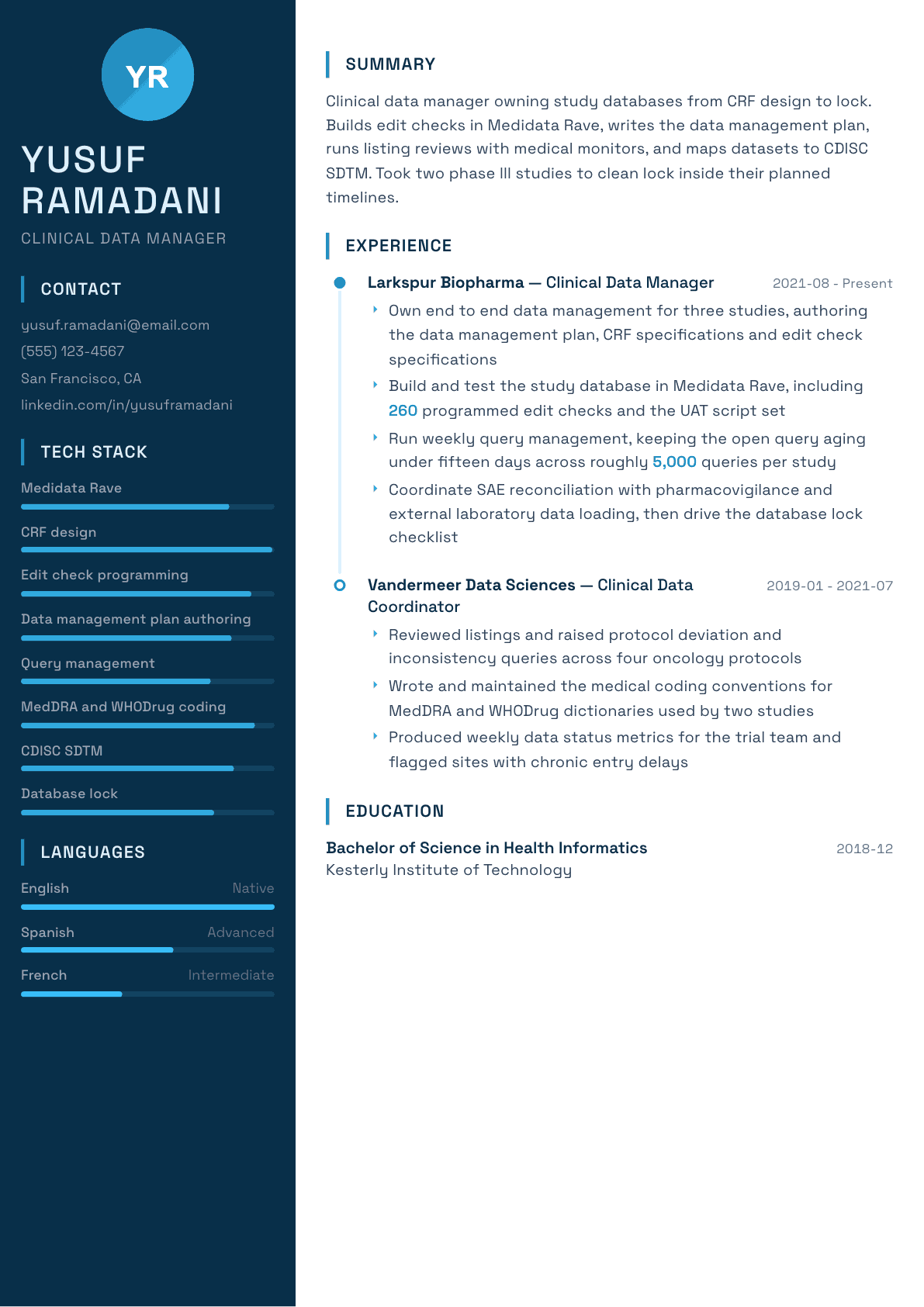
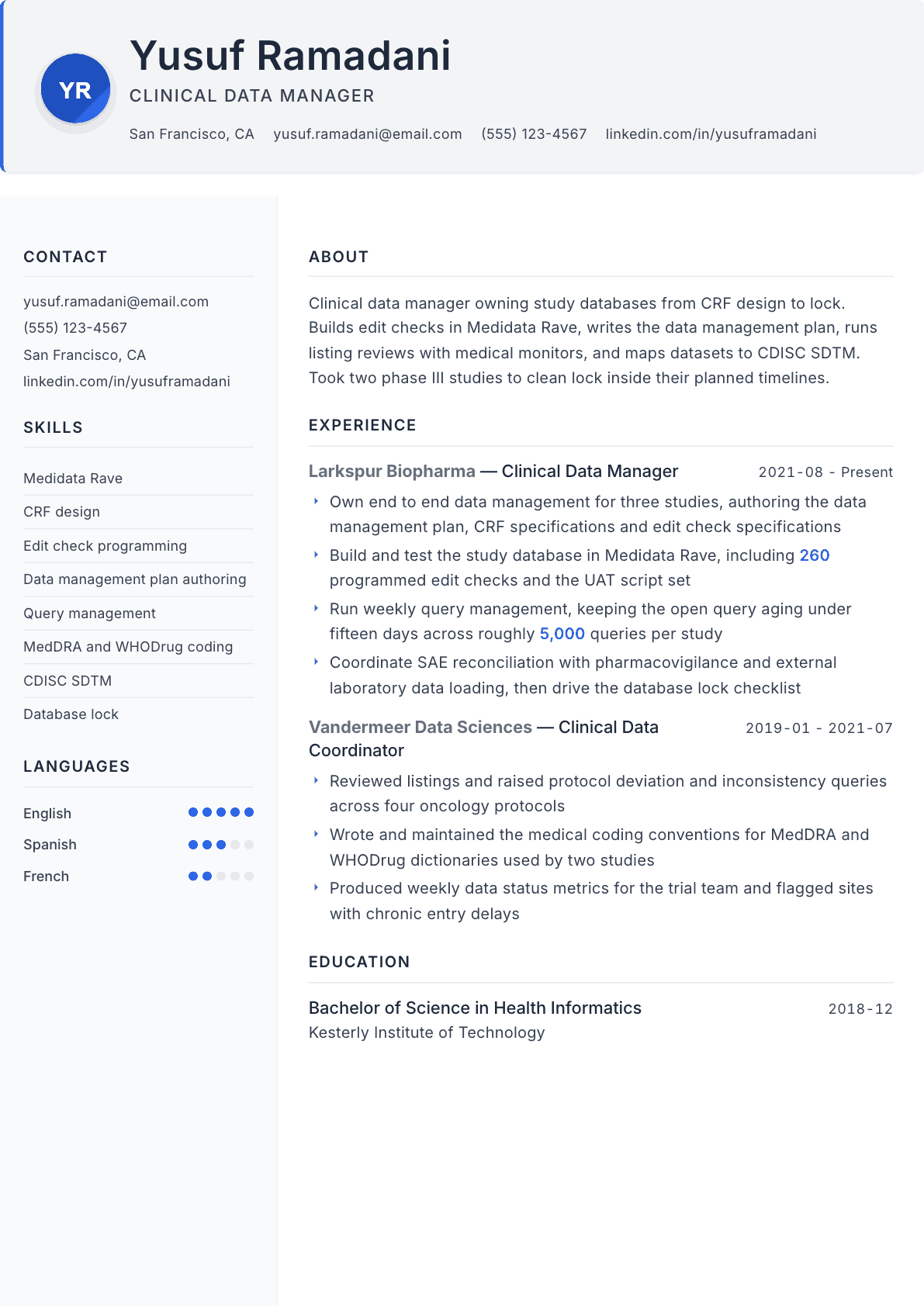
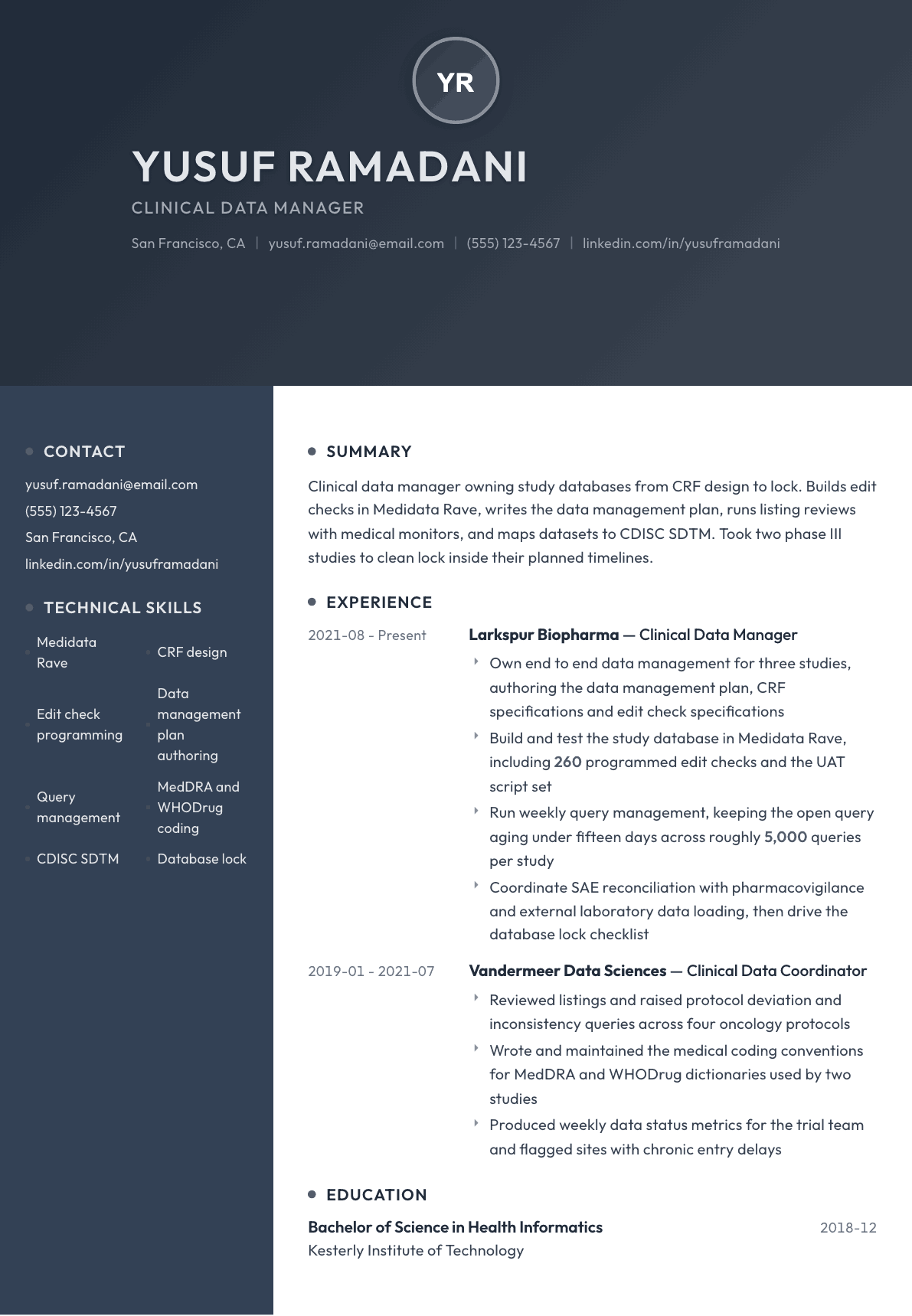
Example Clinical Data Manager summary
Clinical data manager with six years across sponsor and CRO settings, owning study databases from CRF specification through lock. Builds and tests edit checks in Medidata Rave, keeps query aging tight, reconciles safety and external laboratory data, and maps to CDISC SDTM. Has taken five studies to clean database lock, four of them on the originally planned date.
Skills to list on a Clinical Data Manager resume
- Clinical data management
- EDC database build
- CRF and eCRF design
- Edit check specification
- User acceptance testing
- Data validation plan
- Query management and aging
- Medical coding with MedDRA
- WHODrug coding
- SAE reconciliation
- External data reconciliation
- CDISC SDTM
- Database lock
- Medidata Rave
- Veeva CDMS
- SQL and data listings
What actually gets this resume read
- Name every EDC platform you have built in, since Medidata Rave, Veeva CDMS, Oracle InForm and Medrio are hard filters.
- List the study documents you author yourself: data management plan, CRF specifications, edit check specifications and the validation plan.
- Quantify query volume and aging, because those two numbers describe how a data manager actually performs.
- State how many databases you have taken to lock and whether the locks landed on their planned dates.
- Include CDISC work explicitly, naming SDTM, ADaM or the define file rather than saying "industry standards".
- Mention reconciliation work with pharmacovigilance and external vendors, which is where most lock delays begin.
How to write a clinical data manager resume
Clinical data management resumes are screened by people who know exactly what the job involves, which is both good and dangerous. Good, because a precise resume is rewarded. Dangerous, because vague phrases like "managed clinical data" mark you instantly as someone who supported a database rather than owned one.
The reader is checking a short list: which electronic data capture platforms you have built in, whether you author specifications or only execute them, how many studies you have taken to lock, whether the locks landed on plan, and whether you can speak about coding dictionaries and standards without hedging.
This guide covers the section order data management hiring expects, how to describe database build and cleaning work in the terms a lead uses, three summaries from data coordinator to lead data manager, five rewritten bullets, and the questions data managers ask when they move from a contract research organization to a sponsor.
Format: two pages, systems visible on page one
Two pages, reverse-chronological, single column. Put a systems and standards block directly under the summary listing the electronic data capture platforms, coding dictionaries, standards and reporting tools you have used. It is the block a recruiter scans first and the one that gets you past the filter.
Under each employer, add a short study line for each protocol: phase, therapeutic area, approximate patient count and your role on that study. Keep patient counts under a thousand where you can, or write larger numbers as words, so the file stays readable.
- Header: name, city and state, phone, email.
- Order: summary, systems and standards, study experience, documents authored, education, certifications.
- Say plainly whether you were the study lead or a supporting data manager on each protocol.
Summary: ownership, platform, and locks delivered
Three lines that establish ownership. Name the platform you build in, the documents you author, the therapeutic areas you have worked across, and the number of studies you have taken to database lock. Locks delivered is the single most persuasive fact on a clinical data manager resume.
If you are moving up from a coordinator or data entry role, say what you have already owned: listing review, query authoring, coding conventions or user acceptance testing scripts. Ownership of a component is a credible step toward ownership of a study.
Study experience: build, clean, reconcile, lock
Organize each study around the four phases of the data lifecycle. Build covers case report form design, database configuration, edit check specification and programming, user acceptance testing and the data validation plan. Say whether you wrote the specifications or executed someone else's, because that distinction decides the level you are hired at.
Clean covers query management. Give the query volume and the aging you maintained, describe how you triage automated versus manual queries, and name the listing reviews you run with medical monitors and safety. Aging figures are the currency of this role.
Reconcile covers the work that most often delays a lock: serious adverse event reconciliation with pharmacovigilance, external laboratory and central reading vendor data loading, electronic clinical outcome assessment transfers and randomization data. Name the vendors by category and describe the transfer specification you agreed.
Lock covers the checklist: coding complete, queries closed, reconciliation signed, protocol deviations finalized, unblinding controls in place and the lock memo. Say how many studies you locked and how many hit their planned date, then say what you changed after the ones that did not.
Standards and coding: say the words exactly
Name the standards precisely. Study data tabulation model and analysis dataset standards, the define file, and the controlled terminology release you worked to. A data manager who writes "industry standards" is telling a reader that a statistical programmer did that part.
Coding is the same. Say which dictionaries you code against, who owns the coding conventions document, how you run the coding review meeting with the medical monitor, and how you handle uncoded terms at lock. This is a small paragraph that carries a lot of credibility.
Documents, compliance and reporting
List the documents you author by name: data management plan, case report form completion guidelines, edit check specifications, data validation plan, user acceptance testing scripts, transfer agreements and the database lock checklist. Hiring leads treat authored documents as proof of seniority.
Add the compliance frame: ICH E6 good clinical practice, electronic records and signatures requirements, audit trail review and the validation evidence you maintain for a study database. Close with the metrics reporting you produce for the study team, such as entry lag by site, outstanding query aging and data cleaning status against the lock plan.
Clinical Data Manager resume summary examples
Clinical data coordinator
Clinical data coordinator with two years supporting four oncology protocols, running listing reviews, authoring manual queries and maintaining coding conventions for two dictionaries. Produced weekly data status metrics for the study team and flagged sites with chronic entry lag. Trained in good clinical practice.
Study lead data manager
Clinical data manager leading three studies end to end, authoring the data management plan, case report form specifications and edit check specifications, and building the study database in Medidata Rave. Keeps query aging tight, drives safety and external data reconciliation, and has delivered five clean database locks.
Lead or program data manager
Lead clinical data manager for a cardiology program of four studies, setting standards across protocols, governing the outsourced data management vendor, and owning the standards library for case report forms and edit checks. Mentors three study data managers and represents data management at program risk reviews.
Work experience bullets: before and after
Before: Managed clinical trial data for multiple studies.
After: Owned end to end data management for three studies, authoring the data management plan, case report form specifications and edit check specifications for each.
Naming the documents you author proves ownership, where the original bullet could describe a data entry job.
Before: Built the study database.
After: Configured and tested the study database in Medidata Rave, including 260 programmed edit checks and the full user acceptance testing script set before go live.
The platform, the check count and the testing step turn a claim into a build record.
Before: Handled queries from sites.
After: Ran weekly query management across roughly five thousand queries per study, holding open query aging under fifteen days and escalating chronic entry lag to the trial manager.
Volume, aging and the escalation path are the metrics a data management lead judges cleaning performance on.
Before: Reconciled safety data.
After: Reconciled serious adverse events with pharmacovigilance every two weeks and matched external laboratory transfers against agreed specifications before each interim analysis.
Cadence and the transfer specification show a controlled process rather than a one-time comparison.
Before: Helped lock the database.
After: Drove the database lock checklist to completion on five studies, four of which locked on the originally planned date, with coding, reconciliation and deviation review closed beforehand.
Locks delivered against plan is the outcome measure for this role, and the checklist detail shows how it was achieved.
Hard skills
- Data management plan authoring
- Case report form and electronic form design
- Edit check specification and programming
- User acceptance testing
- Data validation plan
- Query management and aging control
- Medical coding with standard dictionaries
- Serious adverse event reconciliation
- External vendor data transfer specifications
- Study data tabulation standards
- Database lock execution
- Medidata Rave and Veeva clinical data systems
- Structured query language for listings
Soft skills
- Precision with specifications
- Negotiating timelines with study teams
- Explaining data issues to non-technical readers
- Vendor follow-through
- Calm under lock deadlines
Certifications worth listing
- Certified Clinical Data Manager (CCDM) (Society for Clinical Data Management)
- Certified Clinical Research Professional (CCRP) (Society of Clinical Research Associates)
- Certified Clinical Research Associate (CCRA) (Association of Clinical Research Professionals)
Mistakes that cost clinical data manager candidates the interview
- Writing "managed clinical data" instead of naming the plan, the specifications and the checks you authored.
- Listing an electronic data capture platform without saying whether you built in it or only entered and reviewed data.
- Omitting query volume and aging, the two numbers that describe cleaning performance in this profession.
- Saying you follow industry standards rather than naming the tabulation model, the define file and the terminology release.
- Leaving out database locks delivered, which is the closest thing this role has to a headline result.
- Ignoring reconciliation with safety and external vendors, which is where most lock delays actually originate.
Clinical Data Manager resume questions
What should a clinical data manager put at the top of a resume?
A systems and standards block: the electronic data capture platforms you have built in, the coding dictionaries, the tabulation standards and the reporting tools. Recruiters filter on those terms before any human reads your study experience.
How do I show database lock experience?
Give the number of studies you have taken to lock, how many locked on the planned date, and the checklist items you personally drove: coding completion, query closure, safety reconciliation and deviation finalization. Locks delivered is the strongest evidence in this field.
Do I need to know a programming language?
It is not always required, but structured query language for listings and familiarity with programmed edit checks make you far more useful and much harder to replace. Statistical programming knowledge helps most when your studies use tabulation and analysis dataset standards.
How is a sponsor data management role different from a contract research organization one?
Sponsors expect standards ownership, vendor governance and cross-study consistency. Contract research organizations expect throughput across multiple concurrent studies under contract. Reframe the same experience toward whichever side you are applying to, and say which one you are coming from.
Should I list every study I have worked on?
List the studies where you were the lead data manager with phase, therapeutic area and patient scale, then compress supporting roles into a single line. An undifferentiated protocol list makes the reader lose track of what you actually owned.