Health Informatics Specialist Resume Examples: free score
Build a Health Informatics Resume That Showcases Your Expertise
By Mustafa Tarabya, founder of CVBooster · Published · Updated
Create a polished health informatics resume with data-driven examples, technical skills, and templates designed for HIT professionals.
Sample resumes for a health informatics specialist
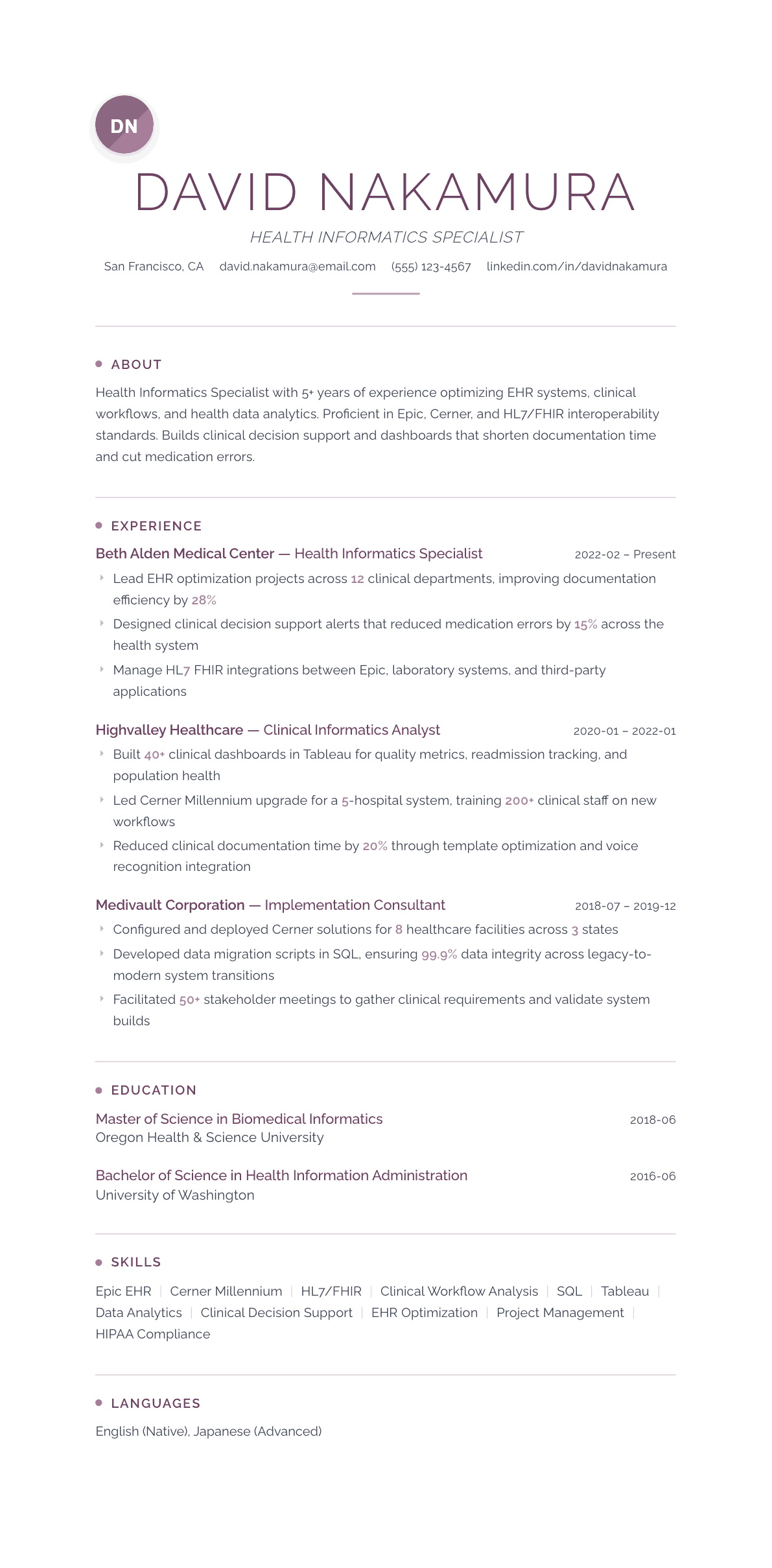
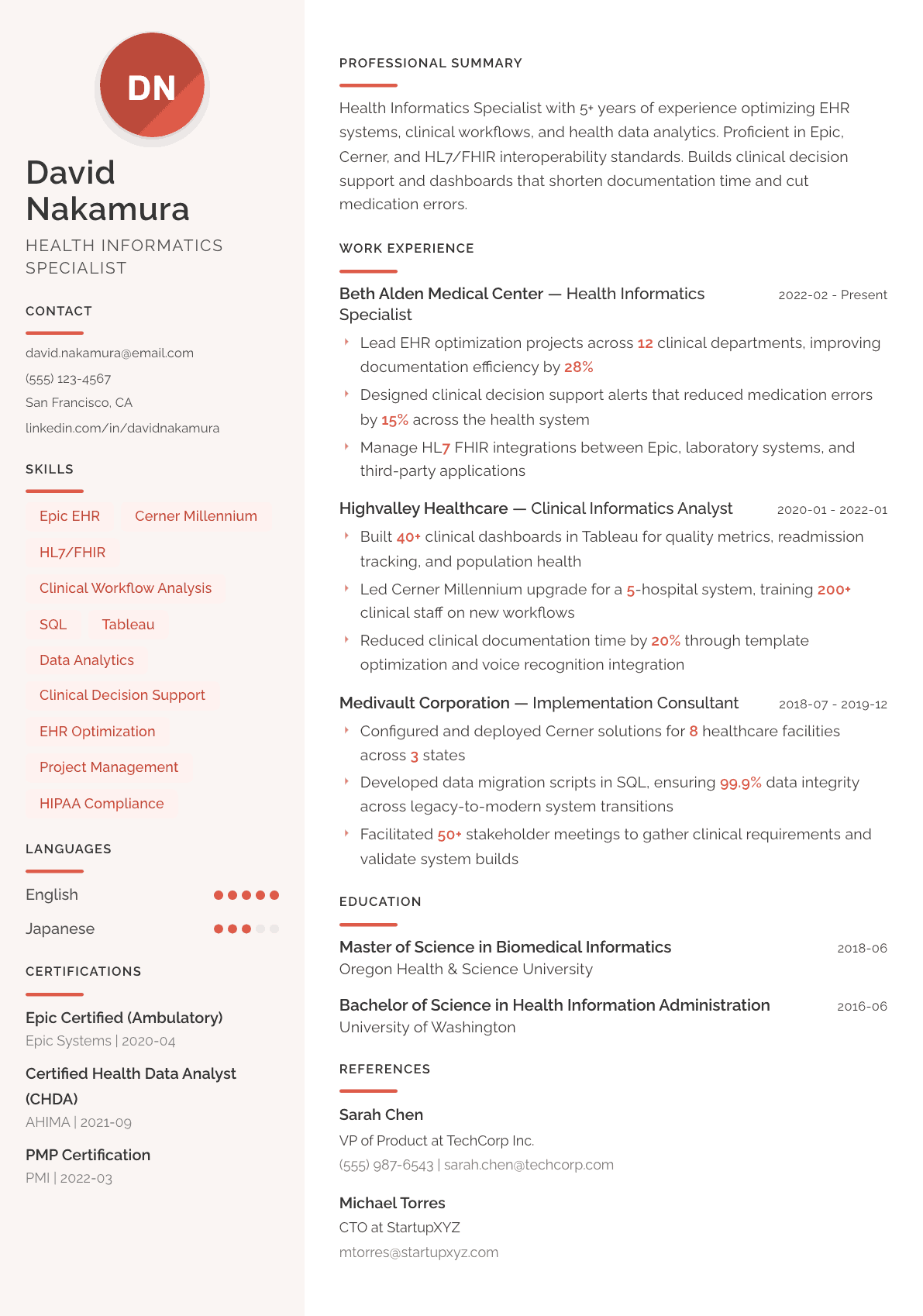
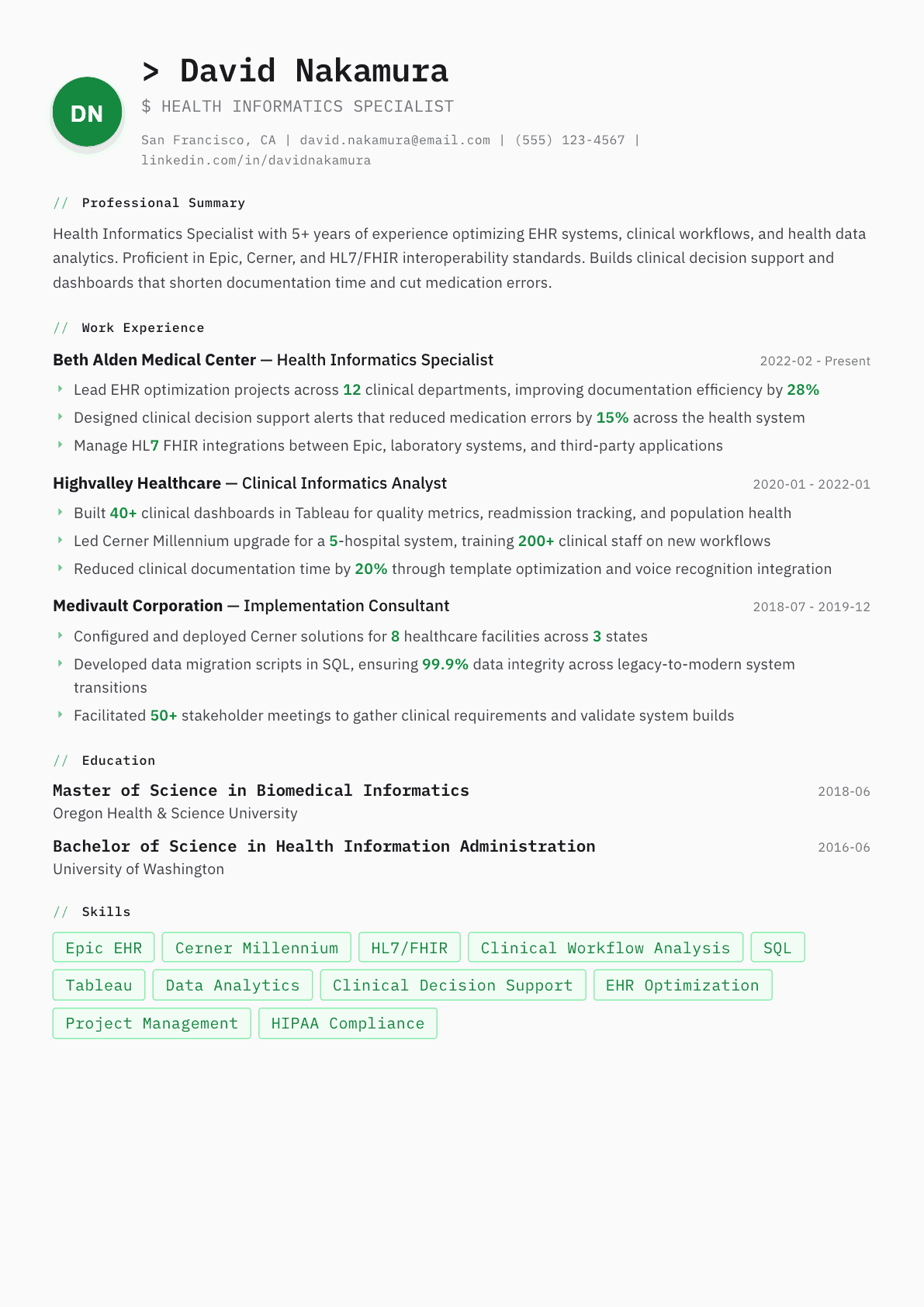
The same health informatics specialist content laid out in three CVBooster templates, so you can see what the finished document looks like before you write a word.
Example Health Informatics Specialist summary
Health Informatics Specialist with 5 years optimizing EHR systems and clinical workflows across multi-hospital systems. Epic-certified, fluent in HL7/FHIR interoperability, SQL analytics and clinical decision support, with a 28% gain in documentation efficiency across 12 departments. Targeting a clinical informatics lead role.
Skills to list on a Health Informatics Specialist resume
- Epic EHR
- Cerner Millennium
- HL7/FHIR
- SQL
- Tableau
- Clinical Workflow Analysis
- Data Analytics
- EHR Optimization
- Clinical Decision Support
- HIPAA Compliance
- Project Management
- Interoperability Standards
- Quality Metrics
- Population Health
What actually gets this resume read
- Highlight specific EHR certifications such as Epic, Cerner, or MEDITECH.
- Quantify improvements in workflow efficiency, documentation time, and error reduction.
- List interoperability standards you work with, including HL7, FHIR, and CDA.
- Include data analytics and SQL skills alongside clinical informatics expertise.
- Mention experience with clinical decision support systems and quality metrics.
- Show project management experience, as informatics roles often involve cross-functional leadership.
How to write a health informatics specialist resume
A health informatics specialist sits between clinicians and systems, and the resume has to prove both halves. The hiring manager, usually a director of clinical informatics or an information technology applications manager, is checking whether you can sit in a workflow observation with nurses in the morning and build or specify the change in the afternoon without breaking the record.
The fastest way to fail that screen is to write a resume that reads as pure information technology or pure clinical. Pure technologists get filtered out because they cannot describe a clinical workflow. Pure clinicians get filtered out because they cannot name a build tool, an interface standard or a reporting layer. The resumes that clear both name the electronic health record modules by name, the certifications the vendor issues, and the clinical outcome the build was supposed to move.
This guide covers the section order informatics teams expect, how to write build and optimization work so it is credible, three summaries covering a clinician moving into informatics, an analyst several years in and a lead, and the bullet rewrites that separate a project participant from a project owner.
Format: a certification block and a systems block, both near the top
Reverse chronological, one to two pages, no graphics. Under the summary place two compact blocks. The first is vendor certification, since Epic module certification and Cerner credentialing are frequently hard requirements written into the posting rather than preferences. The second is systems and standards, listing the records, integration engines, reporting tools and query languages you have actually worked in.
Keep these blocks scannable and specific. Epic Ambulatory, Epic ClinDoc, Epic Willow, Epic Cogito, Cerner PowerChart or Millennium, Meditech Expanse, Rhapsody or Mirth interface engines, SQL, Tableau or Power BI. A screener matching a posting line by line finds these in seconds.
- Header: name with clinical credentials if you hold them, city and state, phone, email.
- Order: summary, vendor certifications, systems and standards, professional experience, clinical experience, education, projects.
- Clinicians moving into informatics keep the clinical role in the timeline, since workflow credibility is the reason they are competitive.
Summary: the clinical domain, the system, and the scale
Two or three sentences naming the clinical domain you support, the record and modules you build in, the size of the organization, and one thing you have delivered end to end. A director staffing an ambulatory optimization team wants to see ambulatory workflows and the matching module certification in the first line.
If you are moving from bedside practice, state it and name the bridge: superuser work, at the elbow support during a go live, order set or documentation template design, or a departmental report you built. These are the tasks that show you have already done informatics under a different job title.
Experience: build, optimization, and the workflow behind it
For each role give the organization scale first: number of hospitals and clinics, approximate user count for the applications you supported, and which service lines. Then write bullets in the shape of a change: the workflow problem, what you built or configured, how it was validated and trained, and what moved afterward.
Name the artifacts. Order sets, documentation flowsheets and templates, clinical decision support alerts with the firing logic and the override review, SmartText and note templates, registry rules, patient portal configuration, charge capture routing, and clinical content governance submissions. These are the deliverables an informatics manager recognizes as real work.
Alert work deserves particular care. Anyone can add an alert; the credible bullet says what the alert fired on, the volume it generated, the override rate, and the tuning you did afterward. Alert fatigue is the problem informatics teams live with, so evidence that you manage it rather than create it is persuasive.
Interoperability, data and reporting
Integration work is what separates an informatics specialist from a trainer. Name the standards you have worked with directly: HL7 version two message types and segments, FHIR resources and application programming interfaces, CDA documents for exchange, LOINC and SNOMED terminology mapping, and ICD and CPT code sets where they drive the build.
Reporting is the other half. Say which layer you worked in, whether that was a vendor reporting workbench, a data warehouse, or direct SQL against a clinical data store, and what the reports were used for: quality measure submission, regulatory reporting, operational dashboards, or population health registries. Give the audience and the decision the report supported, not only the tool.
Go lives, training and governance
Implementation experience is heavily weighted because it is expensive to buy. Describe each go live with the scope, your role, the number of users trained or supported, the command center structure and the issue volume you triaged. Note whether you handled testing, whether you wrote scripts, and whether you did conversion or dual documentation planning.
Governance is the quiet differentiator. Informatics teams need people who can take a request through a clinical content committee, document the decision, and say no with a reason. If you have staffed or chaired that kind of committee, give it a line with the request volume you processed.
Health Informatics Specialist resume summary examples
Clinician moving into informatics
Registered nurse with five years in acute care moving into clinical informatics, having served as unit superuser through an Epic go live and built 14 documentation flowsheet rows adopted across two units. Completed a graduate certificate in health informatics and comfortable with SQL basics and workflow mapping.
Four years as an analyst
Health Informatics Specialist with four years supporting Epic Ambulatory and ClinDoc for a four hospital system with 6,000 clinical users. Certified in two modules, builds order sets and decision support, and cut alert override rates on the sepsis rule from 91% to 62% through firing logic tuning.
Informatics lead
Clinical informatics lead with ten years across Cerner and Epic environments, managing three analysts and the clinical content governance process for a nine site organization. Led two full record implementations, owns HL7 and FHIR interface planning, and chairs the decision support review committee.
Work experience bullets: before and after
Before: Worked on EHR projects for the hospital.
After: Supported Epic Ambulatory and ClinDoc for a four hospital system with about 6,000 clinical users, owning build for primary care, cardiology and endocrinology workflows.
Named modules, organization scale and service lines let a manager map your experience onto their own environment.
Before: Created clinical decision support alerts.
After: Rebuilt the sepsis decision support rule with narrowed firing logic and a two step interruptive design, reducing override rates from 91% to 62% while keeping bundle initiation stable.
Override reduction with no loss of the intended action is the outcome informatics teams actually care about.
Before: Built reports for the quality department.
After: Built 18 reports in the vendor reporting workbench and direct SQL for quality measure submission and readmission review, replacing a monthly manual chart abstraction of about 300 records.
The volume, the purpose and the manual work removed show the report changed how a department operates.
Before: Helped with the go live.
After: Ran a command center pod during a nine clinic go live, supporting 340 users, triaging 210 issues in the first week and escalating 22 build defects with reproduction steps.
Scope, user count and issue volume describe a real implementation role instead of attendance.
Before: Trained staff on the new system.
After: Wrote role based training materials and delivered 26 sessions for nurses, providers and front desk staff, then held four weeks of at the elbow support and fed the recurring questions back into build changes.
Session counts plus the feedback loop into build show training tied to optimization rather than a one time event.
Hard skills
- Epic module build and configuration
- Cerner Millennium configuration
- Clinical workflow analysis
- Order set and documentation template design
- Clinical decision support design and tuning
- HL7 version two messaging
- FHIR application programming interfaces
- SNOMED and LOINC terminology mapping
- SQL querying
- Tableau and Power BI dashboards
- Interface engine support
- System testing and validation scripts
- Data migration and reconciliation
- Quality measure and regulatory reporting
Soft skills
- Clinician requirement gathering
- Translating between clinical and technical teams
- Change management
- Governance facilitation
- Go live composure
Certifications worth listing
- Epic module certification (Epic Systems Corporation)
- Certified Professional in Health Informatics (CPHI) (American Health Information Management Association)
- Certified Associate in Healthcare Information and Management Systems (CAHIMS) (HIMSS)
- Certified Professional in Healthcare Information and Management Systems (CPHIMS) (HIMSS)
- Registered Health Information Administrator (RHIA) (American Health Information Management Association)
- Project Management Professional (PMP) (Project Management Institute)
Mistakes that cost health informatics specialist candidates the interview
- Writing a resume that names no modules, no standards and no query language, which reads as a trainer rather than an informatics specialist.
- Listing certification without the vendor, when the posting is often filtered on exactly that certification name.
- Describing projects without the organization scale or user count, so the reader cannot judge whether the environment resembles theirs.
- Claiming decision support work without override rates or tuning, which suggests you added alerts and left them.
- Deleting the clinical role during a career change, when workflow credibility is the whole reason a clinical background is valuable here.
- Saying supported the go live with no scope, role, user count or issue volume behind it.
- Leaving out governance and content review work, which is the part of the job that scales an informatics team.
Health Informatics Specialist resume questions
Do I need Epic certification to get a health informatics job?
For many analyst positions inside Epic organizations, yes, because certification is granted through an employer sponsorship rather than purchased individually. If you lack it, target organizations that sponsor training, and lead with module experience, superuser work and workflow analysis to show you would certify quickly.
How do I move from bedside nursing into clinical informatics?
Keep the clinical job on the resume and translate it. Superuser work, go live support, order set or documentation design, unit reports, and workflow redesign are all informatics tasks performed under a clinical title. Add a formal informatics course or certificate to signal the direction.
What technical skills should be on the resume?
At minimum SQL, one reporting or visualization tool, and familiarity with HL7 and FHIR. Add the interface engine, testing tools and any scripting you have used. Name the depth honestly, since a technical screen usually follows and overstatement is discovered quickly.
How should I present implementation and go live experience?
Give each implementation its own block with the scope, the record and modules, your specific role, the user count supported, the command center structure and the issue volume you handled. Implementation experience is expensive to acquire, so it deserves detail rather than a single line.
Is a masters degree required for health informatics roles?
Not for analyst positions, where vendor certification and hands on build experience usually outweigh a degree. A graduate degree in informatics matters more for leadership, research and clinical informatics roles that report into a chief medical or chief nursing information officer.