Clinical Research Associate Resume Examples: free score
Craft a Clinical Research Associate Resume for CRO Hiring
By Mustafa Tarabya, founder of CVBooster · Published · Updated
Clinical research associate resume examples with monitoring visit, ICH GCP and EDC keywords, plus a guide to writing site oversight experience.
Sample resumes for a clinical research associate
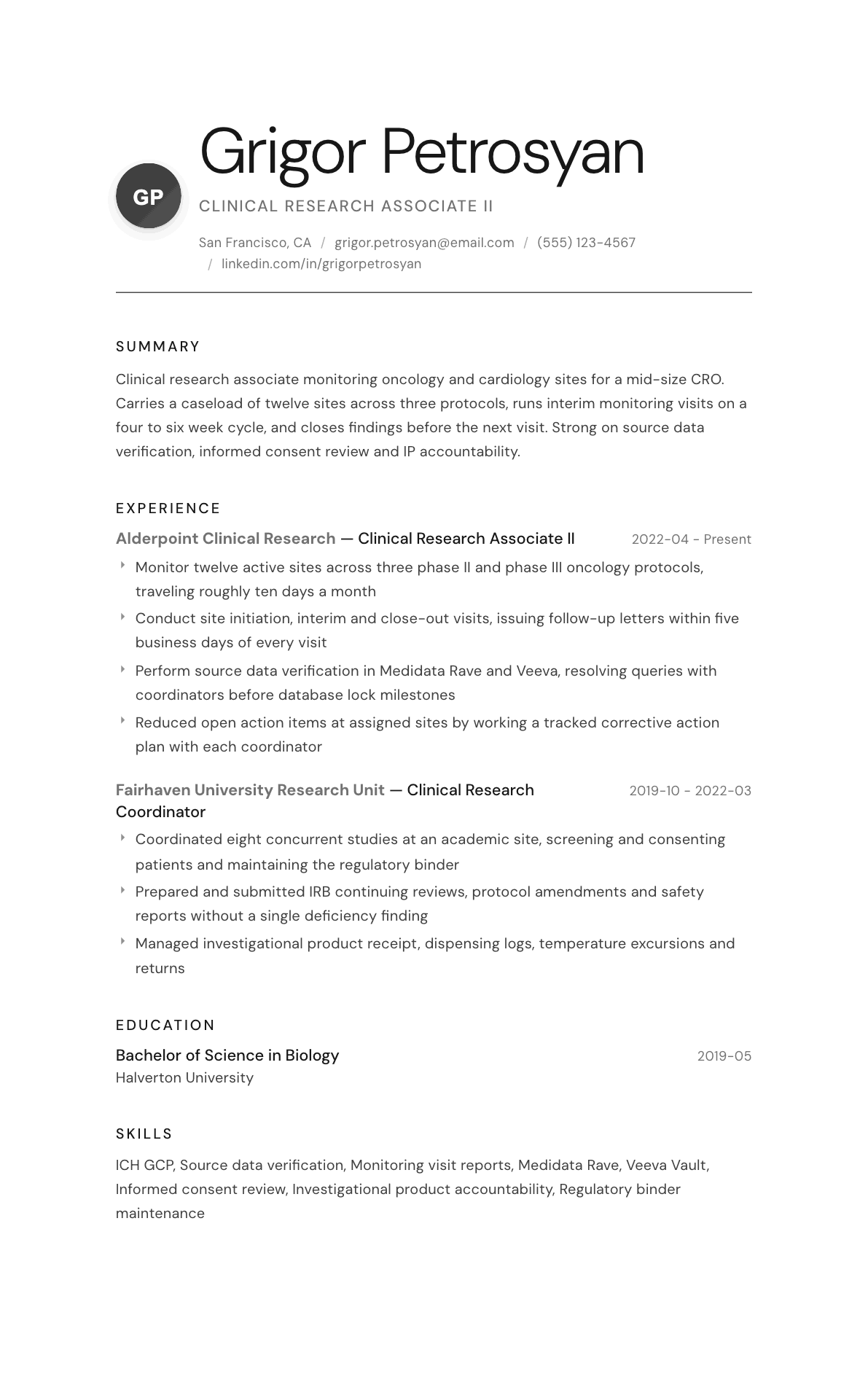
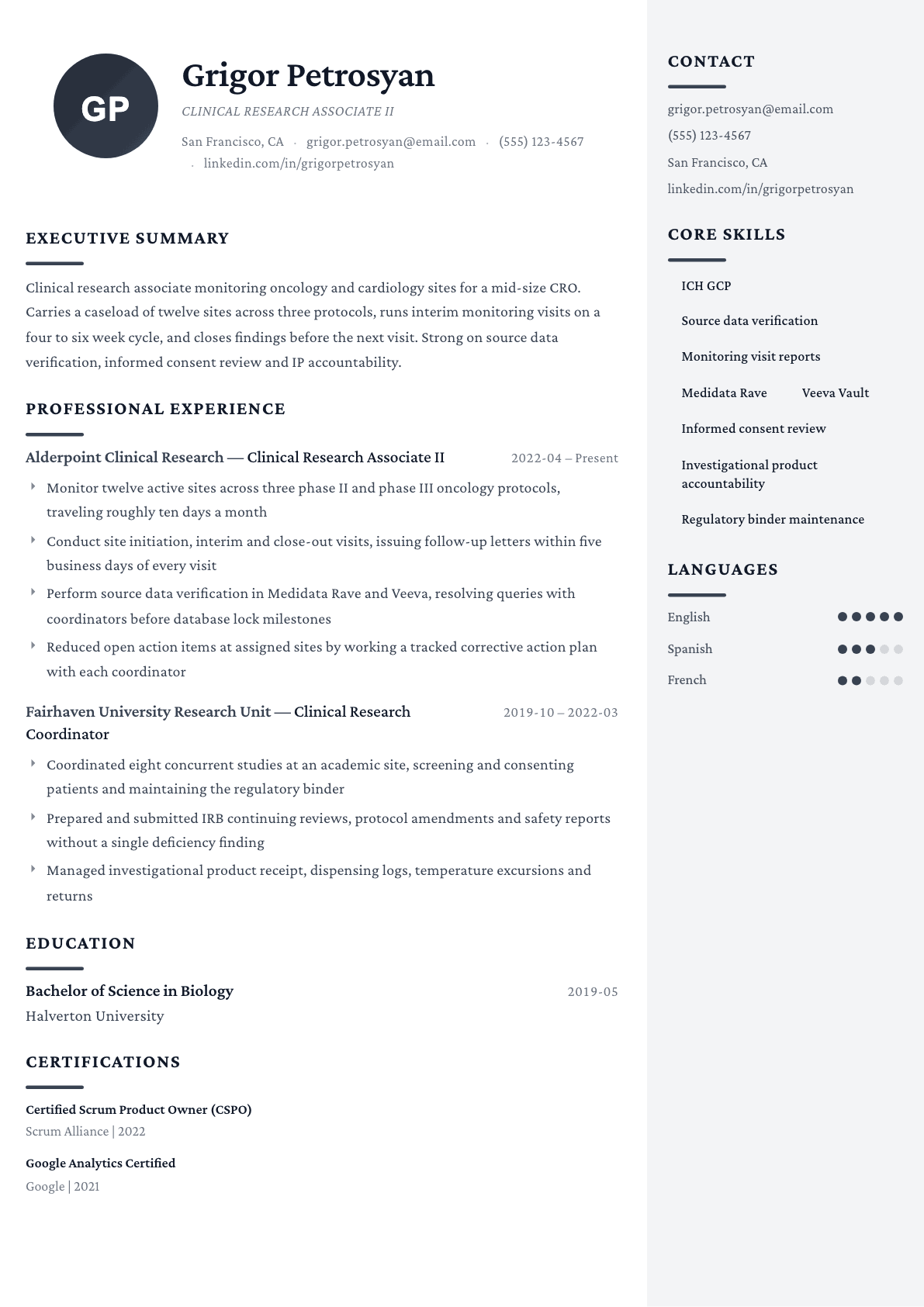
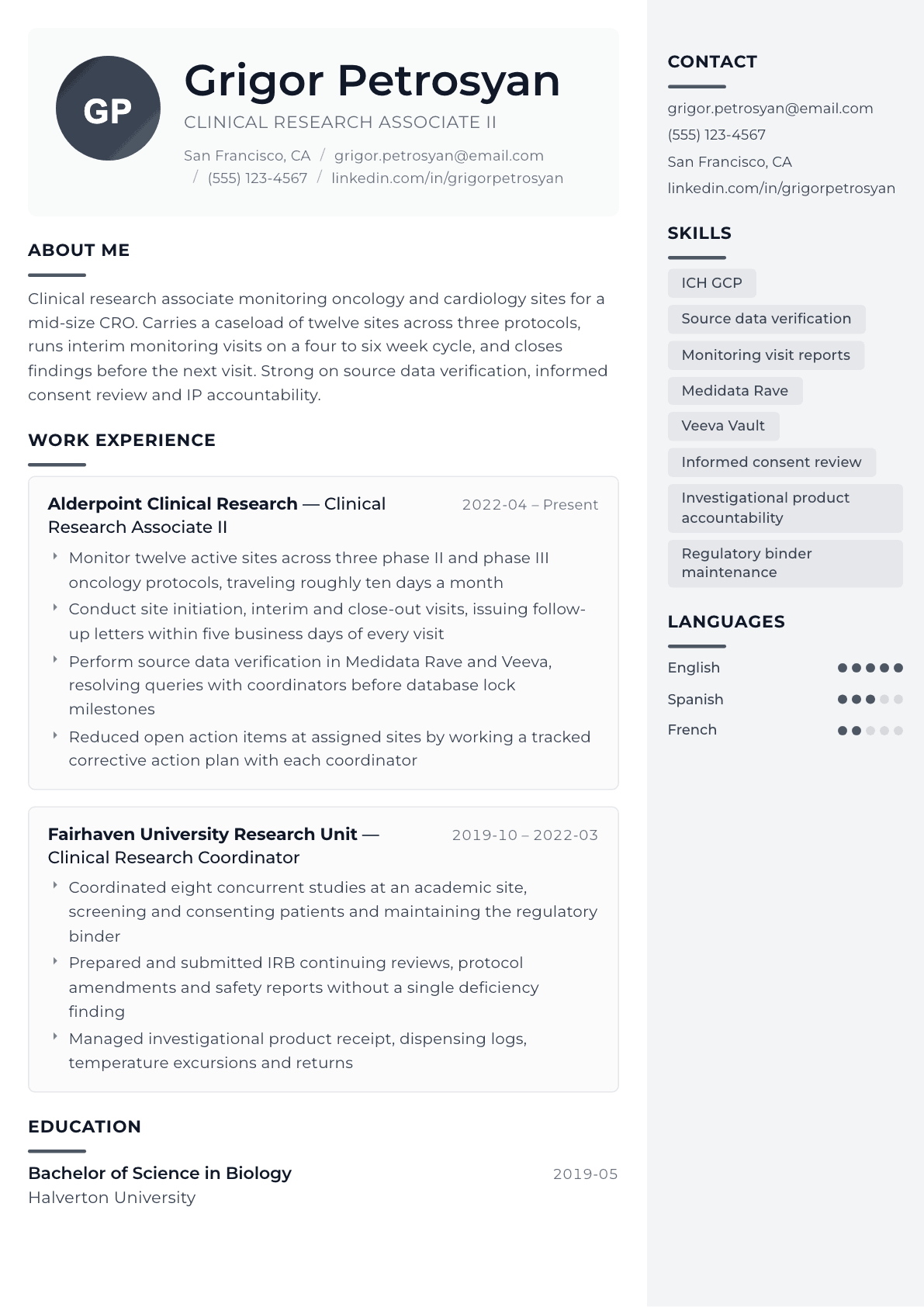
The same clinical research associate content laid out in three CVBooster templates, so you can see what the finished document looks like before you write a word.
Example Clinical Research Associate summary
Clinical research associate with four years of site oversight, currently monitoring twelve oncology and cardiology sites across three protocols for a global CRO. Runs the full visit cycle from qualification to close-out, verifies source data in Medidata Rave, and turns follow-up letters around inside a week. Started as a coordinator, so site problems are recognized before they become findings.
Skills to list on a Clinical Research Associate resume
- ICH GCP compliance
- Site qualification visits
- Site initiation visits
- Interim monitoring visits
- Close-out visits
- Source data verification
- Monitoring visit reports
- Protocol deviation management
- Informed consent review
- Investigational product accountability
- Medidata Rave
- Veeva Vault
- CTMS
- IRB and regulatory submissions
- Corrective and preventive action plans
- Serious adverse event reporting
What actually gets this resume read
- State your monitoring caseload, the therapeutic areas and the phases, because CRO recruiters filter on all three.
- Name the EDC and CTMS platforms you have worked in, since Medidata Rave, Veeva and Oracle are screening keywords.
- Give the visit types you run independently: site qualification, initiation, interim monitoring and close-out.
- Say how fast you turn around monitoring visit reports and follow-up letters, because timeliness is a tracked metric.
- Include travel percentage and territory, since a regional caseload changes what a hiring manager expects of you.
- Show findings you closed, not just findings you raised, because sponsors judge a monitor on resolution.
How to write a clinical research associate resume
Clinical research associate hiring is unusually mechanical. A contract research organization recruiter filters on therapeutic area, trial phase, number of sites monitored, monitoring visit types performed independently, and the electronic data capture system in the resume. If those five facts are not visible in the top third of page one, the file rarely reaches a hiring manager.
The second read is different. A clinical operations lead wants to know whether your sites stay clean between visits. Findings raised are easy; findings closed, coordinators trained, protocol deviations prevented and enrollment kept honest are the evidence that you monitor rather than inspect.
This guide sets out the section order sponsors and contract research organizations expect, how to write monitoring experience in the vocabulary of the visit types, three summaries from coordinator moving into monitoring through senior monitor, five rewritten bullets, and the questions monitors ask when they move between therapeutic areas.
Format: two pages, therapeutic areas visible immediately
Two pages is normal. Use reverse-chronological order and put a compact study table or a study block under each employer listing the protocol phase, therapeutic area, site count and your visit types. Recruiters read that block before they read prose.
Keep the layout single column and avoid graphics. Files pass through several systems between the applicant tracking platform and the hiring manager, and anything decorative tends to arrive broken.
- Header: name, city and state, phone, email, willingness to travel.
- Order: summary, therapeutic and system snapshot, monitoring experience by study, training and certifications, education.
- Coordinators moving into monitoring keep the site role in full and highlight regulatory and consent work.
Summary: caseload, phase, therapeutic area, travel
Four facts in three lines: how many sites you carry, which phases and therapeutic areas, which visit types you run without oversight, and your travel tolerance. Travel is a screening question in every monitoring interview, so answering it on the page saves a round.
If you are coming from a coordinator role, say so and use it. Someone who has sat on the site side knows why a binder is behind and how to fix it without an escalation, and that is a genuine advantage worth stating.
Experience: visit types, source verification, findings closed
Structure every entry around the monitoring cycle. Site qualification and selection, site initiation and training, interim monitoring on a defined interval, and close-out. Say which of these you perform independently and which you co-monitor, because a resume that blurs the two gets tested in the interview.
Then describe the work inside a visit: source data verification against the electronic data capture system, informed consent review including reconsent after amendments, investigational product accountability and temperature excursion handling, delegation log and training documentation, and protocol deviation identification.
Report turnaround is a tracked metric in this job, so put it on the page. Monitoring visit reports submitted within the contracted window and follow-up letters issued within a stated number of business days are facts your reader can verify against her own quality metrics.
Finish with closure. Findings resolved before the next visit, corrective action plans agreed with coordinators, sites brought back into compliance, and query aging reduced ahead of database lock. Sponsors judge monitors on the state their sites are in, not on the length of the finding list.
Systems, training and regulations
List every electronic data capture, clinical trial management and document platform you have used by name. Medidata Rave, Veeva Vault, Oracle systems, Medrio and the trial master file platform belong in the resume text because they are searched for directly.
Add your training record: good clinical practice training with the provider and refresh date left as a status rather than a year, human subjects protection, protocol specific training and any therapeutic area training a sponsor provided. Regulations should be named in the way they appear in postings, meaning ICH E6 good clinical practice and the applicable federal regulations for informed consent and investigational product.
Travel, territory and remote monitoring
State the territory you have covered and the travel percentage you can sustain. Regional monitoring, national travel and fully remote or centralized monitoring are separate hiring pools, and a monitor who has done risk based and remote source review should say so, because sponsors now expect a mix of on-site and remote work.
Clinical Research Associate resume summary examples
Coordinator moving into monitoring
Clinical research coordinator with three years at an academic site running eight concurrent oncology and cardiology studies. Consented patients, maintained regulatory binders, handled investigational product accountability, and passed two sponsor audits without a major finding. Trained in good clinical practice and moving into a monitoring role.
Monitoring twelve sites
Clinical research associate carrying twelve active sites across three phase II and phase III oncology protocols. Runs qualification, initiation, interim and close-out visits independently, performs source data verification in Medidata Rave, and issues follow-up letters within five business days of each visit.
Senior or lead monitor
Senior clinical research associate and lead monitor for global respiratory and immunology programs. Oversees a team of four monitors, co-monitors for quality, authors the monitoring plan and site training materials, and manages the risk register that drives visit frequency across thirty sites.
Work experience bullets: before and after
Before: Monitored clinical trial sites for compliance.
After: Monitored twelve active sites across three phase II and III oncology protocols, running qualification, initiation, interim and close-out visits independently.
Site count, phase and the named visit types are the exact facts a contract research organization recruiter filters on.
Before: Reviewed data at site visits.
After: Performed source data verification against Medidata Rave for primary endpoints and safety data, resolving discrepancies with coordinators during the visit rather than by query afterward.
It names the system, the data prioritized and the resolution method instead of describing a generic review.
Before: Wrote visit reports after monitoring.
After: Submitted monitoring visit reports inside the contracted turnaround and issued follow-up letters within five business days, keeping the report backlog at zero across the assignment.
Turnaround times are tracked quality metrics, so stating them makes the claim checkable.
Before: Made sure informed consent was correct.
After: Reviewed every informed consent form for version, signature order and dating, and coordinated reconsent at four sites after a protocol amendment changed the risk section.
The specific failure modes and the amendment scenario show what consent review actually involves.
Before: Worked with sites to fix issues.
After: Agreed a written corrective action plan with each underperforming site and closed the majority of open action items before the following interim visit.
It moves from raising findings to resolving them, which is how sponsors judge monitoring quality.
Hard skills
- ICH E6 good clinical practice
- Site qualification and selection visits
- Site initiation visits and site training
- Interim monitoring visits
- Close-out visits
- Source data verification
- Monitoring visit report authoring
- Informed consent and reconsent review
- Investigational product accountability
- Protocol deviation identification
- Medidata Rave and Veeva Vault
- Corrective and preventive action planning
Soft skills
- Coaching site coordinators
- Escalation judgment
- Independent time management on the road
- Diplomacy with investigators
- Written precision under a deadline
Certifications worth listing
- Certified Clinical Research Associate (CCRA) (Association of Clinical Research Professionals)
- Certified Clinical Research Professional (CCRP) (Society of Clinical Research Associates)
- Certified Clinical Research Coordinator (CCRC) (Association of Clinical Research Professionals)
Mistakes that cost clinical research associate candidates the interview
- Hiding the site count, phase and therapeutic area in prose when recruiters filter on exactly those fields.
- Claiming independent visit types you have only co-monitored, which the interview will test directly.
- Listing findings raised without ever showing a finding closed or a site brought back into compliance.
- Leaving the electronic data capture platform out of the resume text, so the file never matches the posting.
- Ignoring travel capacity, when it is the question every monitoring interview opens with.
- Writing the same resume for oncology and device studies, when the source documents and the risks differ.
Clinical Research Associate resume questions
How many sites should a clinical research associate list?
List your current active caseload and the total sites you have monitored across your career, separated. Recruiters use the active number to judge capacity and the total to judge breadth, and combining them into one figure makes both harder to trust.
Can I become a monitor from a coordinator role?
Yes, and it is the most common path. Emphasize regulatory binder ownership, informed consent, investigational product accountability and audit outcomes, then state in the summary that you are targeting monitoring and can travel. Sponsors value the site perspective.
Which electronic data capture systems matter most on this resume?
Name every system you have worked in, because postings specify them. Medidata Rave and Veeva are the most frequently requested, but Oracle, Medrio and sponsor-built platforms all count. Add the clinical trial management system and the trial master file platform too.
Do I need a research certification to get hired?
It is not mandatory, but a recognized credential helps when your monitoring experience is thin. Include the certifying organization, since two different professional bodies issue similarly named credentials and credentialing teams check the exact source.
How do I show remote monitoring experience?
Describe it as its own activity: centralized data review, remote source access through the site portal, risk based monitoring triggers, and how remote review changed your on-site visit frequency. Sponsors increasingly hire for a blended model and screen for it explicitly.