Medical Coder Resume Examples: free ATS score and gap list
Medical Coder Resume: Medical Coding Resume Examples and Template
By Mustafa Tarabya, founder of CVBooster · Published · Updated
Medical coding resume examples, a sample and a template for a certified coder, billing specialist and revenue cycle lead, with credentials and keywords.
Sample resumes for a medical coder
The same medical coder content laid out in three CVBooster templates, so you can see what the finished document looks like before you write a word.
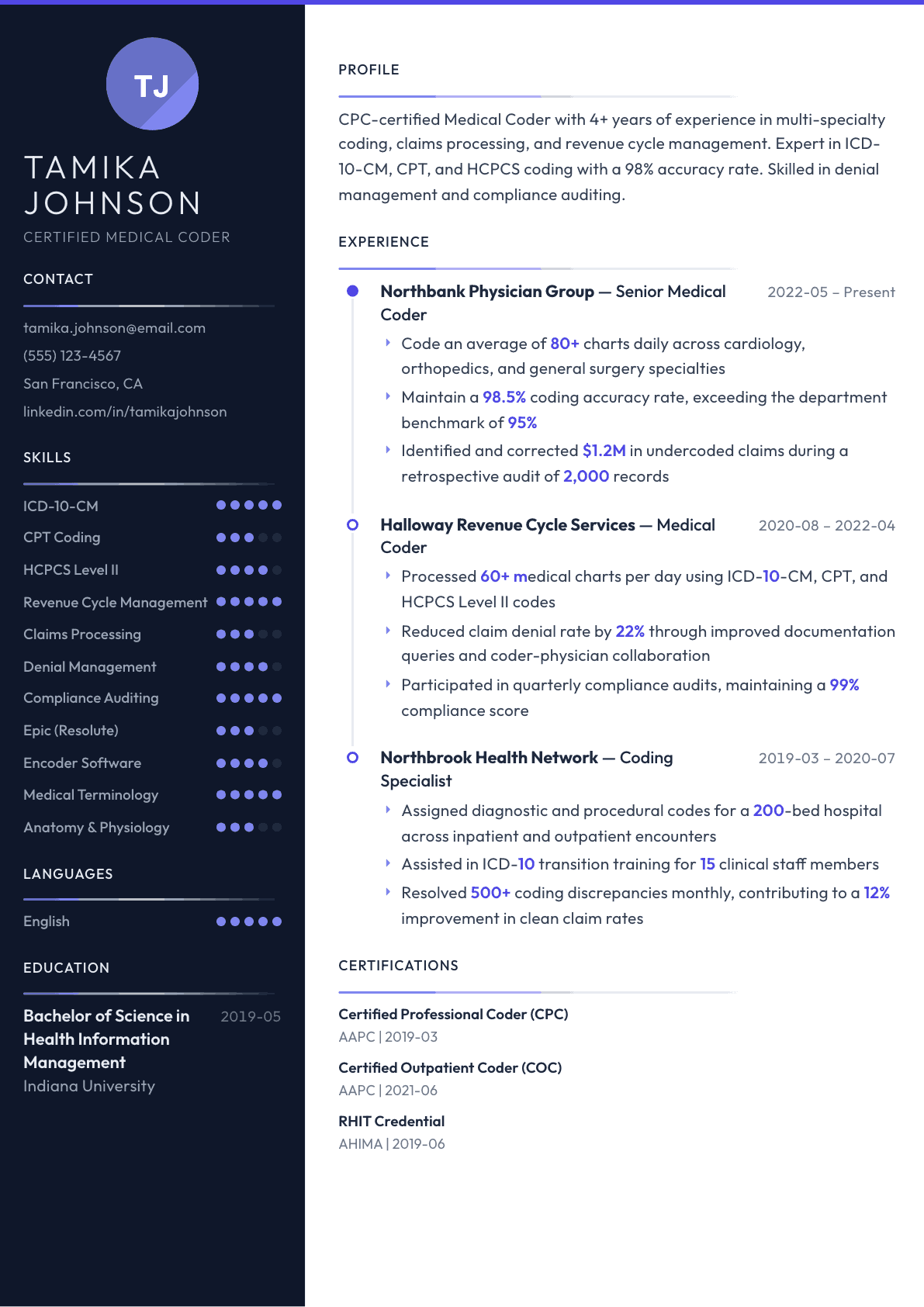
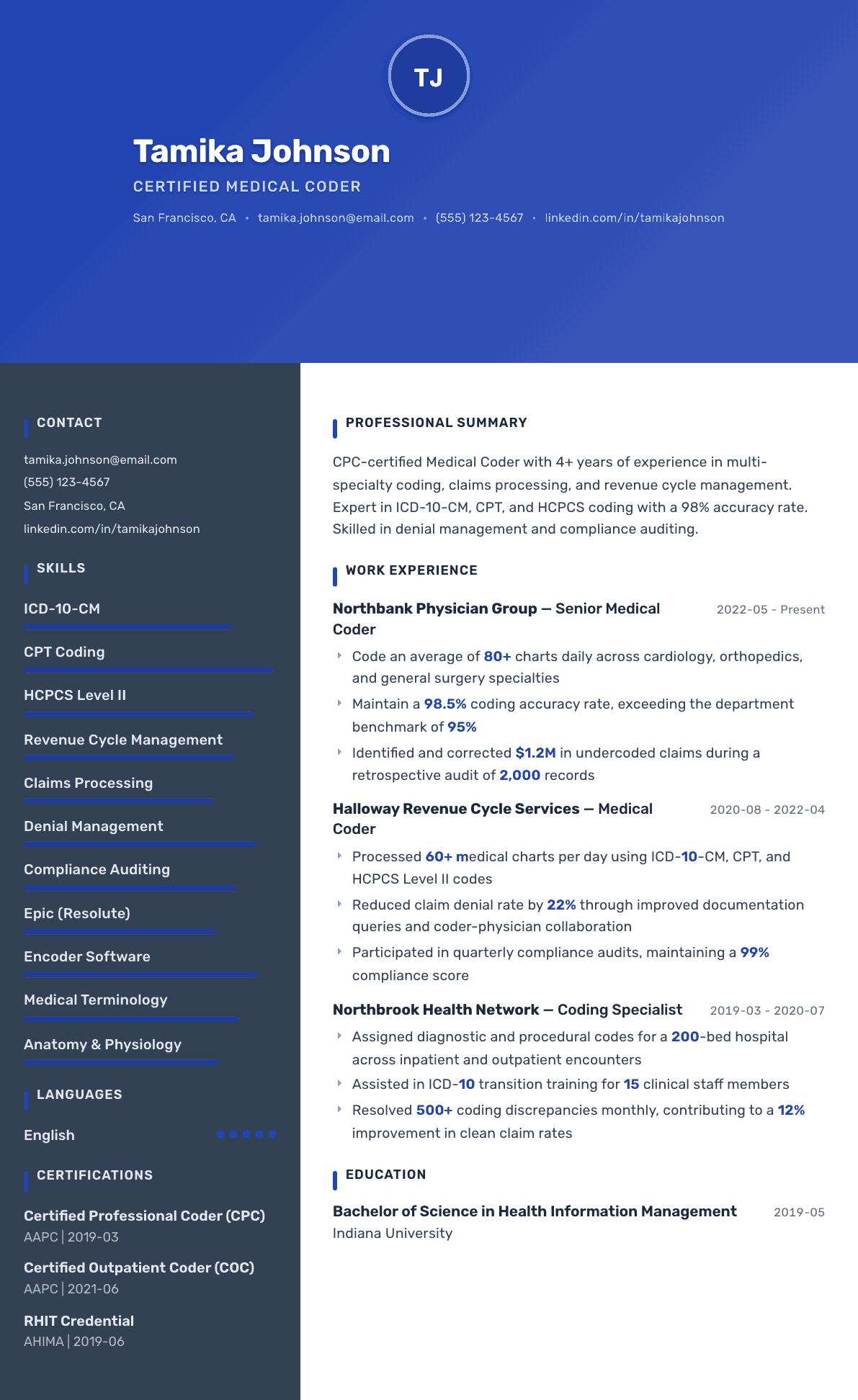
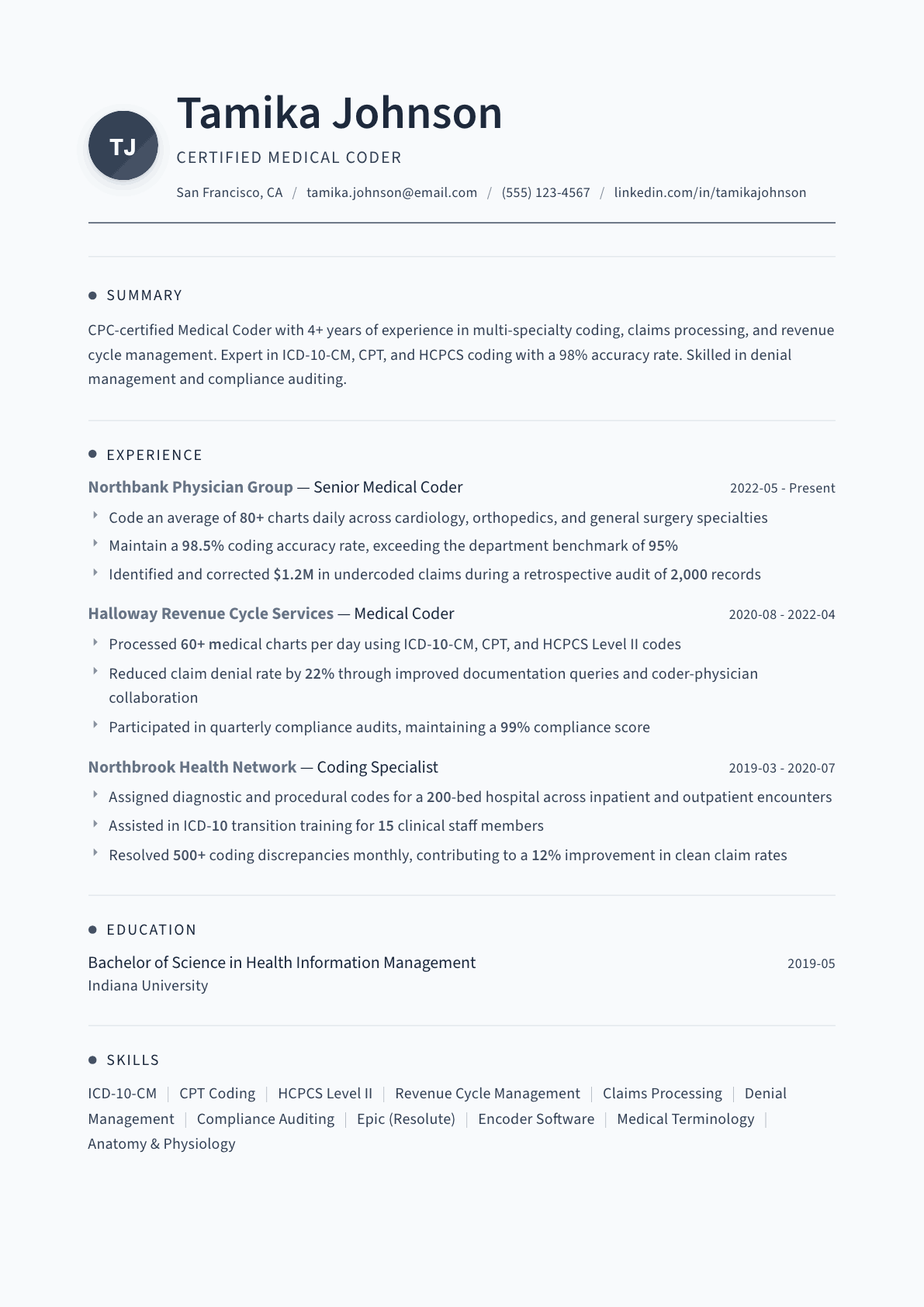
Example Medical Coder summary
CPC-certified Medical Coder with 4 years of multi-specialty coding and a 98.5% accuracy rate on 80+ charts a day. Works in ICD-10-CM, CPT and HCPCS, cut denial rates by 22%, and recovered $1.2M in undercoded claims through retrospective audit. Open to remote coding roles in a large physician group.
Skills to list on a Medical Coder resume
- ICD-10-CM
- CPT Coding
- HCPCS Level II
- Revenue Cycle Management
- Claims Processing
- Denial Management
- Compliance Auditing
- Medical Terminology
- Encoder Software
- Epic Systems
- DRG Assignment
- E/M Coding
- Anatomy & Physiology
- HIPAA Compliance
What actually gets this resume read
- List your CPC, CCS, or RHIT certification prominently near the top of your resume.
- Quantify coding accuracy rates, daily chart volumes, and revenue impact.
- Specify the specialties you have coded for to match job requirements.
- Mention encoder software and EHR systems you are experienced with.
- Highlight compliance and audit experience, as employers value regulatory knowledge.
- Include continuing education units (CEUs) relevant to coding updates.
How to write a medical coder resume
Medical coding hiring is unusually mechanical. A coding manager or health information management director opens the file and looks for three facts in this order: which credential you hold and who issued it, whether you code professional or facility claims, and which specialties or service types you have production experience in. If those three do not match the opening, nothing else on the page is read.
The reason is that coding roles are narrow. Inpatient facility coding with diagnosis related group assignment is a different job from outpatient surgery coding, which is different from evaluation and management coding for a physician group, risk adjustment coding for a health plan, or interventional radiology and cardiology coding that need their own specialty training. A resume that says medical coder and lists code sets forces the manager to guess.
This guide covers the credential and specialty structure a coding resume needs, the accuracy and productivity numbers managers audit against, three summaries from newly credentialed through to a coding auditor, and rewrites of the bullets that appear on nearly every coding application.
Format: credential first, specialty second, systems third
One page for most coders, two once you have auditing, education or management history. Reverse chronological, plain layout, since large health systems and revenue cycle vendors screen through an applicant tracking system that is matching credential strings literally.
Under the summary put a credential block: the credential with the issuing organization, the date earned, current status, and any specialty credential such as inpatient, outpatient, risk adjustment or a specialty coding certificate. Follow it with a specialty and setting block listing the service types you have coded in production and the encounter types, then a systems block naming the encoders, records and billing platforms you have used.
- Header: name with credentials, city and state, phone, email, and remote availability if the role is remote.
- Order: summary, credentials, coding specialties and settings, systems, professional experience, education, continuing education.
- Newly credentialed coders add a practicum or apprentice removal block with the chart types and volume completed.
Summary: professional or facility, specialty, and accuracy
Two or three sentences that answer the manager's screening questions directly: professional or facility coding, the specialties, the encounter types, your credential, and your audited accuracy rate against the department standard. Accuracy is the currency of this job, so a coder who states an audited figure with the benchmark it was measured against reads as someone who has been measured.
If you are moving between coding types, say it and name the bridge. An outpatient coder targeting inpatient work should point at any observation, same day surgery or diagnosis related group exposure, plus the anatomy, pathophysiology and pharmacology coursework that inpatient managers ask about.
Experience: chart types, volume, and accuracy
Head each job with the setting and scope: physician group with the specialty and provider count, hospital with the bed count and the service lines you coded, health plan, or a coding vendor with the client types. Then give the three numbers every coding manager asks for: charts or encounters coded per day, audited accuracy rate, and the quality standard you were held to.
Name the chart types precisely. Evaluation and management office visits, same day surgery, observation, emergency department facility and professional, inpatient with diagnosis related group and severity assignment, ancillary, interventional procedures, or risk adjustment chart review with hierarchical condition categories. This is what tells a manager how fast you would reach production.
Add the query work. Number of provider queries written per month, query response rate, and the documentation gaps you targeted such as unspecified diagnoses, missing acuity, laterality or linkage. Coders who write clean compliant queries are far rarer than coders who assign codes.
Denials, audits and compliance
Denial work belongs on the resume because it connects coding to money. Say which denial categories you worked, medical necessity, bundling and modifier edits, coverage determination, missing authorization or diagnosis mismatch, how many appeals you wrote, and the overturn rate you achieved.
Audit exposure matters just as much. Internal quality audits, payer audits, recovery audit reviews and external coding audits all require a coder who can defend an assignment against the official guidelines. Name the guidance you work from, the official coding guidelines, coding clinic advice and the national correct coding initiative edits, since citing sources is what distinguishes a coder from a code lookup.
Compliance is the third leg. Privacy and security training, the coding compliance plan, and how you handled a request to code something the documentation did not support. Managers ask that question in every interview and a resume that already shows compliance judgment is ahead.
Systems, remote work and keywords
Name the encoder and grouping software you have used, such as 3M or Optum encoders, the computer assisted coding tool if any, the record system such as Epic, Cerner or Meditech, the billing and claim scrubbing platform, and the audit tracking tool. Coding roles are usually remote now, so encoder and record familiarity decides how short your ramp is.
Mirror the exact vocabulary from the posting once in the credential or skills block and once inside a bullet: ICD-10-CM, ICD-10-PCS, CPT, HCPCS Level II, modifiers, diagnosis related groups, ambulatory payment classifications, hierarchical condition categories, charge capture, clean claim rate and revenue cycle. For remote positions, add a short line on your workspace, connection and any prior fully remote production record.
Medical coding resume examples, samples and a template
A medical coding resume template that works for most coders has six blocks in this order: name with the credential beside it, a three line summary naming professional or facility coding and your specialties, a certifications block with issuer, a systems line, experience with daily volume and audit accuracy, then education. One column, no tables or graphics. The medical coding resume examples below show how the summary and experience blocks read in four different jobs; copy the order, not the details.
Many postings, especially in physician practices and small clinics, combine the two jobs: one person codes the encounter and then works the claim through to payment. Medical coding and billing resumes for those roles lead with the coding credential and specialty, then show the billing half with payers, claim volume, denials and accounts receivable. If the posting is billing heavy, put the claims work first and the credential in the header line.
The four samples below show an entry level billing and coding specialist, a certified coder who also works denials, a revenue cycle lead, and a remote outpatient coder whose job is coding only, written the way the summary and first bullets read on the page. For a pure coding post, follow the fourth: accuracy, chart types and the encoder carry the whole medical coding resume sample.
- Sample one, entry level: Medical Billing and Coding Specialist, CBCS, three physician family practice. Codes office visits, vaccines and minor procedures, enters charges, submits claims to Medicare, Medicaid and four commercial payers through the clearinghouse and posts payments from remittance advice.
- Sample one, second bullet: Works the rejection queue every morning, correcting demographic and eligibility errors so clean claims go out the same day.
- Sample two, certified coder: Certified Professional Coder, outpatient orthopedics and pain management. Codes surgery and injection encounters at production standard, then works the coding denials for the department, writing appeals with operative note excerpts and payer policy language.
- Sample two, second bullet: Tracked denial reasons for one quarter, found most modifier denials came from one procedure type and wrote a one page charge entry guide that the front desk and providers now follow.
- Sample three, revenue cycle lead: Revenue Cycle Lead, multispecialty group, CPC and CCS. Supervises five coders and billers, owns the weekly aging report and the payer follow up schedule, and runs monthly coding audits with feedback to providers.
- Sample three, second bullet: Rebuilt the follow up workflow by payer and aging bucket, so claims over sixty days get a named owner and a next action date.
- Sample four, coding only: Remote Outpatient Coder, CPC, health system coding team. Codes emergency department and outpatient surgery charts in 3M and Epic, about 120 ED charts a day, with quarterly external audits at or above the department accuracy standard.
- Sample four, second bullet: Sends provider queries for missing laterality and acuity through the record, and keeps a short list of the five query types that come back most often for the team's monthly education session.
Medical Coder resume summary examples
Newly credentialed
Newly credentialed coder with an associate degree in health information management and a completed practicum covering 240 outpatient charts across family medicine and orthopedics. Proficient in ICD-10-CM, CPT and modifier assignment, with audited accuracy of 94% during the practicum review.
Four years in production
Certified professional coder with four years of multispecialty outpatient production, coding 80 to 95 encounters daily across cardiology, orthopedics and general surgery. Holds audited accuracy of 98% against a 95% department standard and writes 30 provider queries a month with a 92% response rate.
Coding auditor
Inpatient coding auditor with eleven years spanning production coding, diagnosis related group validation and education. Audits 200 charts monthly across a three hospital system, leads a coder education series, and rebuilt the query template set that lifted response rates across the department.
Work experience bullets: before and after
Before: Assigned codes to medical records using ICD-10 and CPT.
After: Coded 80 to 95 outpatient encounters daily across cardiology, orthopedics and general surgery using ICD-10-CM, CPT and HCPCS Level II with modifier assignment.
Daily volume plus the specialties and encounter types tell a manager how quickly you would reach production on her queue.
Before: Maintained a high level of coding accuracy.
After: Held audited accuracy of 98% against a 95% department standard across eight consecutive quarterly reviews, with no repeat findings in any category.
Accuracy only means something with the benchmark, the audit cadence and the finding history attached.
Before: Queried physicians when documentation was unclear.
After: Wrote about 30 compliant provider queries a month targeting unspecified diagnoses, missing acuity and laterality, achieving a 92% response rate through a shortened template and a weekly reminder report.
Query volume, the documentation gaps targeted and the response rate show a skill most coders never quantify.
Before: Helped reduce claim denials.
After: Worked bundling, modifier and medical necessity denials, wrote 140 appeals citing coding guidelines and correct coding initiative edits, and overturned 71% of them.
Denial categories, appeal volume, the guidance cited and the overturn rate connect coding work directly to collections.
Before: Trained new coders on the team.
After: Built a four week onboarding path for three new coders with chart shadowing and weekly audits, bringing each to the 95% accuracy standard within their first month.
The program structure and the time to standard prove training capability rather than informal help.
Hard skills
- ICD-10-CM diagnosis coding
- ICD-10-PCS procedure coding
- CPT and HCPCS Level II coding
- Modifier assignment
- Diagnosis related group assignment and validation
- Ambulatory payment classification
- Evaluation and management leveling
- Risk adjustment and hierarchical condition categories
- Provider query writing
- Denial management and appeals
- National correct coding initiative edits
- 3M and Optum encoders
- Epic and Cerner records
- Coding audit and quality review
Soft skills
- Independent remote productivity
- Provider communication
- Attention to guideline detail
- Compliance judgment
- Coder mentoring
Certifications worth listing
- Certified Professional Coder (CPC) (AAPC)
- Certified Outpatient Coder (COC) (AAPC)
- Certified Inpatient Coder (CIC) (AAPC)
- Certified Risk Adjustment Coder (CRC) (AAPC)
- Certified Professional Medical Auditor (CPMA) (AAPC)
- Certified Coding Specialist (CCS) (American Health Information Management Association)
- Certified Coding Associate (CCA) (American Health Information Management Association)
- Registered Health Information Technician (RHIT) (American Health Information Management Association)
Mistakes that cost medical coder candidates the interview
- Writing medical coder without saying professional or facility, which leaves the manager unable to place you against the opening.
- Listing code sets but no specialties or chart types, so there is no way to estimate your ramp time on a specific queue.
- Giving an accuracy rate with no benchmark, no audit cadence and no sample size behind it.
- Omitting daily production volume, which is the number coding managers use to plan a queue and a schedule.
- Hiding the apprentice designation on a new credential instead of stating it with the experience hours you are accumulating.
- Leaving out the encoder and record systems, when platform familiarity is often the deciding factor between two similar candidates.
- Ignoring query and denial work, the two areas where a coder demonstrates value beyond assigning codes.
Medical Coder resume questions
Which coding certification should I put first on my resume?
Put the one the posting names, with its issuing organization, at the top of the credential block. Facility and inpatient positions usually screen for the hospital oriented credentials, while physician group and outpatient positions screen for the professional coding credentials, so the order should follow the job.
How do I get a coding job with no production experience?
Lead with the credential and any practicum or externship, giving chart counts, specialties and audited accuracy from that review. Name the encoder and record you trained on, state your apprentice status honestly, and target entry pathways such as coding support, charge entry or denial follow up roles.
What productivity numbers should a coder list?
Charts or encounters coded per day by chart type, since inpatient and outpatient volumes are not comparable. Add your audited accuracy rate with the department standard, the audit frequency, and the sample size so a manager can judge how solid the number is.
How do I write a medical coding and billing resume?
Put the credential and specialty in the header, then show both halves of the job: what you code, and how you get claims paid. Name the payers, the claim volume, the clearinghouse and practice management system, and what you do with denials and aging accounts. If the posting leans toward billing, lead with the claims work.
Is there a medical coding resume template I can follow?
Yes: the six block order in the samples section above, in one column with plain headings. The template matters less than what goes into it, so check two things before you send it: the credential sits beside your name, and every experience bullet has a volume or an accuracy figure. If you are moving from outpatient to inpatient work, name any inpatient chart review or diagnosis related group training in the summary.