Clinical Trial Manager Resume Examples: read this first
Build a Clinical Trial Manager Resume Sponsors Take Seriously
By Mustafa Tarabya, founder of CVBooster · Published · Updated
Clinical trial manager resume examples with study startup, vendor oversight and enrollment keywords, plus a guide to writing trial delivery experience.
Sample resumes for a clinical trial manager
The same clinical trial manager content laid out in three CVBooster templates, so you can see what the finished document looks like before you write a word.
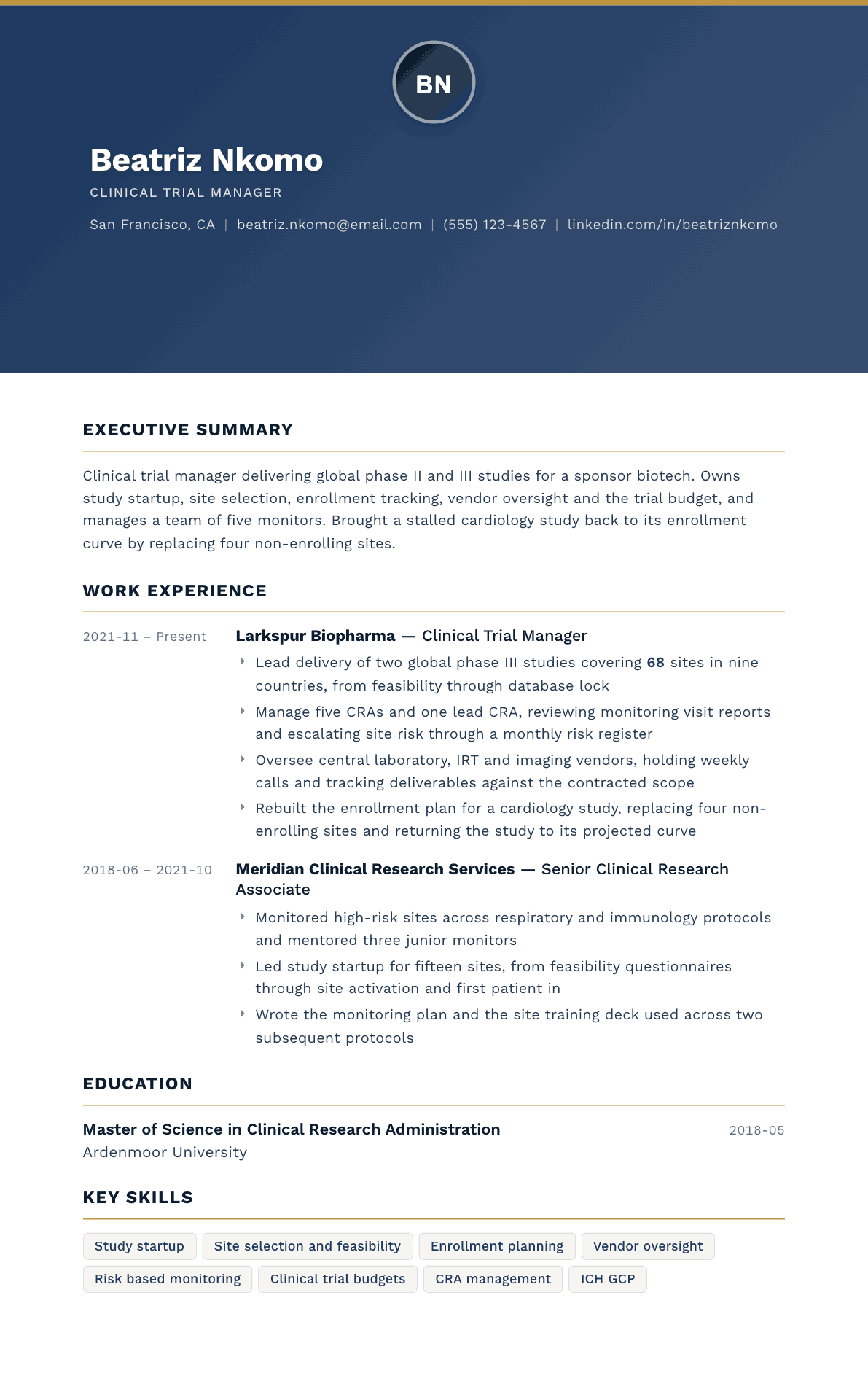
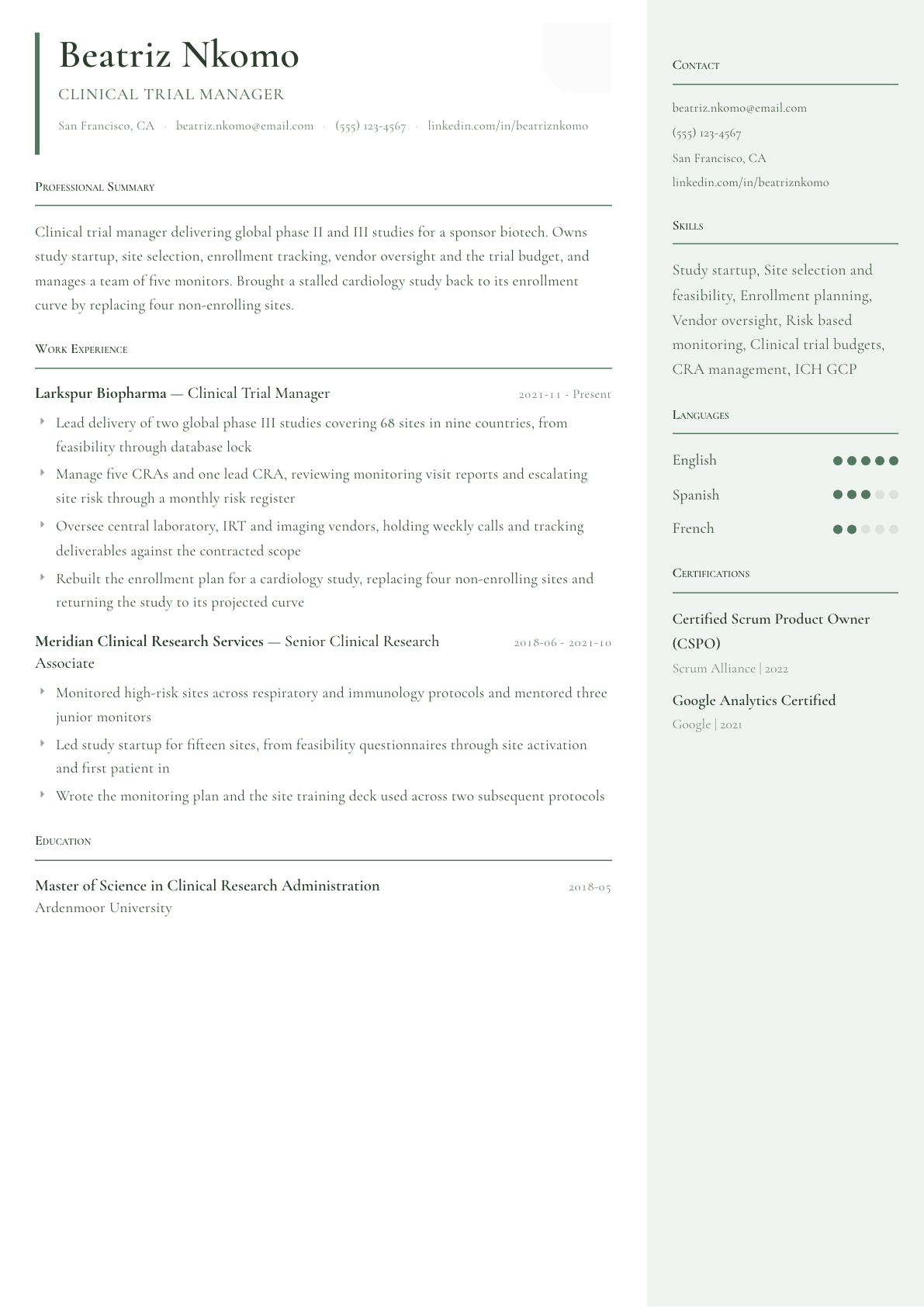
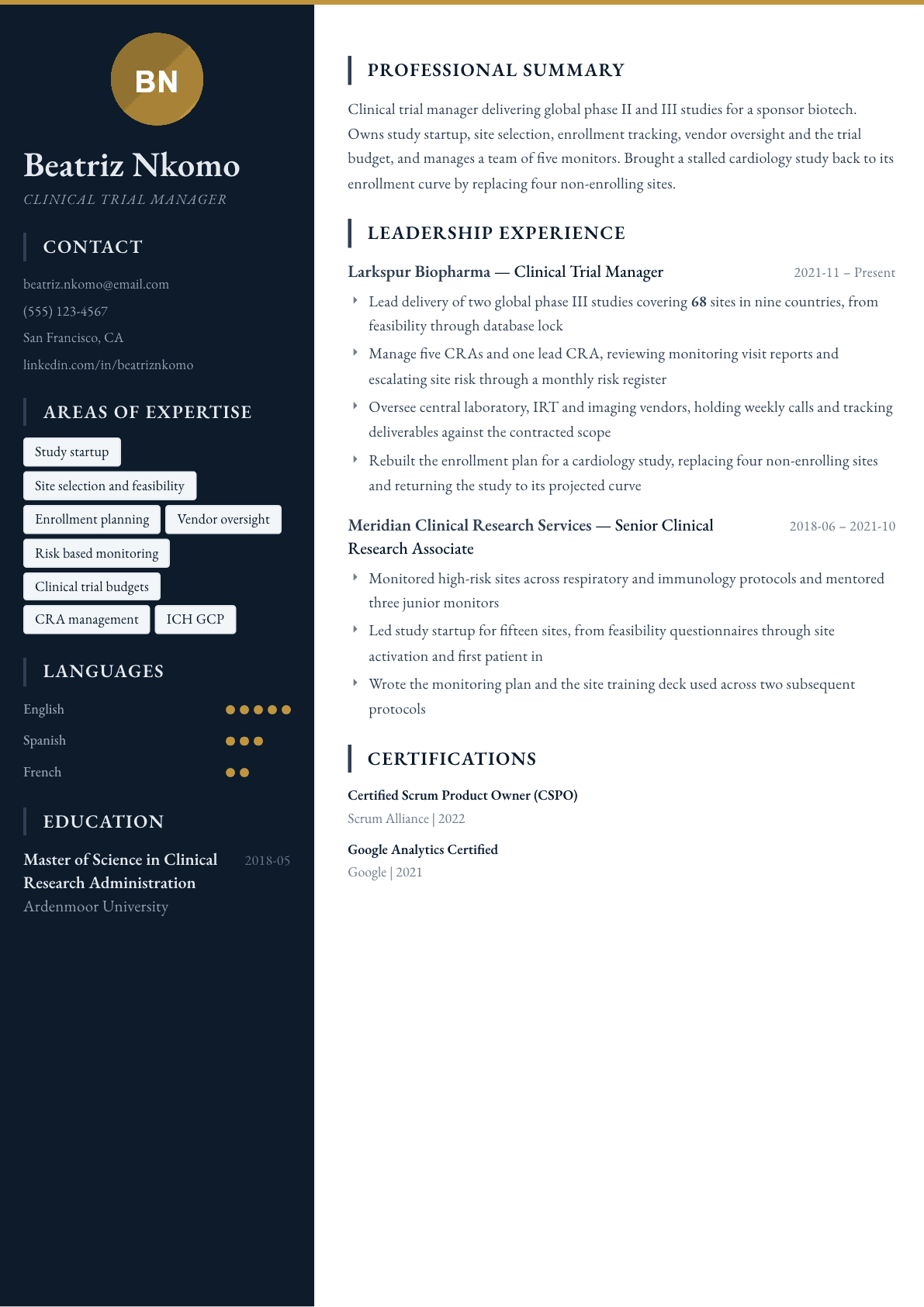
Example Clinical Trial Manager summary
Clinical trial manager with eight years in clinical operations, now leading global phase III delivery across multiple countries for a sponsor biotech. Owns startup, enrollment, vendor oversight and budget, and manages a monitoring team through a documented risk register. Known for fixing enrollment before it becomes a steering committee problem, and for trial master files that survive inspection.
Skills to list on a Clinical Trial Manager resume
- Clinical trial delivery
- Study startup and activation
- Site feasibility and selection
- Enrollment forecasting
- Risk based monitoring
- Monitoring plan authoring
- Vendor and CRO oversight
- Clinical trial budget management
- Timeline and milestone tracking
- CRA line management
- Protocol deviation escalation
- ICH GCP compliance
- Inspection readiness
- Trial master file oversight
- Cross-functional team leadership
What actually gets this resume read
- Open with study scale: phase, therapeutic area, number of sites, number of countries and patient target.
- Separate the studies you led end to end from the ones where you managed a single region or workstream.
- Show enrollment recovery work, because a manager is judged on hitting the curve, not on writing the plan.
- Name the vendors you oversaw, such as central laboratory, IRT, imaging core and eCOA providers.
- Include budget and timeline ownership, since sponsors expect a trial manager to defend both to a steering committee.
- Describe how you managed monitors: caseload assignment, report review, escalation path and performance coaching.
How to write a clinical trial manager resume
A clinical trial manager is hired to deliver a study on time, on budget and inspection ready. The person reading your resume, usually a director of clinical operations, is trying to establish scale and accountability: how many sites, how many countries, which phase, which vendors, and whether you owned the outcome or supported someone who did.
The difference between a strong and a weak resume in this role is almost always ownership language. Supporting a startup is not the same as leading it. Reviewing an enrollment plan is not the same as rebuilding one after the curve flattened. Sponsors have been burned by both, so they read for the verbs as carefully as for the numbers.
The sections below cover how to present study scale, which delivery metrics belong on the page, three summaries from senior monitor stepping up through program level manager, five rewritten bullets, and the questions trial managers ask when they move between a contract research organization and a sponsor.
Format: two pages with a study portfolio block
Two pages, reverse-chronological, single column. Under each employer, place a short portfolio block that lists each study by phase, therapeutic area, site count, country count and target enrollment. A director can price your experience from that block in fifteen seconds, which is the whole point.
Keep the prose bullets for what you did with those studies. Repeating the scale numbers in the bullets wastes space that ownership evidence should occupy.
- Header: name, city and state, phone, email.
- Order: summary, study portfolio, delivery experience, vendor and team management, training and certifications, education.
- Note global versus regional scope explicitly, since it changes the job entirely.
Summary: phase, footprint, team, and what you own
Name the sponsor or contract research organization setting, the phases you deliver, the geographic footprint, the size of the monitoring team you manage, and the three or four workstreams you own outright. Startup, enrollment, vendor oversight and budget are the usual four.
Close with a delivery fact. A study brought back to its enrollment curve, a first patient in date met after a delayed regulatory approval, or an inspection completed without a critical finding are all statements a director will ask about in the first interview, which is exactly what you want.
Delivery experience: startup, enrollment, and the risk register
Study startup is where most timelines are lost, so give it real space. Feasibility questionnaires, country and site selection, ethics and regulatory submission coordination, contract and budget negotiation support, essential document collection and site activation. Say what your activation cycle looked like from selection to first patient in.
Enrollment is the metric your reader lives with. Describe the enrollment plan, the tracking cadence, the triggers you set for underperforming sites, and what you did when the curve flattened: additional site activation, protocol amendment for eligibility, recruitment vendor engagement, or replacement of non-enrolling sites.
Then the risk register. Risk based quality management is expected now, so name the critical to quality factors you tracked, the escalation path to the study team, and how visit frequency changed in response. This paragraph distinguishes a manager from a coordinator with a bigger title.
Close with inspection readiness: trial master file completeness reviews, protocol deviation trending, and any audit or health authority inspection you supported and its outcome stated plainly.
Vendors, budget and team
List the vendor categories you have overseen: central laboratory, interactive response technology, imaging core laboratory, electronic clinical outcome assessment, central reading, courier and comparator supply. For each, say what you managed, whether that was scope, deliverable tracking, quality issues or change orders.
Budget ownership belongs on the page even when you cannot quote figures. Describe the work: forecasting against the study plan, reviewing site payment schedules, approving invoices against deliverables, and raising change orders when scope moved.
Team management means the monitors. Give the number of monitors you managed, how you assigned caseload, how you reviewed monitoring visit reports, and what you did about a monitor whose sites kept generating repeat findings.
Regulations, systems and terminology
Name ICH E6 good clinical practice, the applicable federal regulations, and the regional frameworks you have worked under if your studies ran outside a single country. Then list systems: the clinical trial management system, the electronic data capture platform, the trial master file system and the interactive response technology provider.
Use the vocabulary sponsors use in postings. First patient in, last patient last visit, database lock, site activation cycle time, screen failure rate and protocol deviation rate are all understood immediately and all searchable.
Clinical Trial Manager resume summary examples
Senior monitor stepping up
Senior clinical research associate with five years of monitoring across respiratory and immunology protocols, now leading study startup for fifteen sites from feasibility through first patient in. Mentors three junior monitors, wrote the monitoring plan and site training deck, and is moving into a trial management role.
Managing a global phase III
Clinical trial manager delivering two global phase III studies across sixty-eight sites in nine countries. Owns startup, enrollment, vendor oversight and budget, manages five monitors through a monthly risk register, and returned a stalled cardiology study to its projected curve by replacing non-enrolling sites.
Program level manager
Associate director of clinical operations running a three-study cardiology program from first in human through registration. Sets the operational strategy, selects and governs contract research organization partners, chairs the program risk review, and prepares study teams for health authority inspection readiness.
Work experience bullets: before and after
Before: Managed clinical trials from start to finish.
After: Led delivery of two global phase III studies covering sixty-eight sites in nine countries, from feasibility through database lock.
Phase, site count, country count and the endpoints of your involvement give a director the scale she needs to place you.
Before: Worked on improving enrollment.
After: Rebuilt the enrollment plan for a cardiology study, replaced four non-enrolling sites, activated three additional countries, and returned the study to its projected curve within two quarters.
It names the diagnosis, the actions taken and the recovery, which is the whole job of a trial manager.
Before: Oversaw vendors for the study.
After: Governed central laboratory, interactive response technology and imaging vendors through weekly calls, tracking deliverables against contracted scope and raising two change orders when the protocol amended.
Naming vendor categories and the change order path shows real contract oversight rather than attendance on a call.
Before: Supervised a team of monitors.
After: Managed five monitors and one lead monitor, assigning caseload by site risk, reviewing every monitoring visit report and coaching two monitors through repeat finding trends at their sites.
Assignment logic, report review and a coaching example turn supervision into evidence of management.
Before: Made sure the study was audit ready.
After: Ran quarterly trial master file completeness reviews and protocol deviation trending, and supported a sponsor audit that closed with no critical findings.
A specific readiness routine and a stated audit outcome are verifiable, unlike a claim of readiness.
Hard skills
- Clinical trial delivery and timeline ownership
- Study startup and site activation
- Feasibility and site selection
- Enrollment forecasting and recovery planning
- Risk based quality management
- Monitoring plan authoring
- Vendor and contract research organization oversight
- Study budget forecasting and change orders
- Trial master file oversight
- Inspection readiness
- Protocol deviation trending
- ICH E6 good clinical practice
Soft skills
- Cross-functional leadership
- Escalation to steering committees
- Negotiation with vendors
- Coaching monitors
- Decision making with incomplete data
Certifications worth listing
- Certified Clinical Research Professional (CCRP) (Society of Clinical Research Associates)
- Certified Clinical Research Associate (CCRA) (Association of Clinical Research Professionals)
- Project Management Professional (PMP) (Project Management Institute)
Mistakes that cost clinical trial manager candidates the interview
- Describing study support work with leadership verbs, which falls apart the moment a director asks who signed the plan.
- Leaving out country count and site count, the two numbers that define scale in this role.
- Writing about enrollment plans without ever describing what happened when enrollment fell behind.
- Skipping vendor oversight, even though it is where a large share of a trial budget and most quality escalations sit.
- Ignoring budget entirely because the figures are confidential, when the process can be described without any numbers.
- Presenting the same resume to a sponsor and a contract research organization, when one wants strategy and the other wants delivery under contract.
Clinical Trial Manager resume questions
What is the difference between a clinical trial manager and a project manager resume?
A trial manager resume centers on study delivery: startup, enrollment, monitoring oversight, vendors and inspection readiness. A project manager resume centers on schedule and resource method. Sponsors expect the clinical vocabulary, so lead with the study, not the framework.
How do I show study scale without breaching confidentiality?
Use phase, therapeutic area, number of sites, number of countries and target enrollment. None of that identifies a compound or a sponsor program, and it is exactly what hiring directors need to judge whether your experience matches their portfolio.
Should a clinical trial manager list every study?
List the studies you owned or led in a portfolio block, then summarize earlier monitoring assignments in a single line. A long undifferentiated list of protocols reads as participation, and the reader loses track of which ones were actually yours.
How do I move from a contract research organization into a sponsor role?
Emphasize the workstreams sponsors keep in house: operational strategy, vendor selection and governance, budget forecasting, risk management and inspection readiness. Then show you have managed a contract research organization partner rather than only worked inside one.
Do I need a project management certification for this role?
It is not required, and clinical delivery evidence outweighs it. A recognized project management credential can help when you are moving into trial management from a monitoring background, because it signals formal training in scope, schedule and risk control.