Clinical Research Coordinator Resume Examples: free score
Clinical Research Coordinator Resume and Clinical Trial Coordinator Examples
By Mustafa Tarabya, founder of CVBooster · Published · Updated
Clinical research and clinical trial coordinator resume examples: study portfolio, enrollment, audit record, EDC systems and summaries for every level.
Sample resumes for a clinical research coordinator
The same clinical research coordinator content laid out in three CVBooster templates, so you can see what the finished document looks like before you write a word.
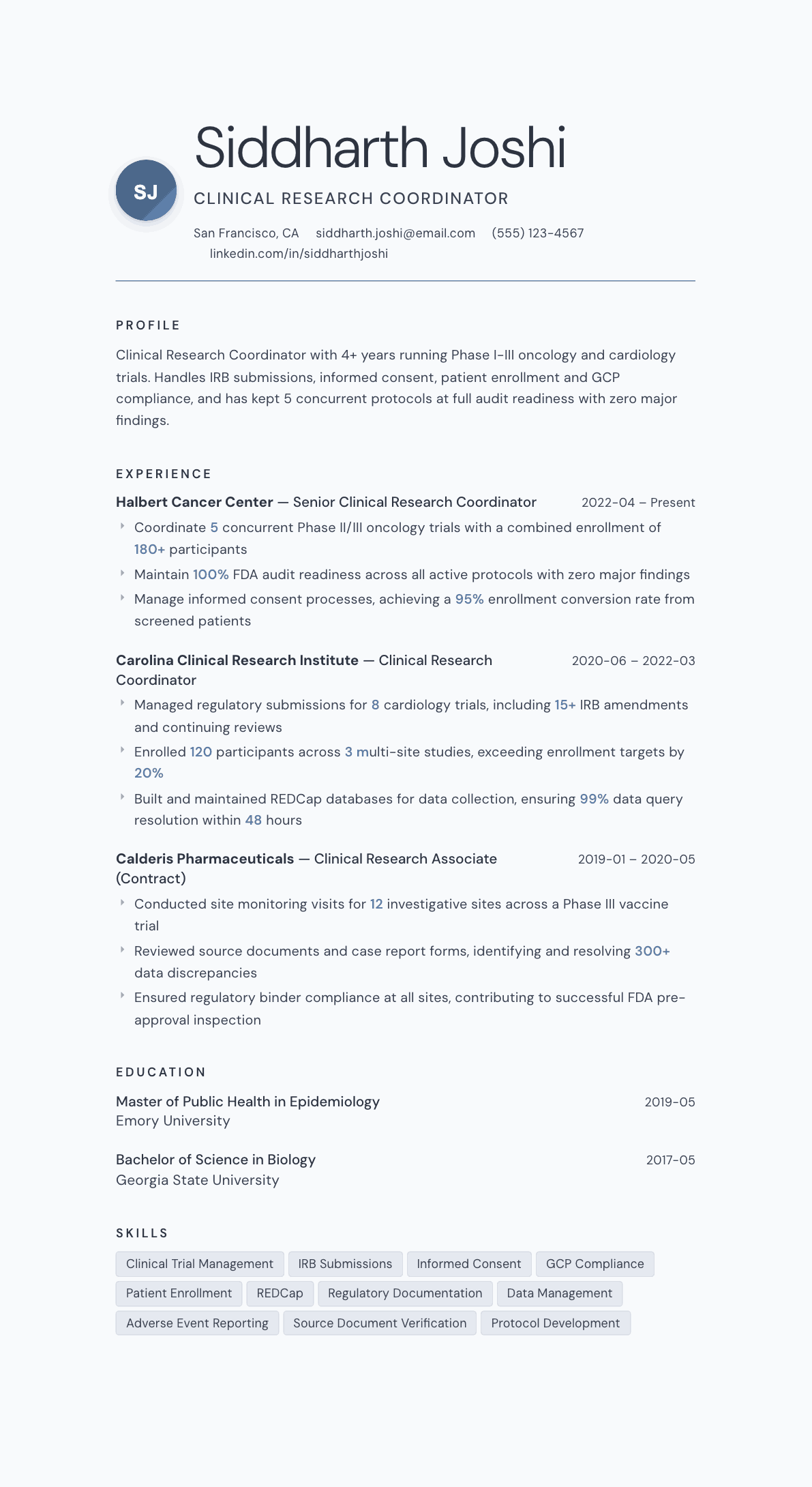
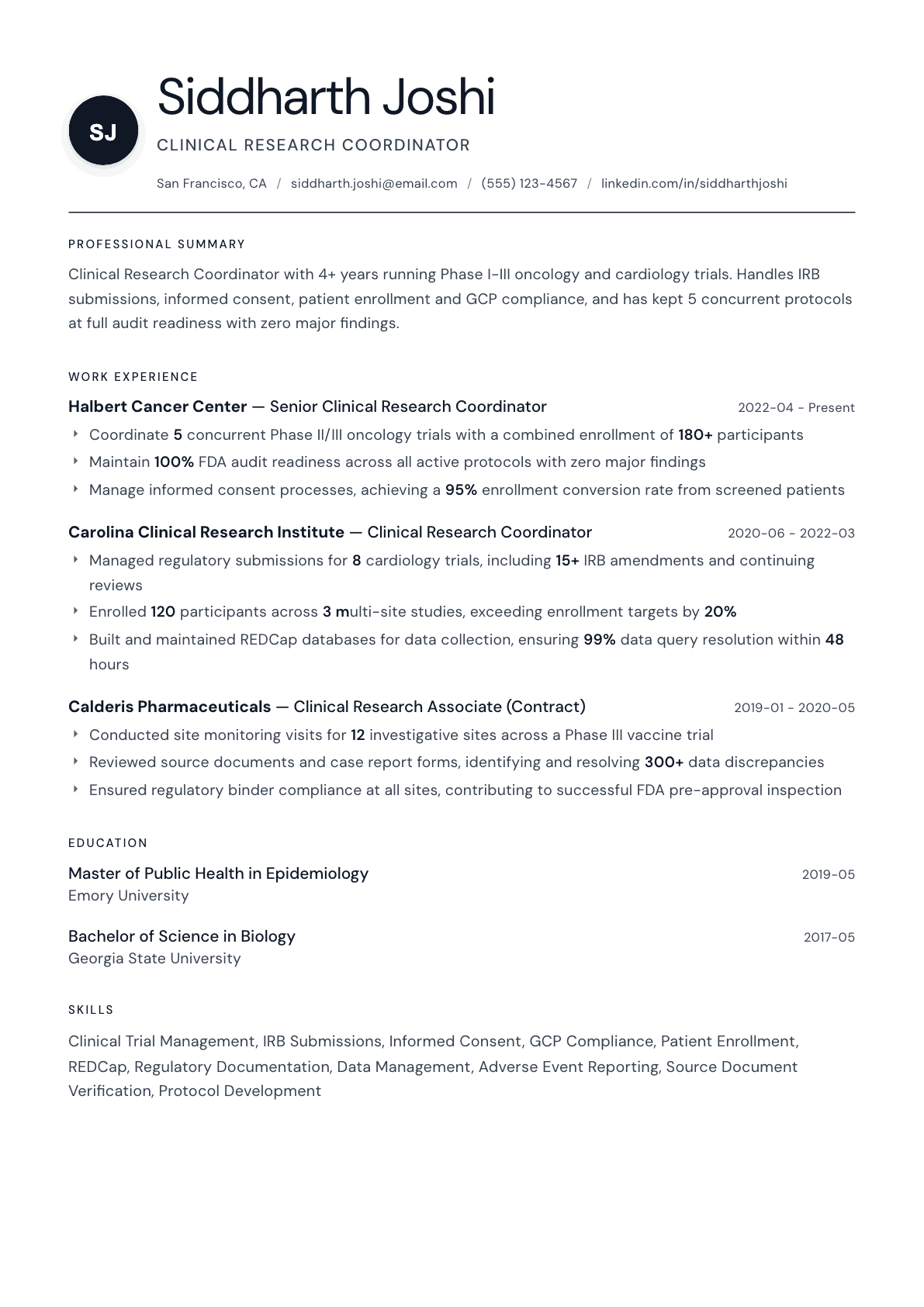
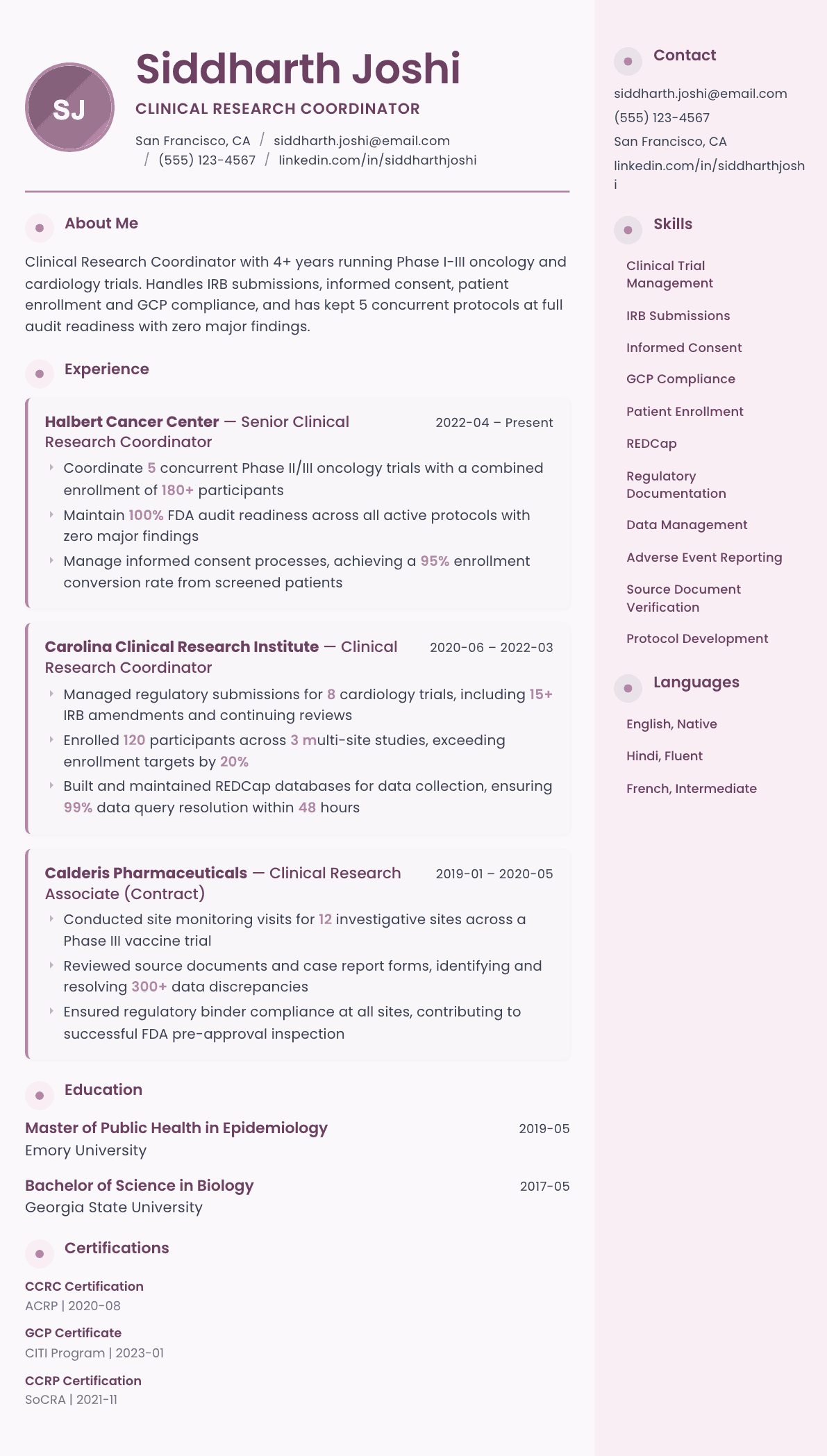
Example Clinical Research Coordinator summary
CCRC-certified Clinical Research Coordinator with 4 years of experience managing Phase I-III trials in oncology and cardiology. Maintained 100% audit readiness and exceeded enrollment targets by 20% across multi-site studies. Seeking a senior CRC role at an academic medical center.
Skills to list on a Clinical Research Coordinator resume
- Clinical Trial Management
- IRB Submissions
- Informed Consent
- GCP Compliance
- Patient Enrollment
- REDCap
- EDC Systems
- Adverse Event Reporting
- Protocol Development
- Source Verification
- Regulatory Documentation
- Data Management
- Study Budgets
- Sponsor Relations
What actually gets this resume read
- Highlight your CCRC or CCRP certification and GCP training prominently.
- Quantify the number of trials managed, enrollment numbers, and audit outcomes.
- List specific therapeutic areas and trial phases you have experience with.
- Mention regulatory tools and systems like REDCap, CTMS, and EDC platforms.
- Include FDA or IRB audit outcomes to demonstrate compliance expertise.
- Show sponsor collaboration experience for contract and multi-site studies.
How to write a clinical research coordinator resume
A clinical research coordinator resume is screened by a research manager or a principal investigator who is trying to answer one question fast: can this person keep a study inspection ready without being watched. That means the reader is hunting for therapeutic area, study phase, sponsor or investigator initiated, monitoring history, and whether you have ever survived a sponsor audit or an FDA inspection.
Most CRC resumes fail because they describe the job instead of the portfolio. Everyone schedules visits and collects consent. What separates candidates is the number of concurrent protocols carried, the enrollment they personally screened and consented, the electronic data capture systems they built in, and the regulatory work they owned rather than assisted with.
Sites and sponsors also call the job clinical trial coordinator, and a clinical trial coordinator resume follows the same rules with one difference in emphasis, covered in its own section below. This guide covers how research sites and CROs actually read a CRC resume, with summaries for someone leaving a bench or nursing job, a coordinator four years in, and a lead coordinator, plus rewrites of the bullets that appear on nearly every application. Universities and hospitals also post plain research coordinator jobs, often for behavioral or health services studies rather than drug trials, and a research coordinator resume keeps the same structure with IRB protocols, recruitment and data systems in place of sponsor monitoring.
Format: put the study portfolio where the reader lands first
Reverse chronological, one page under five years and two pages beyond that. Below the summary, add a short block titled Therapeutic Areas and Study Experience listing the areas you have coordinated and the phases. A hiring manager staffing an oncology unit wants to see oncology in the top third of the page, not buried in the third job.
Certifications belong immediately under that block because CCRP and ACRP-CP are the two credentials that move a file forward, and Good Clinical Practice training is a screening condition at most sites. Write the issuing body next to each one, since sponsors and CROs treat SOCRA and ACRP credentials differently.
- Header: name, credentials, city and state, phone, email.
- Order: summary, therapeutic areas and phases, certifications and GCP training, research experience, clinical or laboratory experience, education, systems.
- Career changers from nursing or laboratory work keep that job in the timeline and translate it, rather than deleting it.
Clinical trial coordinator resume: match the title the employer uses
Employers use clinical research coordinator, clinical trial coordinator, study coordinator and research nurse coordinator for overlapping jobs, and an applicant tracking system may only match the words in the posting. Use the posting title in your summary, and keep your real title on each job entry so a reference check confirms it.
At a hospital or research site the titles describe the same patient facing work. At a sponsor or CRO, a clinical trial coordinator is often the person tracking sites rather than seeing participants: activation packets, essential documents for the trial master file, enrollment tracking across sites. If that is your role, say so plainly, because a site manager expects visits and consent and a CRO reader expects the reverse.
- Site based coordinator: protocols carried, participants screened and consented, visits run, monitoring findings closed.
- Sponsor or CRO trial coordinator: sites supported, essential documents tracked, trial master file completeness, activation timelines.
- Both versions: the EDC and CTMS systems you worked in, and the date of your GCP training.
Summary: therapeutic area, phase, sponsor type, audit record
Three sentences. Name the therapeutic areas, the phases you have run, whether the work was sponsor initiated or investigator initiated, and your audit or monitoring visit record. A coordinator who can say she has closed monitoring visit findings without a repeat query is describing something a site director genuinely values.
Avoid opening with detail oriented. Every coordinator claims it and no reader believes it. Replace it with the concrete version: the number of open protocols you hold at once, which is the real proof of organization in this job.
Experience: protocols, enrollment, regulatory, and the systems
Head each role with the site type and the scale: academic medical center, community oncology site, dedicated research unit or CRO, the number of active protocols, and the therapeutic areas. Then write bullets that separate the four halves of the job: subject recruitment and consent, visit conduct and source documentation, regulatory and IRB work, and data management with query resolution.
Name the systems by name. Electronic data capture platforms such as Medidata Rave, Oracle Clinical, Veeva and REDCap, clinical trial management systems such as OnCore and Complion or Florence for the electronic regulatory binder. A resume that says database experience tells the reader nothing about how long onboarding will take.
Regulatory bullets should say what you owned: initial IRB submissions, amendments, continuing review, safety reporting and deviations, delegation of authority logs, investigator brochure updates, and the 1572 for studies under an investigational new drug application.
Enrollment and data quality: the two numbers managers check
Enrollment is the currency of a research site. Give the screened to consented to randomized funnel for at least one study, and say whether you hit the sponsor target and how you found the patients: chart review, tumor board, referring physician outreach, registry screening.
Data quality is the second number. Query rate per case report form page, average query turnaround time, protocol deviation counts, and whether monitoring visits closed with no major findings. Coordinators who report these numbers are rare enough that it changes the read of the whole resume.
Skills and keywords the screener filters on
Research postings recycle the same regulatory vocabulary, so mirror it once in the skills block and once inside a bullet where it is demonstrated: informed consent process, source document verification, adverse event and serious adverse event reporting, protocol deviation, investigational product accountability, monitoring visit, close out, and the federal regulations for human subjects protection. Add the vendor names for laboratory kits, interactive response technology and imaging submission if you have handled them, because those tasks are invisible unless you name them.
Clinical Research Coordinator resume summary examples
Moving into research
Oncology nurse moving into clinical research, with GCP and human subjects protection training complete and two years supporting a Phase III breast cancer protocol as a treating nurse. Experienced with consent conversations, adverse event documentation and REDCap data entry across 30 enrolled patients.
Four years coordinating
Clinical Research Coordinator with four years running six concurrent Phase II and III cardiology protocols at an academic site. Screened 240 patients and consented 88 against a sponsor target of 70, resolved 92% of queries within two business days, and closed nine monitoring visits with no major findings.
Lead coordinator
Lead Clinical Research Coordinator with nine years in oncology and rare disease, supervising four coordinators across 22 active protocols. Owns IRB submissions, budget and coverage analysis review, and site initiation, and has taken two sponsor audits and one FDA inspection with zero Form 483 observations.
Work experience bullets: before and after
Before: Coordinated clinical trials and worked with study participants.
After: Coordinated six concurrent Phase II and III oncology protocols with a combined active census of 41 participants, covering screening through end of treatment visits.
Phase, therapeutic area, protocol count and census tell a research manager the load you have carried; coordinated trials does not.
Before: Responsible for informed consent.
After: Screened 240 charts through tumor board review and consented 88 participants, exceeding the sponsor enrollment target of 70 and ranking the site third of 34 in the study.
The screening method and the funnel show how you find patients, which is the skill sites are actually buying.
Before: Handled IRB paperwork and regulatory documents.
After: Owned all IRB activity for 11 protocols: initial submissions, 34 amendments, annual continuing review and safety reporting, with the electronic regulatory binder maintained in Florence.
Naming the submission types and the binder system proves you ran regulatory rather than filing for someone who did.
Before: Entered data into the study database.
After: Entered and reconciled case report forms in Medidata Rave for four studies, holding query turnaround to under two business days and reducing open queries at monitoring visits by half.
The named platform plus a turnaround figure turns an assumed task into a measurable data quality claim.
Before: Assisted with monitoring visits and audits.
After: Prepared and hosted 14 monitoring visits and one sponsor audit, presenting source documentation and delegation logs, with all findings closed inside the 30 day response window.
Audit exposure is the single line that separates an experienced coordinator from a trained one, so it needs specifics.
Hard skills
- Protocol coordination
- Informed consent process
- IRB submissions and amendments
- Good Clinical Practice
- Source document verification
- Adverse event reporting
- Protocol deviation management
- REDCap
- Medidata Rave
- OnCore clinical trial management
- Investigational product accountability
- Participant recruitment and screening
- Case report form completion
- Regulatory binder maintenance
Soft skills
- Participant rapport
- Protocol judgment
- Investigator communication
- Competing deadline management
- Sponsor and monitor liaison
- Careful documentation habits
Certifications worth listing
- Certified Clinical Research Professional (CCRP) (Society of Clinical Research Associates)
- Certified Clinical Research Coordinator (CCRC) (Association of Clinical Research Professionals)
- ACRP Certified Professional (ACRP-CP) (Association of Clinical Research Professionals)
- Good Clinical Practice (GCP) Training (CITI Program)
- Human Subjects Protection Training (CITI Program)
- IATA Dangerous Goods Regulations Training (International Air Transport Association)
Mistakes that cost clinical research coordinator candidates the interview
- Listing trials without the phase or therapeutic area, which forces the reader to guess whether your experience transfers to their portfolio.
- Writing assisted with when you owned the task; research managers read assisted as never done alone.
- Leaving out enrollment numbers, the one metric that decides whether a site keeps its slot in a multicenter study.
- Naming no electronic data capture or trial management system, which makes your onboarding time impossible to estimate.
- Hiding audit and monitoring visit experience inside a generic quality bullet instead of giving it its own line.
- Deleting a nursing, pharmacy or laboratory job during a career change, when that clinical background is often the reason a site would hire you.
- Claiming GCP training without the provider and the year, so a screener cannot tell whether it is current.
Clinical Research Coordinator resume questions
Do I need a certification to get a clinical research coordinator job?
Not for the first one. Most sites hire coordinators with a science or nursing background and pay for GCP training, then expect certification after two years of documented experience, since both major credentialing bodies require experience hours before you can sit the exam.
What should a research coordinator resume include if the studies were not clinical trials?
The same backbone: protocols carried at once, participants recruited and retained, IRB submissions and amendments you prepared, and the data systems you used, such as REDCap or Qualtrics. Name the study design, for example surveys, interviews or a cohort study, and any human subjects training you hold, such as the CITI course.
Should I list every study I have worked on?
No. Group them by therapeutic area and phase in a short portfolio block, then detail the three or four that match the posting. A list of 30 protocol numbers means nothing to a reader who does not know those sponsors or compounds.
What enrollment numbers should go on the resume?
Give the funnel for at least one study: charts screened, participants consented, participants randomized, and the sponsor target you were measured against. Add how you sourced patients, because recruitment method matters more to a site director than the raw total.
Is a clinical trial coordinator resume different from a CRC resume?
Mostly in emphasis. At a hospital or research site the two titles mean the same patient facing job, so one resume works with the posting title used in the summary. At a sponsor or CRO, a trial coordinator role is usually document and tracking work, so lead with sites supported, trial master file work and activation timelines instead of visits.