Regulatory Affairs Specialist Resume Examples: free score
Craft a Regulatory Affairs Specialist Resume for Submission Roles
By Mustafa Tarabya, founder of CVBooster · Published · Updated
Regulatory affairs specialist resume examples with submission, labeling and compliance keywords, plus a guide to writing FDA and EU MDR experience.
Sample resumes for a regulatory affairs specialist
The same regulatory affairs specialist content laid out in three CVBooster templates, so you can see what the finished document looks like before you write a word.
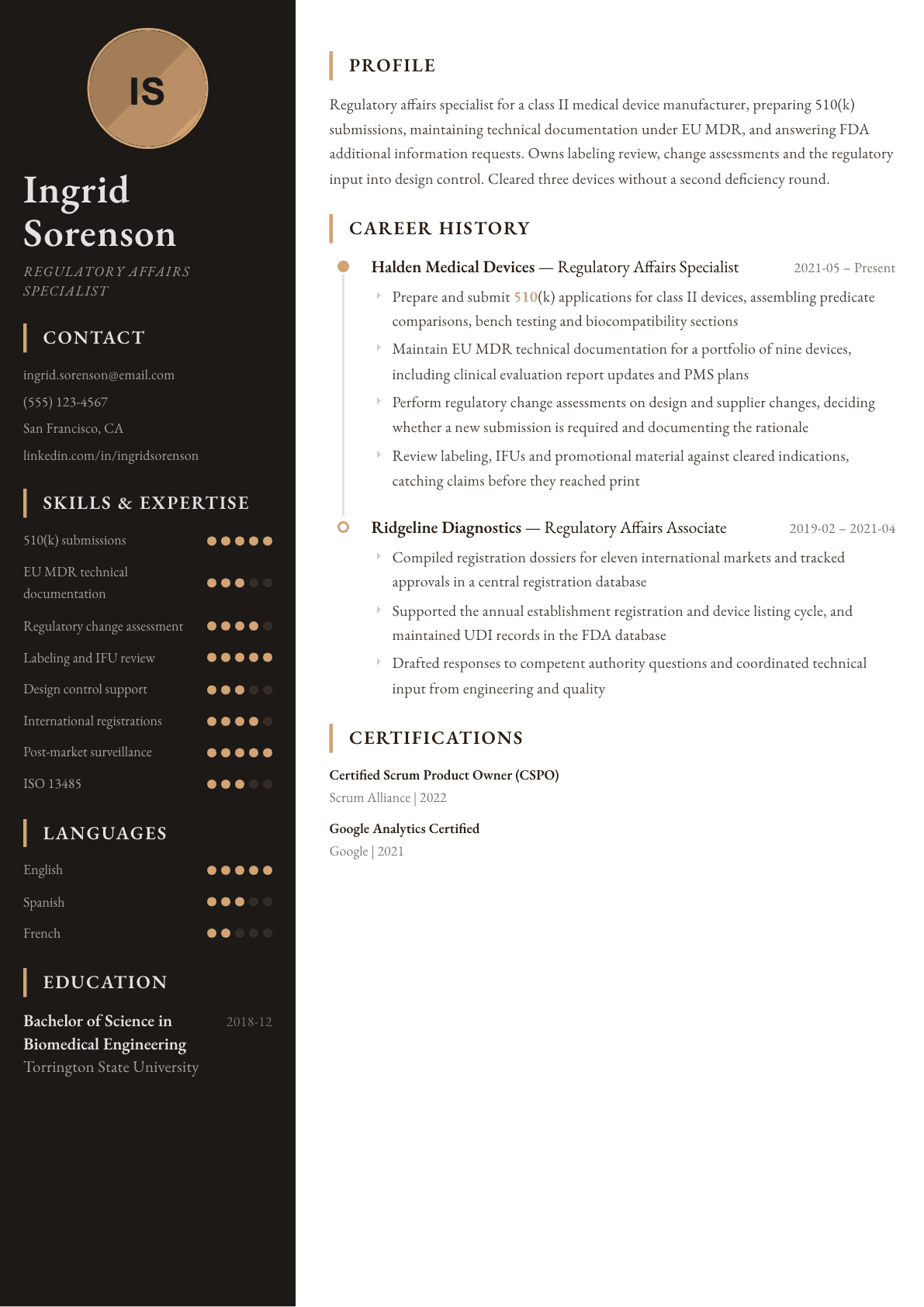
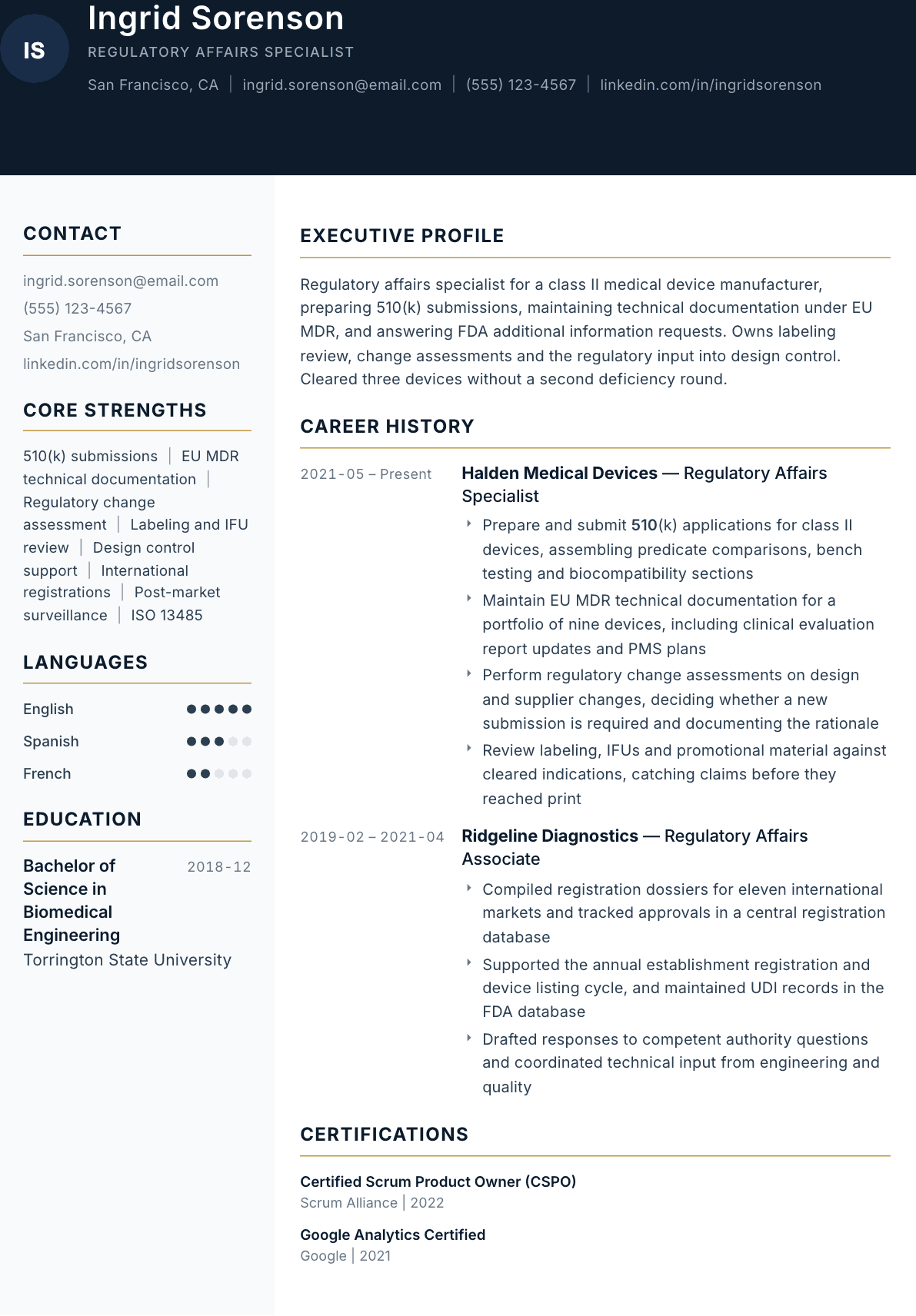
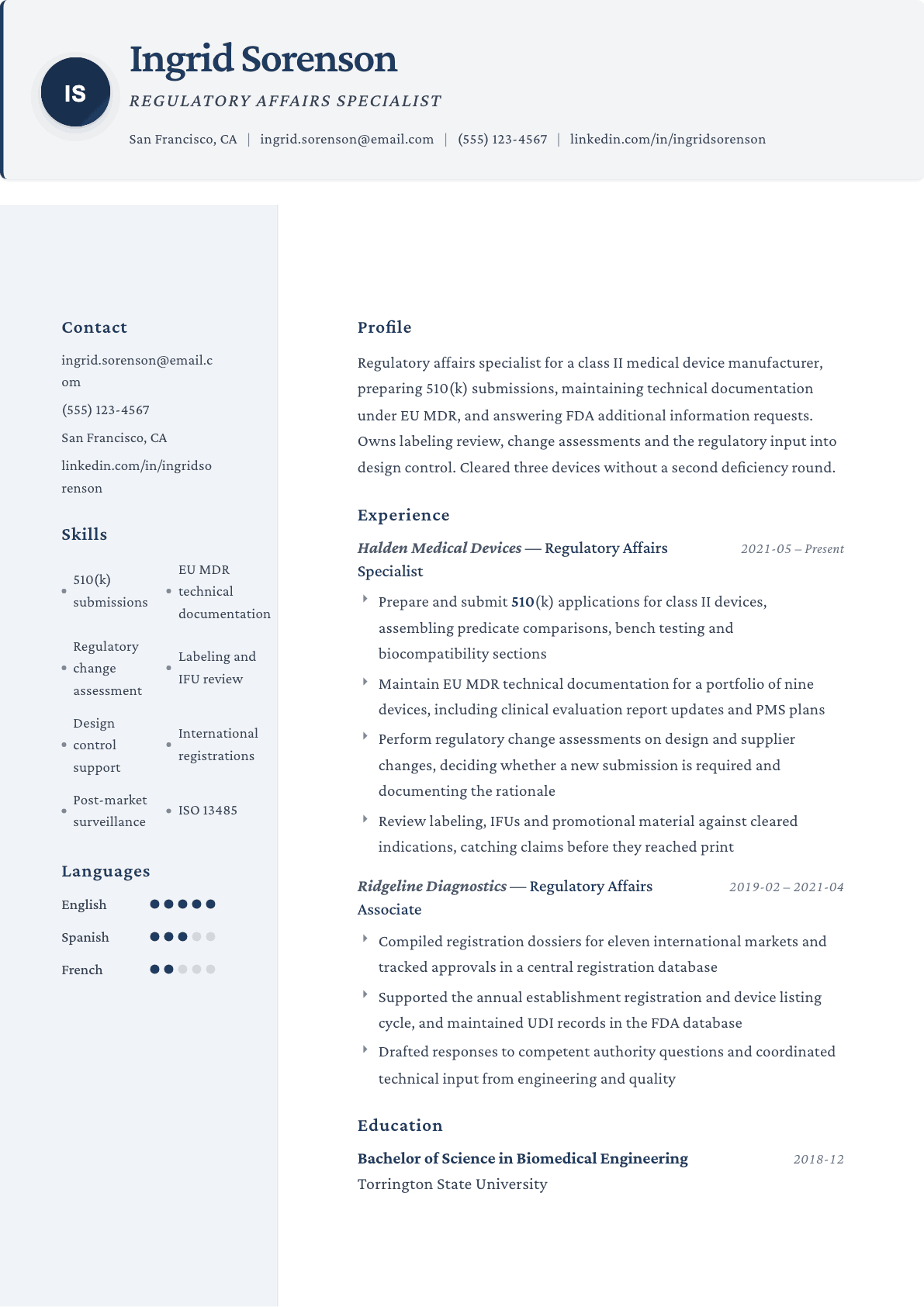
Example Regulatory Affairs Specialist summary
Regulatory affairs specialist with five years supporting class II medical devices, from 510(k) preparation through EU MDR technical documentation and international registrations. Writes change assessments that hold up under audit, reviews labeling against cleared indications, and answers agency deficiency letters with engineering evidence attached. Works daily with quality, design and clinical teams inside an ISO 13485 system.
Skills to list on a Regulatory Affairs Specialist resume
- 510(k) submissions
- De novo and PMA support
- EU MDR technical documentation
- Clinical evaluation reports
- Regulatory change assessment
- Labeling and IFU review
- Promotional material review
- Design control and design history file
- Risk management under ISO 14971
- ISO 13485 quality systems
- 21 CFR Part 820
- International product registration
- UDI and device listing
- Post-market surveillance
- Agency deficiency responses
- Regulatory strategy documents
What actually gets this resume read
- Say which regulated product you work on, because device, pharmaceutical, biologic and combination product hiring pools barely overlap.
- List submission types by name: 510(k), de novo, PMA, IND, NDA, ANDA or CE technical documentation.
- Give submission outcomes, including clearances, approvals and how many deficiency rounds each one took.
- Name the frameworks you work under, such as 21 CFR Part 820, ISO 13485, EU MDR and ISO 14971.
- Show labeling and promotional review work, since that is a daily task that many resumes leave out entirely.
- Include the cross-functional partners you brief: engineering, quality, clinical and marketing, and what you gave each one.
How to write a regulatory affairs specialist resume
Regulatory affairs hiring is narrow by design. A device company will not seriously consider a pharmaceutical submission background, and a company preparing a premarket approval will not hire someone whose entire record is registration paperwork for existing products. The first job of this resume is to tell the reader, in one line, which regulated product you work on and which submissions you have prepared.
The second job is to prove you can write. Regulatory affairs is a writing and evidence assembly profession: rationales for change assessments, responses to agency deficiency letters, clinical evaluation summaries and labeling justifications. A resume with vague duty statements suggests someone who fills templates rather than builds arguments, and that is the exact fear a hiring manager brings to the screen.
What follows is the section order regulatory teams expect, how to present submissions and outcomes, three summaries from associate to senior specialist, five rewritten bullets, and the questions specialists ask when they cross between devices, diagnostics and pharmaceuticals.
Format: two pages with a submission table
Two pages, reverse-chronological, single column. Add a submission summary block near the top listing the submission types you have prepared, the product classes and the markets. Hiring managers read that block first because it answers the fit question immediately.
Do not decorate this resume. Regulatory readers are trained to notice unsupported claims, and a page full of graphics with no evidence behind it reads as a warning rather than as design.
- Header: name, city and state, phone, email.
- Order: summary, submission and market snapshot, regulatory experience, quality system experience, education, training.
- Name the product type in the first line: device class, in vitro diagnostic, drug, biologic or combination product.
Summary: product, submissions, frameworks, outcomes
Four facts. The regulated product and its class, the submission types you own, the frameworks you work under, and one outcome. "Cleared three class II devices without a second deficiency round" is a sentence a regulatory manager will stop on, because deficiency rounds cost months.
If you are switching product areas, be honest and build the bridge. Someone moving from in vitro diagnostics into devices should point at the shared ground: risk management, design control, labeling, technical documentation structure and quality system requirements.
Experience: submissions, change control, labeling
Submissions come first. Name the type, the product class and what you personally assembled: predicate comparison and substantial equivalence rationale, bench and biocompatibility testing summaries, software documentation, sterilization and shelf life data, or the clinical evaluation. Then give the outcome and the number of deficiency rounds, because that number is the closest thing regulatory affairs has to a performance metric.
Change assessment is the daily work and the part most resumes skip. Describe how you evaluate a design, supplier, labeling or manufacturing change, how you decide whether a new submission is required, and where the documented rationale lives. A manager reading that paragraph knows whether you will create audit findings or prevent them.
Labeling and promotional review is the third block. Instructions for use, symbols and translations, unique device identification, packaging text and marketing claims checked against cleared indications. Say what you caught before it reached print, because that is the value the commercial team feels.
Then lifecycle and market maintenance: international registrations and renewals, establishment registration and product listing, post-market surveillance reports, vigilance and adverse event reporting decisions, and periodic safety updates.
Quality system and cross-functional work
Regulatory affairs sits inside the quality system, so show that you can operate there. Design control and the design history file, risk management files, corrective and preventive action input, supplier change notifications, and audit support for notified bodies or regulators.
Name the partners you brief and what you give them. Engineering gets the testing gaps that would block a submission. Quality gets the change assessments. Clinical gets the evidence requirements. Marketing gets the claims boundary. Listing these makes the role look like the coordination job it actually is.
Frameworks and training: name them precisely
Write the frameworks the way postings write them: the quality system regulation for medical devices, the international quality management standard for medical devices, the risk management standard, the European medical device regulation and the usability and software lifecycle standards where they apply. Precision here is a competence signal.
Add your training record and any regulatory affairs credential with the awarding body. If you hold a technical degree, say so early, because regulatory teams for engineered products want someone who can read a test report without a translator.
Regulatory Affairs Specialist resume summary examples
Regulatory affairs associate
Regulatory affairs associate supporting class II device registrations across eleven international markets, compiling dossiers, maintaining the registration database and preparing establishment registration and product listing updates. Drafted responses to competent authority questions with input from engineering and quality. Biomedical engineering degree.
Specialist owning submissions
Regulatory affairs specialist preparing premarket notifications for class II devices and maintaining European technical documentation for a portfolio of nine products. Owns change assessments, labeling and instructions for use review, and clinical evaluation report updates. Cleared three devices without a second deficiency round.
Senior specialist or manager
Senior regulatory affairs specialist leading submission strategy for a device platform, including premarket approval supplements and international market entry. Sets the regulatory pathway with product development, governs the change assessment process across two sites, and represents regulatory during notified body and agency audits.
Work experience bullets: before and after
Before: Prepared regulatory submissions for medical devices.
After: Prepared premarket notification submissions for class II devices, assembling predicate comparisons, bench testing, biocompatibility and software documentation into the substantial equivalence argument.
The submission type, device class and the sections you assembled show what you actually build rather than that you participated.
Before: Responded to questions from the agency.
After: Drafted responses to additional information requests, coordinating test data and engineering rationale, and closed three submissions without a second deficiency round.
Deficiency rounds are the metric regulatory managers track, so naming the outcome makes the claim measurable.
Before: Reviewed labeling and marketing materials.
After: Reviewed instructions for use, packaging text and promotional claims against cleared indications, blocking two claims that exceeded the cleared intended use before release.
A specific catch proves the review has teeth instead of being a formality on a routing form.
Before: Handled change control for products.
After: Performed regulatory change assessments on design, supplier and manufacturing changes, deciding whether a new submission was required and recording the rationale in the change record.
The decision and the documented rationale are exactly what an auditor asks for, and what a manager wants to see you can do.
Before: Maintained technical files for European markets.
After: Maintained European technical documentation for nine devices, updating clinical evaluation reports, post-market surveillance plans and periodic safety update reports on schedule.
Naming the specific documents shows current framework knowledge rather than legacy file keeping.
Hard skills
- Premarket notification submissions
- Premarket approval and de novo support
- European technical documentation
- Clinical evaluation report maintenance
- Regulatory change assessment
- Labeling and instructions for use review
- Promotional claims review
- Design control and design history file
- Risk management file maintenance
- Quality management system compliance
- International registration and renewals
- Unique device identification and product listing
- Post-market surveillance and vigilance reporting
Soft skills
- Technical writing under scrutiny
- Cross-functional negotiation
- Attention to version control
- Explaining constraints to commercial teams
- Composure during audits
Certifications worth listing
- Regulatory Affairs Certification (RAC) (Regulatory Affairs Professionals Society)
- Certified Quality Auditor (CQA) (American Society for Quality)
- Certified Quality Engineer (CQE) (American Society for Quality)
Mistakes that cost regulatory affairs specialist candidates the interview
- Failing to name the regulated product type in the first line, which makes every downstream claim ambiguous.
- Listing submission types without ever giving an outcome or the number of deficiency rounds.
- Leaving change assessment off the resume, when it is the daily work and the most common source of audit findings.
- Writing about regulations generically instead of naming the exact standards and frameworks a posting cites.
- Skipping labeling and promotional review, which is a regulatory task that commercial teams feel every week.
- Describing yourself as a compliance generalist when regulatory hiring is organized entirely around product class and submission type.
Regulatory Affairs Specialist resume questions
What submissions should a regulatory affairs specialist list?
List the types you personally prepared with the product class attached, such as premarket notifications, de novo requests, premarket approval supplements or European technical documentation. Then add the outcome and how many rounds of agency questions each one took.
Can I move from pharmaceutical regulatory affairs into devices?
It is possible but you must build the bridge explicitly. Point at shared ground: labeling control, change management, submission writing, post-market reporting and quality system work. Then show device-specific study, because design control and risk management differ substantially.
Is the regulatory affairs certification worth listing?
Yes, when you hold it. Many postings mention it as preferred and it signals structured knowledge of the frameworks. It does not replace submission experience, so keep the credential in the header and the submissions in the body of the resume.
How technical should a regulatory affairs resume be?
Technical enough to prove you can read a test report and argue from it. Name the testing categories you assemble, such as biocompatibility, sterilization, electrical safety, software and shelf life, and say how you resolved gaps with engineering before submitting.
How do I write this resume without disclosing confidential products?
Describe the product by class, technology category and market rather than by trade name. Regulatory managers are used to this and care about the pathway, the framework and the outcome, none of which require naming a specific commercial product.