Compliance Officer Resume Examples: the lines they read
Build a Compliance Officer Resume That Stands Up to Scrutiny
By Mustafa Tarabya, founder of CVBooster · Published · Updated
Create a compliance officer resume showcasing regulatory expertise, audit readiness, and policy development with a track record of zero material findings.
Sample resumes for a compliance officer
The same compliance officer content laid out in three CVBooster templates, so you can see what the finished document looks like before you write a word.
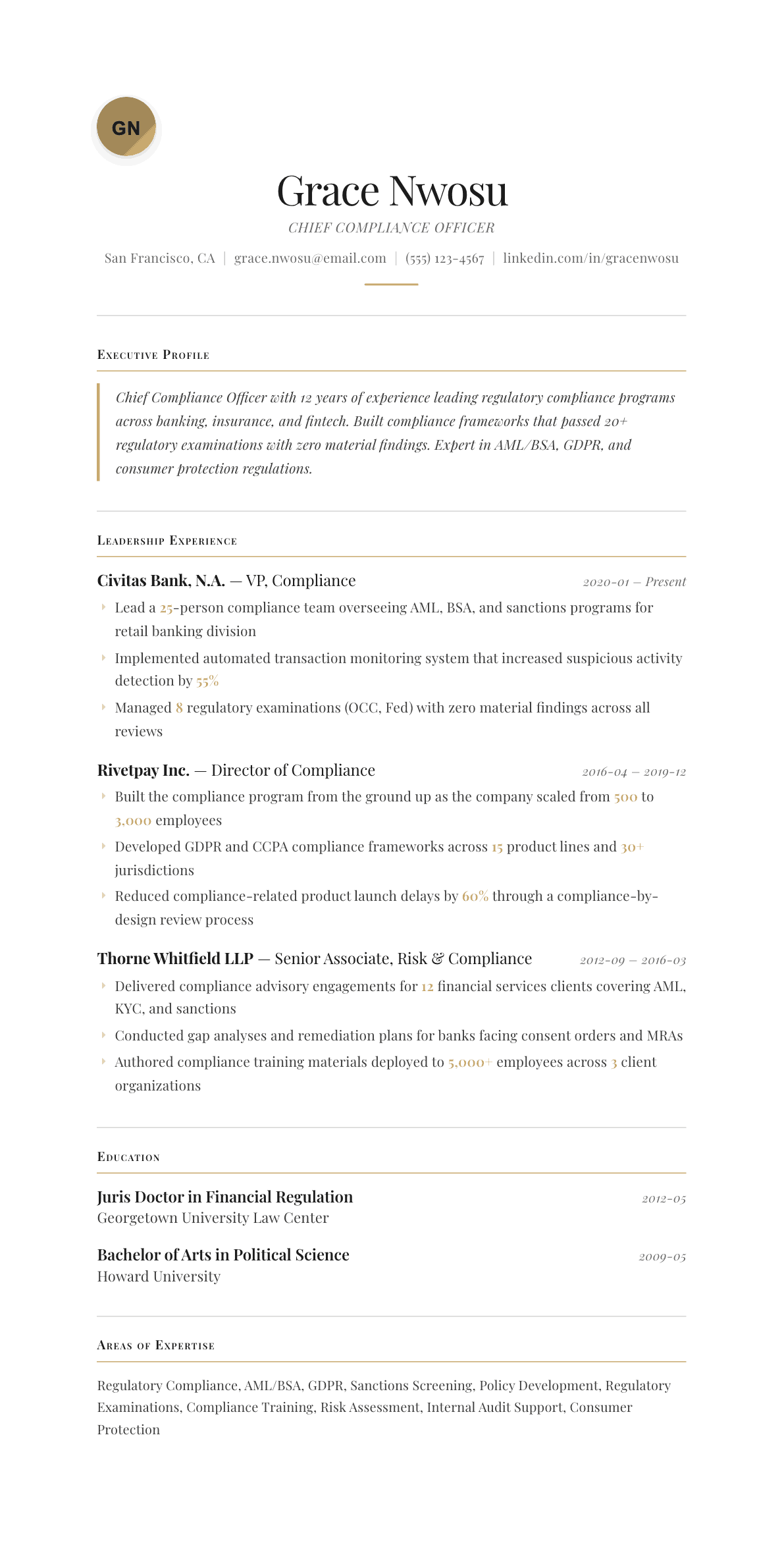
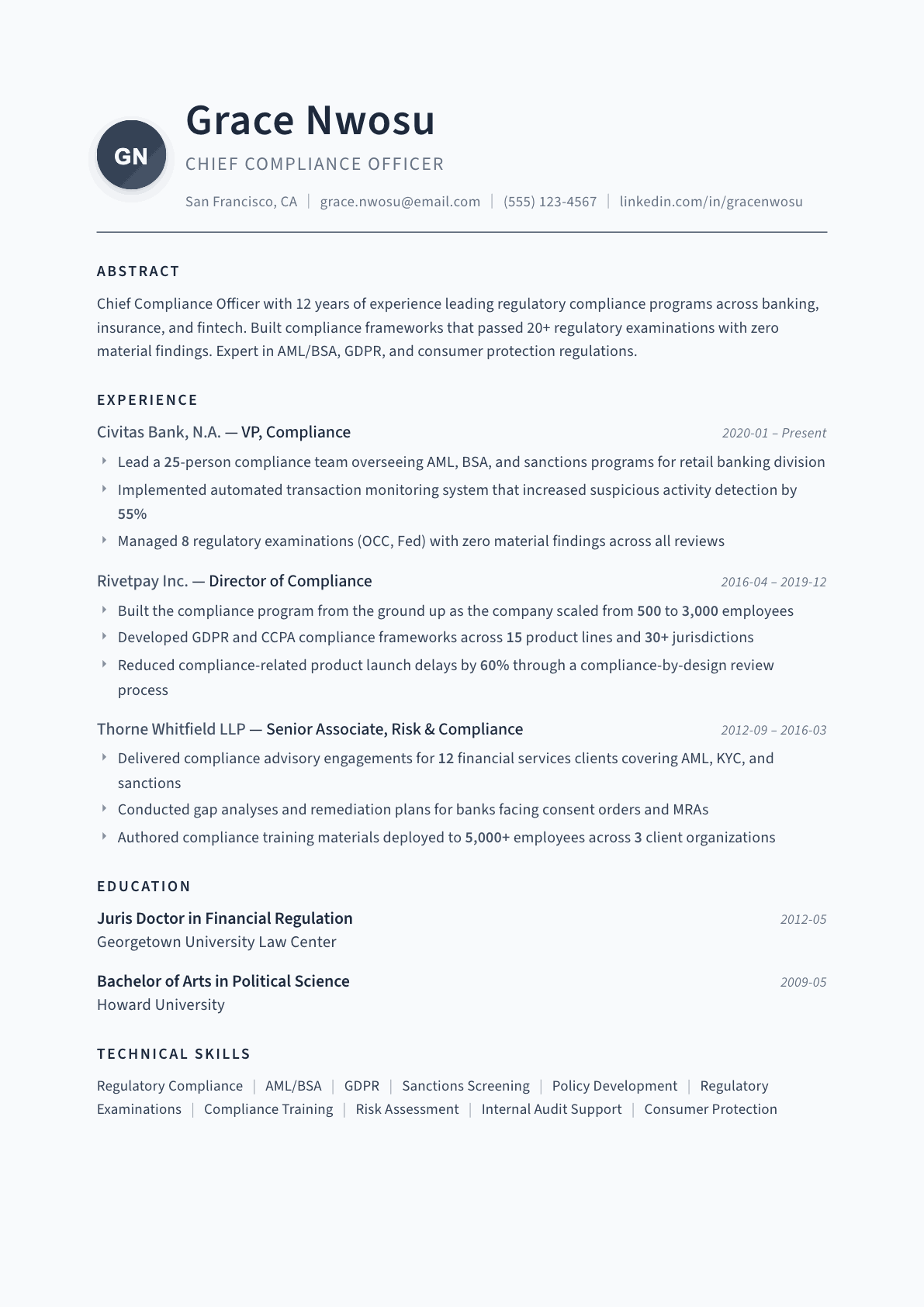
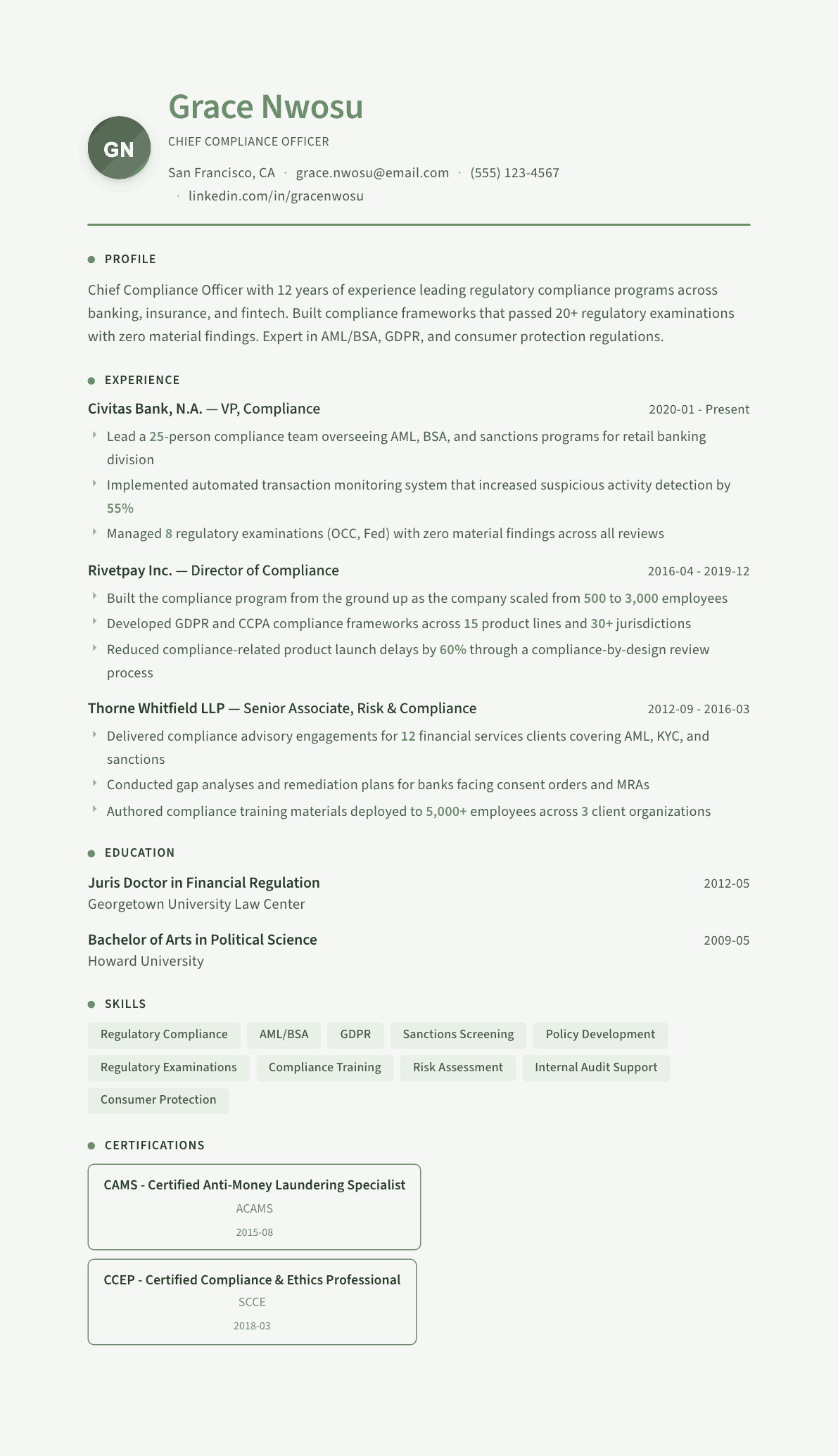
Example Compliance Officer summary
Chief Compliance Officer with 12 years of experience building and leading regulatory compliance programs across banking and fintech. Passed 20+ regulatory examinations with zero material findings. Expert in AML/BSA, GDPR, and consumer protection. Seeking a CCO role to drive compliance excellence at a global financial institution.
Skills to list on a Compliance Officer resume
- Regulatory Compliance
- AML / BSA
- GDPR / CCPA
- Sanctions Screening
- Policy Development
- Regulatory Examinations
- Compliance Training
- Risk Assessment
- Internal Audit
- Consumer Protection
- KYC / CDD
- Compliance Monitoring
- Ethics Programs
What actually gets this resume read
- Highlight specific regulations you oversee: AML/BSA, GDPR, SOX, HIPAA, CCPA.
- Quantify examination results, audit findings resolved, and policy implementations.
- Show experience building compliance programs from scratch versus maintaining existing ones.
- Include team size, budget, and the number of jurisdictions you cover.
- Certifications like CAMS, CCEP, or CRCM are essential - display them prominently.
- Demonstrate your ability to balance compliance rigor with business enablement.
How to write a compliance officer resume
Compliance hiring is unusually specific. A head of compliance or a general counsel reading your resume is checking whether you have worked under the same regulators, the same rulebook and the same supervisory pressure as the role in front of them. A first-rate anti-money laundering officer from a bank is not automatically the right person for a health care privacy program, and everybody in the field knows it.
The second thing they look for is evidence that you have been examined. Building a policy is one thing; sitting across from a regulator, an internal audit team or an external assessor and having your program hold up is another. Examinations, audits, findings and remediation are the events that prove a compliance career, and they belong on the page.
This guide covers how to name your regulatory perimeter, how to write about findings and remediation without either boasting or exposing your employer, what the second line of defense vocabulary should look like on paper, and the questions compliance professionals ask when they change industries or step up to lead a program.
Format: two pages, regulatory perimeter stated under every employer
Reverse chronological, two pages once you have a decade of programs behind you, plain layout because banks and insurers run heavy screening software. Under each employer, write a perimeter line: the entity type, the regulators and supervisory bodies it answered to, the products in scope, and where you sat in the three lines of defense.
That line is the single most useful sentence on a compliance resume. It tells the reader immediately whether your experience transfers, and it saves you from writing generic bullets about promoting a culture of compliance.
- Header: name, city, phone, email, and any compliance certification after your name.
- Sections: summary, certifications and licenses, experience, regulatory coverage, education.
- A short regulatory coverage block listing the regimes you have operated under works well near the top.
Summary: the regimes you own, the program size, the exam record
Four lines at most. Name the regulatory regimes you personally own, the size of the program and team, the entity type, and the examination record. Anti-money laundering and sanctions, consumer protection, privacy, market conduct, health care privacy and anti-bribery are distinct specialties, and mixing them in one vague sentence makes you look like a generalist in a field that pays for depth.
Say what kind of compliance officer you are as well: a program builder for a growing company, a remediation specialist who fixes programs under a supervisory order, or a steady-state officer who runs a mature program through its annual cycle. These attract different employers and are rarely interchangeable.
Experience: risk assessment, controls, monitoring, testing and reporting
Take each role through the compliance lifecycle so a reader can see whether you have run the whole thing. Start with the enterprise or program risk assessment: how often you ran it, the methodology, the number of business units and products covered, and what changed as a result. Then policies and controls: what you wrote, who approved them, and how they mapped to the underlying regulation.
Monitoring and testing is where a compliance officer either has substance or does not. Give the testing plan, the number of reviews completed, how issues were rated and tracked, and how remediation was verified. Say what your monitoring systems actually detected and what happened next, including case investigation and any regulatory filings your team was responsible for making.
Then reporting and governance. Reports to the board or the audit and risk committee, the escalation path you owned, the training program and its completion, and the whistleblower or speak-up channel. Finish with examinations and audits: how many, by whom, and what came out of them.
- Regulatory perimeter: regimes, regulators, products, entities and jurisdictions.
- Program scale: team size, business units covered, budget and reporting line.
- Risk assessment cadence, methodology and the changes it produced.
- Monitoring, testing and issue management, with volumes and how findings were closed.
- Examinations, audits and remediation programs, with the outcome and the timeline.
Writing about findings and remediation honestly
Clean examination records are worth stating, but a resume made entirely of clean outcomes reads as either junior or careless. The strongest compliance bullets describe a finding, the root cause, the remediation you led and the evidence that the fix held through the following review. That is the arc that proves professional judgment.
Keep the detail proportionate and lawful. Do not name a supervisory action, a customer, a case or a document that is not already public. Describe the class of issue, the scale of the remediation and the timescale. A compliance officer who cannot be trusted with confidentiality on a resume will not be hired to run a program.
Certifications, systems and the vocabulary of the posting
Certifications matter more here than in most business roles and are often used as a screening filter. Pick the ones that match your specialty rather than collecting them, and put them near the top with the issuing body. Legal qualifications and audit credentials are also read favorably where the program is examination-heavy.
Name your systems: the transaction monitoring or screening platform, the case management tool, the governance risk and compliance system where policies and issues live, the training platform and any regulatory change tracking service. Then mirror the posting language once in the summary and once in a bullet, using precise regime names rather than the word compliance repeated.
Compliance Officer resume summary examples
Compliance analyst
Compliance analyst with 3 years in a retail bank, working alerts from the transaction monitoring system and completing enhanced due diligence on higher risk customers. Closed an average of 60 cases a month, prepared filings for review, and supported the annual anti-money laundering risk assessment.
Compliance manager
Compliance manager owning the anti-money laundering and sanctions program for a payments business across 12 jurisdictions, with a team of 6. Rebuilt the customer risk rating model, cut false positive alerts by 35% without loss of coverage, and supported 2 regulatory examinations with no repeat findings.
Head of compliance
Head of compliance for a regulated financial services group, leading a team of 22 across financial crime, conduct and privacy. Reports quarterly to the audit and risk committee, owns the annual risk assessment and testing plan, and led a remediation program that closed 40 findings within an agreed timetable.
Work experience bullets: before and after
Before: Responsible for ensuring the company complied with regulations.
After: Owned the anti-money laundering, sanctions and consumer protection programs for a licensed payments entity across 12 jurisdictions, reporting to the audit and risk committee each quarter.
The named regimes, the entity type, the geography and the reporting line define the job that the weak version leaves entirely open.
Before: Managed regulatory examinations.
After: Led 4 supervisory examinations as the main point of contact, coordinated 300 document requests across 6 business units, and closed both findings within the agreed remediation window.
Exam count, request volume and the closure result show what running an examination actually involves.
Before: Improved the transaction monitoring system.
After: Retuned monitoring thresholds against a fresh customer risk rating model, cutting false positive alerts by 35% while keeping detection of the tested typologies unchanged.
Naming the trade-off between alert volume and detection coverage is what proves the tuning was done properly.
Before: Wrote compliance policies and procedures.
After: Rewrote 18 policies against a control mapping to the underlying regulation, so every requirement traced to a named control, an owner and a test in the annual plan.
Traceability from regulation to control to test is the structure an examiner looks for and a hiring manager recognizes.
Before: Delivered compliance training to employees.
After: Built role-based training for 1,800 staff with tailored modules for onboarding, treasury and customer-facing teams, and reached full completion before the annual attestation deadline.
Role-based design and a completion deadline show a training program a regulator would accept, not an annual slideshow.
Hard skills
- Anti-money laundering and counter-terrorist financing
- Sanctions screening and OFAC compliance
- Know your customer and enhanced due diligence
- Transaction monitoring tuning
- Regulatory risk assessment
- Policy and control framework design
- Compliance monitoring and testing
- Issue management and remediation tracking
- Regulatory examination management
- Privacy and data protection programs
- Third party and vendor risk
- Regulatory reporting and filings
- Board and committee reporting
- Governance risk and compliance platforms
Soft skills
- Independent judgment under pressure
- Challenging the first line constructively
- Written precision for regulators
- Investigative questioning
- Confidentiality
- Explaining rules to commercial teams
Certifications worth listing
- Certified Anti-Money Laundering Specialist (CAMS) (Association of Certified Anti-Money Laundering Specialists)
- Certified Regulatory Compliance Manager (CRCM) (American Bankers Association)
- Certified Compliance and Ethics Professional (CCEP) (Compliance Certification Board)
- Certified in Healthcare Compliance (CHC) (Compliance Certification Board)
- Certified Information Privacy Professional (CIPP/US) (International Association of Privacy Professionals)
- Certified Fraud Examiner (CFE) (Association of Certified Fraud Examiners)
Mistakes that cost compliance officer candidates the interview
- Writing that you ensured compliance with all applicable laws, a sentence that names no regime, no regulator and no product.
- Leaving out the examination and audit history, which is the clearest available evidence that a program you built survived scrutiny.
- Presenting only clean outcomes, which reads as either a junior role or a lack of candor about how programs really run.
- Disclosing supervisory actions, case detail or customer information that is not public, which disqualifies you on the spot.
- Mixing distinct specialties into one vague summary, when employers hire for depth in a specific regime.
- Omitting the line of defense you sat in, so the reader cannot tell advisory work from independent testing.
- Listing certifications you are studying for as though you hold them, in a field where credentials are verified.
Compliance Officer resume questions
How do I write about regulatory findings without exposing my employer?
Describe the class of issue, the scale of the remediation and the timeline, without naming the regulator action, the customer or any non-public document. A hiring manager understands the constraint, and handling it well on paper is itself evidence of sound compliance judgment.
Which compliance certification is worth having?
Match the credential to your specialty rather than collecting them. Financial crime, banking regulatory compliance, corporate ethics programs, health care compliance and privacy each have their own recognized certification, and large employers frequently screen on the one that fits the role.
How do I move from one regulated industry to another?
Lead with the parts of the discipline that transfer: risk assessment methodology, control design, monitoring and testing, issue management and examination handling. Then show concrete study of the new rulebook through certification or coursework, because regulators and employers both want evidence of regime knowledge.
Should a compliance officer resume include team size and budget?
Yes, both, along with the reporting line and the committees you report to. Independence is central to the role, so a reader wants to know whether you reported into the business or into a board committee, and how many people carried out testing and monitoring under you.
What if my compliance work sits alongside another job title?
Many smaller firms combine compliance with legal, risk or operations. Use your real title, then split the bullets so the compliance program is clearly delineated: the regimes you owned, the risk assessment, the testing plan and the reporting. That lets a compliance hiring manager count your actual experience.
Related resume examples
- Risk Manager Resume example
- Auditor Resume example
- Compliance Analyst Resume example
- Branch Manager Resume example
- Franchise Manager Resume example
- Executive Director Resume example