Executive Director Resume Examples: the lines they read
Executive Director Resume and Curriculum Vitae Examples for Boards
By Mustafa Tarabya, founder of CVBooster · Published · Updated
Executive director resume examples covering budget, board, fundraising and staff leadership, with ATS keywords and a complete writing guide.
Sample resumes for a executive director
The same executive director content laid out in three CVBooster templates, so you can see what the finished document looks like before you write a word.
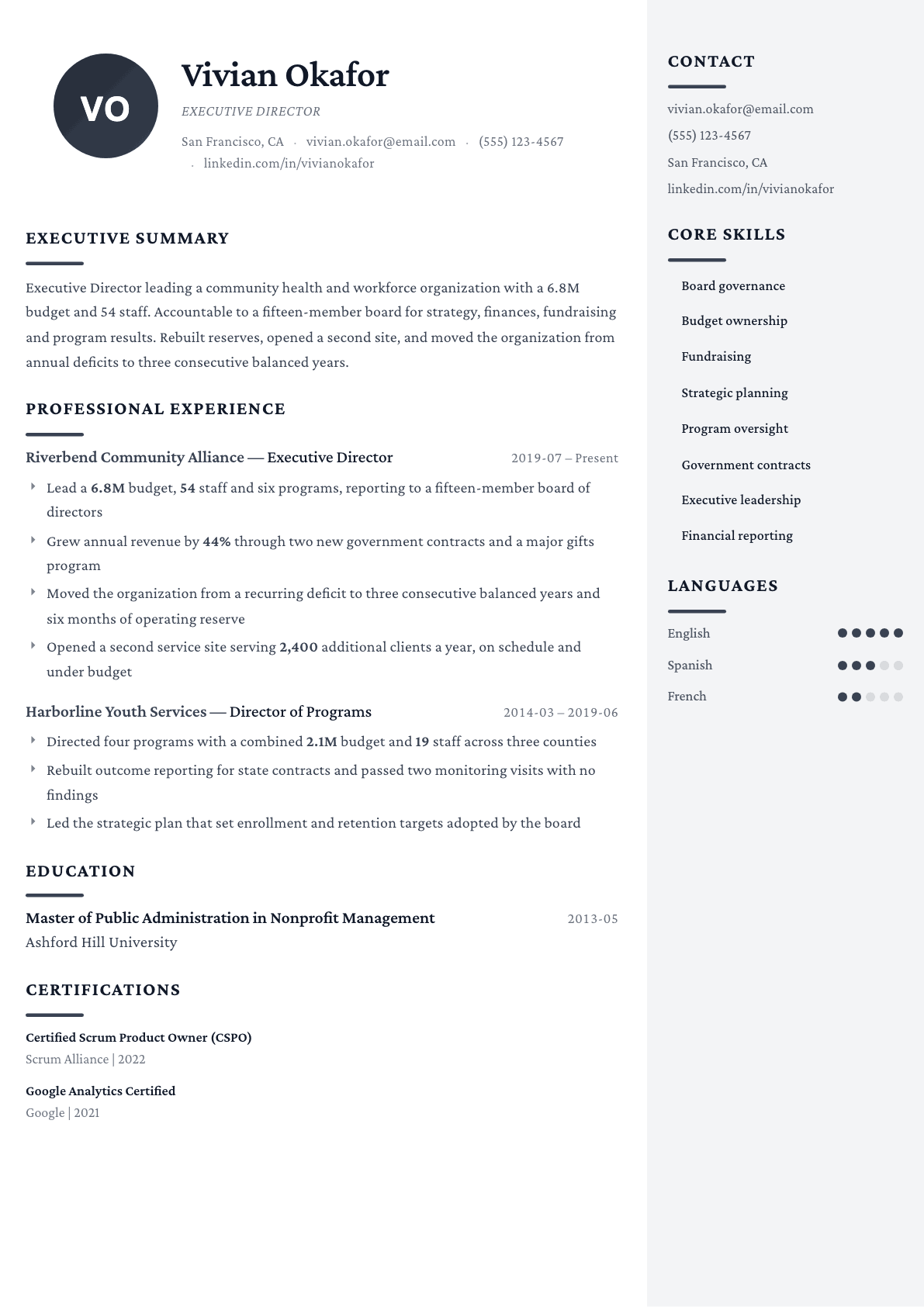
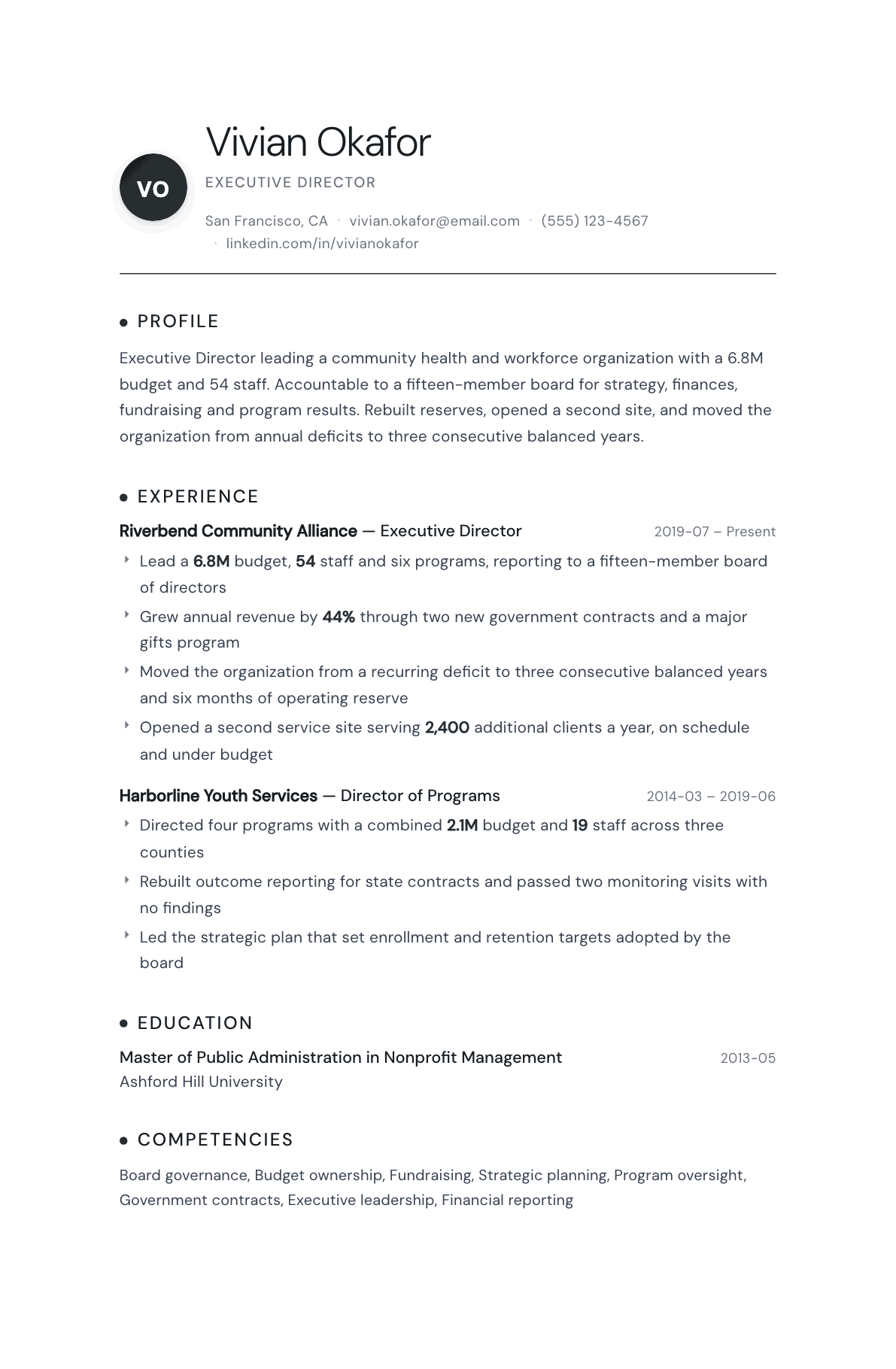
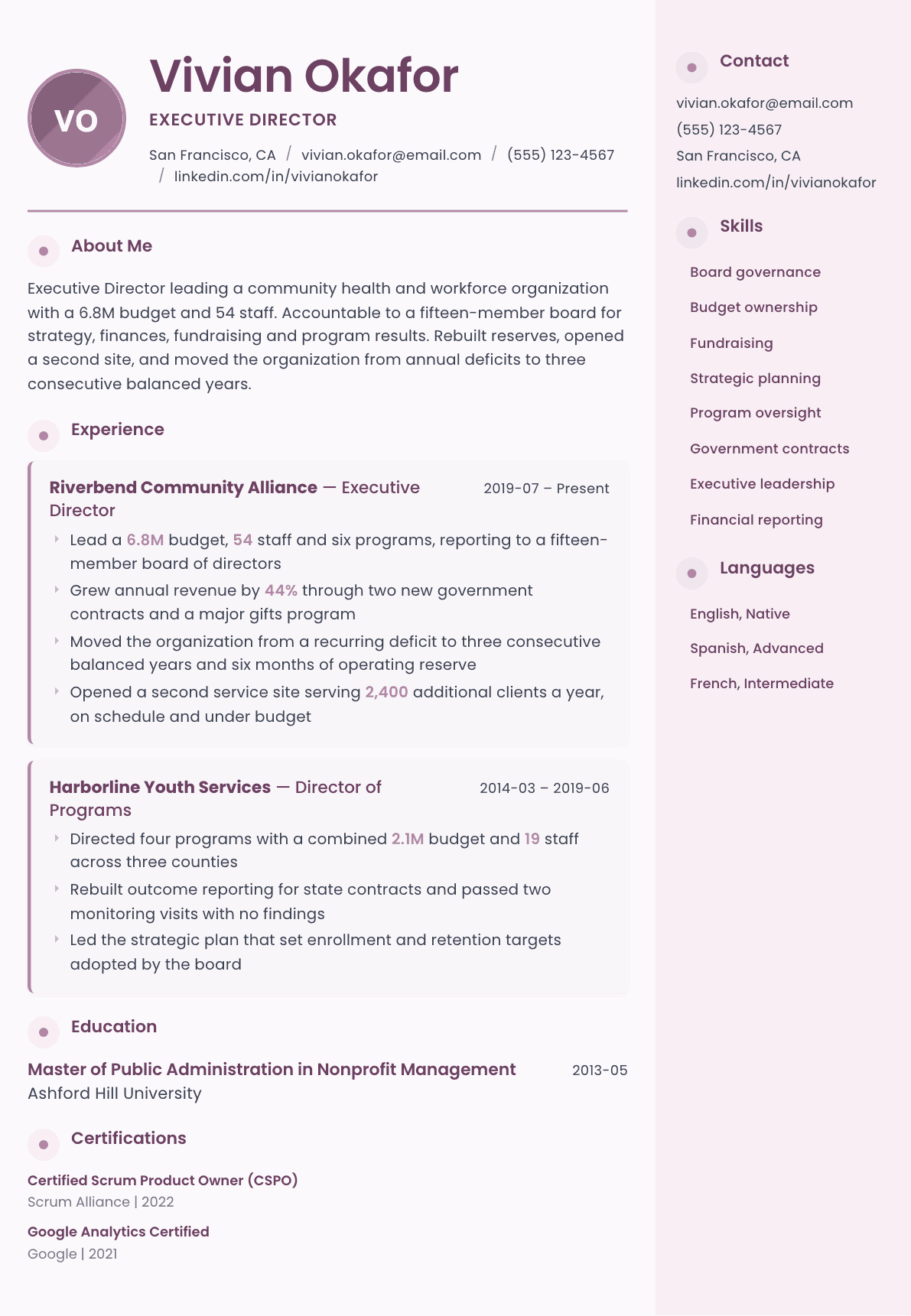
Example Executive Director summary
Executive Director with eleven years in community health and workforce services, currently leading a 6.8M budget, 54 staff and six programs for a fifteen-member board. Grew revenue by 44% through two government contracts and a major gifts program, reversed a recurring deficit into three balanced years with six months of reserve, and opened a second site serving 2,400 more clients.
Skills to list on a Executive Director resume
- Executive leadership
- Board governance
- Strategic planning
- Budget management
- Fundraising and development
- Government contracts
- Grant management
- Program evaluation
- Financial oversight
- Staff leadership
- Community partnerships
- Change management
- Public speaking
- Risk and compliance
- Succession planning
What actually gets this resume read
- Put budget size, staff count and board size in the first line of the role, because that is how scope is judged.
- Show the board relationship explicitly: committees you staffed, reporting you built, and recruitment you drove.
- Give a financial trajectory across your tenure, such as revenue growth, reserve months or deficit reversal.
- Name your funding mix, whether government contracts, foundation grants, individual giving or earned revenue.
- Include one organizational change you led end to end: a merger, a new site, a restructure or a strategic plan.
- Keep the resume to two pages and move the long list of committees and speaking work into a short final section.
How to write a executive director resume
An executive director resume is read by a board search committee, not by a human resources screener, and that changes everything. Board members are volunteers reading in the evening. They want three facts in the first six lines: the size of the organization you led, how its finances moved under you, and what you built or changed. Anything that makes them work for those facts costs you the interview.
Scope is measured in budget, staff and board. Say the budget you were accountable for, the number of employees, the programs, and the size and structure of the board you reported to. A director of a 2M organization with a nine member board and a director of a 40M organization with a twenty five member board are doing recognizably different jobs.
This guide covers the section order a search committee reads, how to write about board relationships and fundraising without generalities, three summaries for different levels of executive scope, and the questions candidates ask when moving between nonprofit, association and small company leadership. Some searches, especially in foundations, universities, health systems and international organizations, ask for an executive director curriculum vitae instead; it uses the same scope-first structure and lists publications, speaking, board seats and academic appointments in full.
Format: two pages, scope line first, no dense paragraphs
Two pages is standard and expected. Reverse chronological, single column, generous white space. A search committee reads quickly and a wall of text loses them before your best evidence arrives.
Under each title, put a scope line: budget, staff count, program count, board size, and geography or population served. Then bullets grouped so that finance, fundraising, programs and governance are each visible. Move the long list of speaking engagements, panels and committee seats into a short final section.
Executive director curriculum vitae example, the top third written out: Rachel Okafor, Executive Director. Scope line: community health nonprofit, five clinic sites, staff of 140, board of fifteen. Summary: Executive director for six years; moved the organization from two funders to a mix of government contracts, foundation grants and individual giving, rebuilt the board committee structure, and opened two new clinic sites. The CV then lists career history, board service, publications and presentations, and education, each with dates.
- Scope line: annual budget, staff, programs, board size, population or geography served.
- Section order: summary, leadership highlights, experience, education, board and community service.
- Keep the first half page free of anything a board member would call background.
Summary: scope, financial trajectory, one signature achievement
Four or five lines, written as a profile rather than an objective. Sector, years leading, current scope, and the direction the finances moved during your tenure. Then the achievement you would be remembered for: a new site, a merger, a turnaround, a strategic plan delivered.
Financial trajectory matters more than a single figure. Revenue growth, reserve months built, a deficit reversed or a diversified funding mix all tell a board that you can be trusted with their balance sheet.
Experience: finance, fundraising, programs, people, governance
Finance. Budget owned, the audit result, reserves in months of operating expense, and any deficit you reversed. Boards care about the audit outcome and about whether you present financial information they can understand.
Fundraising and revenue. Name the mix: government contracts, foundation grants, individual giving, events, earned revenue and membership. Give the growth and the source of it. If you personally cultivated major donors, say how many and at what level of engagement rather than naming amounts you cannot verify.
Programs. What you started, closed, expanded or improved, and the outcome measure that justified the decision. Executive directors who can point to a program they ended for lack of impact demonstrate exactly the judgment boards want.
People. Staff size, leadership team you built, turnover you reduced, and any restructure you led. Include compensation reviews or benefits work if you led it, because that is real executive responsibility.
Governance. Committees you staffed, board recruitment you drove, the reporting package you built, and any bylaw or policy work. Say how you handled the relationship, since board management is the skill most often tested in the interview.
Evidence a board will check
Search committees verify what is verifiable. Public filings, audit outcomes, grant awards and news of new sites are all checkable, so state them precisely and do not round in your favor.
Where numbers are confidential or shared with a board, describe scope in terms that are still meaningful: months of reserve, staff count, number of sites, clients served annually. These carry weight without exposing anything sensitive.
- Financial: audit results, reserve months, revenue mix, multi year growth.
- Operational: sites opened, clients or members served, programs launched or closed.
- Governance: board size, committee structure, strategic plans adopted.
Language that works with a board audience
Boards use a specific vocabulary: fiduciary responsibility, strategic plan, stakeholder engagement, sustainability of the funding model, executive limitations, succession planning and community partnerships. Using those terms accurately signals that you have sat in the room.
Avoid inflated language. Transformational leader and visionary executive are self assessments, and search committees discount them instantly. Let the reserve months and the retained staff make the argument for you.
Executive Director resume summary examples
First executive director role
Program director with nine years leading four programs, a 2.1M budget and 19 staff across three counties. Rebuilt outcome reporting for state contracts and passed two monitoring visits with no findings. Led the strategic plan the board adopted, and now seeking a first executive director appointment.
Executive director
Executive Director leading a community health and workforce organization with a 6.8M budget, 54 staff and six programs, reporting to a fifteen member board. Grew revenue 44% through two government contracts and a major gifts program, and moved the organization from recurring deficits to three balanced years.
Multi site chief executive
Chief executive with sixteen years in nonprofit leadership, currently accountable for a 30M budget, 240 staff and eleven sites. Led a merger that added two service lines without staff loss, built nine months of operating reserve, and rebuilt the board committee structure and succession plan.
Work experience bullets: before and after
Before: Led the organization and reported to the board.
After: Led a 6.8M budget, 54 staff and six programs, reporting to a fifteen member board and staffing its finance, governance and development committees.
Budget, staff, programs and committee work replace a sentence true of every executive director alive.
Before: Improved the financial position of the organization.
After: Moved the organization from a recurring annual deficit to three consecutive balanced years and built six months of operating reserve.
A trajectory across several years with a reserve figure is the strongest financial evidence a board can read.
Before: Responsible for fundraising.
After: Grew annual revenue 44% by winning two multi year government contracts and launching a major gifts program that added 180 individual donors.
Naming the revenue sources shows which fundraising muscles you actually have.
Before: Expanded services to more clients.
After: Opened a second service site serving 2,400 additional clients a year, delivered on schedule and under budget with a state capital grant.
Scale, timing, budget performance and funding source together make the expansion verifiable.
Before: Worked with the board on strategy.
After: Facilitated a three year strategic plan with the board and staff, then reported quarterly against its six measures, retiring one program that was not meeting its outcome target.
Following a plan through to a hard decision proves governance discipline rather than plan writing.
Hard skills
- Budget development and financial oversight
- Board governance and committee support
- Fundraising and major gifts
- Government contract management
- Grant compliance and reporting
- Strategic planning
- Program evaluation and outcome measurement
- Audit preparation
- Human resources and compensation oversight
- Risk management and insurance
- Community and public partnerships
- Succession planning
Soft skills
- Executive judgment
- Public representation of an organization
- Difficult conversations with board and staff
- Coalition building
- Calm under financial pressure
- Coaching a leadership team
Certifications worth listing
- Certified Fund Raising Executive (CFRE) (CFRE International)
- Certified Association Executive (CAE) (American Society of Association Executives)
- Certified Nonprofit Professional (CNP) (Nonprofit Leadership Alliance)
- Project Management Professional (PMP) (Project Management Institute)
Mistakes that cost executive director candidates the interview
- Opening with a personal mission statement instead of budget, staff and board scope.
- Describing the board relationship in one line when governance is half the job.
- Claiming fundraising success without naming the revenue sources that produced it.
- Listing programs without a single outcome measure attached to any of them.
- Writing three dense pages, which a volunteer search committee will not finish.
- Using inflated self descriptions such as visionary leader that a committee immediately discounts.
Executive Director resume questions
How long should an executive director resume be?
Two pages. Search committees expect the extra space for financial trajectory, governance work and program results, but a third page almost always means duties have crept back in and the strongest evidence has been buried.
Is an executive director curriculum vitae different from a resume?
The leadership evidence is the same. A curriculum vitae runs longer and lists everything in full: every board seat, publication, presentation, award and academic appointment. Send a CV when the search firm or posting asks for one, usually in health, academic and international work, and the two page resume otherwise, always with a cover letter.
How do I show board experience if I have never been an executive director?
Draw on committee work you staffed, board reports you produced, and any board seat you have held at another organization. Serving on a board teaches you what a board needs, and committees value candidates who have sat on both sides.
What financial details should go on the resume?
Budget size, revenue growth over your tenure, reserve months, audit outcomes, and any deficit reversed. Avoid detailed line item figures. The point is to show a board that your stewardship produced a healthier balance sheet.
Can a business executive move into a nonprofit executive director role?
Yes, though the funding model is the gap to close. Show any grant, contract or philanthropic experience you have, learn the reporting obligations of restricted funding, and lead with governance, financial stewardship and community partnerships.
Related resume examples
- Executive Director (Nonprofit) Resume example
- Program Director Resume example
- Managing Director Resume example
- Nonprofit Program Manager Resume example
- CEO Resume example
- Development Director Resume example