Risk Manager Resume Examples: free ATS score and gap list
Create a Risk Manager Resume That Proves Your Vigilance
By Mustafa Tarabya, founder of CVBooster · Published · Updated
Build a risk manager resume demonstrating enterprise risk assessment, regulatory compliance, and mitigation strategies with quantified loss prevention outcomes.
Sample resumes for a risk manager
The same risk manager content laid out in three CVBooster templates, so you can see what the finished document looks like before you write a word.
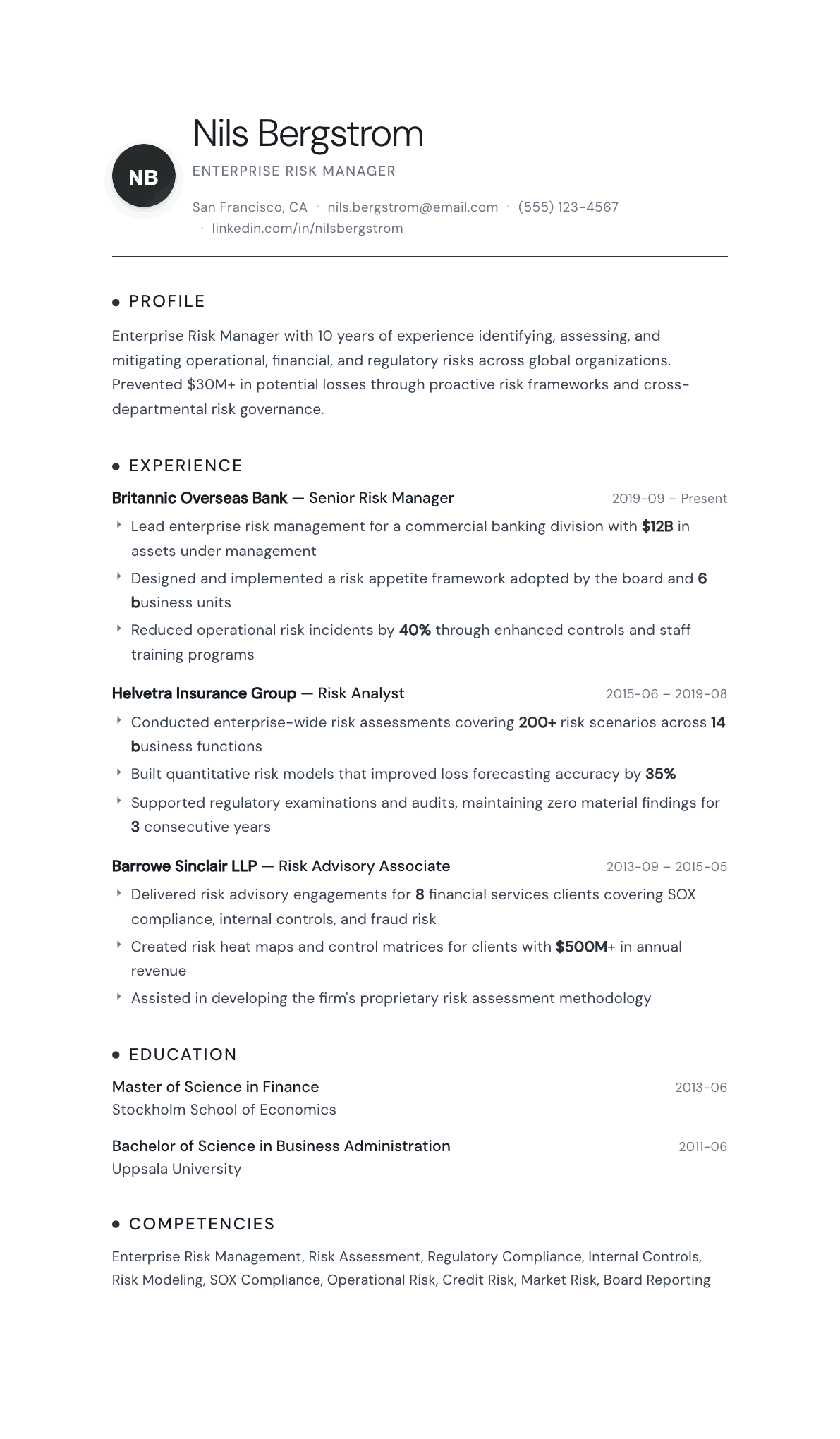
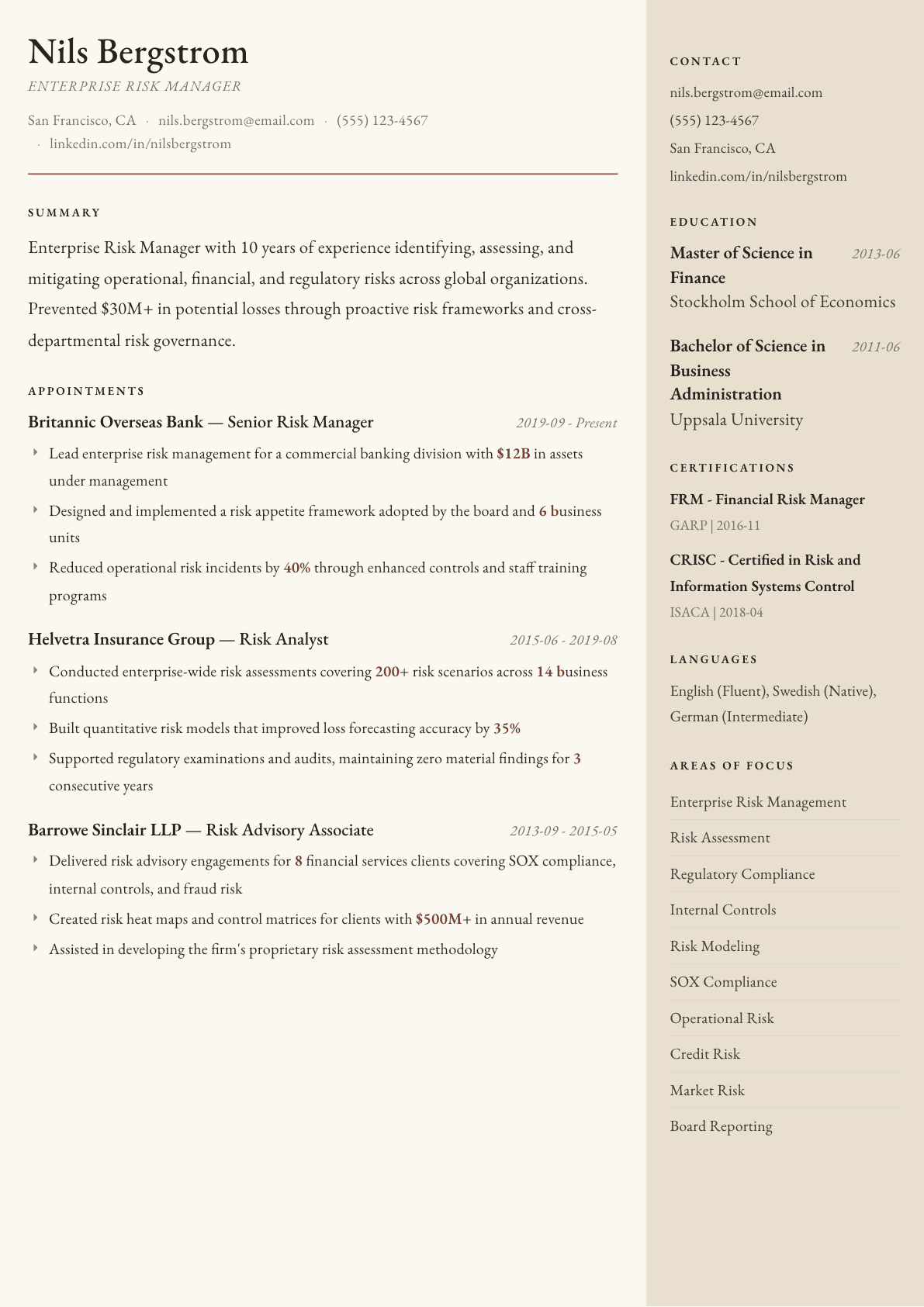
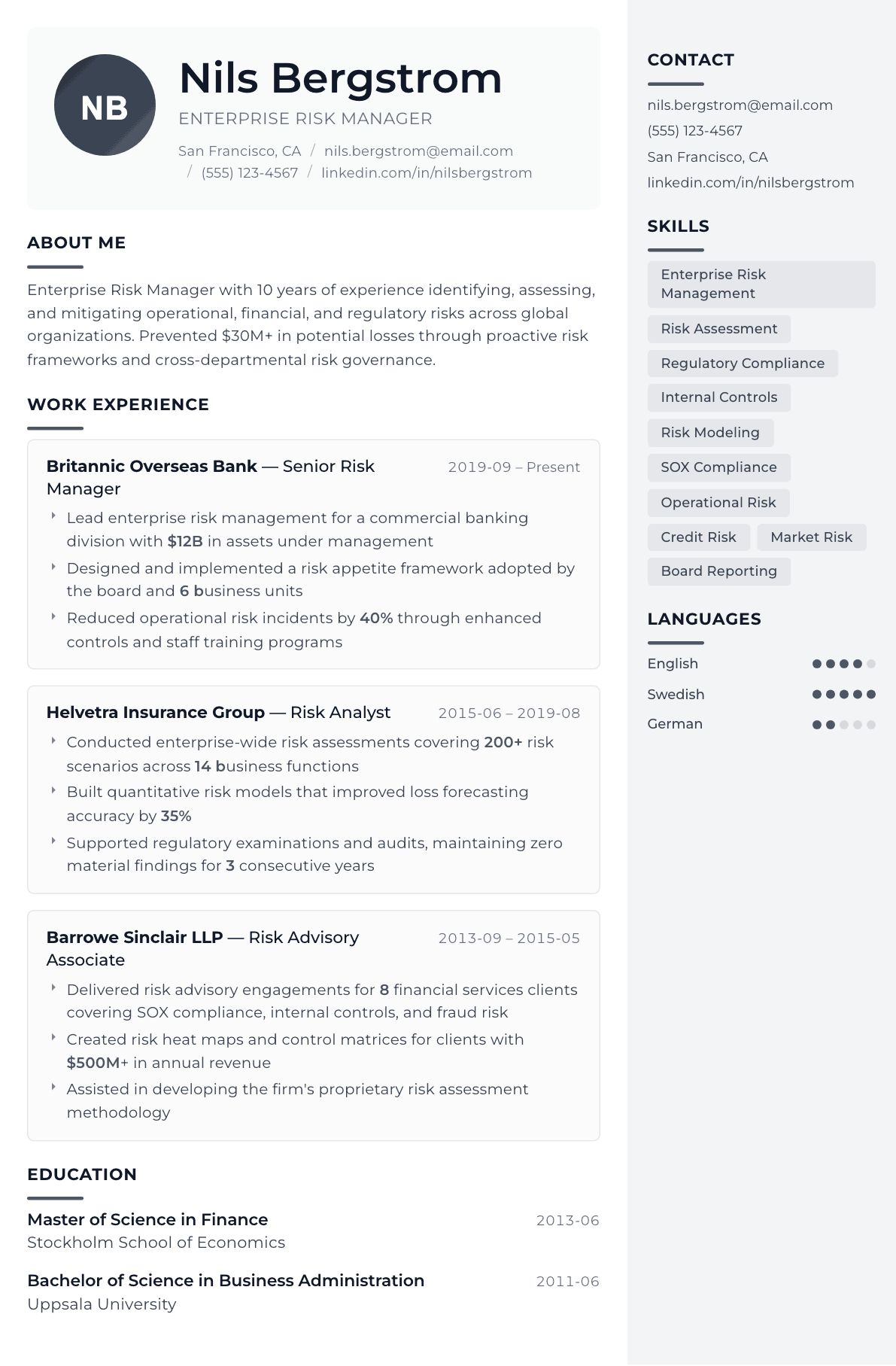
Example Risk Manager summary
Enterprise Risk Manager with 10 years of experience building and executing risk frameworks across global financial institutions. Prevented $30M+ in potential losses through proactive risk identification, quantitative modeling, and cross-departmental governance. FRM and CRISC certified. Seeking a Head of Risk role to lead enterprise risk strategy at a forward-thinking organization.
Skills to list on a Risk Manager resume
- Enterprise Risk Management
- Risk Assessment
- Risk Modeling
- Regulatory Compliance
- Internal Controls
- SOX Compliance
- Operational Risk
- Credit Risk
- Market Risk
- Cyber Risk
- COSO Framework
- ISO 31000
- Board Reporting
- Audit Support
What actually gets this resume read
- Quantify risk mitigation outcomes: losses prevented, incidents reduced, audit findings resolved.
- Highlight specific risk domains you cover: operational, credit, market, cyber, regulatory.
- Show experience with risk frameworks (COSO, ISO 31000) and regulatory requirements (Basel, SOX).
- Include certifications like FRM, CRISC, or CRM prominently on your resume.
- Demonstrate board-level reporting and risk appetite framework development.
- Use industry-standard risk terminology that ATS systems will recognize.
How to write a risk manager resume
Risk management is a credibility profession. A chief risk officer reading your resume is asking whether you would have been believed in the room: whether the business took your assessment seriously, whether the board committee acted on your paper, and whether a regulator or an internal audit function ever tested your work and found it sound.
That means the resume has to be specific about which risk you managed. Operational risk, credit risk, market and liquidity risk, technology and cyber risk, model risk, third party risk, conduct risk and enterprise risk are separate disciplines with separate frameworks, separate regulators and separate tooling. A file that says risk management without naming the type reads as generic to every specialist hiring manager who opens it.
This guide covers how to state risk domain and regulatory environment immediately, how to write about frameworks and appetite in a way that shows judgment rather than recitation, summaries for a risk analyst, an established risk manager and a head of risk, and the questions people ask when moving between the three lines of defense or across industries.
Format: domain, industry and line of defense stated up front
Two pages is normal for a risk manager with a decade of experience, one page below that. In the summary, name the risk domains you own, the industry, the regulatory environment you operate under, and which line of defense you sat in. First line risk sitting inside the business, second line independent risk oversight, and third line internal audit are different jobs, and hiring managers filter on the distinction before they read anything else.
Under each role, add a profile line: the business or portfolio you covered, its scale expressed as a magnitude, the risk taxonomy you worked to, the committees you reported into, and the size of the risk team. That is what lets a reader place a group risk role against a divisional one.
- Domain line: the risk types you personally assessed and monitored.
- Regulatory line: the supervisors, examinations and reporting obligations you worked under.
- Governance line: the committees you wrote for and the frequency of your reporting.
- Systems line: the governance risk and compliance platform, the modeling and data tools.
Frameworks: what you built inside them, not that you know them
Every risk resume names a framework. The ones that get interviews say what was built underneath it. Describe the risk taxonomy you defined, the risk and control self assessment cycle you ran, the key risk indicators you set with thresholds and escalation triggers, the loss event data process you cleaned up, and the control testing you designed and its coverage.
Risk appetite is the same story. Writing an appetite statement is easy and enforcing one is not, so show the enforcement: a breach that triggered escalation, a limit you held when a business head wanted it moved, a new product that went to committee with your assessment attached, or a proposal you recommended against and what happened. That is where a chief risk officer decides whether to interview you.
Quantification without overclaiming
Be careful with prevented loss figures. A number for a loss that never happened invites the question of how it was calculated, and a hiring manager in this field will ask. Safer and stronger evidence includes the reduction in open high rated issues, control failures found before they caused an event, the aging of overdue remediation items, near miss volume once reporting improved, and the movement in a stress test or capital measure after an exposure was reduced.
Where you did model work, say what the model did, the data it used, how it was validated, and who approved it. Model risk governance is its own discipline, and a candidate who understands the difference between building a model and having it independently validated is easy to distinguish from one who does not.
Regulatory examinations, audits and the record they left
Regulated employers screen hard for examination experience. Say which supervisory reviews or examinations you supported, what your area covered, how you prepared the evidence, and how findings were remediated and closed. The same applies to internal audit reviews of your framework and to any independent assurance work over your risk processes.
If you led a remediation, describe it as a program: the number of findings, the deadline, the workstreams, the evidence standard the regulator or auditor accepted, and whether it closed on time. Remediation delivery is one of the most in demand skills in risk hiring and it is often left out because candidates think of it as clean up rather than achievement.
Keywords and how to tailor across industries
The recurring vocabulary includes enterprise risk management, risk appetite, risk and control self assessment, key risk indicators, control testing, three lines of defense, issue management and remediation, scenario analysis, stress testing, operational resilience, third party risk and board reporting. Place each where you have real evidence.
Then adapt for industry. Banking expects capital and liquidity vocabulary and supervisory reporting. Insurance expects underwriting risk, reserving and the own risk and solvency assessment. Healthcare expects patient safety event reporting and clinical risk. Manufacturing and energy expect process safety, hazard studies and business continuity. An enterprise risk manager who cannot speak the operational language of the sector will be read as a framework administrator.
Risk Manager resume summary examples
Risk analyst
Operational risk analyst with two years in a retail bank, running the risk and control self assessment cycle for three business units and maintaining 46 key risk indicators. Cleaned the loss event data set after finding 30% of entries miscategorized, and drafted the quarterly risk pack for the divisional committee.
Risk manager, seven years in
Second line operational and technology risk manager covering a payments division, reporting to the divisional risk committee. Rebuilt the control testing plan to risk based coverage, reduced overdue high rated issues from 41 to nine in four quarters, and led evidence preparation for two supervisory reviews.
Head of risk
Head of enterprise risk with fourteen years across banking and insurance, currently leading a team of eleven and reporting to the board risk committee. Rewrote the group risk appetite statement with cascaded limits, held a limit breach escalation through executive pushback, and closed a regulatory remediation program on schedule.
Work experience bullets: before and after
Before: Responsible for enterprise risk management across the organization.
After: Owned the enterprise risk framework for a group of five legal entities, maintaining the risk taxonomy, running the half yearly risk and control self assessment across 22 business areas, and reporting to the board risk committee each quarter.
Entity count, assessment scope and reporting level convert a broad claim into a measurable span of responsibility.
Before: Developed key risk indicators for the business.
After: Defined 46 key risk indicators with amber and red thresholds agreed with business owners, wired escalation to the divisional committee, and retired 14 legacy measures that had never once triggered a management action.
Retiring measures that did nothing shows judgment about what a risk indicator is actually for.
Before: Reduced risk exposure for the company.
After: Cut overdue high rated issues from 41 to nine over four quarters by agreeing realistic remediation dates with owners, escalating three that slipped twice, and requiring evidence of control operation before closing any item.
A measurable issue population with a described closure standard is credible where an unquantified exposure claim is not.
Before: Supported regulatory examinations.
After: Coordinated the evidence response for two supervisory reviews of the operational risk framework, assembling 180 documents against the information request and preparing four subject matter experts for interview, with no repeat findings raised.
The volume, the preparation and the outcome show examination readiness rather than passive participation.
Before: Advised the business on risk appetite.
After: Held a transaction limit at the agreed appetite despite a business head requesting an exception, took the request to committee with the exposure analysis attached, and had the limit upheld with a review date set for the next quarter.
Independence under pressure is the trait a chief risk officer hires for and it needs a concrete instance to be believed.
Hard skills
- Enterprise risk framework design
- Risk taxonomy and risk register maintenance
- Risk and control self assessment
- Key risk indicator design and thresholds
- Control design and testing
- Issue management and remediation tracking
- Loss event data and near miss analysis
- Scenario analysis and stress testing
- Third party and outsourcing risk assessment
- Operational resilience and business continuity
- Governance risk and compliance platforms
- Board and committee reporting
- Model risk governance
Soft skills
- Independence under commercial pressure
- Concise written analysis for boards
- Challenging senior stakeholders constructively
- Building relationships with first line owners
- Judgment on when to escalate
Certifications worth listing
- Financial Risk Manager (FRM) (Global Association of Risk Professionals)
- Professional Risk Manager (PRM) (Professional Risk Managers International Association)
- Certified in Risk and Information Systems Control (CRISC) (ISACA)
- Certification in Risk Management Assurance (CRMA) (Institute of Internal Auditors)
- Associate in Risk Management (ARM) (The Institutes)
Mistakes that cost risk manager candidates the interview
- Saying risk management without naming the domain, so no specialist hiring manager recognizes their own discipline.
- Leaving out which line of defense you worked in, which is the first structural filter applied in regulated hiring.
- Claiming a large prevented loss figure that cannot survive the obvious question about how it was calculated.
- Reciting frameworks without describing the taxonomy, indicators or testing you actually built underneath them.
- Omitting examination and audit experience, which is one of the strongest signals a regulated employer looks for.
- Presenting an appetite statement as an achievement with no example of it being enforced against resistance.
Risk Manager resume questions
How do I move from first line risk into a second line role?
Show independence. Lead with assessments where you reached a conclusion the business did not want, controls you tested rather than operated, and issues you raised on your own area. Then name the framework knowledge and any credential you hold, because second line hiring managers screen for both mindset and method.
Which risk certification is worth taking?
Choose by domain rather than prestige. A market and credit risk career points to a quantitative finance credential, a technology risk career to an information systems risk credential, an insurance career to an insurance risk credential, and an audit adjacent career to an internal audit one. Name the issuing body in every case.
How do I quantify risk work when nothing bad happened?
Measure the framework instead of hypothetical losses. Open issue counts and their aging, control testing coverage, indicator breaches detected and escalated, remediation delivered on schedule, and repeat findings avoided are all countable, defensible and understood by anyone who has run a risk function.
Should a risk manager resume mention specific regulators?
Yes, when you worked under them directly. Naming the supervisory regime, the examination cycle and the reporting obligations tells a hiring manager whether your experience transfers to their environment, and it is one of the few details that cannot be inferred from your job titles.
How do I write about a risk event that occurred on my watch?
Describe it as a lesson with evidence. State what the event exposed, whether the control had been identified as weak beforehand, what you changed afterwards, and how the fix was verified. Experienced risk leaders trust a candidate who has been through an event more than one who claims a spotless record.
Related resume examples
- Compliance Officer Resume example
- Auditor Resume example
- Financial Analyst Resume example
- Environmental Consultant Resume example
- CEO Resume example
- Managing Director Resume example