Franchise Manager Resume Examples: the lines they read
Build a Franchise Manager Resume That Shows Multi-Unit Success
By Mustafa Tarabya, founder of CVBooster · Published · Updated
Create a franchise manager resume that demonstrates multi-unit leadership, brand compliance, and franchisee support with clear performance metrics.
Sample resumes for a franchise manager
The same franchise manager content laid out in three CVBooster templates, so you can see what the finished document looks like before you write a word.
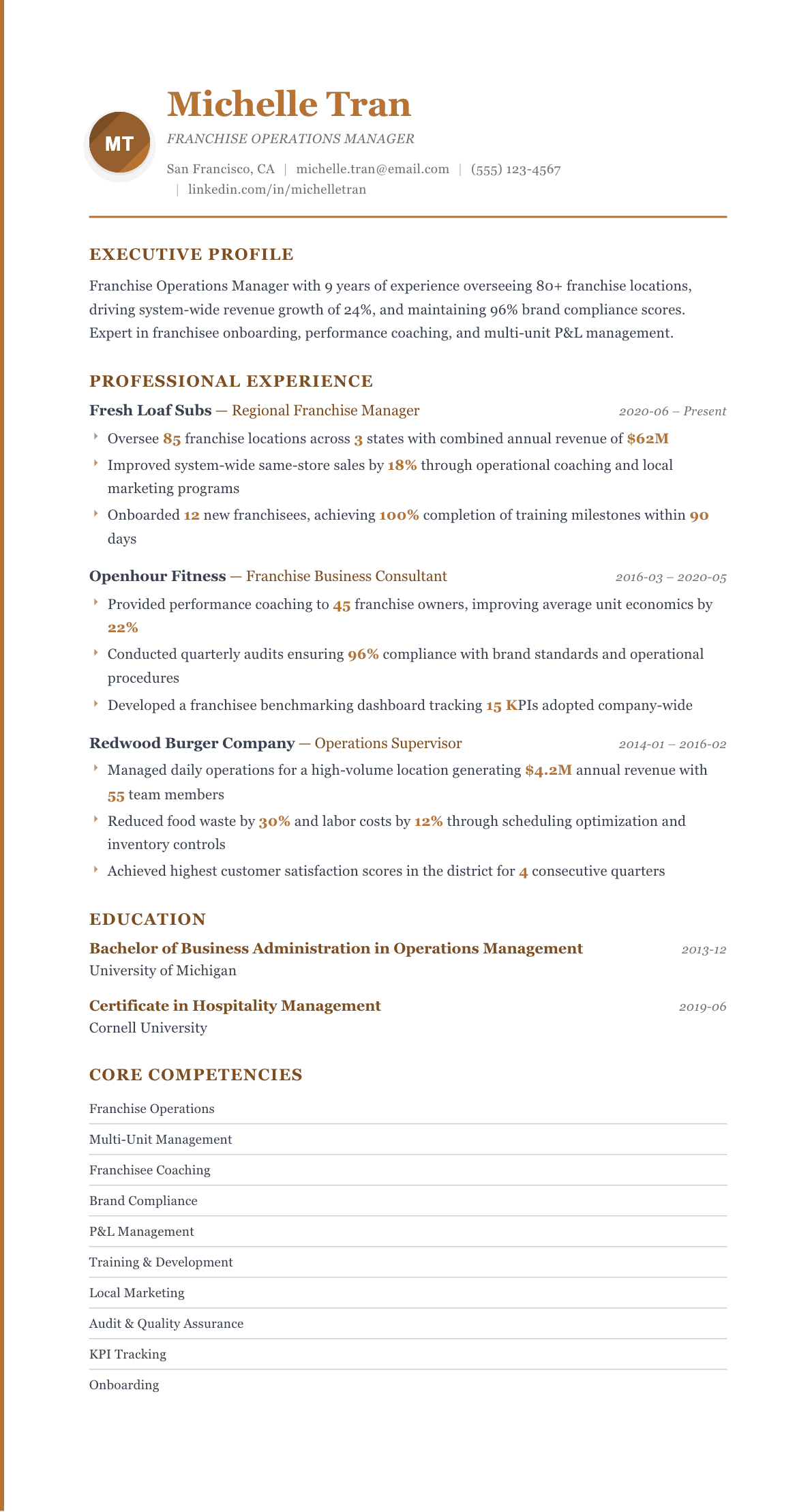
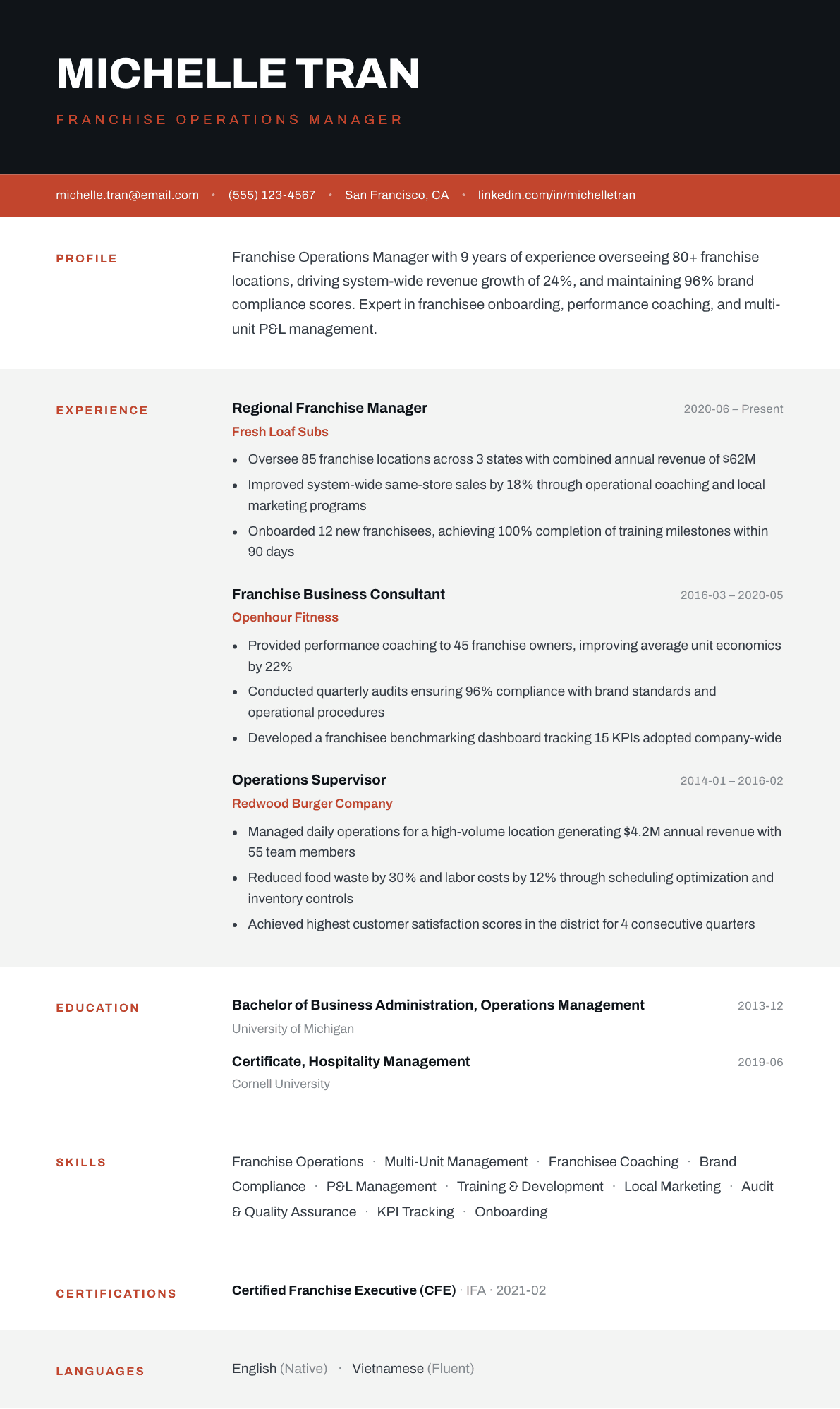
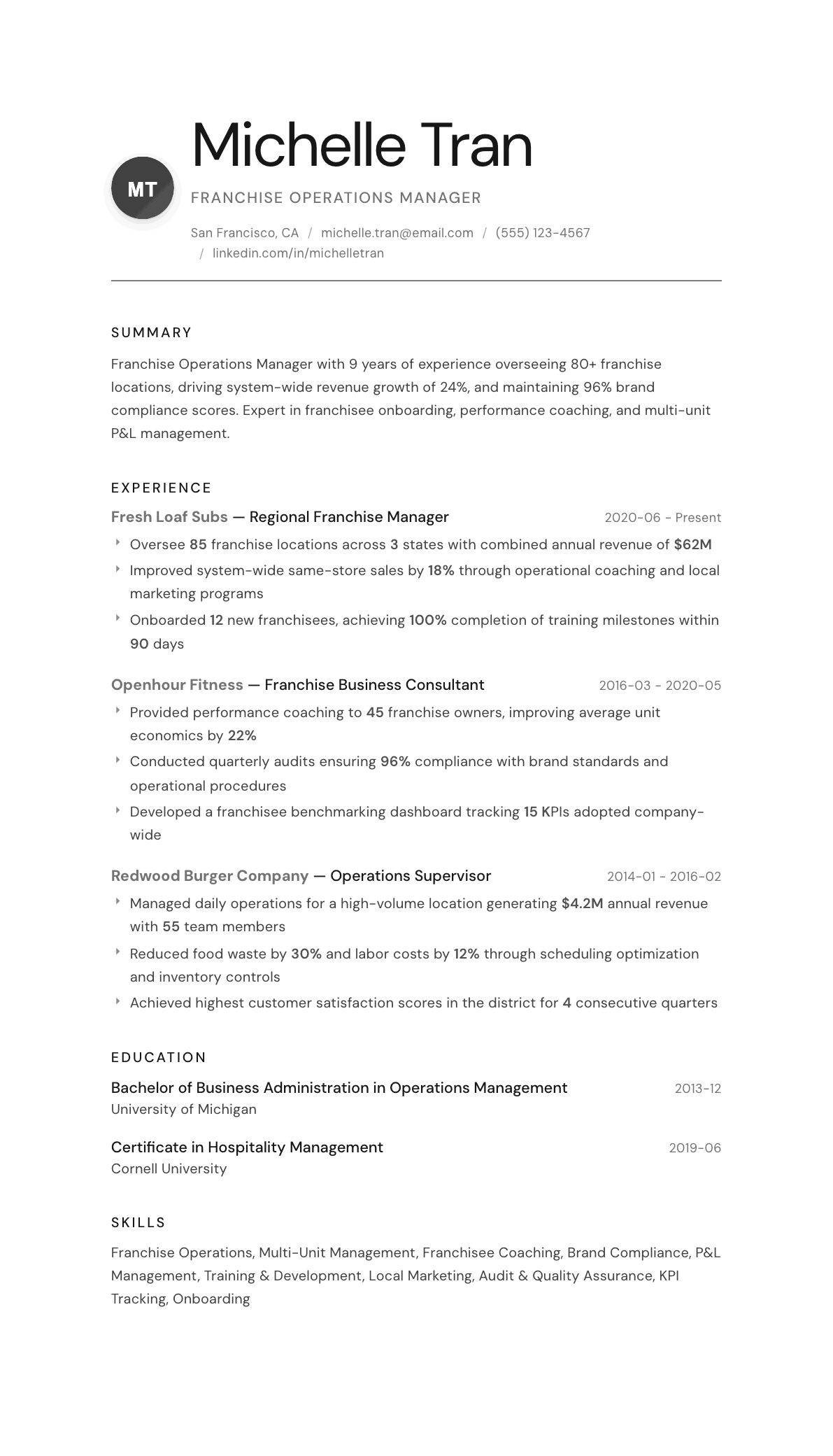
Example Franchise Manager summary
Franchise Operations Manager with 9 years of experience leading 80+ franchise locations and driving 24% system-wide revenue growth. Expert in franchisee onboarding, performance coaching, and brand compliance with a 96% audit score track record. CFE-certified professional seeking a VP Franchise Operations role to scale a growing brand.
Skills to list on a Franchise Manager resume
- Franchise Operations
- Multi-Unit Management
- Franchisee Relations
- Brand Compliance
- P&L Management
- Training & Development
- Performance Coaching
- Local Marketing
- Quality Assurance
- KPI Development
- Onboarding Programs
- Territory Management
What actually gets this resume read
- Specify the number of franchise units, combined revenue, and geographic scope you managed.
- Highlight franchisee satisfaction, brand compliance scores, and same-store sales growth.
- Show experience in onboarding, training, and coaching franchise owners.
- Include P&L management and budget oversight for multi-unit portfolios.
- Demonstrate ability to balance brand standards with individual franchisee needs.
- Mention any franchise-specific certifications like CFE.
How to write a franchise manager resume
A franchise manager resume is judged on a tension no other management resume carries: you are accountable for results in units you do not own and cannot directly command. The franchisor hiring you wants brand standards held, system sales grown and franchisees kept in the network. The franchisees themselves are independent business owners who can decline your advice. A reviewer is reading for evidence that you produce compliance and growth through influence rather than authority.
The most common failure is writing this file as a multi-unit operations resume. Directing company owned stores and supporting franchised units look similar on paper and are different jobs. In one you can transfer a manager; in the other you have to persuade an owner to invest her own capital in a remodel she is not enthusiastic about. Say which one you have done, and if you have done both, distinguish them clearly.
This guide covers the section order a franchise development or operations director expects, how to state portfolio scope, three summary examples from field consultant to regional lead, before and after bullets, and the questions franchise professionals ask when they write this resume.
Format: portfolio scope first, one to two pages
Reverse chronological, one page under five years, two after that. Under each employer give a portfolio line before any bullets: number of units, franchised versus company owned split, brands, territory, combined system sales in a band, and the number of franchisee ownership groups you supported. That last figure matters, because supporting 30 units held by 4 multi-unit owners is a different job from 30 units held by 30 single-unit operators.
Say which side of the system you sat on. Franchise business consultant, field operations for a franchisor, franchise development and sales, area developer, or multi-unit operator on the franchisee side are distinct careers, and a hiring director reads that distinction before anything else.
- Header: name, city and state, phone, email, and a note if you are open to significant travel.
- Order: summary, portfolio scope, professional experience, brand and systems knowledge, education, certifications.
- Name the brands and the segment: quick service, fitness, home services, childcare, automotive, retail.
- State travel percentage and territory size, because field roles are staffed against geography.
Summary: units, segment, and the lever you pull
Three lines. Years in franchising, the segment, the portfolio size you have carried, and the outcome you are known for producing. Same store sales recovery in underperforming units, brand standard scores lifted across a region, new franchisee onboarding to break even faster, or franchisee renewal and retention through a system change.
Franchising is relationship intensive, so name the relationship result too. Franchisee satisfaction scores, renewal rates, participation in national marketing programs and voluntary adoption of new products or systems are the metrics that show you can move owners without a mandate.
Experience: compliance, coaching, and the P&L you influence
Split your bullets across three jobs the role actually contains. Brand compliance, meaning audits conducted, standards scores, corrective action plans closed, and how you handled a persistently non-compliant operator. Business coaching, meaning profit and loss reviews with owners, labor and food or product cost benchmarking, local marketing plans, and staffing or turnover work. And system growth, meaning new unit openings supported, transfers, resales, and remodels or refresh programs landed.
Write the coaching bullets in the owner economics that franchisees care about: prime cost, labor as a share of sales, average ticket, transaction counts, cost of goods, and the payback period on any investment you recommended. An owner who reads your resume should recognize the language of her own profit and loss statement.
Do not skip the difficult work. Underperforming units brought back to standard, a default cured, a resale managed so the territory stayed covered, a franchisee exit handled without litigation. Franchisors hire experienced people specifically for these situations, and vague resumes never show them.
Openings, training and systems
New unit openings are a measurable specialty. State how many you have opened, the ramp support model you ran, the time from lease signing to opening, and the first year performance of units you launched. If you built or delivered training, say the format and the population: initial owner certification weeks, general manager certification, new product rollouts, or a train the trainer program.
Name the systems you work in, because franchisors run on them. Point of sale platforms, the field audit and standards application, the franchise management or intranet system, business intelligence dashboards, learning management platforms, and scheduling or labor tools. Fluency in these is a real screening criterion for field roles.
Keywords a franchisor screens on
Postings repeat a defined vocabulary: multi-unit operations, same store sales, brand standards, franchise business consultant, franchisee relations, unit economics, new unit openings, territory management, operations audits, local store marketing, profit and loss review and franchise agreement compliance. Use the ones you can evidence and place them near the proof.
Add the segment specific terms too. Speed of service and drive-through times in quick service, member retention and attrition in fitness, technician utilization and first-time fix in home services, enrollment and licensing ratios in childcare. These prove you know the operating model rather than the generic franchise vocabulary.
Franchise Manager resume summary examples
New field consultant
Franchise business consultant with 2 years supporting 22 quick service units across 9 ownership groups. Raised average brand standards audit scores from 82 to 94 and coached 4 underperforming units back above system average transaction counts within two quarters.
Six years in franchising
Franchise manager with 6 years in fitness and home services, supporting 48 units across 3 states and 19 franchisee groups. Delivered 11% same store sales growth, opened 9 new units, and lifted franchisee satisfaction scores in the territory to the top quartile of the system.
Regional franchise director
Regional franchise director with 14 years across two brands, leading 6 field consultants and a portfolio of 180 units. Managed 12 resales and 3 defaults without litigation, drove a system-wide remodel program to 78% voluntary participation, and rebuilt the new owner onboarding curriculum.
Work experience bullets: before and after
Before: Managed a territory of franchise locations.
After: Supported 48 franchised units across 19 ownership groups in 3 states, visiting each unit quarterly and running a documented profit and loss review with every owner twice a year.
Ownership groups, visit cadence and the review rhythm show a working field model rather than a territory assignment.
Before: Improved sales performance across the region.
After: Grew same store sales by 11% over two years by rolling out a local marketing playbook to 19 owners and fixing a lunch daypart labor gap that was costing an average of 40 transactions a day per unit.
The mechanism at unit level is what a franchisor is buying, since results without a repeatable play do not scale.
Before: Ensured franchisees followed brand standards.
After: Raised average audit scores from 82 to 94 across the territory, closed 60 corrective action plans, and moved 3 chronically non-compliant units to full standard without escalating to default.
Resolving non-compliance without a default is the hardest version of the task and the strongest possible evidence.
Before: Helped open new franchise locations.
After: Opened 9 units in two years, running site readiness, hiring plans and a 6 week ramp support model, with 7 of the 9 exceeding first year sales projections.
Opening count plus the support model plus first year outcomes prove the launches were successful, not merely completed.
Before: Built strong relationships with franchise owners.
After: Held quarterly business reviews with all 19 ownership groups, chaired the regional franchise advisory council, and took territory renewal from 84% to 100% across two renewal cycles.
A forum you chaired and a renewal rate turn a relationship claim into a measured outcome.
Hard skills
- Multi-unit operations management
- Brand standards auditing
- Franchise agreement compliance
- Unit-level profit and loss coaching
- Same store sales analysis
- New unit opening and ramp support
- Franchisee onboarding and certification training
- Local store marketing planning
- Labor scheduling and cost control
- Resales, transfers and territory planning
- Point of sale and field audit systems
- Inventory and cost of goods management
Soft skills
- Influencing an owner without authority
- Delivering an unwelcome audit result
- Conflict resolution with independent operators
- Coaching first-time business owners
- Facilitating an advisory council
- Consistency across a large travel territory
Certifications worth listing
- Certified Franchise Executive (CFE) (International Franchise Association)
- ServSafe Food Protection Manager (National Restaurant Association)
- Certified Six Sigma Green Belt (CSSGB) (American Society for Quality)
- Certified Manager (CM) (Institute of Certified Professional Managers)
Mistakes that cost franchise manager candidates the interview
- Presenting company owned multi-unit management as franchise experience without naming the difference.
- Giving unit counts with no ownership group count, which hides whether you dealt with one owner or thirty.
- Writing only compliance work and never the coaching that franchisees judge a field manager on.
- Leaving out difficult situations such as defaults, resales and turnarounds that franchisors specifically hire for.
- Using corporate language for owner economics instead of the prime cost and ticket figures an operator recognizes.
- Omitting travel percentage and territory geography, which field roles are staffed against directly.
Franchise Manager resume questions
How do I show results when franchisees make their own decisions?
Use adoption and participation as your metrics. Voluntary uptake of a remodel program, attendance at training, participation in a marketing initiative and renewal rates all prove influence, which is precisely what the role is accountable for.
Should I list the brands I have worked with?
Yes, unless a confidentiality obligation prevents it. Brand names carry immediate context about system size, segment and operating model, and franchisors often hire from adjacent brands because the transition is faster.
Is the Certified Franchise Executive designation worth pursuing?
It is the recognized credential in the industry and signals commitment to franchising as a career rather than a passing role. It matters most for franchisor side positions and development roles, and less if you are moving toward operating units yourself.
How do I move from restaurant management into franchise management?
Lead with the transferable evidence: multi-unit responsibility, profit and loss ownership, training delivery and any work you did with owners or above-store leaders. Then show you understand the difference between directing employees and advising independent business owners.
What travel expectation should I put on the resume?
State it plainly, such as travel across a three state territory with roughly half of nights away from home. Field franchise roles are geographically demanding and hiring managers screen for candidates who have already sustained that pattern rather than are considering it.
Related resume examples
- General Manager Resume example
- Operations Manager Resume example
- Business Development Manager Resume example
- Regional Manager Resume example
- Branch Manager Resume example
- Assistant Manager Resume example