Criminal Investigator Resume Examples: read this first
Write a Criminal Investigator Resume That Reads Like a Closed Case
By Mustafa Tarabya, founder of CVBooster · Published · Updated
Criminal investigator resume example with caseload keywords, clearance outcomes and a guide to writing warrants, interviews and prosecution results.
Sample resumes for a criminal investigator
The same criminal investigator content laid out in three CVBooster templates, so you can see what the finished document looks like before you write a word.
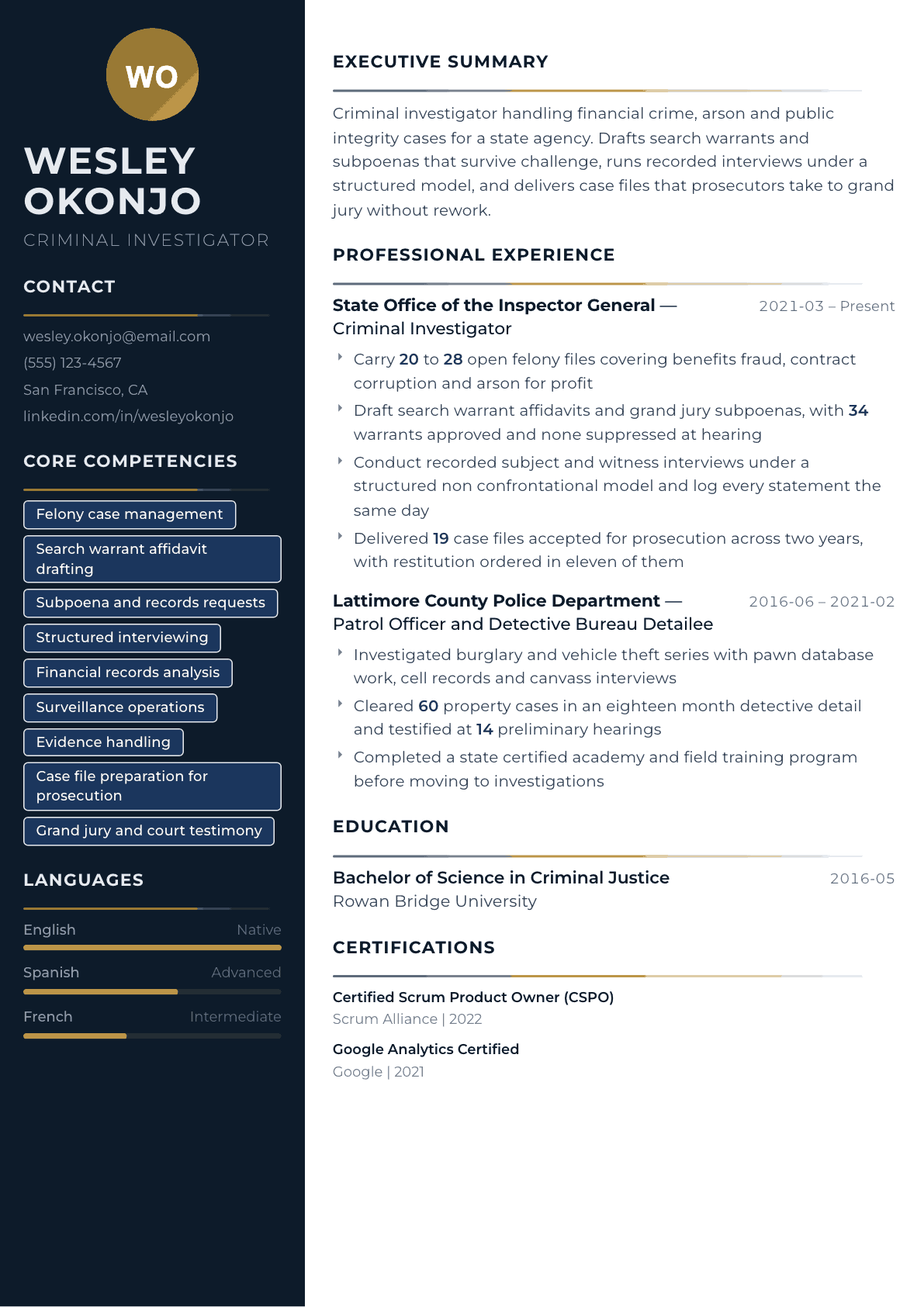
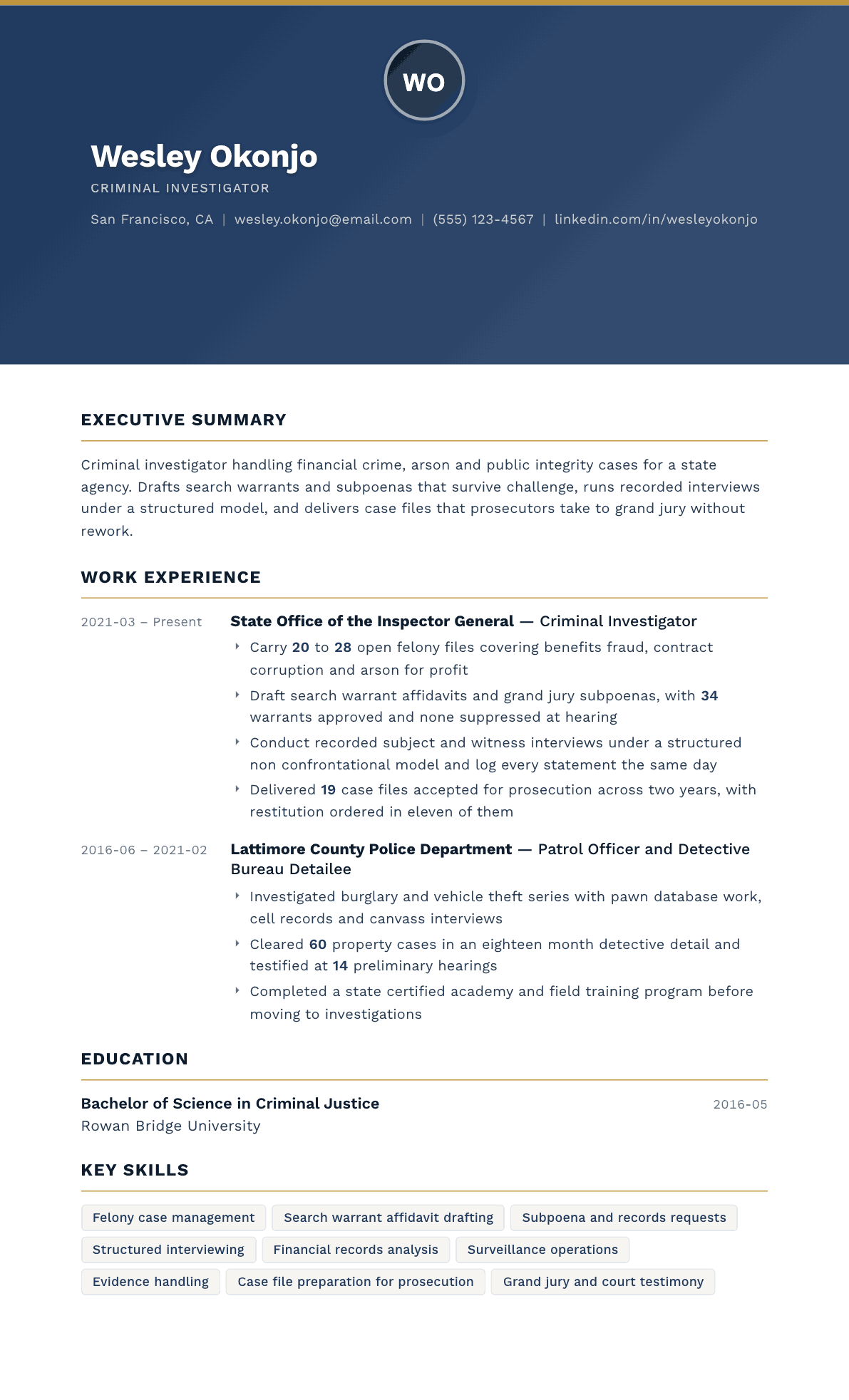
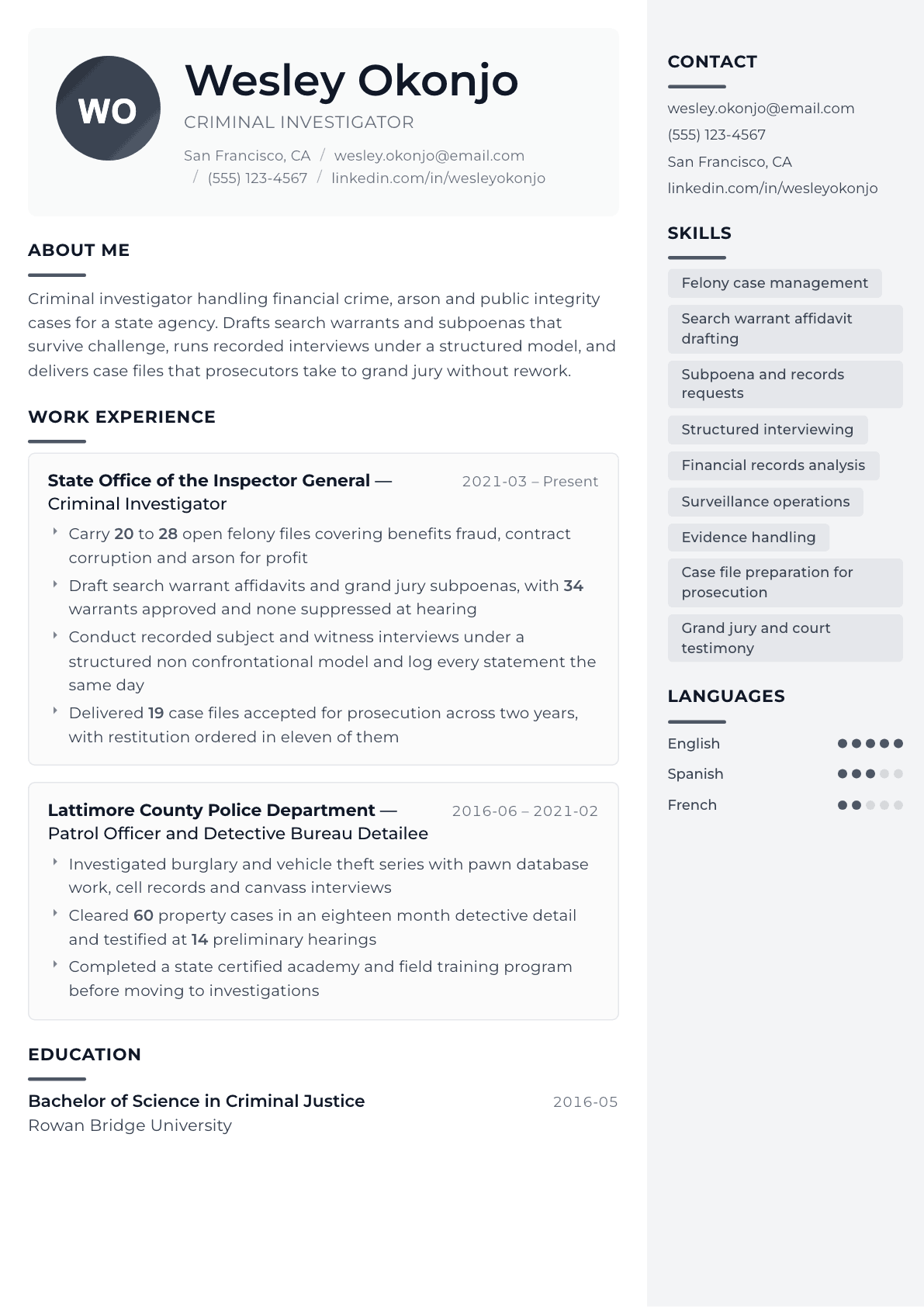
Example Criminal Investigator summary
Criminal investigator working felony financial crime, arson and public integrity cases for a state agency. Drafts search warrant affidavits that have never been suppressed at hearing, runs recorded interviews under a structured non confrontational model, and hands prosecutors case files that go to grand jury without rework. Came up through patrol and a detective detail clearing property series, and testifies at preliminary hearings without needing preparation from counsel.
Skills to list on a Criminal Investigator resume
- Criminal investigation
- Search warrant drafting
- Grand jury subpoenas
- Structured interview techniques
- Surveillance and covert operations
- Financial records analysis
- Cellular records and call detail analysis
- Confidential source management
- Evidence collection and chain of custody
- Case file preparation
- Prosecutor liaison
- Court and grand jury testimony
- Report writing
- Task force coordination
What actually gets this resume read
- Give the number of open felony files you carry, because caseload is the first thing a supervisor sizes.
- Show warrants drafted and whether any were suppressed, since that single fact separates two similar resumes.
- Name the crime types you have worked so an agency can match you to its own unit rather than guessing.
- Put prosecution outcomes on the page: cases accepted, indictments, convictions or restitution ordered.
- State your interview model by name and roughly how many recorded subject interviews you have run.
- List academy, field training and any federal task force detail with the agency that ran it.
How to write a criminal investigator resume
An investigations supervisor filling a criminal investigator seat is protecting two things: the case file and the courtroom. He has assigned files that will be read by a prosecutor, challenged by defense counsel and audited by his own chain of command. He wants an investigator whose warrants stand, whose interviews are clean, and whose files arrive complete.
Which is why the number that matters most is rarely the number applicants lead with. Arrests are easy to write down. Warrants approved without suppression, cases accepted for prosecution, and interviews conducted under a documented model are harder to claim and far more persuasive.
This guide covers the resume structure an investigative unit reads, how to write case work when the details are sealed, summaries from a first detective assignment through a senior investigator, before and after bullets, and the questions candidates ask when moving between local, state and federal investigative work.
Format: two pages, case types and legal process above the history
Investigative resumes carry more than a page of substance once you have real files behind you, and civil service or federal applications often expect detail rather than brevity. Use two pages. Open with a capability block naming the crime types you have investigated, the legal process you draft yourself, and the interview model you work under.
Federal and state applications frequently want narrative depth that a private sector resume would cut. Read the announcement before trimming, because a hiring package built for a rating panel is a different document from one built for a corporate recruiter, and the same bullets do not serve both well.
- Case type line: the offense categories you have carried, marked by which you run as lead investigator.
- Legal process block: search warrant affidavits, subpoenas, court orders for records, and wiretap or surveillance authority if applicable.
- Interview block: the model you are trained in, whether sessions are recorded, and the volume of subject interviews conducted.
- Outcome block: cases accepted for prosecution, indictments, convictions and restitution ordered, with the court level named.
Caseload, complexity and the files you carry alone
Give the number of open files you hold and the offense mix, then say which of them you run without a supervisor reviewing every step. Twenty complex financial files is a heavier load than sixty property crimes, so the mix carries as much information as the count and a supervisor reads both together.
Complexity markers help enormously. Multi jurisdiction cases, cases involving corporate records or forensic accounting, cases with cooperating witnesses, and cases that ran longer than a year all signal that you can hold a file that does not resolve in a week. Name one or two rather than listing every case you have touched.
Warrants, subpoenas and legal process that survives challenge
Drafting a search warrant affidavit that a judge signs and a court later upholds is a specific craft, and it is one of the fastest ways to separate yourself on paper. Give the number you have drafted, the types of premises or records covered, and whether any have been suppressed. An investigator who can state that none were is answering a question the panel would otherwise ask in the interview.
Records process belongs here too. Grand jury subpoenas, court orders for communications records, financial records requests and preservation letters all take practice to get right, and an investigator who knows which instrument to use for which record saves a prosecutor weeks. Say which you draft yourself and which you request through counsel.
Interviews, sources and closing the file for a prosecutor
Interviewing is the skill panels probe hardest. Name the model you are trained in, say whether subject interviews are recorded, and give the approximate volume. Then show outcomes carefully: admissions obtained, statements that held up under challenge, or witnesses who stayed cooperative through trial. Avoid any language that implies pressure, because a supervisor reads that as a future problem.
Confidential source management, where you have it, needs its own restrained line: the number of sources handled, whether you have documented and paid them under agency policy, and any corroboration practice you follow. Policy compliance is the whole point of that sentence.
Finally, describe the handoff. A case file that a prosecutor can charge from without sending it back is the actual product of the job. Say how you organize files, what your case summaries contain, and how many of your files were accepted for prosecution without rework.
Skills, credentials and the keywords investigative postings use
Announcements recycle a consistent vocabulary: criminal investigation, search warrant, subpoena, interview and interrogation, evidence collection, chain of custody, surveillance, case management, prosecutorial referral, testimony. Mirror the exact terms, then evidence at least four of them with counts inside your bullets.
Add the qualifications that gate assignments: state certified academy, field training completion, task force details with the agency named, firearms and defensive tactics currency where the role is sworn, and any specialized schools you have attended. For non sworn investigative roles, name the state investigator license and the certifications you hold with their issuing bodies.
Criminal Investigator resume summary examples
First investigative assignment
Patrol officer completing an eighteen month detective bureau detail investigating burglary and vehicle theft series using pawn databases, cell records and canvass interviews. Cleared 60 property cases, testified at 14 preliminary hearings, and completed a structured interviewing course in 2024.
Five years investigating
Criminal investigator carrying 20 to 28 open felony files covering benefits fraud, contract corruption and arson for profit. Has drafted 34 search warrant affidavits with none suppressed at hearing, conducts recorded interviews under a structured model, and delivered 19 files accepted for prosecution in two years.
Senior investigator
Senior criminal investigator leading multi jurisdiction financial crime cases and coordinating a four agency task force. Manages documented confidential sources under agency policy, mentors two investigators on warrant drafting, and testifies before grand juries and at trial without preparation from counsel.
Work experience bullets: before and after
Before: Investigated criminal cases assigned by supervisors.
After: Carried 20 to 28 open felony files covering benefits fraud, contract corruption and arson for profit, running each as lead investigator from complaint through prosecutorial referral.
Caseload, offense mix and the lead role together describe a real desk instead of a job title.
Before: Obtained search warrants during investigations.
After: Drafted 34 search warrant affidavits covering residences, business records and cloud accounts, all approved and none suppressed at hearing.
Warrant volume, the record types covered and the suppression record are checkable and rare on a resume.
Before: Interviewed suspects and witnesses.
After: Conducted recorded subject and witness interviews under a structured non confrontational model, documenting every statement the same day it was taken.
A named model plus same day documentation shows trained practice a panel can trust.
Before: Worked with prosecutors on cases.
After: Delivered 19 case files accepted for prosecution across two years with restitution ordered in eleven, each file organized so charging decisions were made without a request for further work.
Acceptance and restitution are outcomes, and the no rework detail describes file quality directly.
Before: Participated in a federal task force.
After: Served two years on a multi agency financial crime task force, coordinating records requests across four jurisdictions and running the joint case timeline.
Naming the coordination work shows what you contributed rather than where you sat.
Hard skills
- Felony case management
- Search warrant affidavit drafting
- Grand jury subpoenas and records orders
- Structured interview technique
- Confidential source handling under policy
- Surveillance and covert operations
- Financial records and asset tracing
- Cellular and call detail record analysis
- Evidence collection and chain of custody
- Case file preparation for prosecution
- Task force and interagency coordination
- Grand jury and trial testimony
- Investigative report writing
Soft skills
- Patience on a case that will not close this quarter
- Neutral questioning that does not lead a witness
- Keeping a theory open while the evidence is still thin
- Working a prosecutor relationship without becoming an advocate
- Documenting today what you will be asked about in two years
Certifications worth listing
- Professional Certified Investigator (PCI) (ASIS International)
- Certified Fraud Examiner (CFE) (Association of Certified Fraud Examiners)
- Wicklander-Zulawski Interview and Interrogation Certification (Wicklander-Zulawski and Associates)
Mistakes that cost criminal investigator candidates the interview
- Leading with arrest totals when warrants upheld and cases accepted are the harder and better evidence.
- Leaving the caseload unstated so a supervisor cannot tell whether you have carried real volume.
- Writing that you interviewed suspects without naming a model or saying whether sessions were recorded.
- Omitting prosecution outcomes, which turns an investigative career into a list of activities.
- Trimming a federal or civil service application to one page when the rating panel expects narrative detail.
- Describing source handling in a way that implies working outside agency policy.
Criminal Investigator resume questions
How long should a criminal investigator resume be?
Two pages for most experienced investigators, and longer where a federal or civil service announcement asks for narrative responses. Read the announcement first, because a rating panel scores against stated criteria and cutting detail to fit one page loses points you cannot recover.
How do I write about sealed or ongoing cases?
Describe the offense category, the investigative techniques used and the outcome type without identifying anyone or naming the operation. A multi jurisdiction contract corruption case resolved with restitution ordered says everything a panel needs while disclosing nothing that is protected.
Do I need sworn law enforcement experience?
Not for every investigator role. Agency inspector general offices, insurance carriers, regulators and corporate investigations units all hire non sworn investigators. Those roles weigh interviewing, records work, report quality and referral outcomes far more heavily than arrest powers.
What should I say about interview training?
Name the model, the provider and the year you completed it, then attach a volume figure for subject interviews and say whether they are recorded. Panels are wary of anything that sounds coercive, so describe method and documentation rather than success at getting confessions.
How do I move from patrol into investigations?
Build the page around the investigative fragments you already have: detective details, warrants you drafted, follow up assignments, pawn or records work, and preliminary hearing testimony. Add any interview or financial crime course you have completed, since those signal intent as well as capability.
Related resume examples
- Private Investigator Resume example
- Criminal Defense Attorney Resume example
- Police Detective Resume example
- Crime Scene Investigator Resume example
- Federal Agent Resume example
- Criminal Justice Graduate Resume example