Crime Scene Investigator Resume Examples: free ATS score
Write a Crime Scene Investigator Resume That Holds Up in Court
By Mustafa Tarabya, founder of CVBooster · Published · Updated
Crime scene investigator resume example with evidence processing keywords, scene counts and a guide to writing documentation, court and lab work.
Sample resumes for a crime scene investigator
The same crime scene investigator content laid out in three CVBooster templates, so you can see what the finished document looks like before you write a word.
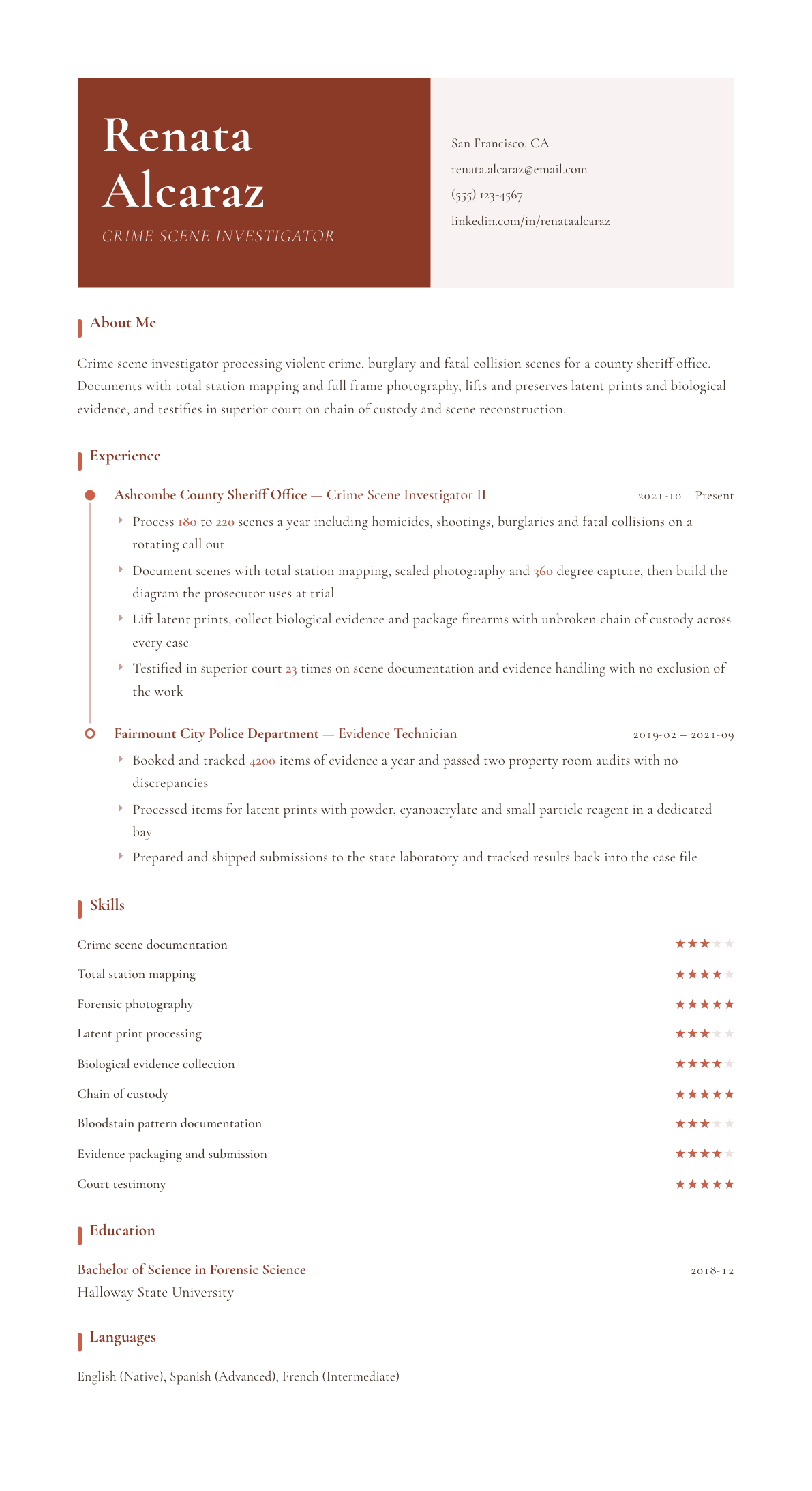
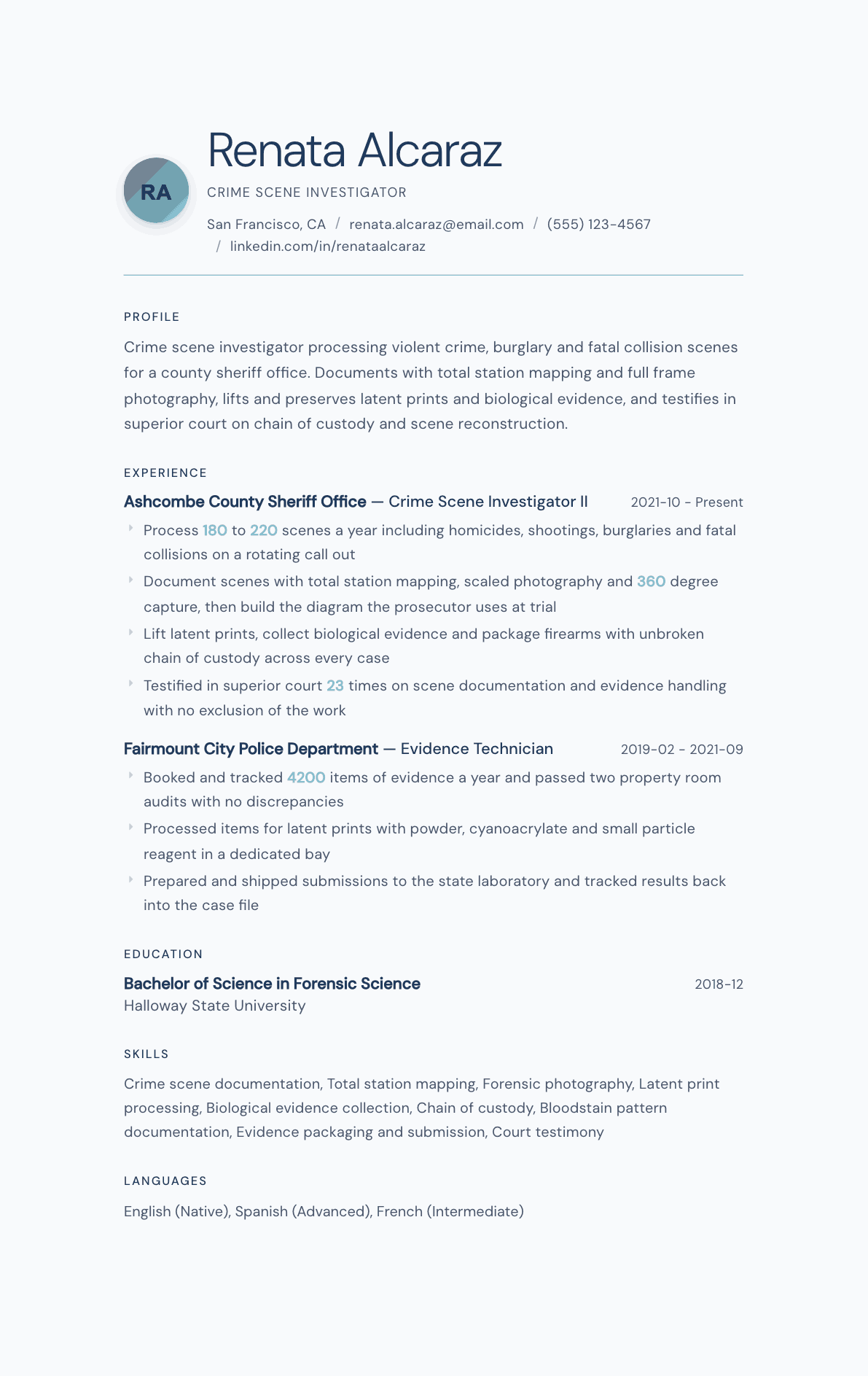
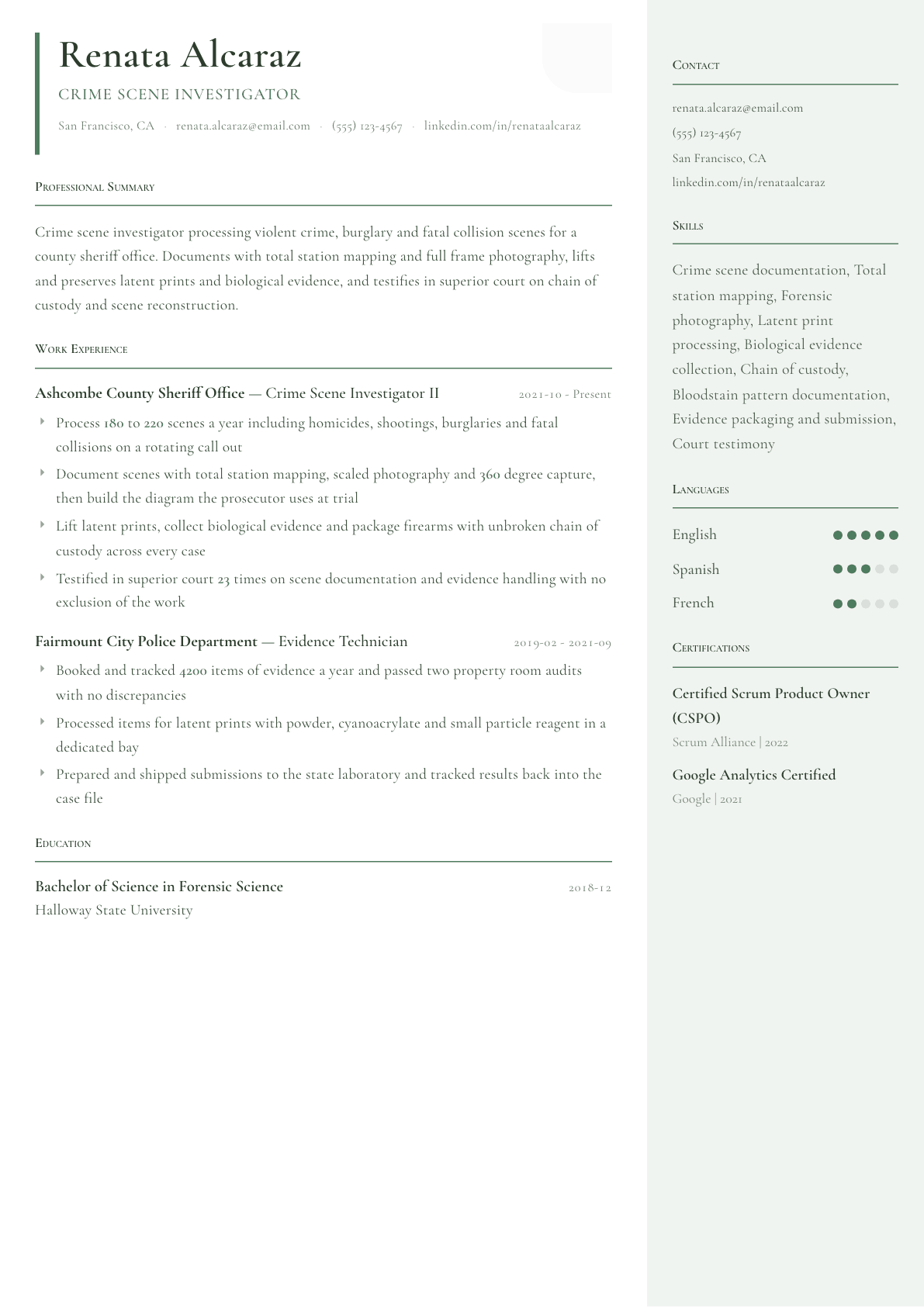
Example Crime Scene Investigator summary
Crime scene investigator processing violent crime, property crime and fatal collision scenes on a county call out rotation. Documents with total station mapping, scaled photography and 360 degree capture, then builds the diagrams prosecutors take to trial. Develops and lifts latent prints, collects biological and trace evidence with unbroken chain of custody, and has testified in superior court more than twenty times without the work being challenged out.
Skills to list on a Crime Scene Investigator resume
- Crime scene processing
- Forensic photography
- Total station and laser scanning
- Scene sketching and diagramming
- Latent print development and lifting
- Cyanoacrylate fuming
- Biological evidence collection
- Bloodstain pattern documentation
- Firearms and toolmark evidence handling
- Trace evidence collection
- Chain of custody procedure
- Evidence packaging and laboratory submission
- Property room management
- Report writing
- Court testimony
What actually gets this resume read
- Give scenes processed per year and break them down by type, because homicide work is not burglary work.
- Name your documentation stack, whether total station, laser scanner, photogrammetry or scaled photography.
- List every processing technique you run unsupervised, from powder lifts to cyanoacrylate and reagents.
- Put court testimony on the page with the court level and the count, since prosecutors ask before they hire.
- Show chain of custody explicitly, including audits you have passed and how you package firearms and biology.
- Say whether you are on a call out rotation and what your response window is, because scenes do not wait.
How to write a crime scene investigator resume
The person hiring a crime scene investigator has a defense attorney in mind. Every photograph, measurement, swab and evidence bag you produce will one day be examined by someone paid to find the gap in it. A supervisor reading your resume is asking whether your work will hold, and whether you will hold when you are on the stand explaining it.
That is why the strongest pages are built on documentation and custody rather than on drama. Scene counts by type, the mapping and photography method you use, the processing techniques you run unsupervised, and the number of times you have testified without your work being excluded say more than any description of a difficult night.
This guide covers how a forensic unit reads a resume, how to write scene work and laboratory submissions with the right specificity, summaries from a first technician job through a senior investigator, before and after bullets, and the questions candidates ask when moving between agencies or into a laboratory.
Format: two pages is normal, credentials and scene types up front
Forensic resumes run longer than most because the credential and training list is genuinely load bearing. Two pages is standard once you have a few years. Use the top of page one for a capability block: scene types processed, documentation methods, processing techniques you run alone, and your certifications with the issuing body.
Below that, each position opens with the agency type and the call out model. Whether you are a sworn investigator, a civilian technician, on a rotating call out or working a fixed shift changes the job entirely, and a supervisor who has to guess will move to the next application.
- Scene profile line: scenes processed a year broken into homicide, shooting, death investigation, burglary, sexual assault and collision.
- Documentation block: photography method, total station or laser scanning, sketching and diagram software, and 360 degree capture if used.
- Processing block: every technique you perform unsupervised, from powder and reagent lifts through fuming, casting and biological collection.
- Testimony block: courts appeared in, number of appearances, and any qualification as an expert with the subject matter named.
Scene counts, types and the call out you actually work
Give an annual scene count and then break it down, because two hundred burglaries is a different career from forty homicides. A supervisor uses that breakdown to work out whether you can be sent to a major scene alone or whether you need a senior investigator beside you for the first year.
Say how the call out works: rotation length, response window, and whether you have run a scene as the lead investigator with responsibility for the search plan and the release. Leading a scene means deciding what gets collected and what does not, and that judgment is exactly what a hiring panel is trying to assess.
Documentation: photography, mapping and the diagram a jury sees
Photography is the backbone of the record, so describe it properly. Overall, midrange and close up sequences, scaled photographs for comparison evidence, painting with light on exterior night scenes, and alternate light source work all belong on the page. Say what camera and lighting you use, since a unit that shoots manual will want to know you can.
Mapping is where units differ most. Total station, laser scanner, photogrammetry or hand measurement with a baseline all produce a diagram, and they produce very different diagrams. Name your method, name the software you draft in, and if your diagrams have been used at trial say so, because a jury facing diagram is the visible product of the whole job.
Evidence, chain of custody and the laboratory relationship
Collection technique needs specifics. Say how you package firearms, wet biological items, digital devices and trace evidence, and name the reagents and powders you work with. A supervisor reads that block to work out how much retraining your habits will need before you touch a case in his jurisdiction.
Chain of custody is the quiet centerpiece. Write how items are booked, tracked and transferred, and put any property room audits you have passed on the page with the outcome. If you have prepared laboratory submissions and tracked results back into a case file, say so, because that closing loop is often nobody job and slows every investigation when it is missed.
If you have worked inside a unit under an accreditation program, mention the standard your procedures were written to and any competency testing or proficiency testing you have completed. Accredited units screen hard for candidates who already understand what documentation that regime demands.
Skills, keywords and the language forensic postings use
Agency postings and civil service listings reuse a fixed vocabulary: crime scene processing, latent print development, chain of custody, evidence packaging, scene documentation, bloodstain pattern, trace evidence, laboratory submission, expert testimony. Match the exact terms and evidence at least four of them inside your bullets with a count or an outcome.
Include the operational realities that decide whether you can be deployed: respirator fit testing, bloodborne pathogen training, confined space awareness, decontamination procedure and a valid driver license. Forensic work happens in unpleasant places at inconvenient hours, and a candidate who has already been trained for that is cheaper to onboard.
Crime Scene Investigator resume summary examples
Evidence technician moving to scenes
Evidence technician with two years booking and tracking roughly 4200 items a year and processing property for latent prints with powder and cyanoacrylate. Passed two property room audits with no discrepancies, completed a scene documentation course in 2024, and assists on burglary scenes under supervision.
Four years on call out
Crime scene investigator processing 180 to 220 scenes a year including homicides, shootings, burglaries and fatal collisions on a rotating call out. Documents with total station mapping, scaled photography and 360 degree capture, and has testified 23 times in superior court on documentation and evidence handling.
Senior investigator
Senior crime scene investigator leading major scenes and owning the search plan, collection priorities and release decision. Trains three investigators on bloodstain documentation and casting, wrote the unit packaging procedure under an accreditation review, and qualifies as an expert in scene documentation.
Work experience bullets: before and after
Before: Processed crime scenes and collected evidence.
After: Processed 180 to 220 scenes a year across homicides, shootings, burglaries and fatal collisions on a rotating call out, leading the search plan on major scenes.
The volume, the scene mix and the lead role tell a supervisor exactly what you can be sent to alone.
Before: Took photographs and measurements at scenes.
After: Documented scenes with overall, midrange and scaled photography, total station mapping and 360 degree capture, then drafted the diagrams the prosecutor used at trial.
Naming the method and the trial use turns a routine duty into a product with a consumer.
Before: Lifted fingerprints from items of evidence.
After: Developed and lifted latent prints using powder, cyanoacrylate fuming and small particle reagent in a dedicated processing bay, documenting every lift against its item number.
Named techniques plus the documentation link show trained processing rather than a single method.
Before: Maintained chain of custody for evidence.
After: Booked and tracked roughly 4200 items a year through the property system and passed two full audits with no discrepancies across the holdings.
An audit result is external verification, which is what chain of custody claims otherwise lack.
Before: Testified in court about my work.
After: Testified 23 times in superior court on scene documentation, evidence handling and diagram accuracy, with none of the work excluded on challenge.
Appearance count plus the absence of exclusion is the strongest quality signal a forensic resume can carry.
Hard skills
- Crime scene processing and search planning
- Forensic photography
- Total station and laser scanning
- Scene sketching and diagram drafting
- Latent print development and lifting
- Cyanoacrylate fuming and chemical reagents
- Biological evidence collection and preservation
- Bloodstain pattern documentation
- Impression casting
- Firearms and trace evidence handling
- Chain of custody and property management
- Laboratory submission preparation
- Report writing and court testimony
Soft skills
- Working methodically at a scene that everyone wants cleared
- Saying what the evidence shows and nothing beyond it
- Composure with families present at a death scene
- Holding a search plan when detectives push a theory
- Explaining technical work to a jury in plain language
Certifications worth listing
- Certified Crime Scene Investigator (International Association for Identification)
- Certified Latent Print Examiner (International Association for Identification)
- Certified Bloodstain Pattern Analyst (International Association for Identification)
Mistakes that cost crime scene investigator candidates the interview
- Quoting a single scene total without breaking it into types, which hides whether you have major scene experience.
- Writing that you photographed scenes without naming the sequence, the lighting method or the equipment.
- Leaving mapping vague when total station, scanning and hand measurement are completely different capabilities.
- Treating chain of custody as a phrase rather than attaching an audit result or an item volume to it.
- Omitting testimony counts and whether any of your work has been excluded on challenge.
- Skipping the training that governs deployment, such as respirator fit testing and bloodborne pathogen instruction.
Crime Scene Investigator resume questions
How long should a crime scene investigator resume be?
Two pages once you have a few years of scenes, because the training, certification and testimony blocks are all load bearing and a panel expects to see them. Keep page one for capability and current work, and use page two for the full credential and course history.
Do I need a forensic science degree?
Many agencies prefer a natural science or forensic science degree for civilian technician roles, while sworn investigator positions often come through patrol instead. List whichever route you took plainly, then let the scene counts, techniques and certifications carry the argument.
How do I show scene experience if I am still an evidence technician?
Lead with what you already own: item volumes, audit results, processing techniques you run in the bay, and laboratory submissions you prepare. Then list any scenes you have assisted on with the role you played, since supervisors will accept supported scene work as a genuine starting point.
Should I describe specific cases on my resume?
Describe case types and the work you performed rather than identifying anyone. A homicide scene documented with total station mapping and a diagram used at trial is fully anonymous and still shows the capability, which is what a hiring panel needs to assess.
What matters most when moving between agencies?
Documentation habits and packaging procedure, because those are the things a receiving unit has to retrain if they differ. Name the standard your procedures were written to, any accreditation regime you worked under, and the competency testing you have completed.
Related resume examples
- Forensic Scientist Resume example
- Private Investigator Resume example
- Police Detective Resume example
- Criminal Investigator Resume example
- State Trooper Resume example
- Police Officer Resume example