Police Detective Resume Examples: the lines they read
Craft a Police Detective Resume Built on Case Results
By Mustafa Tarabya, founder of CVBooster · Published · Updated
Police detective resume examples with caseload numbers, interview training, warrant work and the investigative keywords assignment boards scan.
Sample resumes for a police detective
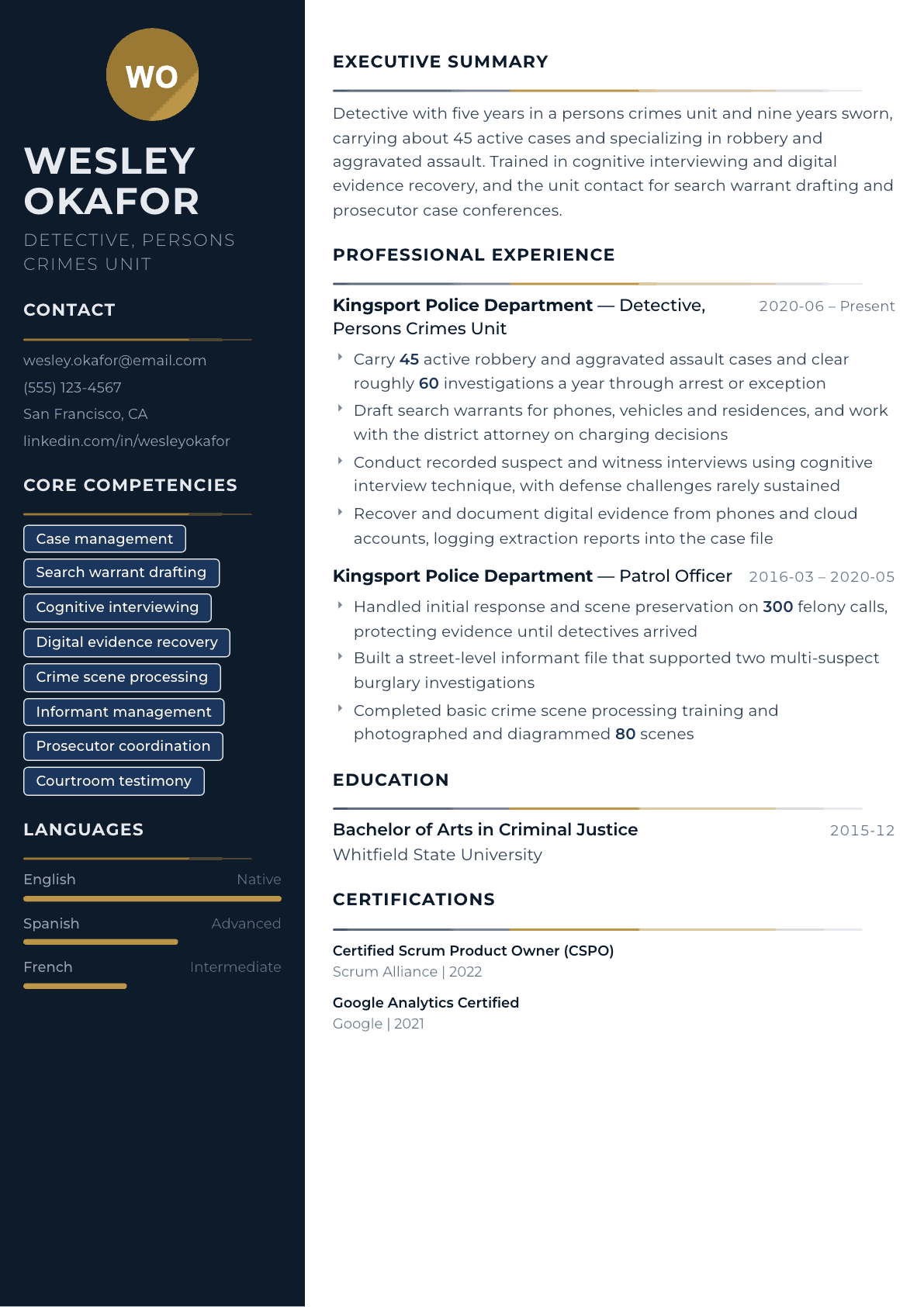
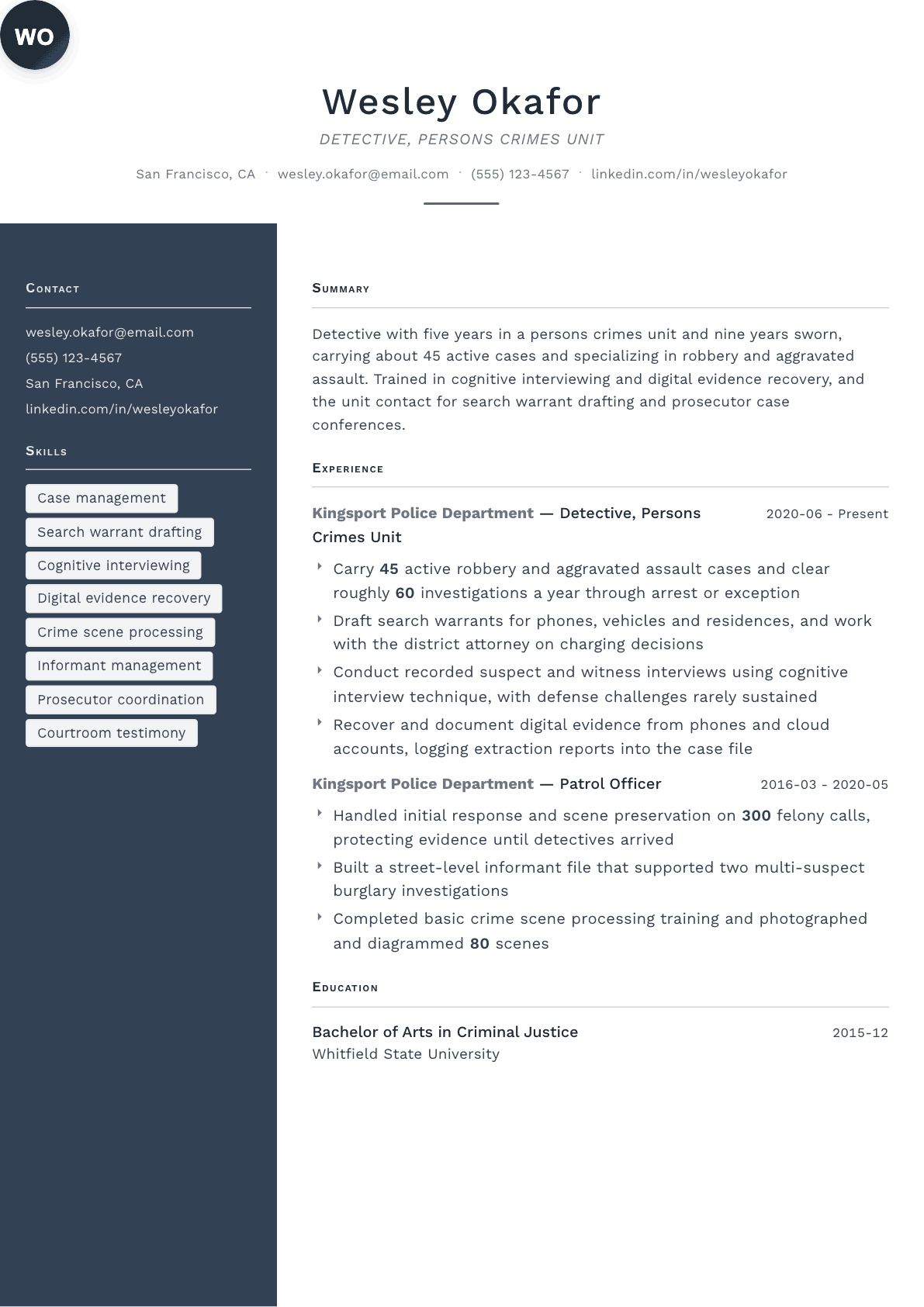
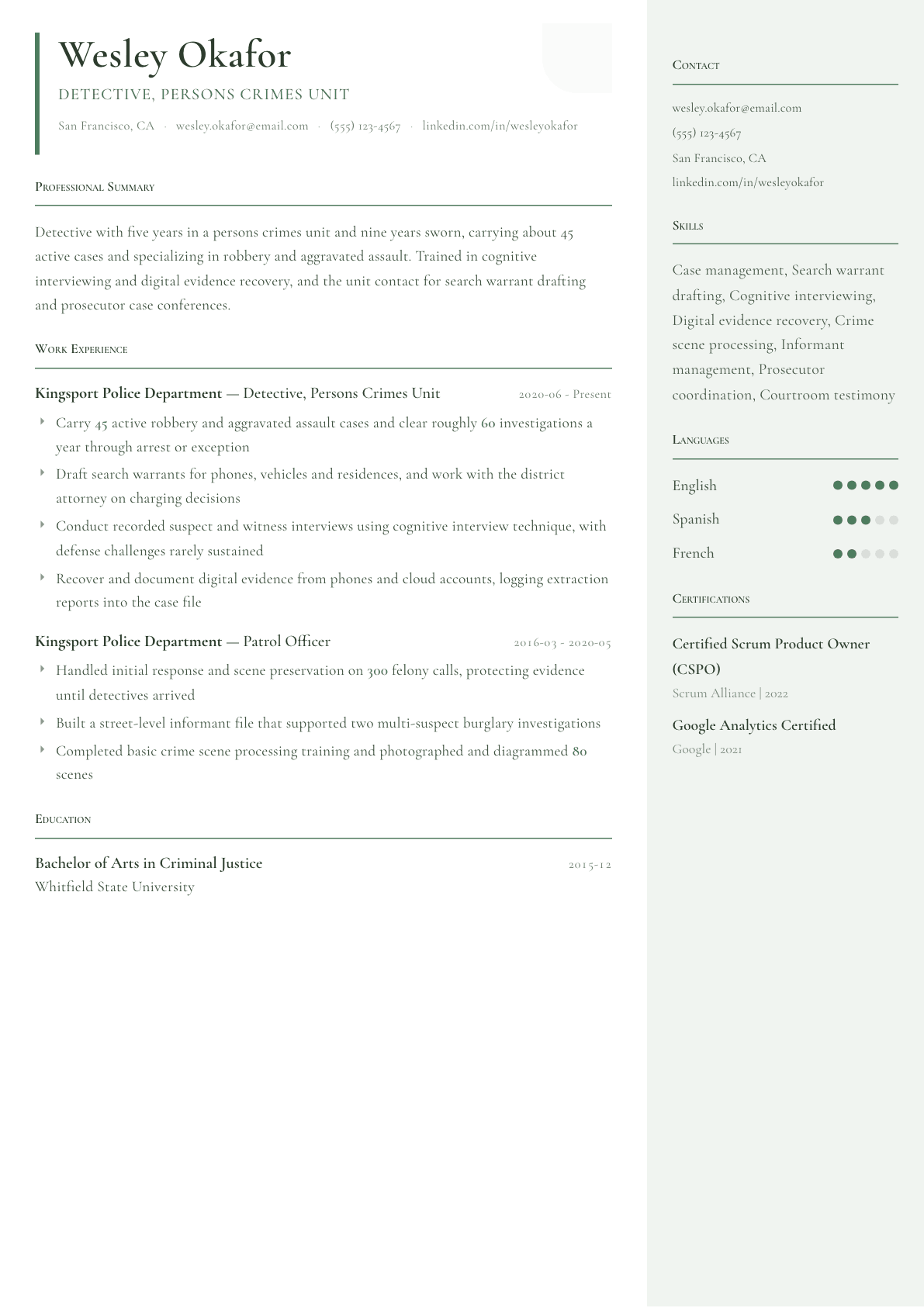
The same police detective content laid out in three CVBooster templates, so you can see what the finished document looks like before you write a word.
Example Police Detective summary
Police detective with five years in a persons crimes unit and nine years sworn, carrying about 45 active robbery and assault cases and clearing sixty investigations a year. Trained in cognitive interviewing and digital evidence recovery, and the unit contact for search warrant drafting and prosecutor case conferences. Seeking a major crimes assignment.
Skills to list on a Police Detective resume
- Criminal investigation
- Case management
- Search warrant affidavits
- Cognitive interviewing
- Suspect interrogation
- Digital evidence recovery
- Cell record analysis
- Crime scene processing
- Chain of custody
- Informant management
- Surveillance operations
- Prosecutor coordination
- Courtroom testimony
- Case file documentation
- Link analysis
What actually gets this resume read
- State your unit by name, because homicide, persons crimes, property and narcotics are read as different careers.
- Give active caseload and annual clearances, since those two numbers tell a commander how you handle volume.
- Show your warrant work, including what devices and locations you have written affidavits for and who reviewed them.
- Name your interview and interrogation training by course, because defense attorneys attack technique on the stand.
- Include digital evidence skills, from phone extraction tools to cell record analysis and social media preservation.
- Describe how you work with prosecutors, because a detective is judged by cases that survive to a verdict.
How to write a police detective resume
A police detective is hired on case results, and a detective resume that hides them behind duty language fails quietly. The commander or assignment board reading it wants the unit you worked, the crime types you carried, how many active cases sat on your desk, how many you cleared in a year, and whether your warrants, interviews and case files held up when a defense attorney went through them line by line.
The second thing that reader is checking is technical range. Investigations moved onto phones and cloud accounts years ago, so digital evidence handling, cell record analysis and preservation requests now sit alongside interviews and surveillance as core detective skills. A candidate who names the tools and the legal process behind them stands out from one who only lists case types.
This guide covers how a detective resume should be built, what to quantify safely, three summaries covering a newly assigned detective, an established unit investigator and a senior investigator, before and after bullets rewritten from case work, and the questions detectives ask when they move units, agencies or into corporate investigations.
Format: unit and caseload up front, sworn history behind it
Start with an investigative profile naming the unit, the crime types, the active caseload you carry and the clearance volume. Homicide, persons crimes, property, financial crimes, narcotics and internet crimes against children are read as different careers, so the unit is the first filter and belongs in the first line.
Below that, run your sworn history in reverse chronological order. Patrol years still matter because scene preservation, initial response and informant development start there, but they should be compressed to make room for the investigative record.
- Investigative profile: unit, crime types, active caseload, annual cases cleared by arrest or exception.
- Warrant work: the affidavits you draft, the targets they cover and who reviews them before filing.
- Interview training by course name, since technique gets challenged on the stand.
- Digital evidence skills, from device extraction to preservation letters and cell record analysis.
Summary: unit, caseload, clearance, specialty technique
Three lines. Name the unit and the crime types, the active caseload, the annual clearances and the technique or specialty you are called on for. Being the unit contact for search warrants, digital extractions, forensic interviews of children or financial record analysis is exactly the detail that gets a resume moved to the interview pile.
If you are applying to a different unit, say what transfers. Financial record analysis moves into fraud, informant development moves into narcotics, and forensic interview training moves into crimes against children. Make the argument yourself instead of leaving it to the reader.
Experience: caseload, warrants, interviews and prosecution
Give each investigative role a caseload line, then bullets across four areas. Case management first: active cases, cases cleared, the tracking method you use and how you triage when the assignment queue outruns the week.
Warrants and legal process second. State the targets you have written affidavits for, whether phones, residences, vehicles, financial records or provider accounts, and note the prosecutor or supervisor review step. A detective who writes warrants that survive suppression is worth more than one who has written many.
Interviews third, naming the technique and the setting, and prosecution fourth. Case conferences, charging decisions, grand jury appearances and trial testimony show that your work travels all the way to a verdict, which is how a commander measures an investigator.
Digital evidence, sources and case documentation
Digital work should have its own bullets. Device extraction, preservation and legal process to providers, cloud account returns, video canvass and recovery, social media documentation and cell site record analysis all belong here, described by what you did rather than by brand claims you cannot back.
Source and informant handling is sensitive but hireable. Describe the discipline of it: documentation, supervisor approval, corroboration before acting, and payment records. Never describe an individual source, an active case or an investigative technique that would compromise anything.
- Digital evidence handled, with the legal process used to obtain it.
- Video canvass and recovery work, including the volume of hours reviewed on a case.
- Source documentation practice and the supervisory approval it runs through.
- Case file standards you follow so a file can be picked up by another detective cleanly.
Keywords investigative postings repeat
Investigative assignment postings reuse a tight vocabulary: criminal investigation, case clearance, search warrant affidavit, probable cause, custodial interview, forensic interview, digital forensics, chain of custody, surveillance, link analysis, informant management, grand jury, courtroom testimony and prosecutor coordination.
Mirror the exact terms the posting uses, once in the skills block and once in a bullet where they are demonstrated. Then name the case management system and analytical tools you have worked in, because a unit that runs on a familiar platform can put you to work immediately.
Police Detective resume summary examples
Newly assigned detective
Detective in a first year with a property crimes unit after six years on patrol, carrying 30 active burglary and theft cases. Completed basic interview and interrogation training and crime scene processing coursework, and drafts search warrants for phones and storage units under supervisor review.
Five years investigating
Detective with five years in a persons crimes unit and nine years sworn, carrying 45 active robbery and aggravated assault cases and clearing about 60 investigations a year. Trained in cognitive interviewing, recovers digital evidence from phones and cloud accounts, and works charging decisions directly with prosecutors.
Senior investigator
Senior detective with fourteen years sworn across homicide and financial crimes, leading multi-agency investigations and mentoring four detectives through their first assignments. Serves as the unit contact for search warrant review, cell record analysis and grand jury preparation on complex cases.
Work experience bullets: before and after
Before: Investigated assigned criminal cases.
After: Carried 45 active robbery and aggravated assault cases and cleared about 60 investigations a year through arrest or exceptional clearance, triaging the queue weekly with the unit supervisor.
Caseload, clearance and triage method show a commander how much volume you can move without dropping cases.
Before: Obtained search warrants during investigations.
After: Drafted search warrant affidavits for phones, vehicles and residences, refining probable cause language with the district attorney before filing and testifying at suppression hearings.
Naming the targets and the review step proves the warrants were built to survive challenge.
Before: Interviewed suspects and witnesses.
After: Conducted recorded suspect and witness interviews using cognitive interview technique, documenting rights advisements and preserving recordings to the case file the same day.
The named technique and documentation practice are exactly what a defense attorney attacks and a commander checks.
Before: Worked with digital evidence.
After: Recovered digital evidence from phones and cloud accounts through preservation letters and legal process, then logged extraction reports and analyst summaries into the case file.
The legal process and the documentation trail turn a vague skill into admissible work.
Before: Prepared cases for court.
After: Prepared case files for prosecution, ran case conferences with the district attorney on charging decisions and testified at grand jury and trial on assigned investigations.
Following the case to charging and testimony shows results, which is how investigative performance is judged.
Hard skills
- Criminal investigation and case management
- Search warrant affidavit drafting
- Probable cause development
- Cognitive and forensic interviewing
- Custodial interrogation procedure
- Digital evidence recovery
- Cell site record analysis
- Video canvass and recovery
- Surveillance operations
- Informant documentation and handling
- Chain of custody
- Grand jury and trial testimony
Soft skills
- Patience through long investigations
- Rapport building in interviews
- Discretion with sensitive information
- Analytical reasoning
- Victim and family communication
- Coordination across agencies
Certifications worth listing
- Certified Forensic Interviewer (CFI) (Center for Interviewer Standards and Assessment)
- Certified Forensic Computer Examiner (CFCE) (International Association of Computer Investigative Specialists)
- Certified Law Enforcement Analyst (CLEA) (International Association of Crime Analysts)
- Certified Fraud Examiner (CFE) (Association of Certified Fraud Examiners)
Mistakes that cost police detective candidates the interview
- Leaving the unit unnamed, so a reader cannot tell whether your experience matches the assignment being filled.
- Listing case types with no caseload or clearance figures, which makes volume impossible to judge.
- Describing an actual investigation in enough detail to identify a person or compromise a file.
- Skipping warrant and legal process work when that is the skill a unit most needs from a new detective.
- Treating digital evidence as a footnote when most modern cases turn on devices and provider records.
- Ending the story at arrest and never showing charging, grand jury or trial outcomes.
Police Detective resume questions
How do I quantify investigative work without breaching confidentiality?
Use aggregate numbers only: active caseload, cases cleared per year, warrants drafted, interviews conducted and hours of video reviewed. Aggregates prove capacity while individual case detail risks identifying people and compromising files.
What does a detective assignment board weigh most?
Caseload handled, clearance rate, quality of case files and reports, warrant and interview training, and how your cases performed with prosecutors. Instructor certifications and multi-agency work help once those fundamentals are established.
How do I move from patrol into an investigative unit?
Show investigative work you already do: follow-up on your own reports, scene preservation, informant development, video canvass and case preparation for detectives. Add any interview, crime scene or digital evidence coursework you completed on your own time.
Do I list courtroom testimony separately?
Yes, with the levels rather than case names. Preliminary hearings, suppression motions, grand jury and jury trials each demonstrate a different level of preparation, and a commander reads that list as proof your work reaches a verdict.
How do I translate this resume for a corporate investigation role?
Rewrite the work in business terms: fact finding, interviewing, evidence handling, report writing and testimony. Corporate employers hire the documentation discipline and the interview skill, so lead with those and drop the tactical vocabulary.
Related resume examples
- Private Investigator Resume example
- Security Guard Resume example
- Police Officer Resume example
- Crime Scene Investigator Resume example
- Fraud Investigator Resume example
- Loss Prevention Detective Resume example