Criminal Defense Attorney Resume Examples: free score
Build a Criminal Defense Attorney Resume That Wins Cases
By Mustafa Tarabya, founder of CVBooster · Published · Updated
Create a powerful criminal defense attorney resume showcasing your trial experience, case outcomes, and client advocacy with authoritative legal templates.
Sample resumes for a criminal defense attorney
The same criminal defense attorney content laid out in three CVBooster templates, so you can see what the finished document looks like before you write a word.
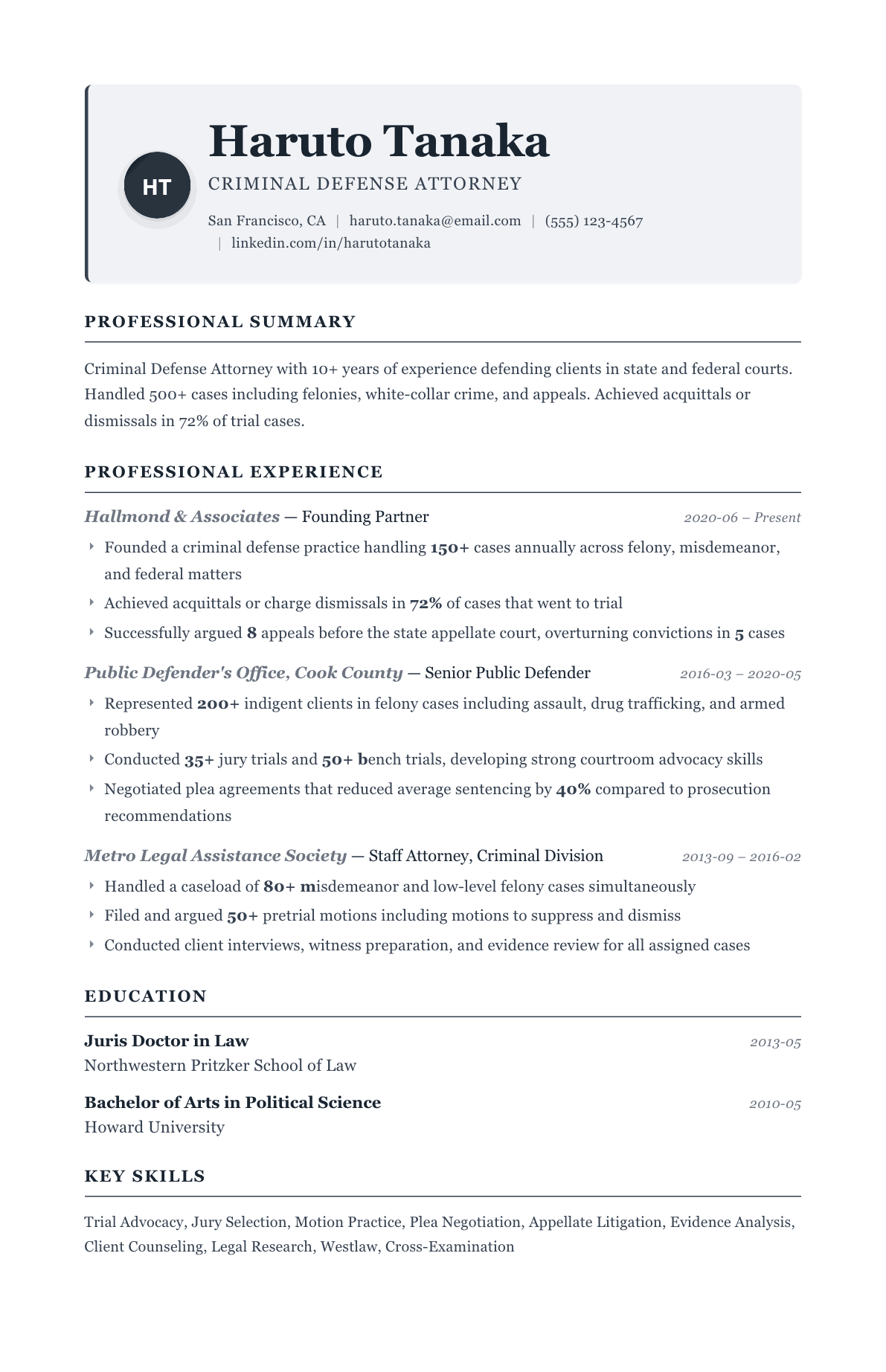

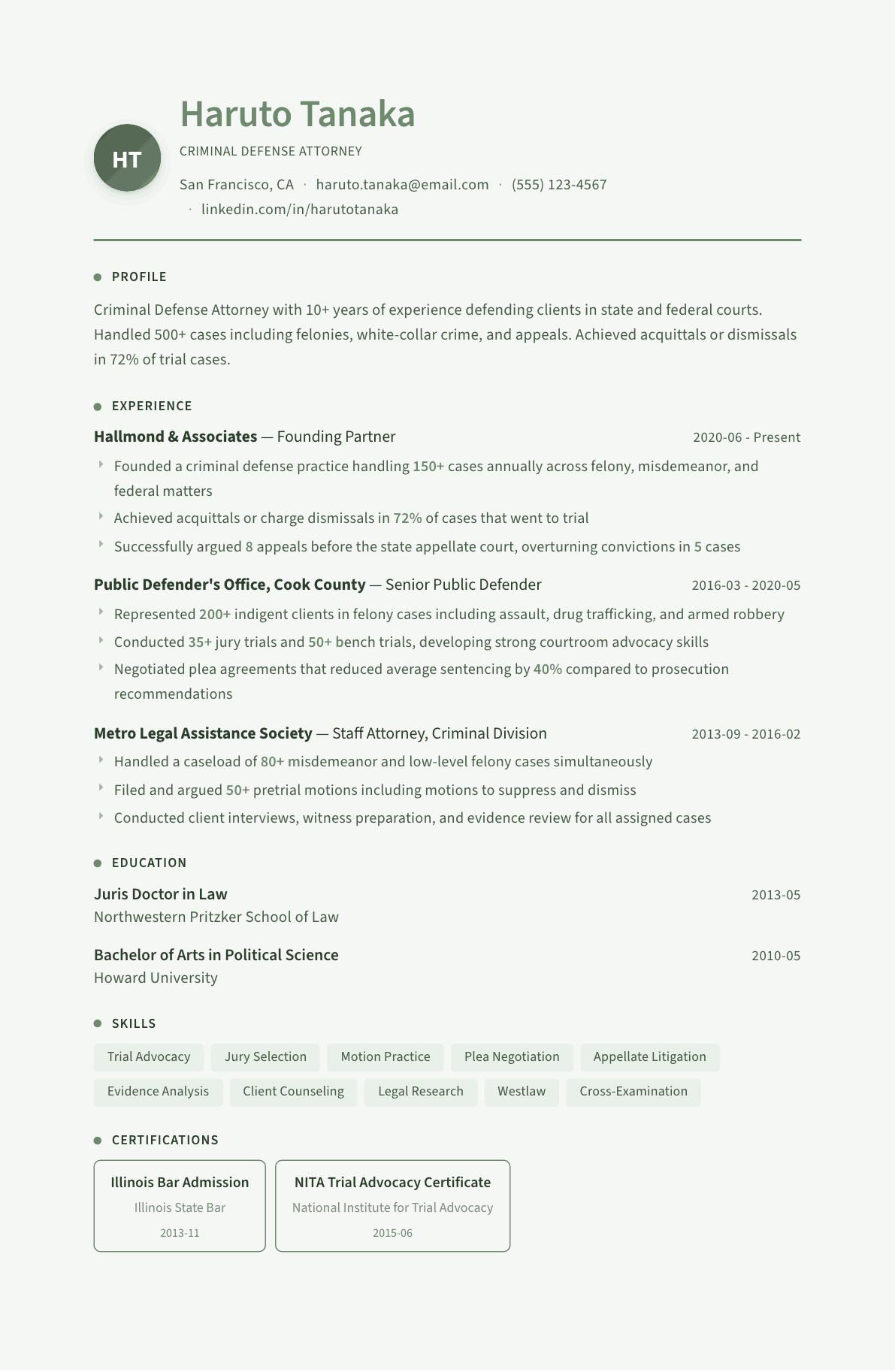
Example Criminal Defense Attorney summary
Criminal Defense Attorney with 10 years in state and federal courts, from public defense to a founding partner seat. Handled 500+ cases with a 72% acquittal or dismissal rate at trial, and 35+ jury trials. Argued 8 appeals before the state appellate court and overturned 5 convictions.
Skills to list on a Criminal Defense Attorney resume
- Trial Advocacy
- Jury Selection (Voir Dire)
- Motion Practice
- Plea Negotiation
- Appellate Litigation
- Evidence Analysis
- Cross-Examination
- Client Counseling
- Legal Research
- Westlaw
- LexisNexis
- Constitutional Law
- Sentencing Advocacy
- Federal Criminal Law
What actually gets this resume read
- Lead with your win rate or favorable outcome percentages -- outcomes matter most in criminal defense.
- Specify case types: felonies, federal crimes, white-collar, DUI, drug offenses, appeals.
- Mention trial counts (jury and bench) to demonstrate courtroom experience.
- Include bar admissions and any federal court admissions prominently.
- Quantify caseload size, plea negotiation success rates, and sentencing reductions.
- Highlight any notable cases (without breaching confidentiality) or precedent-setting arguments.
How to write a criminal defense attorney resume
Criminal defense hiring runs on courtroom evidence. A managing attorney at a defense firm, a public defender office supervisor and a boutique white-collar practice all read for the same core facts: which courts you are admitted in, what charge levels you have handled, how many matters you have tried to verdict, and whether you have carried cases alone from arraignment through disposition.
This is one of the few fields where volume is genuinely meaningful, because caseload size tells a supervisor whether you can survive the calendar. But volume alone is not enough. A resume that lists hundreds of cases with no trials, no motion practice and no charge categories reads as plea processing, and interviewers will treat it that way.
This guide covers the structure defense hiring managers expect, how to present trial and motion experience honestly, three summaries from new attorney to experienced trial lawyer, before-and-after bullets, and the questions defense lawyers ask when moving between public defense, private practice and white-collar work.
Format: admissions and courts before anything else
Reverse-chronological, conservative layout, one or two pages depending on years in practice. Bar admissions and court admissions belong near the top, listed with jurisdictions and admission years. Federal district court and appellate admissions should be named individually, because federal practice is a distinct qualification that many defense candidates lack.
Directly beneath, add a short practice profile line: the charge levels you handle, the courts you appear in most, and any specialty area such as appeals, post-conviction work, juvenile matters, immigration consequences or white-collar and regulatory defense. This is the block a supervisor reads to decide whether to keep reading.
- Header: name, city, phone, email, and bar and court admissions if the space allows.
- Order: summary, admissions, practice profile, experience, trial record, education.
- Name each court by level: municipal, state trial, state appellate, federal district, federal circuit.
The trial record: count it honestly and say what you did
A trial record section is standard in criminal defense and should distinguish jury trials from bench trials, and first chair from second chair. Inflating this is a serious mistake, because the legal community is small and verifiable. An honest record of eight first-chair jury trials is more impressive than a vague claim of extensive trial experience.
Describe the charge categories rather than individual clients: violent felonies, narcotics, driving offenses, property crimes, firearms, sex offenses, fraud and financial crimes, homicide. Charge mix is what a hiring supervisor uses to judge whether you can carry the office's docket, and it also signals your exposure to sentencing exposure and collateral consequences.
Outcomes require care. Acquittals, dismissals, suppression rulings, hung juries, charge reductions and sentences below the recommendation are all legitimate results to report. Report them as counts of matters rather than as a success rate that implies a promise, and never suggest a guaranteed outcome.
Motion practice and the work before trial
Most cases are decided long before a jury is seated, so motion practice is the strongest signal of legal skill on a defense resume. Motions to suppress evidence or statements, motions to dismiss, discovery motions and sanctions, motions in limine, bail and pretrial release applications, and challenges to identification procedures or search warrants all belong here with counts and results.
Add the investigative and expert side. Retaining and preparing forensic experts, working with an investigator, obtaining and analyzing digital evidence, body-worn camera and surveillance review, and cross-examining a state analyst all show a lawyer who builds a defense rather than one who waits for an offer.
- Give counts for the motion types you file most and what proportion were granted in part or full.
- Name one suppression or dismissal win and the legal ground it rested on.
- Show expert and investigator work, since it distinguishes trial preparation from case management.
Caseload, clients and the parts supervisors quietly check
Give the size of the docket you carried and the setting: an appointed caseload in a busy county, a private practice with a lower volume and higher complexity, or a federal defender panel. Supervisors read caseload to predict whether you will drown, and candidates who show they managed a heavy calendar with organized files are attractive for exactly that reason.
Client work deserves explicit mention because it is the daily reality of the job. Jail visits, family communication, managing expectations about outcomes, competency issues, and coordinating treatment or diversion programs are all substantive. In private practice, add the business side: intake, fee agreements, and any client development you contributed.
Keywords criminal defense postings reuse
The recurring vocabulary includes trial advocacy, jury trials, motions to suppress, pretrial motions, discovery, plea negotiation, sentencing advocacy, appeals, felony and misdemeanor defense, client counseling and courtroom experience. Mirror the posting language once in the practice profile and once inside an experience bullet.
Note the specialization signals. Postings for white-collar or regulatory defense screen for document-heavy internal investigation experience, parallel proceedings and federal sentencing guidelines. Postings for a public defender office screen for caseload capacity and trial readiness. Lead with the matching half.
Criminal Defense Attorney resume summary examples
New attorney
Newly admitted attorney with a clinical semester representing clients in misdemeanor court and a summer at a public defender office. Has second-chaired two bench trials, drafted 15 pretrial motions including three suppression motions, and handled client interviews and arraignments under supervision.
Six years in
Criminal defense attorney with six years in a county public defender office, carrying an active docket of 90 felony and misdemeanor matters. First chair in 14 jury trials and 30 bench trials, with a motion practice focused on search and seizure and identification challenges.
Experienced trial lawyer
Criminal defense attorney with fourteen years across state and federal courts, including homicide, narcotics conspiracy and financial crime matters. First chair in 45 jury trials, admitted in two federal districts, and supervises three associates while handling appellate briefing and post-conviction petitions.
Work experience bullets: before and after
Before: Handled a high volume of criminal cases.
After: Carried an active docket of 90 felony and misdemeanor matters, appearing daily in two trial courts and taking each case from arraignment through disposition.
Docket size, charge levels and end-to-end ownership tell a supervisor whether you can handle their calendar.
Before: Tried cases in front of juries.
After: Served as first chair in 14 jury trials covering assault, narcotics and firearms charges, with 4 acquittals and 2 hung juries.
Separating first chair from second chair and naming charge categories makes the trial record verifiable and meaningful.
Before: Filed pretrial motions in criminal cases.
After: Filed 60 pretrial motions including 22 motions to suppress evidence and statements, obtaining full or partial suppression in 9 matters.
Motion counts with outcomes show legal skill in the place where most cases are actually decided.
Before: Negotiated plea deals with prosecutors.
After: Negotiated dispositions that reduced charge levels in 30 felony matters, including diversion and treatment placements for clients with documented substance use histories.
Naming the mechanism and the alternative dispositions shows sentencing advocacy rather than deal acceptance.
Before: Worked with experts on cases.
After: Retained and prepared forensic experts in digital evidence and firearms examination for 8 trials, and cross-examined state analysts on chain of custody and testing protocols.
Expert work and technical cross-examination signal a lawyer who builds a defense rather than reacting to the file.
Hard skills
- Jury and bench trial advocacy
- Motions to suppress and dismiss
- Cross-examination
- Discovery practice
- Plea and disposition negotiation
- Sentencing advocacy
- Appellate briefing
- Post-conviction petitions
- Bail and pretrial release applications
- Expert witness retention and preparation
- Digital and forensic evidence review
- Legal research and writing
- Criminal procedure and evidence rules
Soft skills
- Client counseling in crisis
- Composure in the courtroom
- Caseload organization
- Difficult conversations about outcomes
- Working with families and support networks
- Judgment about when to try a case
Certifications worth listing
- Admission to the State Bar (State Bar Association)
- Admission to the United States District Court (United States District Court)
- Board Certification in Criminal Law (National Board of Trial Advocacy)
- Trial Advocacy Training Program (National Criminal Defense College)
Mistakes that cost criminal defense attorney candidates the interview
- Claiming extensive trial experience without separating first chair from second chair or juries from bench trials.
- Listing case volume with no charge categories, so the reader cannot judge the complexity of the docket.
- Reporting outcomes as a success rate that implies a promise, which reads as both inaccurate and unprofessional.
- Omitting motion practice, when suppression and dismissal work is the clearest evidence of legal skill.
- Leaving federal court admissions off the page when the posting involves federal practice.
- Naming individual clients or matters that are sealed, confidential or involve juveniles.
- Using a decorated resume template, which reads as poor judgment to legal hiring reviewers.
Criminal Defense Attorney resume questions
How do I count trials on a criminal defense resume?
Separate jury trials from bench trials, and first chair from second chair, then give plain counts. Inflated numbers are checked routinely through references and local reputation, and an honest smaller record is far more persuasive than an exaggerated one.
Can I list case outcomes and acquittals?
Yes, as counts of specific results such as acquittals, dismissals and suppression rulings. Do not present them as a rate that could be read as a guarantee of future results, and keep client identities and sealed matters out of the description.
How do I move from public defense to a private firm?
Lead with your trial and motion record, which private firms value highly and cannot easily train. Then add anything commercial: client intake, fee discussions, referral relationships, and matters you carried without institutional support behind you.
What does a white-collar defense employer look for?
Document-intensive investigation experience, parallel civil and regulatory proceedings, federal sentencing guideline analysis, and written advocacy. Trial numbers matter less than the ability to manage a large record and negotiate with agency and prosecutorial staff.
Should a new attorney list law school clinic work?
Yes, and describe it like practice: the court, the charge levels, the number of clients, the motions drafted and any hearings you argued under a student practice rule. Clinic work is real courtroom exposure and hiring supervisors treat it as such.